
Google UCP and Checkout in the SERP: What Ecommerce SEO Has to Prepare For
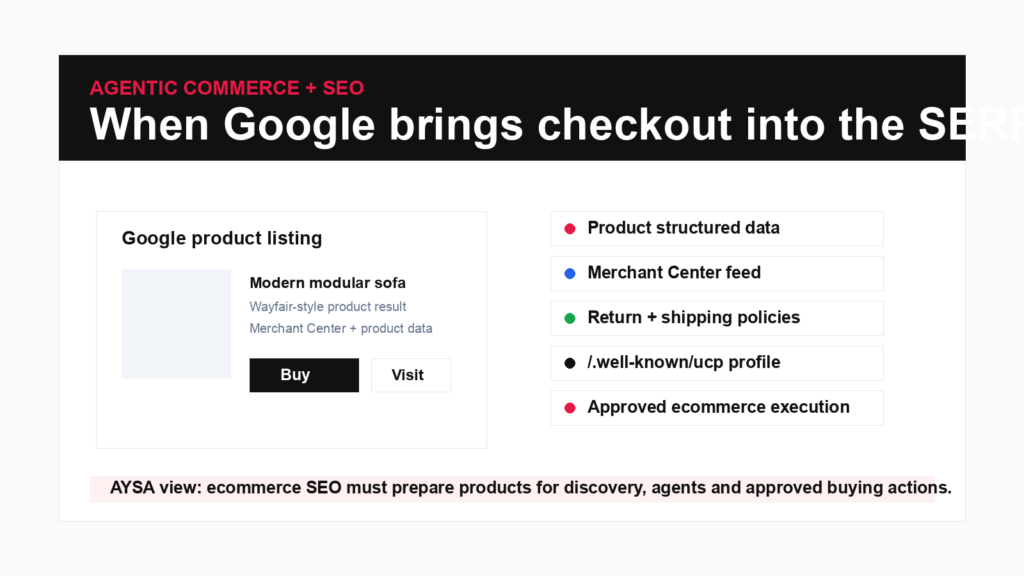
Google is testing checkout-style product actions closer to search results. For ecommerce SEO, this means product data, Merchant Center, structured data and approved execution are becoming part of the conversion path.
Executive summary
Semrush reported that Google has been showing checkout-style product actions directly in the main SERP through Universal Commerce Protocol-style experiences. Whether this becomes a broad product or remains limited, the direction is important: Ecommerce SEO is moving closer to product action, not only product discovery.
- If checkout and buying actions move closer to search results, product data quality becomes a conversion layer, not just a visibility layer.
- Ecommerce SEO now has to manage product pages, Structured data, Merchant Center feeds, policies, availability, pricing, shipping and merchant trust together.
- Agentic commerce makes machine-readable commerce data more important: search systems, assistants and agents need accurate product and merchant information.
- AYSA’s view: ecommerce SEO should prepare and maintain product execution readiness, with approval before public website or feed changes.
A Semrush article highlighted a very important ecommerce search development: Google showing checkout-style product actions directly in the main search results page. The details may evolve, and not every ecommerce website will see this immediately. But the strategic direction is hard to ignore. Search is moving from “find a product” toward “act on a product.”
That changes the SEO conversation. For years, ecommerce SEO focused on category pages, product pages, titles, descriptions, schema, reviews, internal links, Faceted navigation, Crawlability and backlinks. All of that still matters. But if Google, AI assistants or commerce agents can bring buying actions closer to the search result, then product data readiness becomes part of SEO execution.
In plain language: ecommerce SEO is no longer only about winning the click. It is also about making sure the product, merchant and checkout data are accurate enough for discovery, comparison and action.
What happened
Semrush described Google surfacing a checkout-like product experience in the main SERP, connected to Google’s Universal Commerce Protocol direction. The idea is simple but powerful: instead of search only sending users from a product result to a merchant website, the search surface can expose more product action directly.
This is not completely surprising. Google has been building commerce surfaces for years: Shopping results, free listings, Merchant Center, product structured data, local inventory, shipping and returns annotations, product snippets and merchant experiences. What feels different now is the agentic commerce layer: the idea that systems and assistants may need to understand merchant capabilities, not only product pages.
The exact implementation may change. But ecommerce teams should not wait for a universal rollout before preparing. The preparation overlaps heavily with good ecommerce SEO: accurate product data, clean structured data, healthy Merchant Center feeds, trustworthy policies and technically accessible product pages.
Why this matters for ecommerce SEO
Ecommerce SEO has always lived between search visibility and business operations. A product page can rank, but if the price is wrong, the product is unavailable, shipping is unclear or the page experience is slow, the business loses value. Checkout-in-SERP style experiences make that connection even tighter.
The SERP may increasingly need to understand:
- what the product is;
- which variants are available;
- whether the price is accurate;
- whether the item is in stock;
- what shipping and return policies apply;
- whether the merchant is trustworthy;
- whether product data matches website content;
- whether a buying action can be completed safely.
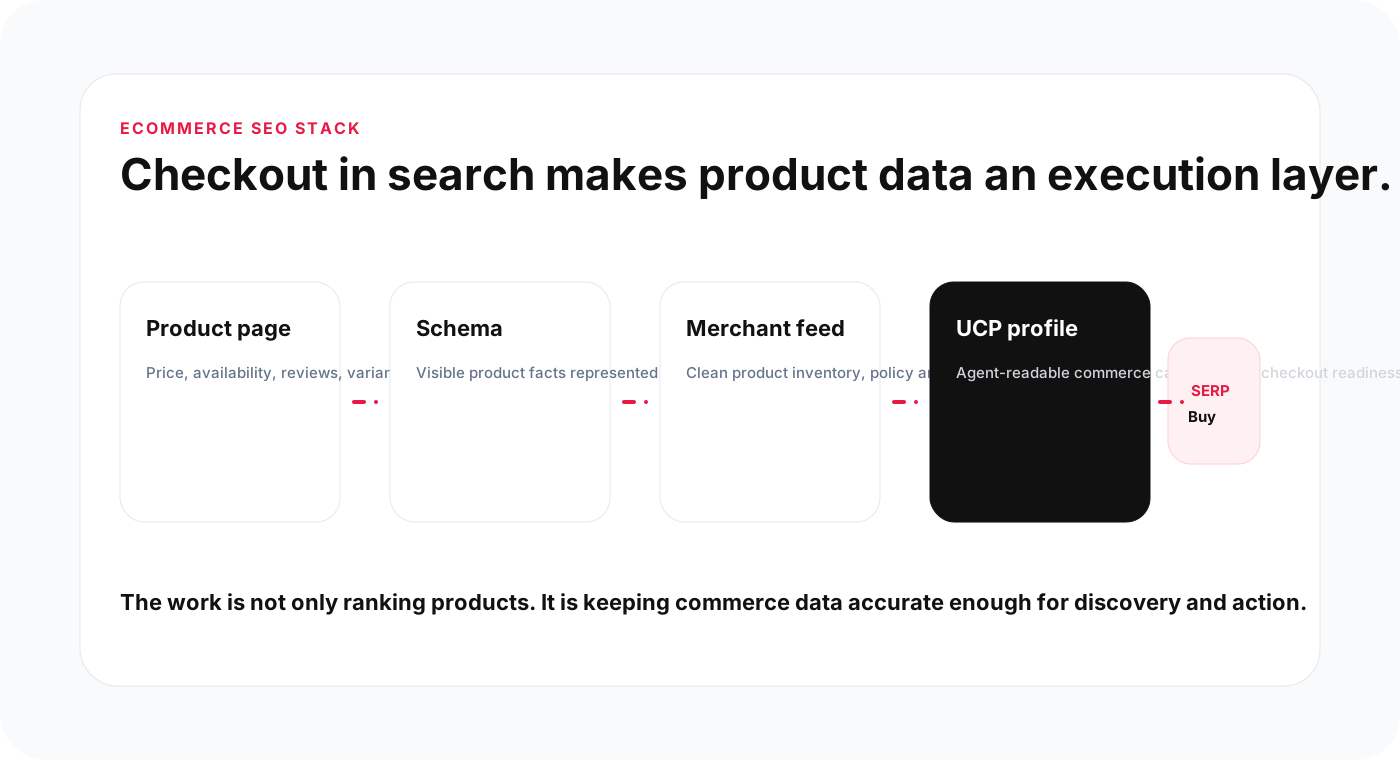
That means SEO teams and ecommerce teams can no longer treat product feeds, schema and product pages as separate systems. If they disagree, the whole experience becomes weaker.
What UCP-style commerce changes
Universal Commerce Protocol-style thinking points toward a more agent-readable commerce web. Instead of a human manually clicking around every website, an agent or search system can understand merchant capabilities, product data and possible actions in a more structured way.
For ecommerce SEO, that creates a new requirement: make commerce information reliable and machine-readable without making it invisible to users. The visible page still matters. Structured data should match visible facts. Merchant feeds should match product pages. Policies should be easy to find. Inventory should not contradict search surfaces.
This is similar to the broader AI Search shift. The goal is not to stuff more metadata into a website. The goal is to make the business easier to understand, cite, recommend and act on.
Product data becomes execution infrastructure
Product data is no longer just catalog administration. It is SEO infrastructure. It includes:
- product titles and descriptions;
- price, currency and sale price;
- availability and inventory status;
- brand, GTIN, MPN and identifiers where relevant;
- images and image quality;
- reviews and ratings where eligible;
- shipping, delivery and return policy data;
- product variants;
- category taxonomy;
- Merchant Center feed quality;
- Product structured data on the page;
- canonical URLs and Indexability;
- page speed and mobile product experience.
Google’s product structured data documentation makes clear that product markup can help Google understand product information and eligibility for product experiences. Merchant Center documentation adds another layer: product data feeds, policies, shipping, returns and account quality all affect commerce visibility. If UCP-style experiences grow, these systems become even more connected.
Risks for ecommerce websites
The opportunity is obvious: fewer steps between discovery and buying. The risks are also real.
Data mismatch
If product schema says one price, the feed says another and the page shows a third, trust breaks. Ecommerce SEO has to detect these mismatches quickly.
Thin product pages
Many stores rely on manufacturer descriptions or very short product copy. That may be weak for SEO and even weaker for AI-assisted product comparison.
Poor policy visibility
Shipping, returns, delivery limits and payment details are not only conversion details. They are trust and commerce-readiness details.
Feed neglect
Merchant Center issues often sit outside the SEO team’s routine. In a more commerce-native SERP, that separation becomes dangerous.
No approval workflow
Product data changes can affect revenue, compliance and customer experience. Automation is useful, but public changes need approval where they affect pricing, claims, policies or availability.
The AYSA point of view
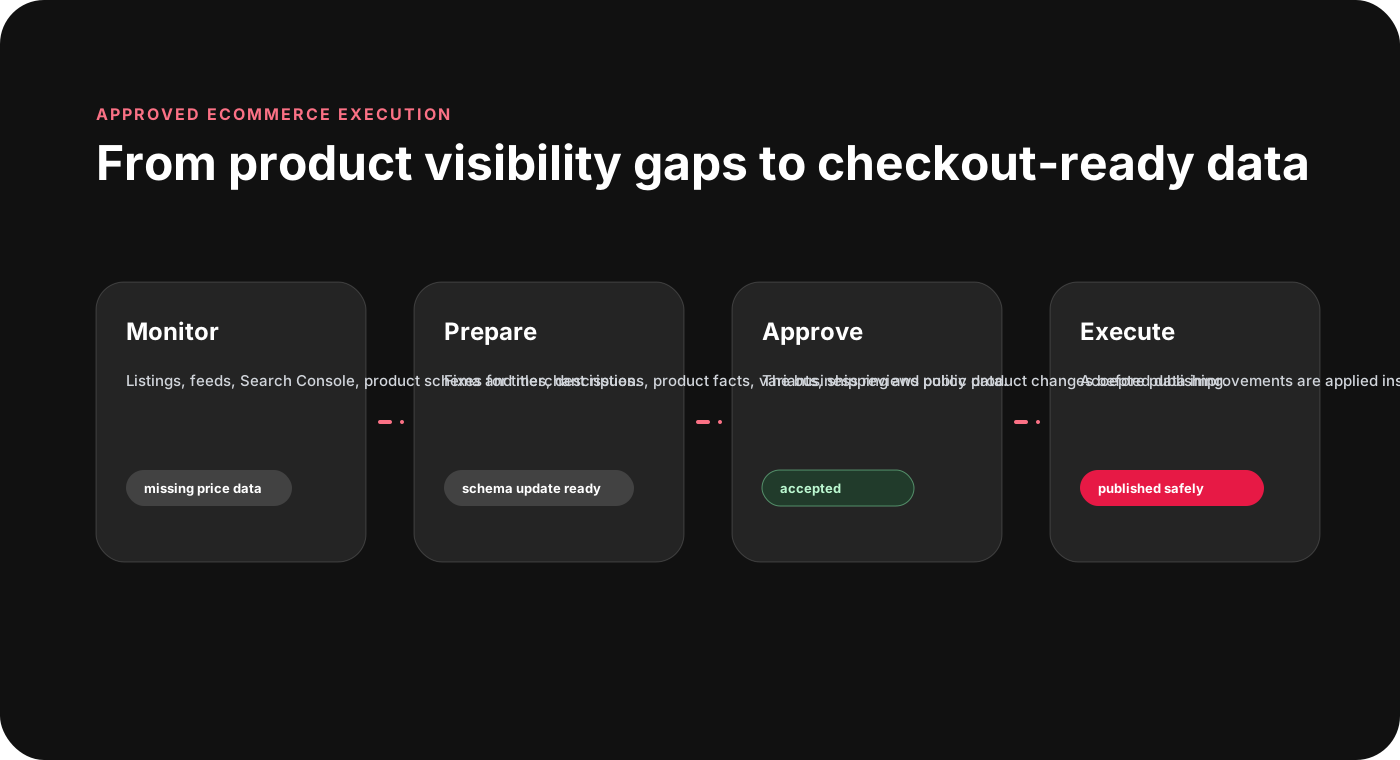
AYSA’s view is that ecommerce SEO is becoming an execution discipline. It is not enough to know that a product has missing schema or weak content. The system needs to prepare the fix, explain the risk, ask for approval and apply accepted changes inside the website workflow.
For ecommerce, AYSA can help connect the pieces:
- monitor product pages for missing or inconsistent SEO data;
- detect titles, descriptions and category content that need improvement;
- identify product schema opportunities that match visible content;
- surface Merchant Center and feed-quality issues where integrations allow it;
- prepare product content updates for SEO, AEO and AI visibility;
- suggest internal links from guides, categories and glossary pages to product collections;
- flag policy and trust gaps that affect product conversion readiness;
- execute accepted changes after approval.
The important part is control. An ecommerce business should not let automation blindly change prices, policies or product claims. But it also should not manually chase every SEO issue across hundreds or thousands of product pages. The practical model is approved automation: AYSA prepares the work, the business approves the important decisions, and accepted changes move into execution.
Checklist for ecommerce teams
If checkout-style SERP experiences grow, ecommerce teams should prepare now. Start with this checklist:
- Audit product structured data and confirm it matches visible page content.
- Review Merchant Center feed quality, disapprovals and warnings.
- Check price, availability and variant consistency across page, feed and schema.
- Improve thin product descriptions and category pages.
- Make shipping, delivery and returns information easy to find.
- Use high-quality product images with appropriate dimensions and alt text.
- Fix canonical and indexability issues on product and category pages.
- Control faceted navigation to avoid crawl waste and duplicate URLs.
- Improve internal links from guides, categories and related products.
- Monitor Search Console queries for product and category opportunities.
- Create an approval workflow for product data changes.
- Track both visibility and conversion impact.
FAQ
What is Google UCP?
UCP refers to Google’s Universal Commerce Protocol direction: a way of making commerce capabilities more structured and agent-readable. The ecosystem is still evolving, but the strategic idea is clear: commerce data needs to be understandable by systems, not only humans.
Does checkout in the SERP mean ecommerce websites will get less traffic?
Not necessarily, and it is too early to make a broad claim. But ecommerce teams should prepare for search surfaces where product action happens closer to Google. That makes product data, merchant trust and measurement more important.
Is product schema enough?
No. Product schema is important, but it should match visible page content and work alongside Merchant Center data, product pages, policies, images, pricing, availability and category structure.
How does this connect to AI search?
AI-assisted search and agentic commerce both need structured, reliable information. Product pages must be understandable, trustworthy and action-ready across search, AI answers and commerce surfaces.
Can AYSA help ecommerce teams prepare?
AYSA can monitor ecommerce SEO opportunities, prepare product and category improvements, surface structured data and content gaps, ask for approval and execute accepted changes inside the website workflow.
The AYSA point of view
The future of ecommerce SEO is not only “rank the product page.” It is “make the product understandable, trustworthy and ready for action wherever the buyer discovers it.”
If Google brings checkout closer to the SERP, ecommerce SEO becomes more operational. Product data, content quality, Merchant Center, schema, policies and execution workflows all need to stay aligned. That is exactly the type of work that should not live only in spreadsheets.
Less manual ecommerce SEO work. More approved product execution.
Sources and further reading
- Semrush: Google UCP checkout in the main SERP
- Google Search Central: Product structured data
- Google Merchant Center Help: Product data specification
- Google Merchant Center Help: Shipping attribute
- Google Search Central: Creating helpful, reliable, people-first content
Continue the AI search topic inside AYSA.
Use these pages to connect the article with AI SEO tools, AI visibility monitoring, AI Overviews and approved website execution.
Turn this topic into a website action plan.
Use these AYSA hubs to move from reading to technical fixes, AI visibility monitoring, research, glossary context and approval-first SEO execution.

