
The Junior Hiring Gap Is a Search Risk: How to Budget, Train, and Execute SEO in 2027
AI isn’t just changing rankings—it’s changing hiring. If entry-level seats vanish, your SEO capability decays quietly. Here’s how to make junior hiring a named line item, define learning roles around AI-era work, and operationalize it with scorecards, monitoring, and approved execution.

AI is changing search, but the bigger strategic shift for 2027 might be happening inside your org chart: entry-level seats are quietly disappearing. Not because companies are laying off armies of juniors—but because they’re simply not hiring them in the first place.
That distinction matters. Layoffs show up in headlines and HR reports. “We never filled that junior role” shows up nowhere—until you realize two years later you don’t have anyone ready to run technical audits, maintain local listings, refresh decaying pages, or build authority the hard way. In SEO, that’s not just a people problem. It becomes a performance problem.
This editorial is my take (Marius Dosinescu, AYSA.ai) on why the junior hiring gap is a direct search risk, how to budget for it explicitly, and how to build a training pipeline that matches AI-era SEO: AEO (Answer Engine Optimization), GEO (Generative Engine Optimization), and the operational discipline to execute changes safely and consistently.
Concise summary
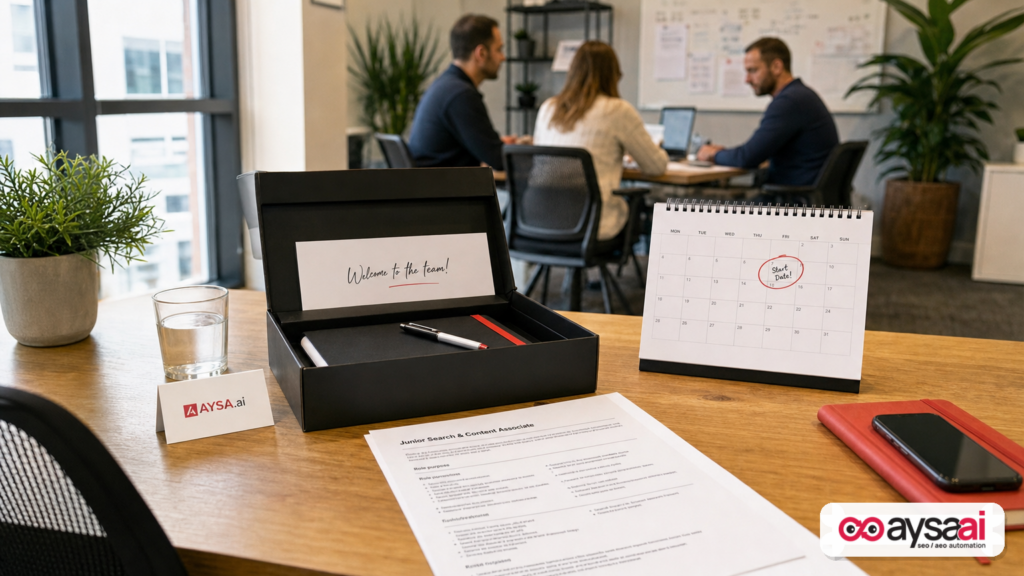
AI can automate tasks, but it can also automate away the “junior runway” that used to train future search leaders. For 2027, your marketing budget should name junior hiring as a distinct capability investment—with defined learning roles, a monthly scorecard that tracks unfilled seats, and a workflow that turns Monitoring into Approved Execution.
Key takeaways

- The junior hiring gap is a capability gap. If entry-level seats remain unfilled, your SEO program degrades over time even if senior staff stays.
- AI shifts work upstream. The “busywork” juniors learned on is shrinking, but the need for judgment, QA, entity consistency, and off-site credibility is growing.
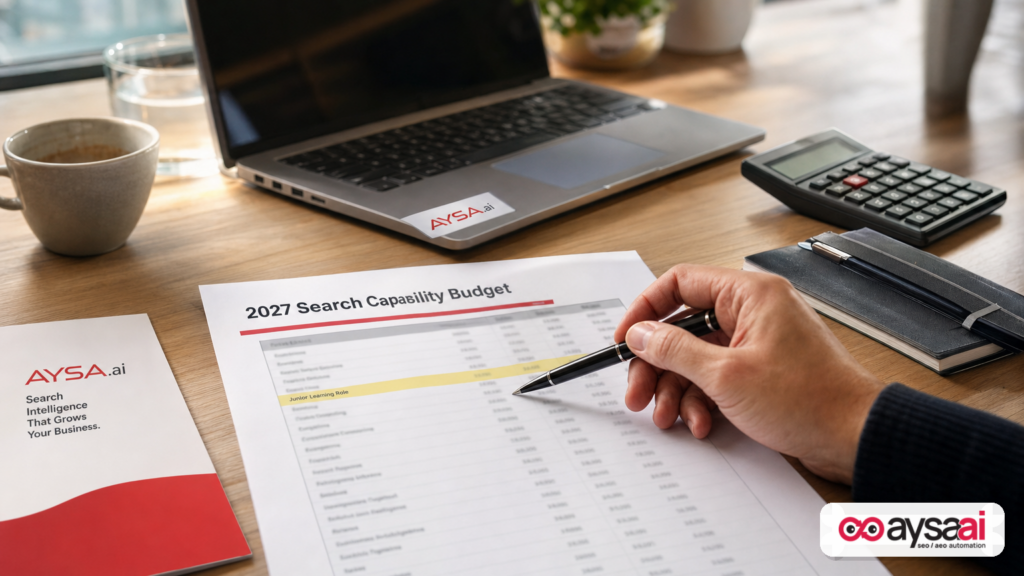
- Budgets need a learning line item. Treat junior roles as a named budget line with a learning plan and a decision date—not a vague headcount placeholder.
- Measure what’s missing. Add “unfilled seats” to your marketing scorecard alongside performance and efficiency metrics.
- Execution is the bottleneck. Monitoring without the ability to safely deploy fixes turns insights into backlog. Use approved execution systems to ship changes with control.
Table of contents
- The junior hiring gap: what changed, and why it’s happening now
- Why this matters specifically in AI Search, AEO, and GEO (not just “SEO”)
- What juniors used to do—and what AI is taking over
- The new junior role: learning work that actually compounds
- A 2027 budget model that makes junior hiring explicit (and CFO-proof)
- The scorecard: track unfilled seats like you track pipeline
- The operating system: monitoring → preparation → approval → execution
- A concrete SME scenario: the local clinic that “saved money” and lost demand
- What agencies must rethink: margins, training, and deliverables
- What can go wrong (and how to reduce the risk)
- Where AYSA fits: approved execution for AI-era SEO
- What to do next: a 30/60/90-day action list
- Sources and further reading
The junior hiring gap: what changed, and why it’s happening now
The best way to understand the “junior hiring gap” is to stop thinking in terms of layoffs and start thinking in terms of missing entrances into the profession. When companies adopt AI for knowledge work, a common adjustment is to reduce entry-level hiring rather than replace experienced workers. That can look “efficient” short-term—until you measure the long-term cost of not training the next wave.
This idea is discussed clearly in Greg Jarboe’s piece on Search Engine Journal, which argues that 2027 SEO budgets should explicitly fund junior hiring with defined learning roles and a scorecard that tracks unfilled seats (Search Engine Journal source).
Jarboe references a Stanford Digital Economy Lab working paper that uses ADP payroll records to describe a shift: younger workers in AI-exposed occupations appear to be employed at lower levels than they would be if they had tracked less-exposed peers—driven primarily by reduced hiring rather than increased separations. Importantly, the authors characterize the findings as early and descriptive rather than causal.
I’m emphasizing that nuance because it’s the nuance finance teams will use against you: “This isn’t causal; we’ll be fine.” In SEO, you won’t be fine if you treat junior hiring as optional. SEO is not a set-and-forget channel. It’s a production system that relies on steady maintenance plus adaptation.
What changed isn’t just AI capability. It’s the interaction of three pressures:
- Tool adoption: Many teams can generate more outputs per senior contributor, so the “need” for juniors is less obvious on paper.
- Budget scrutiny: CFOs prefer fixed costs they can defend. “Junior learning” is often seen as discretionary, even if it’s foundational.
- Workflow fragility: When fewer people do more, execution becomes riskier. So teams become more conservative about letting new hires touch production systems.
That third point is a trap. If your solution to execution risk is “don’t hire juniors,” you’re taking on a different risk: capability decay.
Why this matters specifically in AI Search, AEO, and GEO (not just “SEO”)
Traditional SEO already demanded consistent execution: technical fixes, content updates, internal linking, and ongoing performance monitoring. But AI Search is changing how visibility is earned and measured:
- AEO: Optimizing so your content becomes a reliable answer source, not just a ranked page.
- GEO: Optimizing for how generative systems interpret, cite, and synthesize your brand and content across queries.
Search Engine Journal has been covering these shifts under topics like AI Search and SEO categories (AI Search coverage, SEO coverage), and their broader State of Search 2027 framing reinforces the direction: budgets and scorecards are being redesigned.
In an AI-shaped landscape, junior work doesn’t disappear—it relocates. Instead of spending hours on repetitive, low-context tasks, entry-level roles can (and should) focus on work that compounds:
- Entity consistency and content QA across templates and page types
- Content refresh programs and intent alignment
- Structured data validation and schema hygiene (under supervision)
- Local presence maintenance (listings, services, review response playbooks)
- Off-site mention tracking, outreach coordination, and digital PR ops support
- AI citation/mention monitoring, including investigation and remediation proposals
The tension is real: this work requires judgment and process maturity. That’s exactly why you need a structured learning role rather than informal “help the seniors” tasks.
What juniors used to do—and what AI is taking over
For years, SEO had a fairly standard apprenticeship model. Junior team members learned by doing work that was high-volume and relatively low-risk:
- Weekly reporting and exporting data
- Bulk updating title tags and meta descriptions
- Basic keyword research and mapping
- Routine bid or budget adjustments in paid media environments (adjacent skill sets)
- Light content production under strict templates
Much of this is now faster with AI and automation. That’s good—if you convert the time savings into higher-leverage outputs. It’s bad if you convert it into “we don’t need juniors anymore.”
Here’s the uncomfortable truth: many of the tasks AI substitutes for were also the tasks that produced situational awareness. Juniors learned how messy real websites are, how search consoles lie by omission, how releases break pages, and why “small changes” cause big ranking moves.
When that apprenticeship path is removed, senior people may still deliver results for a while. But the pipeline behind them dries up. And then:
- Agencies struggle to staff accounts without burning out seniors.
- In-house teams become dependent on a few key people (key person risk).
- Execution quality declines because the “middle layer” never forms.
In 2027, the strongest SEO organizations will not be the ones that cut headcount the fastest. They’ll be the ones that turned AI efficiency into a repeatable training and execution system.
The new junior role: learning work that actually compounds
A “junior SEO” role defined as “do whatever the AI can’t do” is not a job description. It’s a guarantee of misalignment. For 2027, entry-level roles need defined learning outputs and bounded permissions.
Jarboe’s SEJ piece makes a key recommendation worth adopting: put junior roles into a dedicated learning bucket with a named owner and decision date. I agree—and I’d go further by specifying the learning program as a set of production responsibilities with measurable outputs.
What a modern junior learning role should own
Below is a practical ownership model. It’s not theoretical; it’s what most teams already need but don’t staff explicitly.
- Content refresh operations: Identify decaying pages, propose refresh briefs, execute approved updates, and track outcomes.
- Internal linking hygiene: Maintain a shortlist of priority pages and implement approved link improvements at scale.
- Structured data QA (supervised): Validate templates, check for errors, propose fixes, and coordinate approvals.
- Local SEO consistency: Audit service lists, hours, categories, and location pages; coordinate updates with ops.
- Mention and citation monitoring: Track off-site brand mentions, unlinked citations, and opportunities for authority building.
- AI visibility investigation: When visibility shifts, document likely causes and create a remediation proposal.
These aren’t “busywork.” They are the backbone of a durable search program.
What juniors should NOT do unsupervised
To reduce risk, define boundaries from day one:
- No site-wide template edits without review
- No indexation changes (robots.txt, noindex) without senior approval
- No major IA changes without a plan and rollback approach
- No content publishing at scale without QA checks and editorial guidelines
This is where governance matters, and it’s also where an approved execution model becomes practical rather than philosophical.
A 2027 budget model that makes junior hiring explicit (and CFO-proof)
Most marketing budgets still hide junior hiring inside a generic labor line. That’s exactly how the junior pipeline disappears: nobody “cut” it; it simply never got prioritized.
Instead, budget for junior hiring as a distinct capability investment with its own rationale, owner, and evaluation criteria. This aligns with the direction discussed in the SEJ source: treat entry-level hires as their own budget line and track unfilled seats.
Start with capabilities, not channels
Channel-based budgeting (“SEO,” “Paid,” “Social”) breaks down when AI makes output cheaper but quality harder to assure. A capability model is more defensible:
- Technical foundation: crawlability, performance, indexation, structured data
- Content system: refresh, expansion, consolidation, editorial QA
- Authority building: PR, mentions, partnerships, expert inputs
- Measurement: visibility, behavior signals, business outcomes
- Execution & governance: monitoring, approvals, change logs, rollback readiness
- Learning & pipeline: junior roles, training, documentation, rotations
Notice “learning & pipeline” is not implied—it’s named.
A CFO-proof way to frame the junior line item
If you want finance buy-in, don’t pitch a junior hire as “support.” Pitch it as:
- Risk reduction: lower dependency on 1–2 key individuals
- Execution speed: more capacity to ship fixes and refreshes
- Asset maintenance: content and technical systems degrade without upkeep
- Future staffing: internal promotion pipeline is cheaper than external hiring at senior levels
Then attach a decision date: “We will review this role quarterly against the scorecard and decide to expand, maintain, or stop.” That’s what makes it feel like a managed investment instead of an open-ended cost.
The scorecard: track unfilled seats like you track pipeline
Traditional marketing scorecards track what happened: traffic, conversions, revenue. Modern AI-era scorecards must also track what didn’t happen: the work you didn’t do and the seats you didn’t fill.
Jarboe’s argument to put a hiring line on the scorecard is the right move. Here’s how I recommend implementing it in a way that is operationally meaningful.
Core scorecard sections (monthly)
- Performance outcomes: pipeline, revenue influence, leads, bookings (use whatever your business actually trusts)
- Visibility indicators: share of voice, brand mentions, AI citations/mentions (track consistently; interpret cautiously)
- Behavior signals: branded search demand, direct visits, returning users (interpret in context; don’t over-attribute)
- Execution throughput: number of approved changes shipped, time-to-fix for priority issues, backlog size
- Efficiency: hours saved via AI, hours reinvested, tool costs
- Capability and seats: roles filled vs planned, unfilled seats, and the reason (budget, hiring market, deprioritized)
Why “unfilled seats” belongs in the same view as revenue
If you’re serious about search as a growth lever, you’re not buying results—you’re buying capability to produce results. Unfilled seats are capability debt. It accumulates quietly and then shows up as:
- slower response to ranking volatility
- stale pages losing relevance
- broken templates persisting for months
- missed brand mentions and authority opportunities
Finance teams understand debt. Put it in their language.
The operating system: monitoring → preparation → approval → execution
Most teams already monitor. The failure is what happens next.
In the AI era, “insight” is cheap. Execution is expensive. And execution without governance is dangerous.
This is exactly why we built AYSA.ai as an execution system for SEO/AEO/GEO: it monitors what’s changing, prepares recommended website changes, asks for approval, and executes accepted changes. The point is not to replace people. The point is to help small teams operate like disciplined teams.
Here’s a 2027-ready operating model you can adopt whether you use AYSA or not:
1) Monitor what matters (not everything)
Monitoring should be aligned to the scorecard:
- Critical technical issues (indexation, crawl anomalies, structured data errors)
- Priority page performance and decay signals
- Brand/entity consistency signals (mislabeling, duplication, conflicting info)
- Local listing inconsistencies and review velocity
AYSA’s monitoring approach is described here: AYSA Monitoring.
2) Prepare proposed changes with context and rollback thinking
Preparation is where juniors can learn safely—if you enforce structure. A good proposal includes:
- what is changing and where
- why it should improve outcomes
- what could go wrong
- how you’ll validate success
- how to roll back
AI can help draft proposals, but humans must own the judgment and accountability.
3) Approve changes deliberately
Approval is the governance layer that keeps AI-era speed from becoming AI-era chaos. This is where founders and marketers sleep at night: no silent site-wide edits, no risky deploys, no “the model changed it” surprises.
4) Execute consistently—and log everything
Execution needs to be fast, repeatable, and traceable. Whether you’re deploying CMS edits, schema updates, internal links, or content refreshes, you need a change log and the ability to see what happened when performance changes.
AYSA is designed around this approved execution principle. If you want the overview of how AYSA fits into AI-era SEO workflows, start here: AI SEO Tools.
A concrete SME scenario: the local clinic that “saved money” and lost demand
Let’s make this real with a scenario I see often in different forms.
Business: a multi-location dental clinic (could be any clinic or local service business).
Starting point (2026): the clinic has a small marketing function: one manager and a part-time coordinator. They use AI tools to generate service page drafts and summaries. It works—at first. The manager proposes not filling a junior role because “AI handles the content now.”
What actually happens over 9–12 months:
- Service pages drift. AI-generated content isn’t refreshed with real operational details (new services, new insurance plans, updated hours).
- Local SEO hygiene slips. Categories and services across listings become inconsistent. Reviews are answered sporadically. Location pages diverge.
- Technical issues persist. A site update changes internal links and breaks a template; nobody notices for weeks.
- Demand capture weakens. The clinic still “does marketing,” but appointments from organic/local begin to soften.
The hidden cause: there was no learning role to own the maintenance system. AI created output, but not accountability. The manager became a bottleneck, and everything not urgent got postponed.
What would have prevented it:
- a named junior learning seat with weekly outputs (listing audits, refresh pipeline, internal linking checklist)
- monitoring tied to specific alerts
- approved execution for changes, so work ships without risking the site
- a scorecard that shows the cost of the unfilled seat before the calendar empties
This is the point: “AI savings” is only real if it’s reinvested into a durable system. Otherwise, it’s borrowed time.
What agencies must rethink: margins, training, and deliverables
Agencies feel the junior hiring gap sooner than in-house teams because agencies live on throughput and repeatability. If juniors disappear, two things happen:
- Margin compression: senior hours replace junior hours; costs rise even if retainers don’t.
- Delivery risk: work gets done, but QA and follow-through slip.
The fix is not “hire fewer juniors.” The fix is “hire differently” and “operate differently.”
Shift deliverables from outputs to operating systems
Clients don’t need 20 AI-written posts. They need:
- a refresh cadence
- a technical maintenance loop
- authority building operations
- clear governance for changes
Agencies that productize the loop (monitor → prepare → approve → execute) will outperform agencies that simply sell “SEO hours.”
Make junior roles client-safe through approval systems
Clients are rightfully cautious about letting juniors touch production websites. That’s not a reason to avoid junior hiring—it’s a reason to build a safer workflow.
This is where approved execution tools matter. When proposed changes are reviewed before deployment, juniors can contribute value without exposing clients to uncontrolled risk.
If you’re an agency evaluating how to run this at scale, start with the concept of AI search visibility and monitoring as a managed service: AI Search Visibility.
What can go wrong (and how to reduce the risk)
Whenever I argue for explicit junior hiring, I hear three reasonable objections:
Objection 1: “Juniors will break the site.”
That risk is real if you operate with informal permissions. Reduce it with:
- approved execution (nothing ships without review)
- bounded access and role-based permissions
- checklists for repeatable tasks
- change logs and rollback processes
Objection 2: “AI makes junior work obsolete.”
AI makes some junior tasks obsolete. That’s different. Replace low-context tasks with learning work that compounds: refresh ops, technical QA, local hygiene, authority ops, citation tracking. The junior role becomes a reliability engine, not a reporting engine.
Objection 3: “We can’t measure it.”
You can measure outputs even when outcomes take time. Track:
- pages refreshed per month and the performance trajectory
- time-to-fix for technical issues
- backlog reduction
- coverage of critical templates and locations
- authority opportunities surfaced and executed (approved)
Not everything will be perfectly attributable. That’s normal in marketing. The goal is disciplined management, not magical certainty.
Where AYSA fits: approved execution for AI-era SEO
AYSA.ai exists because most teams don’t fail at strategy—they fail at execution. Especially small businesses, lean ecommerce teams, and agencies running many accounts.
Our perspective is simple:
- Monitoring without action is just anxiety.
- Action without approval is just risk.
- Approval without execution is just meetings.
AYSA is built to connect those steps:
- Monitor site and visibility signals (Monitoring)
- Prepare suggested changes (technical and content-related) with context
- Request human approval before deployment
- Execute accepted changes and keep the system moving
This is also how junior hiring becomes safer and more valuable: juniors can prepare and propose work, seniors approve, and execution becomes consistent.
If you’re evaluating whether a system like AYSA can fit your org, the fastest overview is here: AI SEO Tools. If you need commercial details, use: AYSA Pricing. For more editorial context, see: AYSA Blog.
What to do next: a 30/60/90-day action list
If you’re planning 2027 now, you don’t need a “transformation.” You need a sequence.
Next 30 days: audit the work and name the gaps
- Inventory tasks: List what actually gets done weekly in SEO/content/local/authority work.
- Classify tasks: “AI-substitutable” vs “judgment/relationship dependent.” (Be honest.)
- Identify ownership: For each critical task, write a single owner (not “the team”).
- Find the missing seat: Where is work consistently unowned, delayed, or repeatedly broken?
Next 60 days: design the junior learning role as a production system
- Write the role as outputs: weekly hours + weekly deliverables + QA checklist.
- Assign a named mentor: one accountable senior who reviews work.
- Define permissions: what can be proposed vs what can be executed.
- Attach a decision date: quarterly review criteria and continuation decision.
Next 90 days: deploy the scorecard and enforce governance
- Add “unfilled seats” to the monthly scorecard with explicit rationale.
- Adopt monitor → prepare → approve → execute as your operating standard.
- Track throughput: time-to-fix and number of approved changes shipped.
- Document playbooks: the first three playbooks should be refresh ops, internal linking, and local hygiene.
Practical checklist: what your 2027 SEO budget should explicitly name
- One junior learning role (or more, depending on scale) with a defined output portfolio
- Monitoring for technical, content decay, and local presence issues
- Authority building operations (digital PR/mentions) with defined weekly hours
- Governance for approvals, change logging, and QA
- Measurement layers that connect visibility → behavior → business outcomes
My perspective: an “intact team” is the wrong goal
The most dangerous story in 2027 will be: “We kept the team intact while AI improved productivity.” That sounds like success. But it can hide a slow-motion failure: the team is intact because junior seats were never filled.
In SEO, the better goal is not “intact.” It’s still training.
If AI truly pays for itself in your organization, some of that value should show up in a visible, accountable investment in the pipeline. Not as charity. As a competitive advantage.
Sources and further reading
- Search Engine Journal: The Junior Hiring Gap Your 2027 Marketing Budget Should Name
- Search Engine Journal: State of Search 2027 (report hub)
- Search Engine Journal: AI Search category
- Search Engine Journal: SEO category
- Search Engine Journal: Technical SEO category
- Search Engine Journal: Local SEO category
- Search Engine Journal: Links & PR category
Related AYSA resources:
What to do next
- Open your current SEO plan and add a new line: Junior learning role (owner, weekly hours, quarterly review date).
- Create a task inventory and label AI-substitutable vs judgment-dependent work.
- Add unfilled seats to your monthly scorecard and review it with finance.
- Implement a monitor → prepare → approve → execute workflow so juniors can contribute safely.
- If you need a system to operationalize that loop, evaluate an approved execution approach like AYSA.
Continue the AI search topic inside AYSA.
Use these pages to connect the article with AI SEO tools, AI visibility monitoring, AI Overviews and approved website execution.
Turn this topic into a website action plan.
Use these AYSA hubs to move from reading to technical fixes, AI visibility monitoring, research, glossary context and approval-first SEO execution.