
GEO Isn’t the Prize: How SMEs Should Win the Agentic Web (Universal Cart, UCP, WebMCP, And AI Search That Actually Converts)
LLM citations are the shiny object. The real opportunity is the agentic web: Google surfaces that execute tasks, compare products, and trigger purchases. Here’s what changed, what to measure, and how SMEs can prepare with approved, trackable execution.

GEO (Generative Engine Optimization) is having its moment. And yes, getting mentioned in AI answers feels like the new page-one ranking.
But for most small and mid-sized businesses, the “mentions game” is a distraction from where the real money will be made: agentic search and agentic commerce—systems that don’t just answer questions, but actively coordinate tasks, compare options, and execute transactions.
This editorial builds on Marie Haynes’ argument that obsessing over LLM visibility can misallocate budgets, because the measurable opportunity is shifting inside Google’s AI-powered surfaces and the next wave of “agent manager” behavior. You can read the original research and context on Search Engine Journal (and I recommend you do).
Table of contents
- The quick summary (what changed, why it matters, what to do)
- Why GEO feels urgent (and why it’s often the wrong KPI)
- Google is still the primary “AI search” channel for most businesses
- The measurement gap: if you can’t measure it, you can’t win it
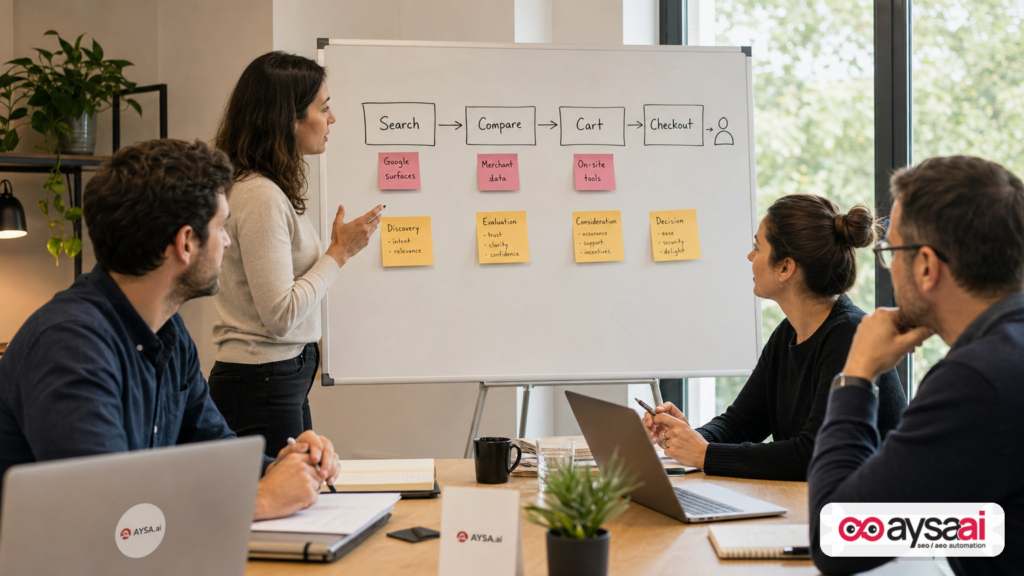
- The real shift: search results are becoming “agent managers”
- Universal Cart and product feeds: the new battleground for ecommerce visibility
- Universal Commerce Protocol (UCP): discovery endpoints become the new SEO surface
- WebMCP: when your website becomes an API for agents
- Intelligent eyewear: “see it, solve it, buy it” becomes normal
- What can go wrong (and how to avoid self-inflicted damage)
- A concrete SME scenario: local clinic + ecommerce bundle offer
- What agencies should rethink before clients do it for them
- Where AYSA fits: visibility monitoring + approved execution (the missing operating system)
- A practical 90-day action plan
- What to do next (checklist)
- Sources and further reading
The quick summary (what changed, why it matters, what to do)
What changed: Search is moving from “ten blue links” to a mix of AI answers, shopping modules, and task completion flows. That includes AI Overviews and AI Mode inside Google, plus emerging “agentic” commerce concepts described in Marie Haynes’ analysis (Universal Cart, UCP, WebMCP, intelligent eyewear).
Why it matters: If the search interface becomes a transaction layer, then the winners won’t be the brands with the cleverest prompt or the most ChatGPT citations. The winners will be the brands whose data, products, and customer experience are easiest for machines to verify and easiest for humans to buy.
What to do:
- Stop treating GEO mentions as the primary KPI. Track outcomes: leads, sales, booked calls, repeat purchases.
- Upgrade measurement: GA4 key events, funnel steps, Attribution sanity checks.
- For ecommerce: treat product data (Merchant Center, feeds, price/shipping/returns clarity) as core SEO infrastructure.
- For services: build interactive tools that reduce friction (quotes, booking, eligibility checks, troubleshooting).
- Adopt an execution system: monitor what AI surfaces show, propose fixes, approve changes, deploy improvements, measure impact. That operating loop is where AYSA’s AI Search Visibility and Monitoring approach fits.
Why GEO feels urgent (and why it’s often the wrong KPI)

Business owners love dashboards. Marketers love new acronyms. Investors love category creation.
So it’s no surprise GEO is booming: tools that track whether ChatGPT or other LLMs cite your brand, workflows that promise to “optimize for answers,” and playbooks that suggest you can “rank” in an AI model the same way you rank in Google.
Here’s the hard part: even if you get cited, the business value is not guaranteed.
Marie Haynes’ dataset (as summarized in the SEJ article) highlights two uncomfortable truths that match what many SMEs quietly see in analytics:
- Referral traffic from LLM tools is often tiny compared to Google organic for most sites.
- Even when LLM visitors convert well, the total volume may be too small to justify large reallocation of budget.
I’m not dismissing the future. I’m dismissing the habit of optimizing for what’s easiest to screenshot in a report.
Mentions are not a strategy. A strategy connects to outcomes: margin, conversion rate, retention, pipeline velocity, repeat purchase. That’s true whether the traffic comes from classic search results, AI answers, shopping widgets, or an agent that buys on the customer’s behalf.
What GEO gets right
GEO, at its best, forces you to answer a good question: “When an AI summarizes my category, does it understand what I sell and who I’m for?”
That pressure can improve your messaging, your information architecture, and your content clarity. Those improvements can help everywhere—Google, human visitors, sales conversations, even customer support.
Where GEO becomes wasteful
GEO becomes wasteful when teams start doing things like:
- Publishing thin “AI bait” pages that don’t align with real buying intent.
- Rewriting content to sound like a model instead of a credible business.
- Chasing citations while their checkout breaks, forms don’t fire events, or product data is incomplete.
If your tracking is weak, your execution is slow, and your customer experience is average, then GEO is lipstick on a leaky funnel.
Google is still the primary “AI search” channel for most businesses
One of the most important reframes in Marie Haynes’ argument is this:
Most people already use “AI search” every day—without opening ChatGPT.
They do it inside Google.
Google Search has been incorporating machine learning for years, and now it’s shipping consumer-visible AI interfaces like AI Overviews and AI Mode (as referenced in the source context). If you’re a business, this matters because it changes:
- How visibility works: your content may be summarized instead of clicked.
- How intent is satisfied: users may complete tasks directly in Google surfaces.
- How competition plays out: fewer clicks means every click is more valuable—and harder won.
What this means operationally
You cannot manage what you cannot see. If your reporting is still “keyword positions + sessions,” you’re already behind.
The new baseline is: visibility + outcomes + execution speed. That’s why an operating system approach matters: observe, decide, approve, ship, measure.
AYSA’s stance is simple: you can’t just monitor AI visibility—you need a path to implement changes safely. That’s the reason our platform is built around monitoring + preparation + approval + execution (see AYSA AI SEO tools and Monitoring).
The measurement gap: if you can’t measure it, you can’t win it
In the SEJ piece, one detail should stop every business owner: many sites still don’t track meaningful conversions (key events) in GA4.
That’s not a “marketing problem.” It’s a CEO problem.
Because the moment search becomes more agentic, the question shifts from:
- “How many sessions did we get?”
to:
- “How many tasks were completed?”
- “How many purchases were executed?”
- “How often were we chosen vs alternatives?”
Minimum viable measurement for SMEs (no fluff)
If you’re an SME and you want a measurement foundation that survives the next two years, start here:
- Define 1 primary conversion: purchase, booked appointment, qualified lead form, phone call, demo request.
- Define 2–5 supporting events: add-to-cart, begin checkout, click-to-call, form start, pricing page view, booking calendar open.
- Validate event firing: test it yourself on mobile and desktop.
- Segment performance by landing page type: product pages, category pages, service pages, blog/informational pages.
When informational clicks decline, you’ll still see whether transactional and commercial-intent pages are gaining share. That’s what keeps you rational when the interface changes.
Why “rank tracking” loses power in an AI-first SERP
Rank tracking assumes:
- Stable query → stable results
- Stable results → comparable positions
But in an AI-personalized world, two people can search the same thing and get different summaries, different product modules, different local packs, and different “best options.” As Marie points out, reporting gets harder, not easier.
So your KPIs must tilt toward what remains real:
- Revenue
- Qualified leads
- Pipeline
- Margin
- Repeat customers
The real shift: search results are becoming “agent managers”
The phrase that should change your roadmap is the one highlighted in the source context: Search becomes an “agent manager.”
In practical terms, that means the search engine becomes:
- A coordinator (find options)
- A comparer (evaluate tradeoffs)
- A doer (book, buy, schedule, submit forms)
Historically, SEO’s job was to earn the click. In the agentic era, SEO’s job expands into: earning selection and enabling completion.
A mental model that helps: from “index” to “interface” to “infrastructure”
- Index era: search crawls and ranks documents.
- Interface era: search summarizes, answers, and reduces clicks.
- Infrastructure era: search becomes a transaction and task execution layer.
We’re in the interface era and moving rapidly into infrastructure.
Universal Cart and product feeds: the new battleground for ecommerce visibility
If you sell products online, here’s the uncomfortable truth:
Your website is no longer the only storefront that matters.
Agentic commerce concepts like Google’s Universal Cart (as described in the SEJ source) point toward a world where customers add items from multiple merchants and check out inside Google surfaces.
Whether every detail lands exactly as described is less important than the direction: the checkout path can move upstream into the platform.
What ecommerce teams should do now (before any “protocol wars”)
You don’t need to predict the final standard to build an advantage. You need to become the brand whose product data is:
- Accurate
- Complete
- Consistently updated
- Aligned with what shoppers actually care about (delivery date, return policy, warranty, compatibility)
Start with what Google already uses heavily: Merchant Center and your product feed quality. Marie explicitly calls this out as an opportunity area.
Feed excellence is the new technical SEO
Classic technical SEO focused on crawlability, indexation, site architecture, and performance. Those still matter.
But ecommerce technical SEO increasingly includes:
- Product identifiers and variants done right (size/color/material)
- Clean pricing and promotion logic
- Stock status accuracy
- Shipping costs and delivery windows that match reality
- Return policies that are unambiguous
Because agents can’t “guess” through ambiguity. They’ll pick the merchant with the least uncertainty.
What to monitor weekly
- Disapprovals in Merchant Center
- Price mismatches between feed and site
- Out-of-stock and backorder representation
- Top products by impressions vs by revenue (misalignment signals feed or landing page issues)
This is where an execution platform helps: monitoring detects changes, and then you need a safe way to deploy fixes quickly. This is exactly the “prepare → approve → execute” loop AYSA is designed for (see Monitoring).
Universal Commerce Protocol (UCP): discovery endpoints become the new SEO surface
In the source article, UCP is described as an “open discovery layer” governed by major commerce players. The specific technical details may evolve, but the strategic implication is clear:
Agents need structured, reliable endpoints to understand what you sell and how to transact.
Historically, crawlers read pages. In the next phase, agents will increasingly “read capabilities.” That shifts attention to:
- Well-defined product options
- Purchase constraints (availability, region, shipping rules)
- Trusted identity signals (business verification, support, policies)
SME-friendly translation: your catalog becomes an API contract
Even if you never touch a line of protocol code, you can prepare by treating your catalog as a contract:
- Every product has one truth for price and stock.
- Every variant is explicit.
- Every policy is discoverable and consistent.
- Every customer promise is verifiable (shipping time, warranty, returns).
If you’re inconsistent, agents will route around you.
WebMCP: when your website becomes an API for agents
Marie’s article points to WebMCP (Model Context Protocol) as a way for websites to expose interactive functions—forms, calculators, schedulers—to AI agents.
Again: you don’t need to bet your business on the first version of a standard. But you should understand the direction: the web becomes executable.
Why interactive tools are the highest-leverage content you can publish
Most SMEs still think content means “blog posts.” In the agentic era, the most valuable content often looks like:
- A quote calculator
- A configurator (“Which model fits my needs?”)
- An eligibility checker
- A booking flow that works flawlessly on mobile
- A troubleshooting assistant that ends in either self-service success or a clean handoff to a human
Those tools do two things at once:
- They convert humans (immediate utility).
- They teach agents (structured inputs → structured outputs).
Tool ideas by business type (practical examples)
Ecommerce:
- Size/fit recommender (returns reduction is a hidden profit lever)
- Bundle builder (“build your kit”)
- Compatibility checker (“will this part fit my model?”)
Local services (plumbers, HVAC, electricians):
- Symptom-based triage tool (“no heat” decision tree) that ends in booking
- Service area + same-day availability checker
- Transparent estimate ranges tied to inputs (home size, equipment type)
Clinics:
- Insurance/coverage pre-check guidance (without overpromising)
- Symptom intake that leads to the right appointment type
- Cost estimator ranges plus financing options (if applicable)
SaaS:
- ROI calculator
- Migration estimator
- Interactive demo sandbox with guided outcomes
What matters most: trust boundaries
As soon as tools touch pricing, medical advice, legal implications, or safety, you need guardrails. Don’t let “agentic” become “reckless.” Make the tool helpful, but constrain it:
- Use ranges, not guarantees
- Require confirmation for high-risk steps
- Provide human escalation
- Log user inputs (with privacy in mind) so you can improve accuracy
Intelligent eyewear: “see it, solve it, buy it” becomes normal
The source context mentions Google’s push toward “intelligent eyewear” (not “AI glasses”) powered by Gemini on Android XR, and points readers to Google’s Android XR hub.
We’re not going to pretend we can forecast adoption curves perfectly. But we can prepare for the behavior shift that eyewear enables:
Search becomes continuous and multimodal.
What changes when search happens in the world (not just on a screen)
- Discovery becomes visual-first: “What is that product?” “Where can I buy it?”
- Intent becomes immediate: less research, more action.
- Brand recognition matters more: the easiest choice wins.
- Local availability becomes critical: “near me” is implicit in the experience.
How SMEs should respond (without building an XR app tomorrow)
Most SMEs should not rush into XR development. The near-term preparation is simpler:
- Make products visually identifiable: consistent naming, clear model numbers, high-quality images.
- Strengthen local presence: accurate business info and service areas (especially for service businesses).
- Reduce friction: mobile checkout, fast booking, clear policies.
- Build “real world” content: how-to, installation, care, troubleshooting—designed for quick answers and quick actions.
What can go wrong (and how to avoid self-inflicted damage)
When teams hear “agents,” they often over-correct. Here are common mistakes I expect to see as agentic commerce gets hyped:
1) Optimizing for citations while your core funnel leaks
If your top-selling product pages are slow, confusing, or missing key info, fix that before you worry about whether ChatGPT names you.
2) Publishing content that can’t win (or can’t convert)
AI Overviews compress informational content. If your strategy is “publish more top-of-funnel blog posts,” you’ll be fighting for shrinking clicks.
Shift toward:
- Commercial comparisons that reflect real buyer decisions
- Use-case pages tied to specific needs
- Tools and calculators
- Customer proof that reduces uncertainty (without inventing claims)
3) Treating technical SEO as a one-time project
Agentic surfaces punish inconsistency. Your product feed and site data need ongoing maintenance. That’s operations, not a project.
4) Letting “automation” ship risky changes without approvals
Automation is powerful, but uncontrolled automation is a liability. In real businesses, the website is connected to revenue, compliance, and brand trust.
This is why AYSA is built around approved execution: the system can monitor, prepare recommendations and changes, and then execute only what a human accepts. (If you want the overview, start at AI SEO Tools.)
A concrete SME scenario: local clinic + ecommerce bundle offer
Let’s make this real with a scenario that combines local services and ecommerce—because many SMEs now do both.
The business
A regional physical therapy clinic with:
- Three locations
- Online booking
- A small ecommerce store selling braces, mobility tools, and recovery kits
The old SEO plan
- Write blog posts targeting “how to fix knee pain”
- Rank for local “physical therapy near me”
- Hope people click, read, then book
What changes in an agentic world
Now the clinic’s customers increasingly:
- Get an AI summary for informational queries (fewer blog clicks)
- Want immediate actions: “book the earliest appointment,” “find a brace for runner’s knee,” “what should I buy today to reduce pain?”
The new plan (practical, executable)
1) Measurement foundation (week 1–2)
- GA4 key event: completed booking
- Supporting events: booking start, phone click, location page view, add-to-cart, checkout start, purchase
2) “Tool content” that converts (week 2–6)
- A symptom-to-appointment selector (not medical advice; triage + disclaimers)
- A “recovery kit recommender” (simple inputs → suggested products)
3) Ecommerce feed readiness (week 2–8)
- Clean product titles, variants, stock, shipping, returns
- Bundle SKUs structured clearly
4) Content shift (week 4–12)
- Replace generic blog content with “decision support” pages: when to see a PT vs rest, what to buy now, what to avoid
Notice what’s missing: “We must be cited by ChatGPT.” If it happens, great. But the plan is built around conversion paths that exist today.
What agencies should rethink before clients do it for them
Agencies and consultants are in a tough spot: clients still demand rank reports, but the SERP is becoming less rankable and more contextual.
Here’s what I believe agencies should change immediately:
1) Sell an operating system, not a list of deliverables
Deliverables don’t adapt. Systems do.
Your client needs a loop:
- Monitor visibility across AI surfaces
- Detect what’s changing
- Prioritize by revenue impact
- Execute improvements quickly
- Measure outcomes
This is also why platforms like AYSA exist: to reduce the gap between “knowing what to do” and “actually shipping changes,” while keeping approvals in the right hands. If you’re exploring that approach, start with AI Search Visibility and Pricing.
2) Reframe reporting around decisions
Clients don’t need 40 KPIs. They need answers:
- What changed?
- Why did it change?
- What should we do next?
- What did we ship last month that moved the needle?
3) Expand technical SEO into commerce and tooling
“Technical SEO” is no longer just crawl/index/page speed. It’s also:
- Feed quality
- Structured data clarity
- Booking and checkout reliability
- Interactive tools
Where AYSA fits: visibility monitoring + approved execution (the missing operating system)
At AYSA, our bias is toward execution because that’s where most SEO strategies die.
Most businesses are not failing because they lack ideas. They’re failing because:
- No one owns implementation.
- Changes get stuck in tickets.
- Approvals take weeks.
- Developers are booked out.
- The team can’t measure impact cleanly.
What an “agentic-ready” SEO operating loop looks like
- Monitor: how your brand and pages appear across modern search surfaces (start here: AYSA Monitoring).
- Prepare: identify improvements to content, internal linking, page structure, schema, and conversion paths.
- Approve: keep humans in control—especially for regulated industries or brand-sensitive pages.
- Execute: ship accepted changes quickly and consistently.
- Learn: measure outcomes and iterate.
This is the difference between “we should do X” and “we did X, here’s the impact.”
How this connects to AI Overviews, AI Mode, and the agentic future
AI-first search increases volatility and reduces the value of static playbooks. The businesses that win will be the ones that:
- Detect changes early
- Ship improvements fast
- Keep risk controlled through approvals
If you want to see the broader AYSA approach and updates, our blog is where we publish strategy and implementation guidance as the ecosystem evolves.
A practical 90-day action plan
This plan is designed for SMEs who need results, not theory. Adjust scope based on your team size, but don’t skip steps.
Days 1–15: Fix measurement and conversion plumbing
- Pick your primary conversion and define it as a GA4 key event.
- Add 2–5 supporting events (form start, click-to-call, add-to-cart, checkout start).
- Audit your top 10 landing pages by revenue/leads: do they clearly answer “what, for who, price range, timeline, next step”?
- Set a baseline dashboard: conversion rate by channel and by landing page type.
Days 16–45: Build one “tool” that removes friction
- Ecommerce: product finder/compatibility checker/bundle builder.
- Services: estimate range tool or booking triage tool.
- Clinic: appointment selector + eligibility guidance + escalation.
Make it simple. Make it fast. Make it measurable.
Days 46–75: Upgrade your “agent-readable” data
- Ecommerce: clean Merchant Center inputs and resolve disapprovals.
- All businesses: ensure consistent business info, policies, and trust signals.
- Review structured data and on-page clarity (products/services, FAQs where appropriate, pricing transparency where possible).
Days 76–90: Shift content toward commercial intent and decisions
- Create 3–6 pages that map to real buying decisions (comparison, use-case, “best for,” “cost of,” “timeline,” “alternatives”).
- Update internal linking so transactional pages receive authority from informational pages.
- Measure impact on leads/sales, not just clicks.
What to do next (checklist)
- Decide your KPI: revenue/leads booked—not mentions.
- Audit tracking: GA4 key event + supporting events working on mobile.
- Evaluate your “selection signals”: clarity, policies, shipping, returns, trust, reviews (where relevant), customer support.
- For ecommerce: treat Merchant Center/feed quality as a weekly operational task.
- Build one tool: something customers (and future agents) can use to complete a task.
- Adopt an execution loop: monitor → prepare → approve → execute → measure. (Explore AI Search Visibility and Monitoring.)
- Document learnings: the teams who learn fastest will outcompete those who only publish.
Sources and further reading
- Search Engine Journal: “GEO Is A Distraction: Here’s Where The Real Opportunity Is” (Marie Haynes)
- Search Engine Journal: State Of Search 2027 / State of SEO report page
- Search Engine Journal: AI Search category
- Search Engine Journal: Technical SEO category
- Search Engine Journal: SEO category
- Marie Haynes on SEJ
Note: The source context references Google initiatives (Universal Cart, intelligent eyewear/Android XR) and emerging protocols (UCP, WebMCP). Where official specifications or documentation are not included in the supplied research context, I have intentionally treated these as directional concepts rather than asserting implementation details.
Continue the AI search topic inside AYSA.
Use these pages to connect the article with AI SEO tools, AI visibility monitoring, AI Overviews and approved website execution.
Turn this topic into a website action plan.
Use these AYSA hubs to move from reading to technical fixes, AI visibility monitoring, research, glossary context and approval-first SEO execution.