
Listicles, Roundups & Comparisons After the “SEO Collapse”: How to Make Them Convert in AI Search (Without Chasing Rankings)
Comparison posts and listicles didn’t “die”—lazy, algorithm-chasing versions did. Here’s how to rebuild roundups and versus pages that earn trust, drive qualified leads, and show up across Google and AI answers—using an execution system that can actually ship improvements.

For years, listicles, roundups, and “X vs Y” pages were treated like an SEO cheat code: publish enough of them, sprinkle affiliate links, and wait for Google to send shoppers. That playbook worked—until it didn’t.
If your comparison and roundup traffic has fallen off a cliff, it’s tempting to declare the format dead. It isn’t. What’s dead is the algorithm-chasing version of the format: thin lists, untested claims, recycled “best of” templates, and pages built to rank rather than help someone decide.
This is where we need to be blunt: the web is shifting from “search results as Clicks” to “answers as a product.” Between AI-driven discovery, changing SERP layouts, and ongoing quality enforcement, the winners are decision assets—content that can be trusted, verified, and acted on.
I’m Marius Dosinescu, and at AYSA.ai we care about one thing more than any ranking report: execution that produces measurable business outcomes. Comparison pages, roundups, and listicles can still do that—when they’re treated as a credibility system, not a traffic hack.
Concise Summary

- Listicles and comparisons still have value, but only when they’re built for readers and buyers, not for manipulating rankings.
- “Traffic collapse” usually signals a quality/intent gap: weak criteria, unclear authorship, shallow experience, over-monetization, or no distribution beyond Google.
- The best modern list content behaves like product research: transparent methodology, clear tradeoffs, proof, FAQs, and next-step paths.
- Measure success by conversion, assisted revenue, and sales enablement—not just organic sessions.
- AYSA fits as the execution layer: monitor performance and SERP/AI visibility, prepare improvements, ask for approval, then ship changes fast and safely.
Key Takeaways
- Stop building lists “for SEO.” Start building them as decision support for real customers.
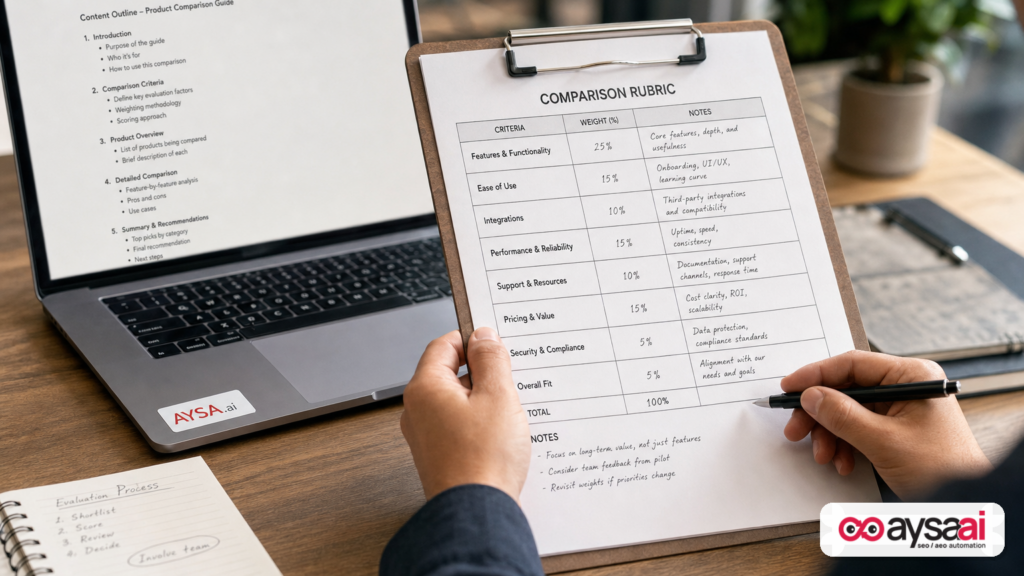
- Use a comparison rubric (criteria + weights + evidence) and publish it.
- Make every list item actionable: best for X, not “best overall.”
- Build distribution: email, partners, YouTube creators, sales teams, and PR—not just Google.
- Improve what you already have before you publish more. Shipping better beats scaling faster.
Table of Contents

- Why Your Listicles and Comparisons “Stopped Working”
- What Changed: From “Ranking Assets” to “Decision Assets”
- Google Doesn’t Hate Listicles—It Hates Abuse
- The Modern Comparison Page: A “Buyer’s Proof System,” Not a Blog Post
- Roundups That Still Win: Curation, Community, and Compounding Distribution
- How Smaller Brands Use Comparisons to Steal Attention from Bigger Brands
- Trust Architecture: Disclosures, Methodology, and Evidence
- AI Search Reality: How LLMs and Shopping Agents Interpret Lists
- A Concrete SME Scenario: Local Clinic vs. Big Telehealth Brands
- How to Measure Success When Organic Sessions Aren’t the Whole Story
- What Can Go Wrong (And How to Avoid Self-Inflicted Penalties)
- A Practical 30–60 Day Action Plan
- Where AYSA Fits: Monitor, Recommend, Approve, Execute
- What to Do Next
- Sources and Further Reading
Why Your Listicles and Comparisons “Stopped Working”
When a business tells me “our roundups and versus pages collapsed,” there are usually three overlapping causes:
1) The content was built to rank, not to help
Old-school listicles often lead with generic claims (“best overall,” “top picks”) and bury the only thing buyers care about: fit. Fit requires tradeoffs, context, and specificity: best for small teams vs. enterprises, best for first-time buyers vs. power users, best for speed vs. control, best for budget vs. compliance.
2) The page has no proof system
If you can’t show how you evaluated products, why someone should trust the ranking, and what evidence supports the claims, search engines and readers converge on the same judgment: this is not reliable.
3) Distribution relied on one channel
A listicle that only exists to capture Google clicks is fragile. The strongest comparison assets are cross-channel: sales enablement, email, partner marketing, YouTube, communities, PR, and yes—search. The more channels that validate your list as useful, the more defensible it becomes.
Search Engine Journal’s Ask an SEO column makes a similar point: comparison content and list formats can still work when created for readers rather than rankings, and when used as part of a broader marketing plan rather than a “silver bullet.” (Source: Search Engine Journal)
What Changed: From “Ranking Assets” to “Decision Assets”
The biggest shift isn’t a single algorithm update. It’s the compound effect of:
- More aggressive quality enforcement against scaled or low-value content patterns.
- More SERP friction: richer results, shopping modules, AI answers, and fewer clicks for generic informational content.
- More competition: every niche now has AI-assisted publishing, which raises the baseline volume and lowers the baseline trust.
So the question becomes: what kind of list content deserves to exist now?
Answer: content that acts like a decision asset—something a buyer can use to make a purchase, a shortlist, or a next step. That’s a higher bar than “can we write 2,000 words with product names and H2s.”
In practice, decision assets share common traits:
- They reveal criteria and tradeoffs.
- They include first-hand inputs (testing notes, customer questions, implementation realities) when possible.
- They are updated and maintained, not published and forgotten.
- They are built to convert (to trial, demo, appointment, quote, or store visit), not just to “get traffic.”
Google Doesn’t Hate Listicles—It Hates Abuse
Businesses often interpret a Traffic Drop as “Google hates listicles” or “affiliate is dead.” That’s an oversimplification.
The more accurate view is: Google dislikes patterns that look designed to exploit ranking signals without delivering unique value. That can happen with any format, including guides, definitions, and even landing pages.
Google’s own Search Quality Rater Guidelines emphasize evaluating content quality and credibility, including reputation and the presence of satisfying, helpful information. (Primary reference: Google Search Essentials; and for broader evaluation context, Google’s rater guidelines are publicly available on Google’s site, but versions change—use the latest official copy when referencing.)
Listicles survive when they:
- Stay in the publisher’s area of expertise.
- Provide original framing, experience, or data.
- Help users complete a task (choose, compare, buy) rather than “consume content.”
The Modern Comparison Page: A “Buyer’s Proof System,” Not a Blog Post
If you publish a “Brand A vs Brand B” page today, treat it like a mini product evaluation report. Here’s what that looks like in practice.
Start with a rubric (and publish it)
A rubric is your criteria list plus the way you weigh tradeoffs. Example categories for a SaaS comparison:
- Time to first value (setup, onboarding)
- Core features tied to use-cases
- Integrations and ecosystem
- Pricing transparency and typical total cost
- Support model and SLAs
- Security/compliance (if relevant)
You do not need to pretend to be “perfectly objective.” You need to be honest about how you evaluated.
Make “best for” the spine of the page
Stop ranking everything 1–10 like a fantasy football list. Instead:
- Best for budget-sensitive teams
- Best for regulated industries
- Best for advanced workflows
- Best for beginners
This reduces bounce, increases trust, and creates natural internal-link targets to deeper pages (pricing, onboarding, case studies, docs).
Answer the real questions people ask sales and support
Comparison content becomes powerful when it reduces pre-sales friction. Examples:
- “Can I migrate from X?”
- “Will this work with Shopify/WordPress/Square?”
- “What happens if I cancel?”
- “Do you support HIPAA / SOC 2?” (only if true and documented)
Build conversion paths that match intent
A buyer reading “X vs Y” is often near a decision. Give them the next step that fits their risk level:
- Low-risk: checklist download, email course, calculator
- Medium-risk: interactive demo, pricing estimator, consultation
- High-commitment: quote request, assessment, onboarding call
Use structured markup carefully (but don’t worship it)
Schema won’t save a weak page, but it can help clarify entities and structure. Start with the basics that are appropriate for your content type and eligibility.
Use Google’s documentation to avoid spammy markup patterns: Structured data intro and Search appearance documentation.
Roundups That Still Win: Curation, Community, and Compounding Distribution
Roundups have a different job than comparisons. A roundup isn’t there to “rank for best SEO articles”—it’s there to save time, signal taste, and build an audience.
The most durable roundups operate like a media product:
- Consistency: weekly or monthly cadence
- Editorial voice: why each item matters
- Distribution engine: email list, social, community, partners
In the SEJ piece, examples like SEO Roundtable and SEOFOMO are referenced as proven roundup models that grow audiences by curating and distributing hand-selected content. The tactical takeaway for SMEs is not “become a publisher,” but “build a repeatable distribution asset.” (Search Engine Journal)
Roundups work when they’re a relationship, not a post
If you curate other people’s work, you create a reason for them to notice you, share you, and sometimes partner with you. That can lead to:
- Referral traffic
- Co-marketing
- Podcast invites
- Sales intros
Those outcomes don’t show up in a single “SEO traffic” chart, but they are often more valuable than rankings.
How Smaller Brands Use Comparisons to Steal Attention from Bigger Brands
If you’re not the category leader, comparisons are one of the few ethical ways to borrow attention from bigger brands—without pretending you have their Search volume.
The play: piggyback on existing demand, but earn your spot
In the SEJ source, one suggested strategy is partnering with creators (like YouTubers) who already rank for comparisons in your niche and adding your brand as an alternative. This can put you in front of shoppers who are already evaluating the big names—at the moment of intent. (Search Engine Journal)
My take: this is smart if you understand what you’re buying. You’re not buying “views.” You’re buying:
- Trust transfer
- Shortlisting
- Language alignment (how real buyers describe the problem)
What to insist on when working with creators
- Disclosure (paid, affiliate, gifted product)—protects everyone long-term
- Use-case match: don’t force-fit your product where it doesn’t belong
- Specific scenarios: “best for X” beats “best overall”
- Evergreen update agreement if the creator’s content is meant to last
Trust Architecture: Disclosures, Methodology, and Evidence
The biggest mistake list publishers make is thinking trust is a vibe. Trust is architecture.
Disclose incentives like a grown-up business
If a list includes affiliate links or sponsorships, say so clearly. Not in a footnote designed to be missed—up front in plain language. It’s better for users and safer for your brand.
Explain how you selected and evaluated items
Even a short methodology section changes how people read the page. It signals that you did work, not aggregation.
Use evidence you can stand behind
Evidence can include:
- Your own testing notes (even lightweight)
- Customer support questions (anonymized)
- Public documentation references (feature availability, pricing pages)
- Policies (returns, cancellations, onboarding timelines)
If you can’t verify it, label it as opinion, remove it, or source it.
AI Search Reality: How LLMs and Shopping Agents Interpret Lists
A lot of teams are panicking and trying to “optimize for AI” with superficial tactics: stuffing prompts into pages, rewriting headings, or chasing new acronyms.
Here’s the practical truth: AI systems tend to reward content that is easy to interpret as a set of claims with supporting context. Lists and comparisons can be excellent for this—if they are structured and grounded.
What AI-friendly list content actually looks like
- Clear entities: product/service names, audience, use-case
- Clear claims: “best for … because …”
- Constraints and caveats: who should not choose this option
- Freshness signals: updated dates, change logs (when appropriate)
What doesn’t work
- Unverifiable superlatives (“#1,” “best,” “leading”)
- Template-driven “top 10” pages with no lived experience
- Over-optimized intros written for algorithms, not humans
SEJ’s Ask an SEO also warns against using comparison content as an “SEO and AIO/GEO” silver bullet. The format is not the strategy. The user benefit is the strategy. (Search Engine Journal)
A Concrete SME Scenario: Local Clinic vs. Big Telehealth Brands
Let’s make this real.
Imagine a local clinic: physical therapy + sports injury rehab. They’re competing against big telehealth brands that dominate search demand. The clinic tried writing “Best physical therapy near me” blog posts and got nowhere. They also wrote a thin “Top 10 rehab programs” listicle that briefly ranked and then disappeared.
What actually works for the clinic
They create three decision assets:
- In-person PT vs telehealth PT: who should choose which, based on injury type, timeline, and goals.
- Dry needling vs massage vs exercise therapy: what it is, what it’s good for, risks, and typical timelines (no medical claims beyond what they can support).
- “Best for” list: best options for runners, desk workers, post-surgery patients—mapped to services they actually offer.
How they distribute it (the missing piece)
- Front desk shares the “which option is right for me” page when callers ask about telehealth.
- The clinic emails the comparison pages to leads who didn’t book after the first consultation.
- They collaborate with local trainers and gyms who link to the “in-person vs telehealth” explainer as a resource.
This is the point: for SMEs, comparisons are often sales enablement disguised as content. Even if organic traffic is modest, conversion impact can be meaningful.
How to Measure Success When Organic Sessions Aren’t the Whole Story
If you only evaluate listicles by organic sessions, you’ll kill assets that are quietly driving revenue.
Instead, measure in layers:
Layer 1: Business outcomes
- Lead submissions, calls, bookings, demo requests
- Assisted conversions (content touched before conversion)
- Sales cycle acceleration (fewer pre-sales questions, faster close)
Layer 2: Intent indicators
- Scroll depth / engagement events
- Clicks to pricing, product pages, booking
- Internal site searches after reading comparisons
Layer 3: Visibility indicators
- Impressions and query mix (Google Search Console)
- Indexing and crawl behavior
- Mentions and links from relevant sites (earned, not bought)
For Google Search Console basics, use Google’s primary documentation: Search Console documentation. For Analytics concepts, Google’s resources for Analytics/GA4 can provide event and conversion setup guidance (use the latest official docs in your implementation).
What Can Go Wrong (And How to Avoid Self-Inflicted Penalties)
Let’s be direct about failure modes that sink list content.
Scaled templates with no unique evaluation
If 200 pages share the same structure, the same claims, and the same “pros/cons” language, you are begging to be treated as low-value at scale.
Hidden conflicts of interest
Undisclosed incentives erode trust with readers and can become a reputational liability.
Over-claiming
“Best,” “#1,” “guaranteed,” “always”—these are credibility grenades unless you can support them with transparent methodology and legitimate evidence. In regulated verticals, over-claiming can become a legal problem, not just an SEO problem.
Publishing without maintenance
Lists go stale. Products change. Pricing changes. Policies change. Your content needs an update cadence and ownership, like any revenue asset.
A Practical 30–60 Day Action Plan
If you’re rebuilding your list and comparison strategy, here’s a pragmatic plan you can run without a massive team.
Days 1–7: Inventory and triage
- List every roundup, listicle, and comparison URL you have.
- Mark each page as: keep & improve, consolidate, redirect/retire.
- Identify which pages map to revenue (leads, sales, bookings).
Days 8–21: Upgrade 3 “money” decision assets
- Add a rubric and methodology.
- Rewrite intros for humans (what this helps you decide).
- Add “best for” sections and “not for” caveats.
- Build conversion paths aligned to intent.
- Add internal links to the next step: pricing, booking, demo, product detail.
Days 22–45: Build distribution and proof
- Turn one comparison into a short email series for leads.
- Create one partner version (a co-branded checklist or summary).
- Pitch one creator collaboration where you are an alternative option (only where you actually fit).
Days 46–60: Systematize maintenance
- Set an update cadence (e.g., quarterly for comparisons; monthly for roundups).
- Create an editorial QA checklist (disclosure, accuracy, broken links, pricing references).
- Assign an owner for each decision asset.
Where AYSA Fits: Monitor, Recommend, Approve, Execute
Most businesses don’t fail because they lack ideas. They fail because improvements don’t ship consistently. That’s the gap AYSA is built to close.
AYSA is an approved execution system for SEO/AEO/GEO work:
- Monitor: track visibility and performance signals across your site’s key pages and changes over time.
- Prepare: generate recommended updates—content improvements, internal linking opportunities, technical fixes, structured data checks—packaged as proposed changes.
- Ask for approval: you control what goes live (critical for regulated industries and brand risk).
- Execute: once approved, changes get implemented—reducing the “strategy-to-shipping” delay that kills most SEO programs.
If you want to see how AYSA approaches AI-era visibility and execution, start here:
How AYSA specifically helps with listicles and comparisons
- Find decaying assets: identify comparison pages losing impressions/clicks and prioritize fixes.
- Standardize quality: apply a consistent rubric, disclosure blocks, and section patterns across key pages without turning them into templates.
- Ship internal linking upgrades: ensure list pages route users (and crawlers) to the right money pages.
- Maintain freshness: monitor changes and prompt reviews so lists don’t rot.
The point isn’t to “do SEO faster.” It’s to create a system where the content you publish behaves like an owned asset—maintained, improved, and connected to revenue.
What to Do Next
- Pick one high-intent comparison page and rebuild it with a rubric, “best for” framing, and transparent disclosures.
- Turn two recurring sales/support questions into sections inside your comparison pages (with clear answers and caveats).
- Build one distribution loop: email nurture, partner handout, or creator collaboration.
- Define success metrics beyond sessions: assisted conversions, bookings, demo requests, quote requests.
- Operationalize updates: assign owners and a cadence so the assets stay accurate.
- Use an execution system so improvements ship: explore AYSA monitoring and AI search visibility.
Sources and Further Reading
- Search Engine Journal (Ask an SEO): Do Comparison Posts, Roundups & Listicles Still Have Any Value?
- Google Search Essentials
- Google: Introduction to structured data
- Google Search Console documentation
- Search Engine Journal: SEO category (context and related research leads)
- Search Engine Journal: AI Search category (research lead)
- Search Engine Journal: Google Updates / algorithm history (research lead)
Continue the AI search topic inside AYSA.
Use these pages to connect the article with AI SEO tools, AI visibility monitoring, AI Overviews and approved website execution.
Turn this topic into a website action plan.
Use these AYSA hubs to move from reading to technical fixes, AI visibility monitoring, research, glossary context and approval-first SEO execution.