
Why LLMs-Author.txt Won’t Fix Your Name Confusion (And What Actually Works In AI Search)
Google’s John Mueller says Google doesn’t use llms.txt or llms-author.txt—and “content-signal” directives don’t move crawlers either. If your name is shared with bigger entities, the solution isn’t a new text file. It’s entity clarity, authoritative mentions, and consistent brand signals that AI and search can trust.

In early 2026, a niche idea floated through SEO circles: if large language models are summarizing the web, maybe you can hand them a clean “who I am” file—something like llms-author.txt—and fix identity confusion, especially when your name matches other people or brands.
Google’s John Mueller responded to a question along those lines and, in plain language, poured cold water on the premise: Google doesn’t use llms.txt or llms-author.txt, and the “content-signal” directives being tested aren’t used by Google either. The bigger lesson isn’t just “don’t bother with this file.” It’s that the problem many people are trying to solve—being correctly identified, summarized, and recommended by AI systems—is fundamentally an entity and authority problem, not a missing technical directive.
From the AYSA.ai perspective, this is an important moment. We’re entering an era where the costs of chasing “AI SEO hacks” are real: wasted engineering time, accidental Crawling/Indexing mistakes, and years of maintenance debt. Meanwhile, the actions that actually move the needle are unglamorous: consistent identity signals, credible mentions, unambiguous bios, structured pages, and a deliberate plan to earn the kind of citations AI systems can trust.
Concise summary
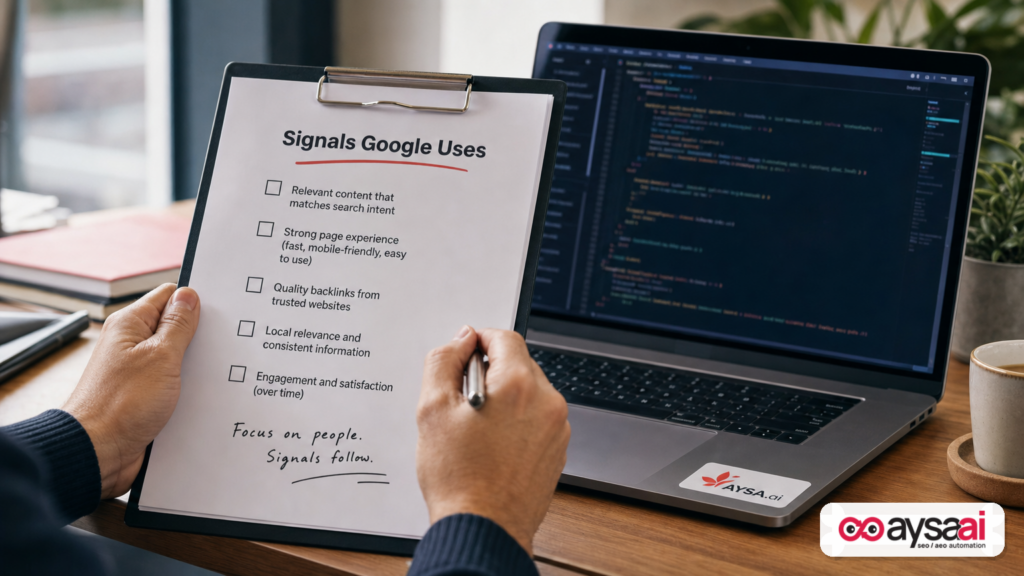
- Google does not use
llms.txtorllms-author.txt, according to John Mueller, and “content-signal” robots directives aren’t used by Google crawlers either. - If you share a name with other entities, the fix is Entity disambiguation: consistent, verifiable signals across your site and the broader web.
- For AI Overviews, chatbots, and LLM-driven discovery, the win is rarely a new header or file; it’s clear content structure + proof + distribution (mentions, interviews, profiles, references).
- SMEs should build a system to monitor how they’re represented, prioritize changes, and execute safely—this is exactly where AYSA fits: monitor, prepare, ask for approval, execute accepted website changes.
Table of contents

- What Google Actually Said About llms-author.txt (And Why It Matters)
- Why These “AI Control Files” Keep Appearing
- The Real Problem: Entity Confusion, Not A Missing File
- How AI Systems Decide “Who You Are” (In Plain English)
- What Actually Influences AI Summaries And Citations
- What To Avoid: The Technical SEO Trap
- Your On-Site Foundation: The Pages That Do The Heavy Lifting
- Off-Site Proof: Mentions, Profiles, And Why “Known On The Web” Still Wins
- A Practical SME Scenario: The “Same Name” Problem In The Wild
- What Agencies Should Rethink In The AI Search Era
- What To Monitor (Because AI Visibility Is A Moving Target)
- Where AYSA.ai Fits: Monitoring + Approved Execution For AI Search
- What To Do Next: A No-Nonsense Action List
- Sources And Further Reading
What Google Actually Said About llms-author.txt (And Why It Matters)

The catalyst here is a Search Engine Journal report about John Mueller responding to a question from a Redditor who tried to separate their identity from other people/brands with the same name by doing two things:
- Publishing an
llms-author.txtfile (separate from a mainllms.txtidea) describing job title, agency, location, and practice area in plain sentences. - Adding a “Content-Signal” directive (e.g.,
ai-train=no, search=yes, ai-input=yes) toRobots.txt, partly to test whether declared intent changes anything measurable.
Mueller’s response, as quoted in the SEJ piece, is direct:
- Google doesn’t use
llms.txtorllms-author.txt. - He’s not aware of other major crawlers/LLMs publicly confirming they use them (outside of some SEO tools).
- “Content-signal” robots directives are not used by crawlers/LLMs he’s aware of; it was proposed by a CDN and has no effect for Google. Unsupported directives are ignored.
Read the reporting here: Search Engine Journal: Google Answers Question About LLMs-Author.txt For SEO.
Why this matters: it gives business owners and marketers permission to stop treating experimental “AI files” as a must-do tactic. If Google isn’t consuming the directive, it’s not a lever. And if your goal is to be correctly represented by AI systems, you’re better served by building signals that are already known to matter: content clarity, Structured data where appropriate, and authority signals across the web.
Why These “AI Control Files” Keep Appearing
Every major platform shift spawns a rush of unofficial standards:
- They promise a simple mechanism to control complex systems.
- They are easy to implement, which makes them attractive for “quick wins.”
- They spread quickly because they’re plausible: LLMs read text, so why not give them a special text file?
There’s also a practical pain underneath the hype: people are seeing AI-generated answers that confuse them with someone else, cite outdated sources, or blend multiple entities. That’s real, and it’s expensive—especially if you sell services based on personal credibility (clinics, attorneys, consultants, agency owners) or if you operate a multi-location business where accuracy determines calls, bookings, and trust.
The temptation is to find a technical override. But search and AI systems rarely work like that. They behave more like “confidence engines.” If the web’s signals about you are mixed, the system’s output will be mixed.
The Real Problem: Entity Confusion, Not A Missing File
Let’s translate the “same name” issue into something any business owner understands.
If three different entities share the same name—say, a local consultant, a famous athlete, and a company—then the web contains multiple clusters of information under that label. When a model or search feature tries to summarize “who is this,” it has to decide which cluster you mean.
That decision is not made because you created a clever file. It’s made because the system sees repeated, corroborating signals that connect:
- a name
- to a profession/service category
- to a location/service area
- to an organization (company)
- to evidence (mentions, citations, profiles, interviews, awards, publications)
In other words: if you want AI to “pick you,” you need to become the most distinct and validated version of that name online.
This is why the SEJ article’s concluding angle is so important: the Redditor’s solution may not be Technical SEO. It’s broader digital footprint building—being referenced in places that matter.
How AI Systems Decide “Who You Are” (In Plain English)
Without speculating about any specific model’s proprietary internals, we can still describe the practical reality:
- Search engines are heavily influenced by crawlable content, indexing, links, and structured data. For identity, they also lean on consistent on-site signals and corroboration elsewhere.
- LLM-based assistants often rely on a mix of training data, retrieval from the web, and/or licensed or curated sources. When they retrieve, they still need “decidable” content: explicit statements with corroboration.
If the system sees multiple versions of “you,” it will either:
- pick the most authoritative cluster (often the bigger brand/person),
- blend clusters (the dangerous one), or
- avoid specifics (“I’m not sure which one you mean”).
The business goal is to reduce ambiguity. That means providing explicit identity statements and making sure they’re repeated consistently in the places machines tend to trust.
What Actually Influences AI Summaries And Citations
Here’s the practical framework I recommend for SMEs and agencies in 2026: focus on signals that are (a) durable and (b) independently confirmable.
1) Clarity beats cleverness
AI systems do not reward ambiguity. They reward explicitness.
- Use a consistent “identity string” across your site: Name + role + company + city/region + specialty.
- Repeat it in the places that matter: author bio, About page, contact page, footer, and relevant service pages.
- Write like you want to be quoted. Because increasingly, you will be.
2) Proof beats self-assertion
A sentence that says “I’m the best” is weak. A sentence that says “Featured in X,” “Board certified,” “Speaker at Y,” “Cited by Z,” or “Published research in…” is stronger—provided it’s real and verifiable.
This is why off-site mentions and credible profiles matter so much in entity disambiguation.
3) Structure beats long-form rambling
Long-form content is still valuable, but it needs structure so both humans and machines can extract meaning. For AI-facing content, structure is not “for SEO.” It’s for comprehension.
- Put the answer first, then detail.
- Use headings that match user intent (“What we do,” “Who we serve,” “Where we operate,” “Credentials,” “Pricing model,” “Policies”).
- Use FAQs where appropriate, but keep them factual.
4) Corroboration beats isolation
If your site is the only place that claims a fact, AI may treat it as less reliable than a fact repeated elsewhere. This is one reason Reddit, forums, and third-party reviews can appear so prominently in AI answers: they provide independent corroboration (even if imperfect).
5) Consistency beats one-time campaigns
Identity is not a one-week fix. A “same name” collision doesn’t disappear because you shipped a file. It fades because the web becomes saturated with consistent, corroborating signals about your entity.
What To Avoid: The Technical SEO Trap
Technical SEO matters. But it’s easy to misuse it as a coping mechanism when the real work is brand building and clarity.
Here are the common traps I see SMEs and even sophisticated teams fall into:
Trap #1: Adding unsupported directives to robots.txt and hoping for policy enforcement
Robots directives work only when crawlers choose to support them. If the directive isn’t recognized, it’s ignored. Mueller’s point (as reported by SEJ) is a reminder: adding bloat creates maintenance risk without guaranteed benefit.
Trap #2: Believing schema alone will fix identity
Structured data is helpful, but it doesn’t override the web. If the broader web strongly associates a name with a different entity, schema on your site is only one signal among many.
Trap #3: Treating a new file format as a shortcut to authority
Even if a future standard emerges, you still won’t “declare your way” into being the correct answer. AI systems will always weigh corroboration and reliability.
Trap #4: Creating long-term maintenance debt for short-term comfort
Every extra rule and file becomes a liability:
- It can be forgotten during redesigns.
- It can conflict with other directives.
- It can be misconfigured by well-meaning devs.
SMEs can’t afford brittle systems. Build the durable foundation first.
Your On-Site Foundation: The Pages That Do The Heavy Lifting
If you want to be the “correct” entity for your name, your website must be unambiguous. Not “optimized.” Unambiguous.
Here’s the on-site blueprint I recommend for most SMEs and personal brands:
1) A real About page (not a vibe statement)
Your About page should answer, explicitly:
- Who are you?
- What do you do (category + specialty)?
- Where do you do it (city/region/service area)?
- What should people trust (credentials, years in business, licenses, memberships)?
- How can someone verify (links to profiles, publications, interviews)?
2) A dedicated bio page for the person (if the person is the brand)
If your business depends on a practitioner (doctor, therapist, lawyer, consultant, agency owner), create a dedicated page that is linkable and consistent. Include:
- Full name (and middle initial if used professionally)
- Current role and organization
- Location
- Areas of practice
- Education, certifications, licensing (where relevant)
- Media and speaking
3) Contact page with consistent NAP signals (where relevant)
For local and multi-location businesses, inconsistent address/phone data creates confusion that spills into AI summaries. Keep it consistent, and make it easy to parse.
4) Author attribution that’s consistent across content
If content is authored by a person, link the author name to that person’s bio page. Avoid multiple “versions” of the same author name (e.g., “Mike D.” on one page and “Michael Dosinescu” on another). Consistency is a signal.
5) Service pages that clearly define scope
Identity confusion often happens because the web doesn’t have crisp boundaries. Your service pages should make it hard to misunderstand what you do.
- Who the service is for
- What problems it solves
- What you do not do (optional, but powerful)
- Location/service area
6) Use structured data as reinforcement, not as a crutch
Structured data can help clarify relationships (person ↔ organization ↔ location), but treat it as reinforcement. If you’re relying on schema to communicate basic facts that aren’t clearly stated in the visible content, you’re already behind.
Off-Site Proof: Mentions, Profiles, And Why “Known On The Web” Still Wins
The SEJ story highlights a key reality: identity is diluted because the web contains other entities with your same name, and those entities may be more popular or better documented.
So what do you do? You build a bigger, clearer footprint.
1) Build and standardize credible profiles
This depends on your industry, but the principle is the same: choose reputable platforms your customers (and the web) already trust, and make your identity string consistent.
If you’re a local service business, that might include major business directories and review platforms. If you’re a professional, it may include industry directories and associations. If you’re a founder, it may include a professional profile page and podcasts/interviews.
Be careful: don’t spray into low-quality directories. You’re trying to create corroboration, not noise.
2) Earn mentions that explain who you are in context
A mention that says “Alex Kim spoke at the Austin PT Summit on sports rehab” is far more useful than a mention that just lists your name.
This is where classic PR, partnerships, and guest expertise (podcasts, webinars, industry roundups) help in the AI era. They create contextual disambiguation.
3) Think beyond links: context-rich citations
Links are still valuable, but in the AI discovery era, context-rich citations and mentions matter because they give systems the “who/what/where” frame that reduces confusion.
4) Don’t assume there’s a single “ultimate” source
Some people default to “I need a Wikipedia page.” For most SMEs, that’s not realistic, and it’s not required. What’s required is a network of reputable references that reinforce the same identity details.
A Practical SME Scenario: The “Same Name” Problem In The Wild
Let’s make this real with a scenario I see constantly.
Scenario: A physical therapy clinic in Austin is led by a practitioner named “Jordan Lee.” Unfortunately, there’s also a well-known fitness influencer named Jordan Lee and a Jordan Lee who is a professor with many publications. When someone searches “Jordan Lee Austin physical therapy,” results are mixed. When an AI assistant is asked “Who is Jordan Lee in Austin?”, it sometimes blends the influencer bio with the therapist’s business details.
What doesn’t work:
- Publishing an unofficial
llms-author.txtfile and hoping models read it. - Stuffing extra directives into
robots.txtthat major crawlers don’t support. - Changing meta titles repeatedly and expecting the identity confusion to vanish.
What does work (practically):
- Create a dedicated practitioner page on the clinic website with a consistent identity string: “Jordan Lee, DPT — Sports Rehab Physical Therapist — Austin, TX — [Clinic Name].”
- Link every authored article and FAQ that uses Jordan’s expertise back to that page.
- Get at least 5–10 context-rich mentions in local or industry-relevant places (podcasts, local news features, association directories, conference speaker pages) that include profession + city.
- Standardize profiles across key platforms with the same title, location, and clinic association.
- Monitor AI and search representations over time. When you see confusion, you fix the inputs that likely fed it (on-site clarity, off-site references, inconsistent profiles).
That’s not a hack. It’s an identity system.
What Agencies Should Rethink In The AI Search Era
Agencies are under pressure because clients increasingly ask, “How do we show up in AI answers?” And the market is full of shiny objects: new proposed standards, new headers, new “AI-friendly” checklists.
Here’s what I believe agencies should rethink:
1) Shift from keyword obsession to entity clarity
Keywords still matter, but identity confusion isn’t solved by more keyword targeting. It’s solved by reinforcing the correct entity graph: who/what/where/why trust.
2) Stop selling deliverables; sell outcomes and maintenance
A one-time “AI optimization package” is rarely sufficient. AI representations change because the web changes. Agencies should sell monitoring + iterative improvements.
3) Don’t lead with technical theater
Technical SEO is foundational (crawlability, indexability, performance). But adding unsupported directives is technical theater. If it doesn’t affect the systems that matter, it’s not strategy.
4) Execution quality is the differentiator now
The playbook is knowable. The hard part is implementing changes across dozens (or thousands) of pages without breaking things, and doing it consistently over time. This is why SEO is moving toward execution systems, not just audits.
What To Monitor (Because AI Visibility Is A Moving Target)
If you take one operational lesson from this conversation, make it this: you can’t improve what you don’t monitor.
SMEs should monitor three layers:
1) Search layer (classic SEO reality)
- Are brand queries returning the right entity?
- Are sitelinks and knowledge-like features pointing to the right pages?
- Are there confusing results that need to be countered with better content and mentions?
2) AI answer layer (representation)
- How do AI assistants describe your business or founder?
- Do they confuse you with another entity?
- Do they cite reputable sources or random forums?
3) Input layer (your controllable sources)
- Is your About/bio information consistent everywhere?
- Are there old pages, outdated bios, or inconsistent author names?
- Are your key profiles accurate and aligned?
This is exactly where tooling should help: detect drift, highlight inconsistencies, and propose specific fixes that a business can approve and apply without turning every improvement into a multi-week development cycle.
Where AYSA.ai Fits: Monitoring + Approved Execution For AI Search
At AYSA.ai, our philosophy is simple: monitor what the market is saying, prepare the changes that will improve your visibility and accuracy, ask for approval, then execute safely.
In the context of the “same name / wrong entity” problem, AYSA fits in four practical ways:
1) Monitoring for representation and drift
Identity issues aren’t one-and-done. You want a system that continuously checks whether your brand and key people are being represented accurately and whether important pages remain consistent. Learn more about our monitoring approach: AYSA Monitoring.
2) AI search visibility workflows, not just SEO checklists
AI visibility is increasingly about being the best-corroborated source. That means content structure, entity clarity, and distribution. See how we think about AI search visibility: AI Search Visibility.
3) Practical AI SEO tools that translate strategy into tasks
You don’t need ten speculative tactics. You need a prioritized plan that connects “wrong identity in AI answers” to “here are the exact pages and fields we should fix.” Explore the toolset: AI SEO Tools.
4) Approved execution: safe changes without chaos
The failure mode for many SMEs is execution: changes sit in docs, or they ship inconsistently. AYSA is designed to prepare website changes and request approval before executing—so you keep control while still moving fast. If you’re evaluating whether this model fits your team, pricing and packaging are here: AYSA Pricing.
If you want more practical editorials like this—focused on what actually works versus what’s trendy—you can also browse: AYSA Blog.
What To Do Next: A No-Nonsense Action List
If you’re dealing with name confusion or inaccurate AI summaries, here’s the action plan I’d use for an SME over the next 30–60 days. No hacks, no speculative directives.
1) Audit your identity string
- Decide the canonical format: Full name + role + company + location + specialty.
- Write it once, then reuse it consistently.
2) Fix your on-site “identity surfaces” first
- About page
- Bio page
- Contact page (and location pages)
- Author bylines and author pages
3) Reduce ambiguity with explicit statements
- Include “not affiliated with” language only if legally appropriate and truly needed—otherwise focus on positive clarity.
- Add a short “About [Name]” paragraph to key pages that get traffic.
4) Build corroboration with context-rich mentions
- Target a shortlist of reputable industry and local outlets.
- Pitch expertise-based contributions (interviews, Q&A, guest commentary).
- Make sure the mention includes profession + location (not just your name).
5) Standardize key third-party profiles
- Use the same name format, same title, same organization, same location.
- Link back to the canonical bio page on your site where possible.
6) Set up ongoing monitoring and iteration
- Track brand queries and “who is” queries.
- Periodically check AI answers for accuracy.
- When you see confusion, fix the inputs and repeat.
7) Avoid speculative technical work unless a crawler supports it
If you’re considering a new directive, header, or file format, ask one question: Which major systems have publicly documented support? If the answer is “unclear,” treat it as experimental—not foundational.
Sources And Further Reading
- Search Engine Journal — Google Answers Question About LLMs-Author.txt For SEO
- Search Engine Journal — SEO section (context and ongoing coverage)
- Search Engine Journal — News section
- Search Engine Journal — Google Algorithm Updates archive (background reference)
Note: The SEJ reporting references a “Content-Signal” concept tied to a CDN proposal and to Cloudflare’s “Markdown for Agents” behavior in certain contexts. In this editorial, I’ve intentionally focused on the business implication validated by Mueller’s statement (unsupported directives are ignored) rather than asserting broader adoption claims that would require primary documentation not included in the provided research context.
If you’re wrestling with accuracy in AI search—and you want a system that monitors, prepares changes, asks for approval, and executes the accepted fixes—start here:
Continue the AI search topic inside AYSA.
Use these pages to connect the article with AI SEO tools, AI visibility monitoring, AI Overviews and approved website execution.
Turn this topic into a website action plan.
Use these AYSA hubs to move from reading to technical fixes, AI visibility monitoring, research, glossary context and approval-first SEO execution.

