
Traffic Is Down. Influence Isn’t: The New SEO Measurement Playbook For AI Search
AI Overviews and AI-driven SERPs are breaking the 20-year habit of using organic clicks as the main measure of content success. Here’s a practical, business-first measurement system—plus an execution plan—to prove what’s working, protect revenue, and build visibility where customers actually decide.

By Marius Dosinescu (AYSA.ai)
Organic traffic is declining for a lot of competent businesses. The reflex is predictable: “Our AI content stopped working.” Or worse: “SEO is dead.”
Most of the time, the content didn’t suddenly become useless. The measurement system did.
AI Overviews, AI Mode-style experiences, and richer SERPs are changing where decisions happen. The search results page itself is now doing work that used to be done on your landing page. When the “destination” moves upstream, Clicks fall—even if your influence (and revenue) holds steady.
This editorial is a practical, business-first playbook for measuring what matters when clicks stop telling the truth. It’s based on industry reporting from Search Engine Journal and the wider research it surfaced, plus the operational reality I see with SMEs: you don’t get paid in sessions—you get paid in booked appointments, orders, qualified leads, renewals, and retention.
We’ll cover what changed, how to stop making bad decisions with outdated KPIs, and how to build a measurement system your CFO can accept. Then I’ll show where AYSA fits: Monitoring what AI Search says about you, preparing the right fixes, asking for approval, and executing accepted changes consistently—so you’re not stuck in analysis while competitors quietly win the new surfaces.
Concise Summary
AI-driven search is increasing “zero-click” behavior: more queries get answered on Google without a visit to your site. Search Engine Journal highlighted that this breaks the historic relationship between content value and traffic, and that clicks no longer reflect how many people saw, compared, or were influenced by your content—even when your pages are being referenced in AI experiences (SEJ source).
The fix isn’t to publish more AI content or panic-delete pages. The fix is to change measurement:
- Track influence signals (brand demand, direct traffic, conversion quality, repeat visits) alongside classic SEO metrics.
- Track AI-surface presence (where available) and treat it like an upper-funnel impression layer that alters Attribution.
- Use triangulation and correlation dashboards instead of a single KPI like “organic sessions.”
- Build content that provides an extra layer beyond the summary (tools, templates, interactive elements, proof), so clicks that do happen are worth more.
Key Takeaways (For Busy Operators)
- Traffic can go down while impact goes up. SERPs now answer more questions directly, especially for informational queries.
- Clicks are becoming a “late-stage” signal. Fewer people click, but those who do may be deeper in the decision cycle—so post-click behavior matters more.
- Stop judging content by sessions alone. Use a multi-signal scorecard: branded searches, direct visits, conversions, engagement depth, assisted revenue, and AI-surface presence when available.
- Don’t delete pages just because they lost clicks. Some pages still create demand and “memory” that shows up later as brand queries.
- Execution now beats strategy decks. The winners will be the teams who monitor changes weekly and ship improvements reliably.
Table of Contents

- What Changed: Search Results Became The Destination
- Why The Old SEO Metrics Broke
- What “Failed Content” Often Is Now
- The Metric Reset: From Clicks To Influence Signals
- A Practical Dashboard Blueprint (That Your CFO Will Accept)
- Where AI Search Hits Hardest (And Where It Doesn’t)
- How To Earn The Click When The Summary Is Free
- SME Scenario: A Local Clinic Losing Traffic But Booking More Patients
- What Agencies Must Rethink (Before Clients Fire Them)
- Where AYSA Fits: Monitoring → Preparation → Approval → Execution
- The 30–90 Day Action Plan
- What To Do Next (Checklist)
- Sources And Further Reading
What Changed: Search Results Became The Destination
For two decades, the web ran on a simple bargain:
- Publish the best page.
- Rank well.
- Earn the click.
- Convert.
That model depended on a stable assumption: the SERP was a gateway, not the final product.
In 2026, that assumption is increasingly false. Search Engine Journal’s reporting frames the core issue clearly: teams are scrapping content that may still be working because the goal post moved. Clicks dropped, but that doesn’t automatically mean value dropped (SEJ).
The mechanism is straightforward:
- AI summaries absorb the “quick answer” intent. The user gets what they came for without leaving the SERP.
- SERPs are richer and more comparative. People scroll, cross-check, and decide before they ever click.
- Attribution shifts upstream. Influence happens without a measurable session.
SEJ cited research indicating a rising share of searches end without a click (via SparkToro) and that AI Overviews correlate with reduced click-through (via Ahrefs). Those specifics are worth reading in the original SEJ piece because the key operational takeaway is not the exact percentage—it’s that zero-click is not a rounding error anymore.
Why The Old SEO Metrics Broke
Many businesses still run SEO like it’s 2016:
- Primary KPI: organic sessions
- Secondary KPI: rankings
- Proof: “we grew traffic”
That was never perfect, but it was directionally reliable. If your content helped people, Google sent you visits. If it didn’t, you didn’t get the visits. So traffic became a proxy for usefulness.
SEJ’s core argument is that the proxy is breaking. Not because analytics tools are “wrong,” but because they can’t see what the SERP is doing with your work. Google Search Console (GSC) still reports clicks, impressions, and average position—but not in a way that cleanly distinguishes classic results from AI-powered surfaces in the main performance view. SEJ notes that as AI expands its link options without giving websites clear visibility into how they appear, attribution gets messy (SEJ).
As a result, two different realities can produce the same chart:
- Reality A: You lost relevance. Rankings dropped. Competitors outranked you. Your page is genuinely less useful.
- Reality B: You’re still relevant, but clicks are being intercepted. Users read an AI summary, compare options, and proceed without a site visit—or click later when they’re ready.
If you respond to Reality B as if it’s Reality A, you’ll make expensive mistakes:
- Deleting pages that still create demand
- Over-optimizing for CTR at the cost of clarity
- Publishing more “SEO blog posts” when you actually need conversion layers and proof
- Declaring the channel dead and reallocating budget to less efficient acquisition
None of that is theoretical. It shows up in weekly calls as “Our traffic is down; should we cut content?” When your measurement is broken, your decisions become broken too.
What “Failed Content” Often Is Now
In the AI SERP era, a page can do its job without producing the old “proof” (a click). Here are the most common roles content plays now—roles that your analytics may not credit properly.
1) The Citation Layer (Visibility Without Visits)
Your content may be used as a reference in AI answers. The user sees your brand or your facts, but never clicks.
You still gained something:
- Brand exposure at decision time
- Trust transfer (“this came from a source”)
- Future recall (“I saw them mentioned; I’ll search them later”)
You also lost something: the chance to pixel the visitor, retarget them, capture email, or move them through your own funnel.
2) The Comparison Trigger (The SERP Does The Reading For Them)
SEJ referenced research suggesting users slow down when AI Overviews appear: they scroll and evaluate options more carefully. That means your content may influence someone while they’re still “in Google.” If you only measure sessions, that influence looks like nothing.
3) The “Demand Creator” (Brand Searches Later)
Influence can show up later as:
- Branded queries
- Direct traffic
- Referral traffic from people sharing your name, not your URL
This is why SEJ suggests watching branded query volume and direct traffic as influence signals. These are imperfect, but they’re often the first place you’ll see the “ghost conversions” that AI SERPs create (SEJ).
4) The “Click Quality Filter” (Less Volume, More Intent)
When AI summaries remove low-intent clicks, the remaining clickers can be more serious. That means:
- traffic down
- conversion rate up
- lead quality up
In classic SEO reporting, that can look like failure because the top-line sessions chart is ugly. In business terms, it can be an upgrade.
The Metric Reset: From Clicks To Influence Signals
Here’s the new operating principle:
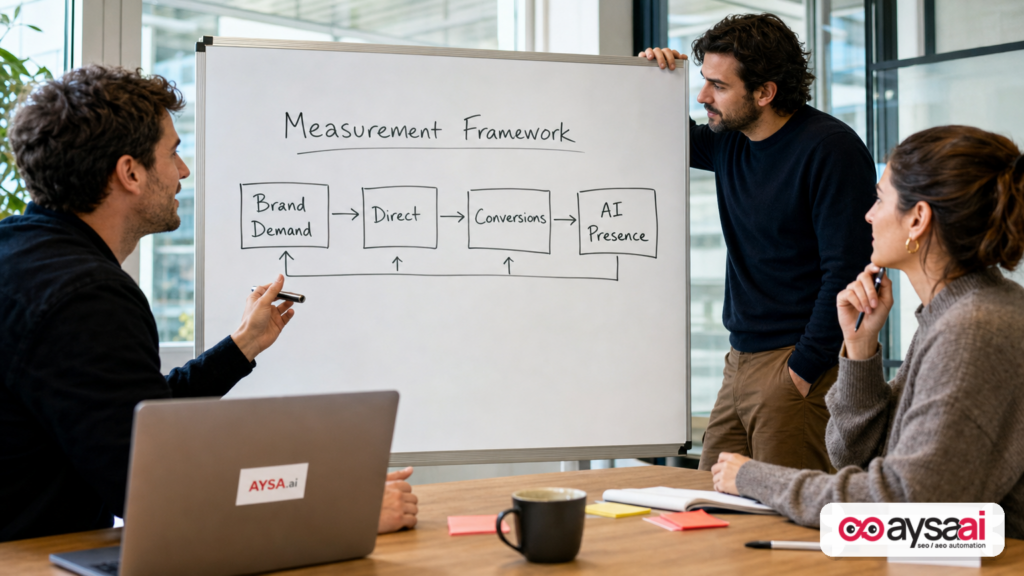
You don’t have one SEO funnel anymore. You have two.
- On-SERP funnel: impressions, AI answers, comparisons, shortlists, brand recall
- On-site funnel: sessions, engagement, conversion, revenue
If you only measure the on-site funnel, you’re blind to where much of the decision-making now happens.
So what should you measure?
Influence Signal #1: Branded Search Demand
When people see you in an AI answer and later type your brand name, that’s demand you created but didn’t immediately capture.
How to use it:
- Track branded queries over time in Google Search Console.
- Correlate spikes with publishing dates, PR moments, and major page updates.
- Segment by product line or location terms when possible (e.g., “Brand + city”).
Important: branded demand is influenced by many things (offline ads, word-of-mouth, seasonality). That’s why we use it as a signal, not a perfect attribution channel.
Influence Signal #2: Direct Traffic And Returning Users
Direct traffic can be messy (dark social, email apps, privacy features), but directionally it often rises when brand recall rises.
Returning users matter even more now. If the first interaction happens on the SERP, the second interaction may be the first measurable session.
Influence Signal #3: Conversion Quality And Post-Click Behavior
SEJ’s practical point is crucial: if fewer people click, those who do click may be further along. So you should measure what happens after the click:
- scroll depth / reading depth
- repeat visits
- newsletter signups
- demo requests / bookings
- add-to-cart and checkout completion
It is entirely rational for a page to “lose traffic” and “win revenue.” The more AI answers the basics, the more your site needs to win the decision.
Influence Signal #4: Presence In AI Surfaces (When Available)
SEJ mentions that when available, GSC’s generative reporting can show impressions for AI Overviews and AI Mode, but that clicks can be combined in ways that limit clean separation (SEJ).
Operational takeaway: treat AI impressions and AI visibility tracking as an upper funnel input, not a direct conversion line.
Triangulation Beats A Single KPI
SEJ references Rand Fishkin’s advice to build a correlation dashboard rather than a single traffic KPI. I agree with the premise: if you want one number, you’ll pick the wrong one.
What you want is a triangulation dashboard:
- Publishing / updates timeline
- Non-branded impressions and average position (context)
- Branded query trend (demand)
- Direct traffic and returning users (memory)
- Conversions and conversion rate (outcome)
This isn’t softer; it’s more honest.
A Practical Dashboard Blueprint (That Your CFO Will Accept)
CFOs don’t hate SEO. They hate unfalsifiable SEO.
In the AI SERP era, you can’t pretend to have perfect attribution. But you can still build a reporting framework that aligns with finance expectations: leading indicators, lagging indicators, and a clear narrative of cause-and-effect—without inventing precision you don’t have.
Layer 1: Business Outcomes (Lagging Indicators)
This is the section that keeps budgets alive:
- Revenue from organic (where measurable)
- Leads / bookings from organic
- Trials / demos / signups from organic
- Organic conversion rate and assisted conversions (if your analytics setup supports it)
Even if traffic falls, outcomes can stay stable or improve. That is the story you must be able to tell.
Layer 2: Demand And Brand (Leading Indicators)
- Branded search trend
- Direct traffic trend
- Returning users trend
- Email list growth (if content is used to capture subscribers)
These are your “influence receipts.” Not perfect, but hard to fake over time.
Layer 3: Distribution Reality (Context Indicators)
- GSC impressions and average position for key topics
- Query mix shifts (informational vs. transactional)
- AI-surface impressions where available
This layer explains why clicks changed, without over-assigning blame to the content team.
Layer 4: Content Quality And Efficiency (Operator Indicators)
- Top pages by conversion rate, not just sessions
- Engagement depth by intent type
- Content refresh velocity (how quickly you update what matters)
- Technical health checks that protect crawling and indexing
This layer is where teams actually improve performance.
How To Explain “Traffic Down, Revenue Flat” Without Sounding Defensive
Use a three-part explanation:
- Distribution changed. AI experiences answer more questions in the SERP, reducing click volume (see SEJ’s synthesis: Read the source article on searchenginejournal.com).
- Click quality increased. The people who still click are more qualified; conversion rate is up or stable.
- We’re optimizing for outcomes. We’re adding proof layers and conversion paths so each click is worth more.
That’s not spin. It’s aligning measurement to customer behavior.
Where AI Search Hits Hardest (And Where It Doesn’t)
Not all queries are equally affected. SEJ’s analysis points out that AI Overviews tend to handle informational and research queries, while branded, local, and high-intent transactional searches often remain more resilient.
Here’s how I think about it operationally.
Informational / Research Queries: Highest “Summary Risk”
Examples:
- “how to choose a standing desk”
- “what is VAT in Romania”
- “best time to visit Paris”
If your page’s primary value is a clean explanation, AI can compress that value into an answer. You’ll likely see impression growth without proportional clicks.
Response: add “second-layer” value (tools, templates, calculators, comparison tables, original testing, video walkthroughs).
Commercial Investigation: Mixed Risk, But Big Opportunity
Examples:
- “best email marketing software for clinics”
- “Shopify vs WooCommerce for small catalog”
- “best running shoes for flat feet”
These terms are vulnerable because summaries can be “good enough.” SEJ mentions that buying guides and “best of” pages are impacted in ecommerce.
Response: the businesses that win will provide things AI can’t reliably generate from public text alone—real testing, inventories, pricing nuance, warranties, availability, shipping times, and clear differentiation.
Transactional Queries: Lower Risk (For Now)
Examples:
- “book dentist appointment near me”
- “buy X product size Y”
- “hotel in Austin with parking”
Even if AI assists the journey, users still need to transact somewhere. Your job is to be the best “final destination.”
Publishers: The Hardest Hit
SEJ calls out the publisher problem directly: influence doesn’t pay salaries when ad revenue depends on pageviews.
My POV: publishers need to diversify measurement and monetization faster than any other category:
- subscriptions / memberships
- apps and direct audiences
- events / courses
- high-intent newsletters
That’s outside the scope of this editorial, but the measurement principles are the same: less obsession with raw sessions; more emphasis on loyal audience and conversion actions.
How To Earn The Click When The Summary Is Free
When a user sees an AI summary, the “why click?” question becomes brutal.
SEJ relays a practical observation: if someone clicks through and finds the same summary they already saw, they may bounce. So the page needs an additional layer that AI can’t produce from your existing text.
Here are concrete patterns that work for SMEs.
Pattern 1: Add A Proof Layer
Examples:
- Original photos and video demonstrations (not stock)
- Before/after, case study structure, measured outcomes (only if you can substantiate)
- Pricing examples and what changes the price
- FAQ based on real customer calls
AI can summarize claims. It struggles to replace credible proof and specificity.
Pattern 2: Add An Interactive Layer
Examples:
- Calculator: “Estimate your shipping cost”
- Configurator: “Build your plan”
- Quiz: “Which product fits your situation?”
- Downloadable checklist or template
The goal is simple: give the click a reason to exist.
Pattern 3: Add A Decision Layer
Most content stops at education. Decision content helps people choose.
Examples:
- “Who this is for / not for” sections
- Comparison tables with real constraints and trade-offs
- “What to do next” steps with timelines and cost ranges
Decision layers increase conversion rate even when traffic is flat.
Pattern 4: Create Memory, Not Just Answers
SEJ notes that memorable content can inspire branded searches later. I’ll make that more operational:
- Have a point of view.
- Give names to frameworks.
- Use clear examples from the real world.
- Stop writing like a glossary.
In an AI summary world, “being correct” is baseline. Being remembered is a moat.
The SME Scenario: A Local Clinic Losing Traffic But Booking More Patients
Let’s make this real.
Imagine a local clinic that publishes a strong guide: “What to expect during a root canal.” For years, that page brought in steady traffic and a predictable number of new patient bookings.
Then AI Overviews expand. People search “root canal pain how long” and get an AI summary right on the SERP. The clinic’s organic sessions drop 35% on that page in three months.
The clinic owner panics:
- “The content stopped working.”
- “SEO is a waste.”
- “Let’s delete it and write new AI articles.”
But a proper measurement review shows:
- Bookings from organic are flat. Fewer visits, same appointments.
- Conversion rate is up. The people who do click now are ready to call.
- Branded searches increased. More people search the clinic name + “root canal.”
- Direct traffic is up slightly. People type the URL after seeing the brand referenced elsewhere.
What changed is not the clinic’s expertise. It’s where the early-stage education happens.
So the clinic upgrades the page:
- Add a short video: “3 signs you should call us today.”
- Add a downloadable checklist: “Root canal prep + aftercare.”
- Add clear next steps: insurance, scheduling, emergency policy.
Result: the page may never return to its old traffic peak. But it becomes a conversion asset, not a traffic trophy.
What Agencies Must Rethink (Before Clients Fire Them)
Agencies are caught in the middle of the KPI reset. Clients still want “more traffic.” CFOs still want “attribution.” And the SERP is increasingly taking credit for work the brand produced.
If you run an agency, here’s what will break first if you don’t adapt.
Risk 1: Reporting That Over-Promises Precision
When you present click-based KPIs as if they reflect total search impact, you create a trust gap. Clients will feel you’re either hiding something or losing control.
Fix: replace “organic traffic” as the North Star with a business outcome scorecard, supported by influence signals. Set that expectation explicitly.
Risk 2: Content Calendars That Ignore Click Interception
Publishing ten more top-of-funnel explainers may increase impressions but not business outcomes.
Fix: allocate content into three buckets:
- Demand creation (influence)
- Decision content (conversion)
- Retention/support content (reduces churn and support load)
Risk 3: Execution Bottlenecks
AI search changes quickly. If it takes you six weeks to implement schema, refresh a page, or fix location data, you are effectively choosing to lose.
Fix: build an approved-execution motion where monitoring leads to prepared changes, approvals happen fast, and execution is consistent. This is exactly the category of operational pain AYSA is built to solve.
Where AYSA Fits: Monitoring → Preparation → Approval → Execution
The AI era creates two new problems for SMEs:
- Measurement complexity: you need more signals and a clearer narrative.
- Execution velocity: you need to ship improvements continuously, not quarterly.
AYSA is designed as an execution system for SEO/AEO/GEO work: it monitors, prepares the right changes, asks for your approval, then executes accepted website changes.
Here’s how that maps to the playbook in this editorial:
1) Monitor The New Reality (Not Just Rankings)
- Track the pages and topics that matter to revenue.
- Watch for visibility shifts and content decay signals.
- Use a consistent monitoring cadence so you don’t overreact to weekly noise.
Start here: AYSA Monitoring
2) Track AI Search Visibility As A First-Class Surface
If classic SEO is “rank and click,” AI-era SEO includes “be referenced and remembered.” AYSA’s AI visibility focus is built to help businesses understand how they show up in AI-driven search experiences and where inputs need to be corrected or strengthened.
Explore: AYSA AI Search Visibility
3) Prepare And Implement The Fixes That Actually Move Outcomes
Measurement alone doesn’t save you. Execution does.
Most businesses need a mix of:
- content layering (proof, interactive elements, decision sections)
- internal linking improvements (so authority flows to money pages)
- structured data/schema where appropriate
- technical hygiene (indexing and crawl efficiency)
See capabilities: AYSA AI SEO Tools
4) Approved Execution: How SMEs Avoid “Unauthorized SEO”
AI tools can propose dozens of changes. That’s dangerous without governance. AYSA’s model is simple: prepare improvements, request approval, execute only what’s accepted.
This is critical for regulated or brand-sensitive industries (clinics, finance, legal, enterprise SaaS), and it’s just as valuable for small ecommerce shops that can’t afford accidental template edits.
5) Operate With A Clear Cost Model
When clicks are volatile, you need predictable operating costs. If you’re evaluating how to run SEO/AEO with accountability, see: AYSA Pricing
More practical playbooks
We publish additional execution-focused guidance at: AYSA Blog
The 30–90 Day Action Plan
If your organic traffic is down and you suspect AI Overviews or AI SERP changes are involved, here’s a plan that avoids panic and produces clarity.
Days 1–7: Diagnose Without Blame
- Segment pages by intent: informational, commercial investigation, transactional, branded.
- Identify the “traffic down” cohort and compare conversion rate and assisted outcomes.
- Pull branded query trends in GSC and compare to the same period last year (seasonality matters).
- Review direct traffic and returning users in your analytics tool (e.g., GA4), but treat as directional.
Days 8–30: Upgrade The Pages That Still Influence Decisions
- Do not delete yet. First, determine whether the page still supports conversions or brand demand.
- Add a “second layer” to top informational pages: tools, downloads, or decision sections.
- Strengthen internal links from high-impression pages to high-intent pages.
- Improve on-page conversion paths (book now, get a quote, compare plans) so fewer clicks still mean sufficient pipeline.
Days 31–90: Build The Measurement System You’ll Use All Year
- Build a correlation dashboard (publishing timeline + branded demand + conversions).
- Define new KPIs by role: exec KPIs (outcomes), marketing KPIs (demand + conversion quality), SEO KPIs (visibility + technical health).
- Create a refresh cadence for your top 20 revenue-impact pages.
- Operationalize execution so improvements ship weekly, not quarterly.
If you want that execution loop automated and governed, that’s where AYSA fits: monitoring, preparing changes, getting approval, and executing consistently.
What To Do Next (Checklist)
- Replace your “SEO success = traffic” dashboard with a multi-signal scorecard.
- Identify which pages lost clicks but gained conversion rate—protect and upgrade them.
- Track branded query volume and direct traffic as influence signals (not perfect attribution).
- Add a second layer (proof/interactive/decision content) to pages vulnerable to AI summaries.
- Stop deleting pages based solely on sessions—evaluate their influence and conversion role.
- Adopt an execution system that ships improvements continuously (monitor → prepare → approve → execute).
- Explore AYSA resources: AI Search Visibility, Monitoring, Tools, Pricing, Blog.
Sources And Further Reading
- Search Engine Journal: AI Content Didn’t Stop Working, Your Metrics Did
- Search Engine Journal (SEO section): SEO coverage and context
- Search Engine Journal (On-Page SEO): On-page SEO strategy
- Search Engine Journal (Technical SEO): Technical SEO strategy
- Search Engine Journal (Local SEO): Local SEO strategy
- Search Engine Journal (Google algorithm updates hub): Google algorithm updates history
Note on citations: The SEJ article references additional third-party research (e.g., SparkToro, Ahrefs, Seer Interactive, GWI, and academic experiments). Those primary links were not provided in the supplied research context, so I’m not directly linking to them here. Where you need exact numbers for board reporting, rely on the primary sources and your own data.
Continue the AI search topic inside AYSA.
Use these pages to connect the article with AI SEO tools, AI visibility monitoring, AI Overviews and approved website execution.
Turn this topic into a website action plan.
Use these AYSA hubs to move from reading to technical fixes, AI visibility monitoring, research, glossary context and approval-first SEO execution.

