Local AI For SEO: What To Run On-Device, What To Keep In The Cloud, And How To Build A Practical Hybrid Stack
Frontier models are powerful—but expensive, slow, and risky when you ship sensitive data. Here’s a practical blueprint for moving the right SEO workloads onto local compute (browser/desktop), reserving cloud LLMs for judgment calls, and using approved execution to turn insights into safe, measurable site changes.

There’s a quiet mistake happening in SEO teams right now: we’re treating every problem as if the only credible answer is a frontier model in the cloud.
That mindset is understandable. Frontier LLMs are impressive, easy to access, and they can make a messy pile of signals sound coherent. But it’s also a costly habit—financially, operationally, and strategically. It increases your dependency on services you don’t control, creates privacy headaches, and encourages “AI everywhere” architectures where deterministic work gets done in probabilistic ways.
A better mental model is emerging: do the exact work with code, do the lightweight interpretation locally (on-device), and reserve big-cloud AI for the few moments where real judgment is needed. Search Engine Journal recently published a useful field experiment exploring how far you can push local compute for SEO tasks using Chrome’s built-in small model (Gemini Nano) inside a browser extension environment. It’s a practical prompt for a bigger discussion: what should your SEO stack look like when compute costs rise, privacy expectations tighten, and AI Search changes what “optimization” even means?
This editorial is my take—through an AYSA.ai lens—on how to build a hybrid SEO Automation system that’s efficient, safer, and more resilient than “send everything to ChatGPT.” We’ll cover what changed, why it matters for SMEs and agencies, where local AI fits, what can go wrong, and how Approved Execution turns analysis into improvements you can actually ship.
Concise Summary

- Local AI won’t replace frontier models—but it can remove a surprising amount of friction from SEO operations when used for the right tasks.
- The most reliable architecture is three-layer: deterministic code for facts, a small local model for summarization/communication, and a frontier model only for high-judgment reasoning.
- The biggest risk in “LLM for everything” is probabilistic answers to deterministic questions (status codes, canonicals, redirects, DOM differences, etc.).
- SMEs should prioritize privacy, cost control, speed, and continuity (tools still work even if an API is down or pricing shifts).
- AYSA fits this future as an approved SEO/AEO/GEO execution system: monitor, prepare changes, request approval, then execute and measure.
Key Takeaways (What To Remember)

- Small models are best as “translators,” not judges. Let them turn evidence into plain English, not final decisions that could break pages.
- Deterministic first. If a script can answer it exactly, don’t ask a model.
- Hybrid beats ideological. You want the right compute in the right place, not a philosophical commitment to local-only or cloud-only.
- Execution is the bottleneck. Insights don’t move rankings; shipped improvements do—safely, with approval and measurement.
Table of Contents
- What Changed: Why Local Compute Is Suddenly A Serious SEO Topic
- The Real Question: “How Much SEO Work Can Move Closer To The User?”
- Local AI vs Frontier Models: Tradeoffs Business Owners Actually Feel
- The Three-Layer Architecture That Actually Works (Code → Local Model → Frontier Model)
- What Local AI Is Good At In SEO (And What It’s Not)
- “Small Task” Doesn’t Mean “Easy Task”: The Reasoning Trap
- Practical Hybrid Workflows You Can Implement This Quarter
- SME Scenario: A Local Clinic That Can’t Ship Sensitive Context To The Cloud
- What Agencies Should Rethink: Packaging, Margins, And Reliability
- What To Monitor In 2026–2027: Beyond Rankings
- Where AYSA Fits: Approved Execution For SEO, AEO, And GEO
- What To Do Next: A Straightforward Action List
- Sources And Further Reading
What Changed: Why Local Compute Is Suddenly A Serious SEO Topic
For years, “AI for SEO” mostly meant one of two things:
- Cloud APIs (send text/data to a provider, get an answer back).
- Platform features baked into SaaS tools (you never see the model; you see a button).
What’s changing now is that local inference is becoming normal consumer software behavior—browsers, operating systems, and devices increasingly ship with small models or make it straightforward to run them. That shift opens a third option: some AI assistance can happen without a server round-trip, without an API key, without a credit card, and without pushing potentially sensitive site data into a black box you don’t control.
Chris Green’s experiment (via Search Engine Journal) is valuable because it frames local AI as an architecture question, not a “who wins the benchmark” contest. His testing with Chrome’s Gemini Nano (a small, on-device model) highlights where local AI can be helpful and where it breaks down—particularly when the task requires careful reasoning from structured technical evidence. Read the original reporting here: Search Engine Journal: Using Local (AI) Compute To Reduce Reliance On Frontier Models.
My add-on to that: as AI search changes discovery, we’re going to run more audits, more content checks, more competitive reviews, and more technical validations. If every one of those actions becomes a cloud LLM call, costs and complexity climb fast. Local compute is not just an engineering curiosity—it’s a way to keep SEO operations sustainable.
The Real Question: “How Much SEO Work Can Move Closer To The User?”
The wrong framing is: “Can a local model beat ChatGPT/Claude/Gemini?”
The useful framing is: Which parts of the SEO workflow are best handled locally, which should be deterministic code, and which truly need frontier-model judgment?
That’s the difference between:
- Replacing a brain (unrealistic, unnecessary), and
- Reducing friction (highly realistic, immediately valuable).
In practical SEO operations, friction shows up as:
- People avoiding audits because they’re annoying to run.
- Data living in exports, never read.
- Teams not fixing issues because translating evidence into tasks is slow.
- Businesses delaying improvements because “we need an agency/dev sprint.”
Local assistance—especially inside the browser where SEO work happens—can cut those micro-delays. But only if we respect what small models can and can’t do.
Local AI vs Frontier Models: Tradeoffs Business Owners Actually Feel
If you’re a founder, a marketing lead, or an operator, you don’t care about model size as much as you care about outcomes. Here are the tradeoffs in business terms.
1) Cost & Budget Predictability
Cloud LLM calls are not just “a fee.” They’re a variable operational cost that can spike when:
- You scale content workflows.
- You increase audit frequency.
- You adopt agentic processes that do many calls per task.
Local compute doesn’t eliminate cost—you still pay for hardware—but it can convert some variable costs into sunk costs you already have (employee laptops, standard devices).
2) Privacy & Data Handling
Even if you’re not regulated, you still manage sensitive information: pricing strategy, supplier lists, conversion data, internal URLs, staging environments, customer language. Local inference can reduce what leaves the device.
This isn’t a claim that cloud AI is “unsafe by default”—it’s that many teams can’t confidently explain what they sent, when, and why. And that’s a governance failure.
3) Reliability & Points Of Failure
APIs go down. Rate limits appear. Pricing changes. Models get swapped. Output styles drift. When your workflow depends on external calls for trivial tasks, you inherit all that risk.
Local processing can keep essential workflows running even if the internet is flaky or a provider is having a day.
4) Speed & “Time To Insight”
Local compute can be fast, but only when you avoid heavy model startup costs and you keep tasks small. For quick translations of evidence into plain English—summaries, explanations, “what does this mean?”—local can feel instant.
5) Control & Auditability
Deterministic code produces answers you can verify. LLMs produce answers you must evaluate. The more you can shift into “verifiable outputs,” the easier it is to build trust inside your team and to justify changes to stakeholders.
The Three-Layer Architecture That Actually Works (Code → Local Model → Frontier Model)
Chris Green’s takeaway—put the right work in the right place—is the part I want more SEO teams to internalize. It’s the cleanest blueprint we have for building useful AI tooling without turning SEO into a pile of unpredictable agent behaviors.
Layer 1: Deterministic Code Handles What Should Be Exact
These are SEO tasks where you want the same input to always produce the same output. If you ask an LLM to do this, you’re introducing risk for no benefit.
Examples of “code-first” SEO operations:
- Fetch a URL and record HTTP status codes.
- Detect redirect chains and final destinations.
- Parse XML sitemaps and deduplicate URLs.
- Extract canonicals, Hreflang annotations, robots directives.
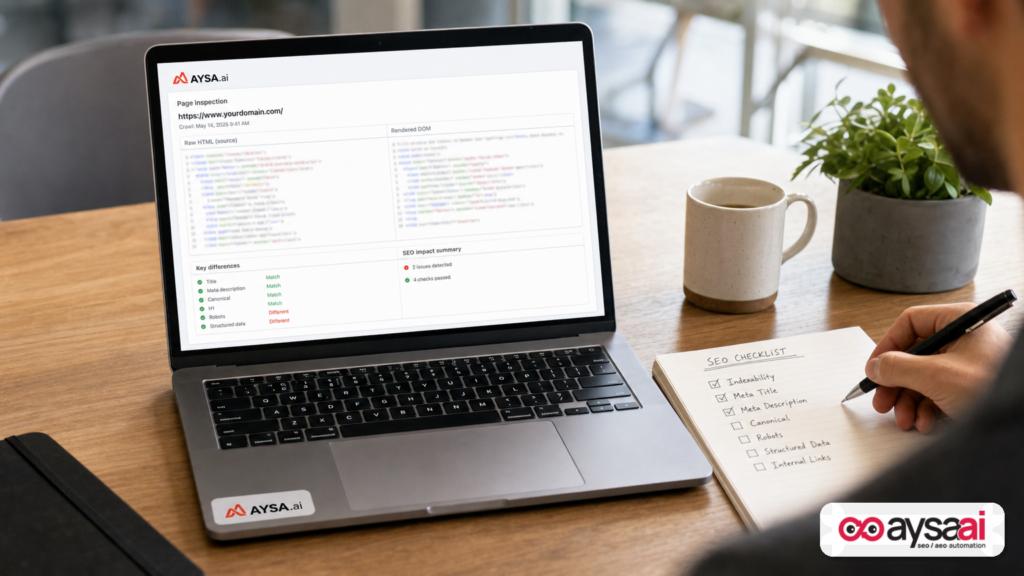
- Compare raw HTML vs rendered DOM and list differences.
- Compute internal link counts and detect broken links.
- Validate Structured data syntax (at least at schema/JSON-LD structure level).
The principle: don’t ask a probabilistic system to do exact math.
Layer 2: A Small Local Model Handles Light Interpretation & Communication
Once you have facts, most teams hit a bottleneck: translating evidence into something a human can act on. This is where small local models can shine:
- Summarize the results of a technical check in plain English.
- Rewrite a warning message to be user-friendly for non-technical people.
- Suggest “what to look at next” based on a known set of outputs.
- Create consistent issue titles/descriptions for tickets (Jira/Asana/Trello).
Notice what’s missing: final decisions. Local models are great “interfaces” between data and humans. That alone can save hours weekly in SMEs.
Layer 3: Frontier Models Are Available When Real Judgment Is Needed
Some problems do require deep reasoning or broader context:
- Ambiguous technical tradeoffs (e.g., canonical vs noindex vs redirect).
- Content strategy decisions for AI discovery (what to publish, how to structure topics).
- Brand-sensitive copy or compliance-aware edits.
- Complex SERP/AIO interpretation (what is Google “implying” users want?).
Frontier models are valuable here because you’re paying for judgment and synthesis, not for a fancy way to do string matching.
The operational win is: the pipeline doesn’t change; only the model tier changes. That’s how you keep systems maintainable.
What Local AI Is Good At In SEO (And What It’s Not)
Local AI can be excellent—if you’re honest about the job description.
Local AI is good at:
- Summarization of known evidence: turning outputs from crawls, checks, comparisons into readable guidance.
- Normalizing language: consistent tone for issue descriptions or internal documentation.
- UI assistance: inline explanations in browser extensions or internal tools.
- Light classification: labeling issues into predefined buckets (with deterministic guardrails).
- Drafting templates: checklist items, ticket skeletons, QA steps.
Local AI is not reliably good at:
- Multi-signal technical judgment where errors are expensive (indexing decisions, canonicalization edge cases).
- Inventing missing context (hallucination risk rises as tasks become more “why” than “what”).
- Complex tool orchestration unless the surrounding system is engineered to be deterministic and safe.
The key is not to shame small models for not being huge. It’s to avoid hiring a “translator” and demanding they be a “judge.”
“Small Task” Doesn’t Mean “Easy Task”: The Reasoning Trap
One of the most important lessons from the SEJ experiment is that a task can be small in scope but still hard in reasoning.
Technical SEO is full of these traps:
- A raw HTML link points to URL A, rendered DOM points to URL B. Is that a problem or a feature?
- Two URLs resolve to the same destination. Is that consolidation or duplication?
- A canonical exists, but internal linking contradicts it. Which signal “wins” in practice?
Humans answer these by combining evidence with mental models of search engine behavior. A small on-device model can struggle because it must:
- Respect all provided facts without contradicting them.
- Not invent extra rationale.
- Weigh multiple signals correctly.
- Output a decision that stands up to scrutiny.
Even frontier models sometimes fail here. The difference is that frontier models tend to fail less often, and their reasoning can be more coherent when given structured evidence.
The practical response isn’t “don’t use local AI.” It’s: tighten the system design. Improve deterministic preprocessing, make assumptions explicit, and only elevate to a stronger model when the decision has real downside risk.
Practical Hybrid Workflows You Can Implement This Quarter
Let’s make this tangible. Below are hybrid workflows that fit the three-layer architecture and work for SMEs and agencies.
Workflow 1: Technical Issue Triage Without Cloud Dependency
Goal: Reduce time wasted on “noise” issues while keeping critical issues escalated.
- Code (exact): Run a set of checks: status codes, redirect chains, canonical presence, robots tags, sitemap coverage, raw vs rendered diffs.
- Local model (translate): Summarize each issue into: what happened, where, why it might matter, what to verify.
- Frontier model (judge, optional): Only for ambiguous items: “Is this likely harming indexing or internal equity?”
Where AYSA fits: monitoring and structured preparation of fixes, with an approval queue before anything changes on your site. See: AYSA Monitoring.
Workflow 2: Content Refresh That Doesn’t Leak Competitive Strategy
Goal: Update pages to improve retrievability for AI systems and clarity for humans without shipping sensitive positioning to third parties.
- Code (exact): Extract headings, FAQs, entities/terms present, internal links, and metadata.
- Local model (assist): Rewrite sections for clarity and scannability based on provided style rules; generate on-page Q&A from existing content only.
- Frontier model (judge): When you need strategic reframing, new section proposals, or competitive differentiation.
Where AYSA fits: as an AI SEO/AEO/GEO system that prepares content and technical changes, asks for approval, and executes accepted changes. Start here: AYSA AI SEO Tools.
Workflow 3: On-Page SEO QA Before Publishing
Goal: Catch avoidable issues (missing titles, thin sections, broken internal links) before they ship.
- Code: Validate required elements, schema presence (where applicable), internal links, image alt presence, and basic performance flags.
- Local model: Provide a “publisher-friendly” QA report explaining what to fix and why.
- Frontier model: Optional for tone/brand rewrites or complex page intent alignment.
Where AYSA fits: continuous checks and workflow-ready change suggestions you can approve. Learn more: AYSA AI Search Visibility.
Workflow 4: “Evidence Packs” For Better Cloud AI Calls
Goal: When you do use frontier models, get better answers with fewer calls.
This is an underrated benefit of building local/deterministic layers: they produce structured evidence you can pass upstream.
- Code: Build an evidence pack: page HTML summary, key elements, extracted links, canonical/robots, performance notes, change history.
- Local model: Convert the evidence pack into a concise brief: “Here’s what matters, here’s what’s weird, here’s the question.”
- Frontier model: Answer the single hard question with context.
This approach reduces “prompt thrash,” token spend, and contradictory outputs.
SME Scenario: A Local Clinic That Can’t Ship Sensitive Context To The Cloud
Consider a realistic scenario: a multi-location clinic with a small marketing team.
They want to improve visibility for high-intent services, but they have constraints:
- They don’t want staff pasting patient-adjacent language, intake details, or internal notes into third-party chat tools.
- They still need to keep service pages accurate, accessible, and easy for users (and AI systems) to retrieve and understand.
A hybrid approach looks like this:
Step 1: Local + deterministic checks
- Code extracts page structure, headings, FAQs, location info blocks, phone numbers, and internal links.
- A local model rewrites confusing sentences for clarity and consistency using only on-page content and style guidelines.
Step 2: Cloud judgment only for strategy
- When deciding which services deserve new landing pages or how to differentiate messaging, they use a stronger model—but based on sanitized, non-sensitive briefs.
Step 3: Approved execution
- Changes are prepared as drafts, reviewed by a responsible person (marketing lead or compliance-aware manager), then executed—no silent edits.
This is the pattern SMEs need: make progress without creating governance nightmares. AYSA is designed to support that loop—monitoring what matters, preparing changes, requesting approval, executing, and tracking impact. See pricing and workflow expectations here: AYSA Pricing.
What Agencies Should Rethink: Packaging, Margins, And Reliability
If you run an agency, local compute shouldn’t feel like a threat. It should feel like leverage.
Here’s what changes when more work can happen on-device or inside lightweight tooling:
1) You stop selling “hours,” and start selling “systems”
Clients don’t want 12 exported spreadsheets. They want issues prioritized, explained, and resolved. Hybrid stacks help you productize that delivery.
2) You can reserve frontier model spend for premium outcomes
If your internal process burns frontier tokens on basic tasks, your margins suffer. Use local for translation and triage; use cloud for the hard problems you can charge for.
3) You build trust with auditability
Clients are increasingly skeptical of “the AI said so.” Evidence-first workflows let you show inputs, deterministic outputs, and approval history—especially important when you execute changes.
4) You reduce dependency risk
If one provider changes pricing or output quality, you don’t want your deliverables to collapse. Hybrid architecture reduces that fragility.
For agencies building modern offerings around AI search and SEO automation, AYSA’s model aligns well: the system monitors and prepares, the human approves, and the platform executes. That’s how you scale without losing control. Explore more editorial thinking on this in our library: AYSA Blog.
What To Monitor In 2026–2027: Beyond Rankings
Even though this piece is about compute placement (local vs cloud), it connects directly to how SEO itself is changing. If search is moving from “ten blue links” to AI-mediated discovery, monitoring must evolve too.
At a minimum, SMEs and agencies should monitor:
- Indexing health: coverage, canonicals, noindex mistakes, redirect anomalies.
- Content retrievability: whether key passages exist in a form AI systems can quote or summarize accurately (clear sections, explicit answers, consistent entities).
- Technical rendering issues: differences between raw HTML and rendered output that change links, content, or structured data.
- Change impact: what happened after edits—traffic is lagging, but crawl/index signals often move earlier.
Important caution: this article won’t invent new metrics or pretend there’s one magic dashboard. But the direction is clear: visibility is no longer only “rankings.” It’s also whether AI systems can reliably retrieve and represent your content.
That’s why AYSA focuses on AI search visibility workflows alongside traditional SEO execution. See: AI Search Visibility.
Where AYSA Fits: Approved Execution For SEO, AEO, And GEO
I’m opinionated about this: analysis without execution is the new vanity reporting.
The market is full of AI features that generate:
- recommendations,
- draft copy,
- issue lists,
- audits,
- and “opportunity scores.”
But businesses don’t win because they generated ideas. They win because they implemented the right ideas safely, repeatedly, and measurably.
AYSA is built as an execution system for modern search—SEO plus AEO/GEO realities—designed to:
- Monitor the site and surface what changed or what’s at risk (Monitoring).
- Prepare recommended changes (technical and content) as concrete proposals.
- Ask for approval so changes aren’t silently pushed by an agent.
- Execute accepted changes and support ongoing iteration.
This editorial’s local-vs-cloud framework aligns with how we think about production-grade SEO automation:
- Where code should be exact, it’s exact.
- Where AI helps reduce friction, it helps.
- Where judgment is needed, humans stay accountable—and strong models can assist without owning the final say.
If you’re evaluating what AI to trust in your SEO workflow, start by asking: “What parts of this process are we willing to let be probabilistic?” Most teams will realize the answer is: fewer parts than they thought.
What To Do Next: A Straightforward Action List
If you want to move toward a sustainable hybrid approach (local + deterministic + frontier), here’s a practical plan.
1) Inventory your AI calls (even informal ones)
- Where are team members pasting data into chat tools?
- Which tasks are “daily annoyances” that could be localized?
2) Identify deterministic candidates
- If it’s a status code, parsing job, diff, or validation—move it to code.
- Make outputs structured (JSON/CSV) even if humans don’t see them.
3) Add local AI only where it reduces friction
- Summaries, explanations, ticket writing, checklists.
- Keep prompts constrained: “Explain these findings,” not “Decide the fix.”
4) Escalate to frontier models only with evidence packs
- One hard question per call.
- Provide deterministic outputs first.
- Require the model to reference evidence, not invent it.
5) Implement approved execution
- Don’t let agent workflows ship changes without review.
- Use an approval queue, change diffs, and rollback-aware processes.
6) Build monitoring around change, not hope
- Track what changed, what broke, what got better.
- Align with business outcomes (leads, bookings, sales), not only “optimization tasks completed.”
If you want a starting point for operationalizing this, review AYSA’s tooling overview (AI SEO Tools) and monitoring workflow (Monitoring), then evaluate fit and scope via pricing (Pricing).
Sources And Further Reading
- Search Engine Journal — Using Local (AI) Compute To Reduce Reliance On Frontier Models
- Search Engine Journal — AI Search coverage
- Search Engine Journal — Technical SEO coverage
- Search Engine Journal — SEO coverage
- Search Engine Journal — SEO News
Note: This editorial intentionally avoids quoting claims that require additional primary verification beyond the supplied research context. Where teams need policy-level certainty (privacy, compliance, model data handling), consult your legal counsel and the relevant vendor documentation directly.
Continue the AI search topic inside AYSA.
Use these pages to connect the article with AI SEO tools, AI visibility monitoring, AI Overviews and approved website execution.
Turn this topic into a website action plan.
Use these AYSA hubs to move from reading to technical fixes, AI visibility monitoring, research, glossary context and approval-first SEO execution.