ChatGPT Ads + First-Party Data Is Here: What LiveRamp’s RampID Integration Changes (And What Smart Advertisers Should Do Next)
LiveRamp’s RampID integration brings first-party audience activation into ChatGPT Ads—making it feel more like Google and Meta, but with very different mechanics. Here’s what changed, why it matters, the risks, and a practical playbook for SMEs and agencies using AYSA to execute SEO/AEO/GEO improvements that make AI-driven demand measurable.
By Marius Dosinescu (AYSA.ai)
AI discovery is moving fast. And the ad stack around it is starting to look… familiar.
According to Search Engine Journal, LiveRamp is expanding its partnership with OpenAI so advertisers can activate first-party audiences in ChatGPT Ads using LiveRamp’s RampID. If you’ve spent the last decade building Customer Match lists, CRM segments, and suppression audiences for Google and Meta, you immediately understand why this matters: it’s a step toward first-party data parity inside a new, conversation-driven surface where people research, compare, and decide.
But here’s the point of view you should walk away with:
ChatGPT Ads getting “Google-like” audience controls does not mean it behaves like Google Ads. The context is different, the user behavior is different, the measurement is different—and the operational risks (data hygiene, consent, Attribution) are still the part that breaks for most SMEs and many agencies.
This editorial is a practical guide: what changed, why it matters beyond PPC, what can go wrong, and what to do next—especially if you’re an SME or an agency trying to protect performance while learning the new AI discovery layer.
Concise summary
- What changed: LiveRamp’s RampID can now be used to activate first-party audiences in ChatGPT Ads (in addition to a prior measurement-focused partnership), making it easier for existing LiveRamp customers to onboard audiences without managing manual uploads.
- What stays true: OpenAI also supports direct Custom Audience uploads inside Ads Manager (CSV/TXT with emails/phones, hashed identifiers, and Google Advertising IDs) and lets advertisers include/exclude audiences and use bid multipliers.
- Why it matters: First-party targeting and suppression are foundational levers for efficient growth. Putting those levers into a conversational AI Surface accelerates experimentation—but also increases the cost of sloppy measurement.
- Best early use case: Start with suppression (exclude recent purchasers/current customers) and controlled bid multipliers before you attempt narrow prospecting segments.
- Where AYSA fits: AI ads are only half the story. You still need pages and content that AI surfaces can understand, cite, and send traffic to—plus tracking that doesn’t throw AI referrals into “direct/other.” AYSA helps by monitoring, preparing recommended changes, getting your approval, and executing accepted fixes across SEO/AEO/GEO workflows.
Key takeaways (for busy operators)

- First-party audiences in ChatGPT make the platform operationally easier to test—especially if you already use LiveRamp across channels.
- Suppression is the highest-confidence first test because it reduces waste even if targeting “performance” is unknown.
- Don’t assume match rates, conversion rates, or CPCs will behave like Google/Meta. The environment is conversational and early in its learning curve.
- Attribution will mislead you unless you fix tracking. AI-driven referrals often end up mislabeled; you need a plan to prevent “direct/other” blindness.
- AI ads will reward brands with strong AI visibility fundamentals. If your site content is thin, outdated, or poorly structured, you’ll pay more for fewer downstream results.
Table of contents

- What Changed: LiveRamp RampID Now Activates First-Party Audiences in ChatGPT Ads
- How First-Party Targeting in ChatGPT Ads Works (What We Actually Know)
- Why This Matters Beyond PPC: AI Answers Are Becoming a Discovery Layer (With Ads)
- Is This “Google/Meta-Level Targeting”? Similar Controls, Different Physics
- The Best First Tests: Suppression, Bid Multipliers, and Controlled Prospecting
- Will First-Party Audiences Cost More in ChatGPT? How to Think Without Benchmarks
- The Practical Risks: Matching, Measurement, and “Direct/Other” Blind Spots
- An SME Scenario: The Ecommerce Brand That Stops Wasting Budget With Suppression
- What Agencies Should Rethink: Reporting, Learning Agendas, and Client Expectations
- Why SEO/AEO/GEO Still Decides Your Unit Economics (Even If You Buy Ads)
- Where AYSA Fits: Approved Execution for AI Visibility + Conversion Readiness
- What to Do Next (30/60/90-Day Action List)
- Sources and further reading
What Changed: LiveRamp RampID Now Activates First-Party Audiences in ChatGPT Ads
The news is straightforward, but the implications are not.
As reported by Search Engine Journal, LiveRamp expanded its partnership with OpenAI to enable advertisers to activate first-party audiences in ChatGPT Ads via RampID. In practical terms, this means brands can use existing first-party data sources—CRM, loyalty programs, site/app behavior, and other customer/prospect datasets—to reach or suppress known users, and to apply bid multipliers that reflect how valuable a given segment is.
This matters because it lowers friction. If you already run LiveRamp for identity resolution and audience activation across other channels, ChatGPT becomes another destination in your existing “first-party data distribution” workflow.
It also signals something bigger: OpenAI is building a real ad platform, not a novelty ad unit. It’s filling in the fundamental advertiser controls—audiences, measurement partners, bidding knobs—needed to attract performance budgets.
RampID in plain English
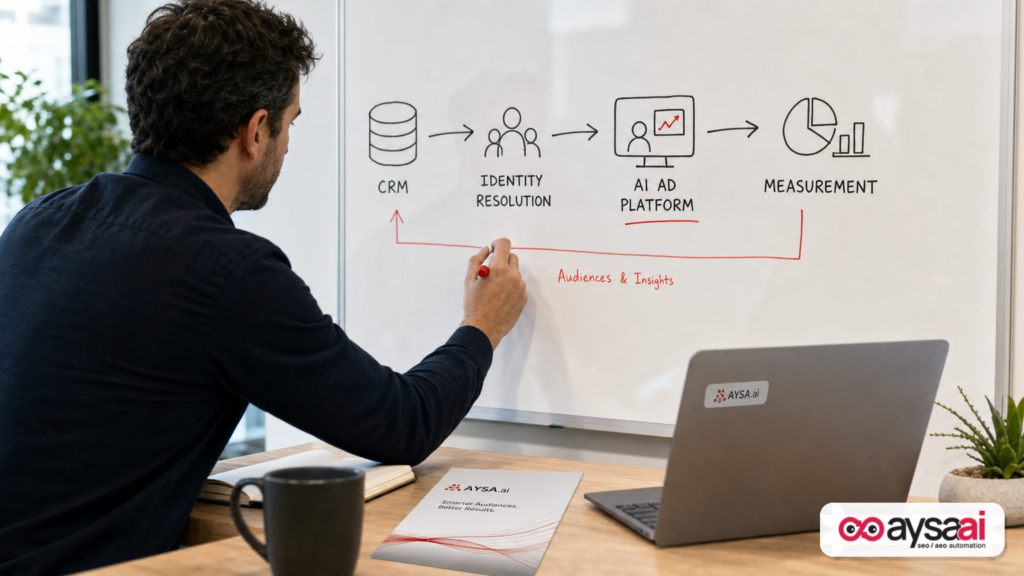
Identity is the quiet engine of performance advertising. RampID is LiveRamp’s way of helping brands connect first-party data to ad platforms and destinations. The core value proposition (conceptually) is:
- You store and update customer/prospect records in your systems.
- An identity layer maps those records to identifiers accepted by ad environments.
- You can then activate audiences across multiple platforms without constantly rebuilding manual lists.
The key operational advantage is repeatability: you’re not treating each ad platform like a separate audience island.
How First-Party Targeting in ChatGPT Ads Works (What We Actually Know)
From the available reporting in the SEJ piece, here’s what we can state without guessing:
- LiveRamp path: Existing LiveRamp customers can use RampID to activate first-party audiences in ChatGPT Ads.
- Direct OpenAI path: Advertisers can also create Custom Audiences directly in OpenAI Ads Manager by uploading a file (CSV/TXT) with identifiers such as emails, phone numbers, hashed versions of either, or Google Advertising IDs.
- Controls: Those audiences can be included/excluded at the campaign level; advertisers can apply bid multipliers at the ad group level.
- Bid multiplier range: OpenAI supports multipliers from 0.1x to 10x (as described in the article).
- Buying models: ChatGPT Ads supports CPM and CPC buying, plus conversion-optimized campaigns billed by Clicks or Impressions (per the article).
Also important: the SEJ article notes the LiveRamp integration was initially available in 11 markets, with expansion planned as ChatGPT Ads becomes available in more regions. If you’re operating globally, you should treat this as an uneven rollout rather than a universal capability on day one.
What this does not mean
It does not mean you can instantly replicate your Google Ads or Meta playbook. The controls may look similar (upload list, include/exclude, bid higher for Segment A), but the environment is meaningfully different:
- Conversation context influences what people see and how they behave.
- Platform learning history is short compared to Google/Meta.
- Performance norms and benchmarks are not public or mature.
So the correct posture is: treat this as a new surface with familiar knobs—not as a copy of the existing ad ecosystem.
Why This Matters Beyond PPC: AI Answers Are Becoming a Discovery Layer (With Ads)
Advertisers have always followed attention. For a long time, that attention flowed through two dominant interfaces:
- The search results page (keywords and intent expressed as a query)
- The social feed (interests inferred from behavior)
AI assistants introduce a third interface: the conversation. It’s not just “search.” It’s research, summarization, planning, shortlisting, and decision support—all in one place. That changes what “top-of-funnel” looks like because the funnel collapses into fewer steps.
When ads enter that experience, performance marketers get a new opportunity and a new risk:
- Opportunity: Influence decisions earlier (and sometimes closer to purchase) with context-aware messaging.
- Risk: If you can’t measure it, it will be the first budget line cut—or worse, it will look like it’s working when it isn’t.
This is why first-party audiences are such a big deal. In an environment where targeting and attribution are still being figured out, first-party data is one of the only levers you actually control.
Is This “Google/Meta-Level Targeting”? Similar Controls, Different Physics
The SEJ article makes a smart observation: the feature set is starting to look familiar to anyone who uses Google Customer Match or Meta Custom Audiences. You can:
- Decide who to include (reach a known segment)
- Decide who to exclude (suppress known customers)
- Bid differently for different segments
But the part many teams miss is that platform behavior isn’t defined by controls—it’s defined by feedback loops.
Why “same controls” doesn’t mean “same outcomes”
Google and Meta have:
- Decades (Google) or many years (Meta) of conversion feedback loops at scale
- Mature auction dynamics
- Enormous advertiser diversity feeding optimization systems
- Standardized measurement expectations
ChatGPT Ads is still early. Even if the ad auction is technically sound, it won’t have the same density of historical outcomes across industries and objectives. That means:
- Performance volatility should be expected
- Learning phases may be longer or less predictable
- Segment-level performance may not generalize the way it does in mature channels
The right comparison is not “is ChatGPT Ads like Google Ads?” The right comparison is: what does ChatGPT Ads do better or differently because it sits inside a conversation?
The Best First Tests: Suppression, Bid Multipliers, and Controlled Prospecting
If you’re a pragmatic operator—especially an SME—your first job is not to chase novelty. Your first job is to protect unit economics while you learn.
Here’s the testing ladder I recommend, based on what we know from the SEJ report and how first-party data tends to perform across channels.
Test 1: Suppression (exclude recent purchasers / current customers)
Suppression is unglamorous, but it’s often the cleanest ROI lever:
- Retail: exclude people who bought in the last 7–30 days from acquisition campaigns
- Subscriptions: exclude current subscribers from intro offers
- Lead gen: exclude closed-won customers from “book a demo”
Even if ChatGPT’s targeting performance is still unknown, suppression can prevent obvious waste. And it gives you a lower-risk way to validate that matching works and reporting is sane.
Test 2: Bid multipliers for known high-value segments
Once suppression is stable, use bid multipliers carefully. The article notes a wide multiplier range (0.1x to 10x). That doesn’t mean you should use extreme settings early.
Start small:
- +10% to +30% for high-LTV customers you want to re-engage
- -10% to -30% for low-value or high-return-rate segments
Then evaluate not just CPC/CPM, but downstream conversion quality: revenue, margin, retention, lead-to-close rate. A higher CPC is acceptable if the audience is materially more valuable.
Test 3: Prospecting with CRM-derived “qualified lead” audiences
This is where things get uncertain fast. If you have a strong definition of “qualified” (SQLs, demos attended, repeat buyers), you can test prospecting-like goals using that segment as a target. But you should assume:
- Minimum audience size requirements may limit segmentation
- Benchmarks aren’t established
- Conversation context may override your expectations of how/when ads appear
So treat this as exploration, not a budget replacement for proven Google/Meta campaigns.
Will First-Party Audiences Cost More in ChatGPT? How to Think Without Benchmarks
Per the SEJ reporting, OpenAI’s documentation doesn’t identify separate pricing for Custom Audiences, but advertisers can bid up (or down) when someone matches a Custom Audience using multipliers.
In mature channels, first-party segments often become more competitive because:
- They’re closer to conversion
- Multiple advertisers may be targeting similar high-intent users
- Algorithms learn that these users are “valuable” and auctions adjust
We can’t claim that’s already true in ChatGPT Ads without data. But we can say this:
You should assume costs will rise for the audiences you tell the system are valuable. Not because the platform is “charging more,” but because your own bid multipliers and optimization goals will push the auction higher.
What to measure (instead of panicking about CPC)
- Incremental conversions: Are you gaining conversions you wouldn’t have gotten otherwise?
- Cost per qualified action: Not just leads—qualified leads.
- Revenue/margin per click: Especially for ecommerce.
- Time-to-conversion: Conversational discovery can shorten (or lengthen) cycles depending on category.
Until the ecosystem publishes reliable norms, your job is to build your own baseline through controlled tests and consistent measurement.
The Practical Risks: Matching, Measurement, and “Direct/Other” Blind Spots
If first-party audiences are the growth lever, measurement is the safety harness.
The SEJ page itself contains a prominent related prompt: “Your ChatGPT Calls Are Hiding in the ‘Direct/Other’ Bucket,” which reflects a real, growing issue across AI assistants—referrals and actions can be misattributed if tracking isn’t configured in a way that recognizes AI-driven entry points.
Even without diving into additional documentation (not provided in the research context here), we can outline the risk categories you should actively manage:
Risk 1: Match quality is not guaranteed
Uploading a list doesn’t mean the platform can match it at a high rate. Match rate depends on:
- Identifier quality (typos, old emails, shared phones)
- Consent/eligibility constraints
- Platform-specific identity availability
If match rates are low, your “audience strategy” becomes mostly theoretical. That’s why suppression is a good first step: even partial suppression can reduce waste, and it’s easier to validate than prospecting performance.
Risk 2: Attribution gaps create false winners and false losers
AI assistants can influence decisions without sending a clean click path the way search ads do. If you’re only looking at last-click attribution, you may:
- Undervalue the channel if it assists conversions
- Overvalue it if tracking collapses sources into “direct” and you assume branded strength
The outcome is the same: bad decisions with real budget consequences.
Risk 3: Creative and landing pages are not conversation-native
Many brands will try to port over existing ad creative and landing pages built for:
- keyword intent (“buy X now”)
- feed-style interruption (“here’s a discount”)
But conversational discovery often looks like:
- “Which option is best for my situation?”
- “What’s the difference between A and B?”
- “What should I ask before I purchase?”
If your landing page doesn’t answer those questions quickly, you’ll pay for clicks that don’t convert—even with perfect targeting.
An SME Scenario: The Ecommerce Brand That Stops Wasting Budget With Suppression
Let’s make this real with a scenario that matches how SMEs actually operate.
Business: A 12-person ecommerce brand selling premium skincare.
Current setup:
- Google Ads drives most incremental new customer volume.
- Meta retargeting captures some returning visitors.
- Email/SMS drives repeat purchases.
The problem: The brand keeps seeing acquisition campaigns “convert,” but the finance team flags that too many orders are coming from customers who purchased within the last two weeks—people who likely would have repurchased via email anyway.
First-party suppression test in ChatGPT Ads:
- Create a suppression audience: purchasers in last 14 days.
- Exclude from acquisition campaigns.
- Keep budgets small and stable for 2–4 weeks.
- Measure: new customer rate, CAC, contribution margin per order.
Why this is a smart “first” test:
- Even if ChatGPT Ads is early, you’re using it in a way that protects budget efficiency.
- You validate that audience activation works.
- You reduce the chance of paying to “convert” customers you already owned.
What can go wrong:
- Purchase events aren’t reliably tracked (you can’t build accurate suppression).
- The CRM or ecommerce platform doesn’t update quickly (people slip through).
- Attribution is messy (sales show up as “direct” and the team argues about credit).
This is exactly where operational discipline beats clever targeting.
What Agencies Should Rethink: Reporting, Learning Agendas, and Client Expectations
Agencies will feel this shift before most in-house teams because clients will ask the same question they always ask when a new channel shows up:
“Should we be testing this?”
Testing is not the hard part. Defending the test is the hard part—especially when performance data is limited and attribution is disputed.
Move #1: Define a learning agenda (not a channel expansion)
Instead of pitching “ChatGPT Ads management,” pitch a learning agenda:
- What audience types work first: suppression vs. prospecting
- What creative angles match conversational discovery
- How bid multipliers affect auction dynamics and downstream quality
- Where measurement breaks, and how to fix it
This repositions early spend as R&D with guardrails, not as a performance promise.
Move #2: Upgrade reporting to include “assist” and “influence”
If you report only last-click ROAS, you’ll lose the narrative. You need a reporting layer that can account for assisted influence and multi-touch journeys—without inventing credit.
When you can’t fully prove causality, you can still show directional evidence:
- Holdout or geo-split tests (when feasible)
- Lift in branded search or direct traffic (carefully interpreted)
- CRM-based backfills (did leads from the period increase in quality?)
Don’t overclaim. But also don’t let “we can’t measure perfectly” become an excuse for not measuring at all.
Move #3: Tie AI ads to AI visibility work
This is the agency opportunity most teams will miss: AI ads are not isolated. They sit inside an AI discovery ecosystem that includes:
- Organic AI citations and references
- Brand presence in AI answers
- Content quality and structure that AI can parse
- Landing page experiences that answer conversational questions
If you run ChatGPT Ads but your content is weak, you’ll be paying to compensate for low trust and poor clarity. In other words: you can buy the click, but you can’t buy understanding.
Why SEO/AEO/GEO Still Decides Your Unit Economics (Even If You Buy Ads)
Here’s the uncomfortable truth: most paid media teams optimize what they can see. In AI-driven discovery, what you can see is often incomplete early on.
So the defensive move is to strengthen the parts that compound regardless of attribution model:
- Clear product/service pages that answer real questions
- Structured information that AI systems can interpret
- Content that matches “customer language” (not internal jargon)
- Proof elements that build trust: policies, returns, shipping, pricing clarity, credentials
At AYSA, we treat this as the execution bridge between SEO and paid outcomes. When AI assistants summarize options, they favor clarity. When users click, they favor pages that resolve uncertainty fast.
If you want a deeper overview of how we approach AI-era visibility, start here:
Where AYSA Fits: Approved Execution for AI Visibility + Conversion Readiness
Most teams don’t fail because they don’t understand the strategy. They fail because they can’t execute consistently across:
- content updates
- technical fixes
- tracking/measurement hygiene
- page improvements that increase conversion rate
That’s why we built AYSA as an execution system: it monitors your site and visibility, prepares specific recommendations, asks for approval, and then executes accepted changes. This “approved execution” model matters in the AI era because the iteration speed is increasing—while the cost of mistakes (privacy, measurement, misaligned messaging) is also increasing.
Here’s how that connects to ChatGPT Ads + first-party audiences:
1) Better pages make your paid tests more truthful
If a campaign underperforms, you want to know why. Is it targeting? Message? Page clarity? Offer mismatch?
AYSA helps reduce false negatives by making sure key pages are:
- structured for AI parsing and human scanning
- kept fresh when products/services change
- aligned with the questions customers actually ask
That makes early platform testing more diagnostic and less chaotic.
2) Monitoring catches “AI visibility drift”
AI surfaces evolve quickly. What earns visibility today may slip tomorrow as models adjust, competitors publish better content, or your own site changes.
AYSA’s monitoring helps you spot changes before they show up as revenue surprises.
3) Execution beats dashboards
A lot of teams respond to AI platform shifts by buying more tools and creating more reports. The real advantage is operational: shipping improvements weekly, not quarterly.
If you want to see how we package this for different business sizes, review pricing and browse current thinking in our blog.
What to Do Next (30/60/90-Day Action List)
This is the practical part. If you’re an advertiser (or an agency) evaluating first-party audiences in ChatGPT Ads, don’t start with channel hype. Start with readiness and guardrails.
Days 1–30: Get the basics right
- Inventory first-party data sources: CRM, ecommerce platform, email list, loyalty program, lead database.
- Define suppression rules: “recent purchasers,” “current customers,” “active subscribers,” “existing contracts.”
- Audit data hygiene: duplicate records, missing emails/phones, inconsistent formatting.
- Confirm privacy posture: make sure your use of customer data aligns with your policies and applicable laws (work with counsel if needed).
- Pick a measurement plan: decide what counts as success (qualified lead, first purchase, margin, etc.) and how you’ll attribute influence.
- Use AYSA to stabilize landing pages: prioritize key money pages and ensure they answer conversational questions clearly. Start with AI search visibility and AI SEO tools.
Days 31–60: Run a controlled test (don’t over-segment)
- Launch a suppression-first test: exclude recent purchasers/current customers in acquisition campaigns.
- Add cautious bid multipliers: small adjustments for high-value segments; avoid extreme 5x–10x jumps early.
- Keep budgets intentionally limited: treat this as learning spend.
- Track downstream quality: revenue, margin, lead-to-close rate—not just clicks.
- Document what changed: audience definitions, creative variations, landing pages, offers.
Days 61–90: Expand only where you can explain the “why”
- Introduce one prospecting audience: e.g., qualified leads or high-LTV cohorts, if size thresholds allow.
- Test conversation-native messaging: address comparisons, objections, and “which is best for me?” framing.
- Refine measurement: resolve attribution gaps that surfaced in the first test period.
- Use AYSA to iterate site changes weekly: monitor performance and ship approved fixes quickly via Monitoring.
What to do next (checklist)
- Decide whether your first ChatGPT Ads test is suppression or bid multipliers—not broad prospecting.
- Write down your success metric (qualified outcomes, not platform KPIs alone).
- Confirm you can recognize AI-driven traffic/conversions and not lose it in “direct/other.”
- Pick 3–5 pages that must convert from AI-driven discovery and improve them (clarity, objections, structured info).
- Use AYSA to monitor and execute site changes with approvals: AYSA Monitoring
- If you’re exploring AYSA, start with: AI Search Visibility and AI SEO Tools
Sources and further reading
- Search Engine Journal — LiveRamp Expands OpenAI Deal With First-Party Data Targeting
- Search Engine Journal — Paid Media (context and related coverage)
- Search Engine Journal — AI Search (broader AI search/ads context)
Note: The source article references OpenAI Ads Manager capabilities and bid multipliers. This editorial does not add undocumented claims beyond what’s described in the provided research context. If you need platform-specific implementation details, confirm them inside your OpenAI Ads Manager account and official OpenAI documentation available to you.
Final AYSA perspective
The LiveRamp/OpenAI expansion is not just a feature announcement. It’s another signal that conversational AI is becoming a full-stack commercial surface: discovery + persuasion + transaction pathways + measurement.
If you’re a business owner or marketing lead, your advantage won’t come from being “first.” It will come from being disciplined:
- use first-party data to reduce waste before you try to scale
- fix measurement blind spots so you don’t fund myths
- strengthen content and pages so AI-driven intent actually converts
That’s the gap AYSA is built to close: monitoring what’s changing, preparing the right fixes, getting approval, and executing—so your marketing doesn’t just learn faster, it improves faster.
Continue the AI search topic inside AYSA.
Use these pages to connect the article with AI SEO tools, AI visibility monitoring, AI Overviews and approved website execution.
Turn this topic into a website action plan.
Use these AYSA hubs to move from reading to technical fixes, AI visibility monitoring, research, glossary context and approval-first SEO execution.