
Make AI Write Like an Aircraft Manual: The Practical Fix for SEO, AI Search, and Business Clarity
Andrej Karpathy’s “aircraft manual” prompt isn’t a quirky writing trick—it’s a reliability strategy for the AI Search era. Controlled language, diagrams, HTML artifacts, and explainer-video storyboards make content easier to verify, easier to ship, and more quotable by AI systems. Here’s how SMEs and agencies can operationalize it—with approval-based execution via AYSA.

By Marius Dosinescu (AYSA.ai)
Most teams are using LLMs like an intern with infinite energy: fast drafts, lots of words, uneven quality, and a review cycle that gets slower as output gets longer.
Andrej Karpathy’s recent idea—ask LLMs to explain things using an aerospace writing standard built for aircraft maintenance manuals—sounds like a niche prompt trick until you see what it really is: a reliability framework. It’s about constraining language so it becomes easier to verify, easier to reuse across a site, and harder for humans (or AI systems) to misread.
Search Engine Journal covered Karpathy’s post and the ladder of “even better” output formats he recommends: controlled English → diagrams → HTML pages → custom explainer videos. That original coverage is here: OpenAI Founding Member: Make LLMs Write Like An Aircraft Manual (Search Engine Journal).
My take: if you care about AI Search visibility (AEO/GEO), Karpathy’s point isn’t “write like a manual.” It’s “write so the answer survives extraction.” When discovery shifts from “ten blue links” to AI systems assembling answers, ambiguity becomes a tax on growth. The businesses that win will have content that is:
- Unambiguous (one meaning per term, fewer hidden assumptions)
- Auditable (easy for a human reviewer to check and approve)
- Extractable (easy for machines to parse into answers, steps, policies, comparisons)
- Shippable (changes implemented consistently and safely across the site)
This editorial is not a summary of the SEJ post. It’s a standalone, practical guide for SMEs and agencies on how to operationalize the “aircraft manual” concept for modern SEO and AI Search—plus how AYSA fits as an execution system that monitors, prepares changes, asks for approval, and implements what you accept.
Key takeaways (read this first)

- Controlled language is a business control, not a writing style. Use it to reduce returns, support load, legal risk, and content drift—while making pages easier to cite in AI answers.
- Stop asking LLMs for “a paragraph.” Ask for artifacts: controlled steps, decision tables, diagrams, HTML prototypes, and (sometimes) explainer storyboards.
- The bottleneck moved from drafting to oversight. If you don’t redesign review and approvals, AI makes you faster at producing inconsistency.
- AI Search rewards “quotable structure.” Short sentences, explicit constraints, and consistent terminology are easier for models to extract and attribute.
- Execution is where most teams fail. A better draft in a Google Doc doesn’t change your website. You need a system to ship improvements safely—this is the core of AYSA’s approach.
Table of contents

- The “Aircraft Manual” Prompt: What Karpathy Actually Unlocked
- The Shift Nobody Budgeted For: From “Writing Pages” to “Building Answerable Systems”
- Controlled English in Plain Business Terms
- Four Output Formats That Beat “Just Give Me a Paragraph”
- Why This Matters for AI Search (AEO/GEO), Not Just Writing
- Where AI Content Operations Break (and How to Fix Them)
- Page Patterns That AI Systems Can Reliably Extract
- SME Scenario #1: Ecommerce Product Pages AI Shopping Agents Skip
- SME Scenario #2: A Local Service Business That Needs Fewer “Bad Leads”
- What Agencies Need to Rethink: Deliverables, QA, and Governance
- What You Should Monitor Weekly (SMEs) and Daily (Agencies)
- Where AYSA Fits: Monitoring → Preparing → Approval → Execution
- A 30-Day Action Plan to Operationalize “Aircraft Manual AI”
- What to do next
- Sources and further reading
The “Aircraft Manual” Prompt: What Karpathy Actually Unlocked
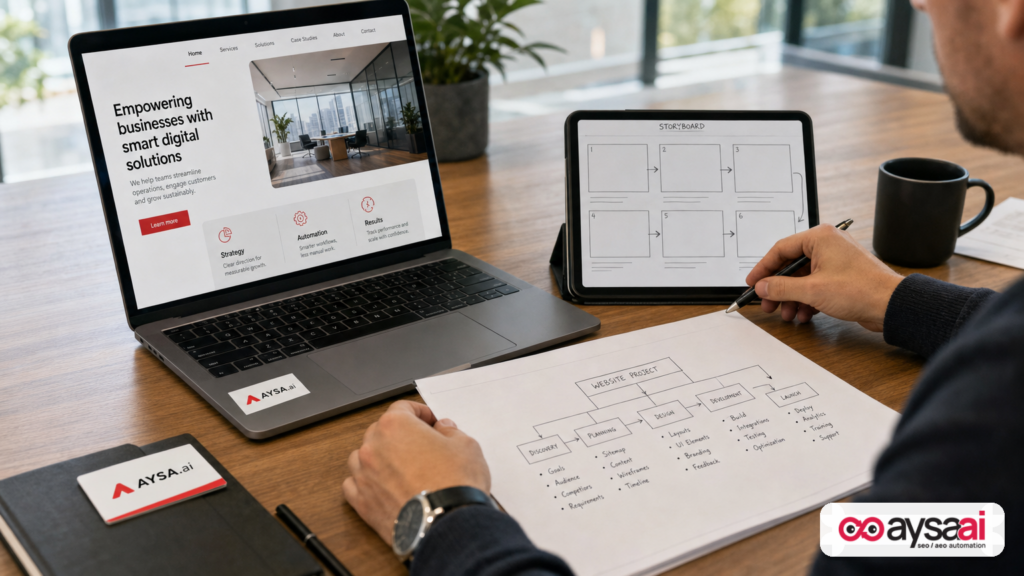
Karpathy’s recommendation (as reported by Search Engine Journal) is to prompt LLMs to explain things using ASD-STE100 (Simplified Technical English), a controlled form of English designed to make aircraft maintenance manuals easier to read. He also notes that because the standard is stringent, you can ask for something like “80% of the way to STE” to keep it usable.
I’m not going to pretend every business should adopt a formal aerospace standard. But the underlying mechanism matters:
- Constraints reduce variance. Your content becomes more consistent across writers, pages, and time.
- Constraints reduce hidden claims. Short sentences force you to state what’s true, what’s assumed, and what’s unknown.
- Constraints reduce interpretation drift. If your site calls the same concept five different names, AI systems (and customers) treat it as five different concepts.
Karpathy’s ladder of output formats is equally important. He suggests not only controlled writing, but also asking models for diagrams, HTML pages, and even custom explainer videos—because each format can be easier for a human to process and validate than a wall of prose.
That’s the unlock: using AI to produce reviewable artifacts rather than just wordy drafts.
Source context: the SEJ piece frames this as changing how model output is presented to a reviewer and predicts that as models do more legwork, more human work will “rise up the abstractions into oversight and understanding.” That line is the real story for businesses.
The Shift Nobody Budgeted For: From “Writing Pages” to “Building Answerable Systems”
In the pre-LLM content era, output was the product. You paid for pages, blogs, and landing copy. If you were a business owner, you probably judged content production like this:
- How many pages did we publish?
- How fast can we publish?
- Does it “sound good”?
AI flips that.
Now output is cheap. The scarce resource is confidence—your ability to believe what’s on the page is correct, consistent, compliant, and aligned with what you actually sell and deliver.
That’s why the work moves “up the abstraction ladder” into oversight:
- What is the approved terminology? (And does the site use it everywhere?)
- What are the constraints? (Eligibility, compatibility, exclusions, exceptions, timelines.)
- What is the evidence? (Policies, documentation, references, product data.)
- What is the canonical version? (Where is the single source of truth stored and enforced?)
- How do changes get shipped? (Not “edited,” but implemented on the website consistently.)
If you don’t evolve your workflow, you’ll experience the most common “AI content paradox”:
- You publish more content…
- …and your site becomes less trustworthy and harder to manage.
This is exactly why we built AYSA as an execution system—not another writing assistant. Writing is not the hard part anymore. Shipping changes safely is.
If you want the big-picture framing, start here: AI Search Visibility.
Controlled English in Plain Business Terms
Controlled English sounds academic. In practice, it’s a set of habits that make information harder to misinterpret.
Here’s how I translate “aircraft manual writing” into business content that still feels human:
A practical controlled-language rule set (SME-friendly)
- One idea per sentence. If a sentence contains “and,” there’s a good chance it contains two claims. Split it.
- One approved term per concept. Pick “subscription” OR “plan” OR “membership.” Not all three.
- Use the same label everywhere. If your product attribute is “Battery life,” don’t call it “Runtime” in another section unless you define the difference.
- Prefer verbs over adjectives. “Reduces drying time” is testable. “High-performance drying” is vibes.
- State constraints explicitly. “Works with iPhone 15 and later” is better than “works with most iPhones.”
- Separate facts from recommendations. Facts: what it is. Recommendations: who should choose it and why.
- List unknowns. If you don’t know compatibility with a model, say so and tell users how to check.
Why this helps SEO and AI Search
Controlled language isn’t primarily about rankings. It improves the odds that your content becomes a reliable source for AI systems because it creates “extractable units”:
- A definition sentence that can be paraphrased cleanly.
- A policy rule that can be quoted without losing meaning.
- A step list that can be turned into a summary.
- A constraint that prevents overbroad answers.
That is AEO/GEO in practice: building content that survives extraction.
Does controlled language kill brand voice?
Only if you apply it everywhere indiscriminately.
My recommendation is to separate your site into zones:
- “Truth zones” (must be controlled): product details, compatibility, pricing rules, policies, clinical/service eligibility, onboarding instructions, troubleshooting, guarantees.
- “Persuasion zones” (can be more expressive): brand story, positioning pages, campaign landing pages, editorial thought leadership (still accurate, but less rigid).
Most conversion problems in SMEs come from broken “truth zones,” not from weak slogans.
Four Output Formats That Beat “Just Give Me a Paragraph”
Karpathy’s ladder—controlled English → diagrams → HTML pages → explainer videos—is a useful way to redesign how you collaborate with LLMs. Each step produces an artifact that can be reviewed and approved.
1) Controlled writing (STE-inspired, business-adapted)
Use this when accuracy matters more than tone:
- Returns, shipping, cancellations
- Compatibility and requirements
- Setup steps and troubleshooting
- Service eligibility and exclusions
- Pricing rules and what’s included
Prompting pattern (practical):
- “Write in short sentences. One topic per sentence.”
- “Define key terms once. Reuse the same term.”
- “Use active voice. State who does what.”
- “List constraints and exceptions explicitly.”
- “At the end, add a checklist of what a reviewer should verify.”
You don’t need the full formal standard to get 80% of the benefit. The benefit is in the constraints and the reviewability.
2) Diagrams (for comprehension and QA)
Diagrams are underrated as an SEO workflow tool because they force you to formalize logic:
- Inputs → process → outputs
- If/then eligibility
- Decision branches
- Dependencies (what must be true first)
For SMEs, diagrams are often the fastest way to discover your own contradictions. If your team can’t agree on the flowchart for “Which plan should a customer choose?” your website copy is guaranteed to be confusing—no matter how well-written it sounds.
How to use diagrams without making your site ugly: you can keep diagrams internal for QA, and then translate them into a clean “How to choose” section, an FAQ, or a step-by-step list on the page.
3) HTML prototypes (structure first, copy second)
Karpathy suggests asking models for output “in HTML” to get an interactive web page. The point isn’t that HTML is magical; the point is that HTML makes the model think in:
- headings
- sections
- lists
- tables
- progressive disclosure (accordions/tabs)
In other words: an interface for understanding, not just a paragraph.
Two practical uses:
- Page-type templates: create a repeatable structure for product pages, service pages, help docs, and location pages.
- Review acceleration: stakeholders review structure and claims in context (where it lives on the page), not in a document detached from the website.
Important: treat AI-generated HTML as a prototype. Review for accessibility, performance, and security. Don’t ship random scripts. Don’t let an LLM decide what goes into your production stack.
4) Explainer videos (or at least storyboards)
Karpathy says he’s “most bullish” on custom explainer videos and references a “3Blue1Brown style” explainer with narration, including a prompt that uses an ElevenLabs API key (as noted in the SEJ coverage). I’m not making SEO promises about videos. But I will say this: the process of producing a storyboard forces clarity.
Even if you never publish a video, a storyboard or script can:
- expose missing steps in onboarding
- reveal where you’re overpromising
- force you to define terms in plain language
- create assets for sales and support teams
For complex products (technical ecommerce, B2B SaaS, clinics explaining procedures), “explain it like a storyboard” is sometimes a better internal QA step than “write another 1,500 words.”
Why This Matters for AI Search (AEO/GEO), Not Just Writing
AI Search changes the unit of competition.
You’re not only competing for a click. You’re competing to become the source behind an answer, a citation, a recommended option, or a summarized comparison. That competition is less about eloquence and more about extractability and trust.
Here’s the non-technical way to think about it:
- Traditional SEO: Can Google understand and rank this page?
- AI Search: Can an AI system safely reuse parts of this page as an answer?
When content is vague, AI systems fill gaps. That’s where hallucinations get introduced—not always by the model, but by the ambiguity in the source material.
Controlled writing helps because it:
- creates clean “quotable units” (short, clear sentences with one meaning)
- reduces term drift (consistent entities and labels)
- exposes unknowns (so your team can fix data gaps rather than marketing around them)
And diagrams/HTML prototypes help because they:
- enforce hierarchy (what’s important, what’s supporting detail)
- make relationships explicit (compatibility, dependencies, steps)
- speed up review (humans spot mistakes faster in structured forms)
If you want ongoing coverage on how AI Search is evolving, SEJ maintains an AI-focused section: Search Engine Journal: AI Search / Generative AI.
Where AI Content Operations Break (and How to Fix Them)
Most AI content failures in businesses aren’t dramatic. They’re operational. They happen because the company scaled drafts faster than it scaled governance.
Failure mode #1: Terminology drift across the site
What it looks like: the same concept has multiple names across product pages, blog posts, FAQs, and support docs.
Why it’s costly:
- customers get confused (“Is this the same thing?”)
- support tickets increase
- AI systems treat terms as different entities and summarize incorrectly
Fix: create a short controlled glossary (10–50 terms depending on business size) and enforce it in “truth zones.” Don’t overthink it. You just need canonical terms and definitions.
Failure mode #2: Policy ambiguity that creates refunds and disputes
What it looks like: returns, cancellations, and guarantees written in vague marketing language (“hassle-free,” “easy,” “risk-free”) without explicit constraints.
Fix: rewrite policies in controlled language:
- time window
- conditions
- exceptions
- step-by-step process
- what happens next (timelines)
That’s not just SEO. That’s revenue protection.
Failure mode #3: “Content that sounds correct” but is operationally wrong
What it looks like: AI-generated explanations that introduce unverified claims about product performance, medical outcomes, timelines, or “industry standards.”
Fix: require a verification checklist for high-risk pages. Controlled writing makes this easier because claims are separated into short sentences. Review becomes a “yes/no” process instead of interpretive editing.
Failure mode #4: Prototypes that never ship
What it looks like: better copy exists in documents, tickets, or Figma. The site stays the same because implementation is slow or blocked.
Fix: redesign the execution loop. This is where AYSA is built to help: monitor what’s live, prepare proposed changes, route approvals, and execute what gets accepted—without copy/paste chaos.
More on that later, but if you want to see the product lens now: AI SEO Tools.
Page Patterns That AI Systems Can Reliably Extract
Here’s the practical truth: AI systems don’t reward “long.” They reward “clear.” In many cases, clarity comes from using page patterns that map to how people ask questions—and how AI systems summarize answers.
Pattern 1: Definition + boundaries
For a service, product category, or feature, use a structure like:
- What it is (1–2 sentences)
- Who it’s for (bullets)
- Who it’s not for (bullets)
- Requirements (bullets/table)
- Common mistakes (bullets)
That structure is friendly for both humans and extraction systems. It also reduces bad leads.
Pattern 2: Step-by-step process with explicit actors
Don’t write: “After your order is processed, it will be shipped and delivered depending on your location.”
Write:
- “We process your order in X time.”
- “We ship via Y carriers.”
- “Delivery takes Z days, depending on location.”
- “You can track your shipment here.”
Notice how each sentence has one claim. That’s controlled language in action.
Pattern 3: Comparison tables and decision guides
Businesses often hide the “how to choose” logic because they’re afraid to push users away from premium options. That’s short-term thinking.
AI systems—and shoppers—love decision guides that look like:
- “Choose A if…”
- “Choose B if…”
- “Do not choose either if…”
You can do this without being negative. You’re reducing returns and improving satisfaction.
Pattern 4: FAQ built from real support questions
Don’t build FAQs from brainstorming. Build them from:
- support tickets
- sales calls
- live chat
- reviews (what confused customers)
Then answer in controlled language: short, explicit, no fluff.
Pattern 5: Constraints and exceptions are first-class content
In the AI Search era, constraints are not “fine print.” They’re the difference between being cited correctly and being misrepresented.
Examples of constraints worth making explicit:
- compatibility (devices, models, versions)
- eligibility (location, age, condition, prerequisites)
- limitations (not waterproof, not for sensitive skin, not for commercial use)
- timelines (delivery windows, processing times)
- pricing rules (renewals, setup fees, add-ons)
SME Scenario #1: Ecommerce Product Pages AI Shopping Agents Skip
Let’s make this real with a scenario I see constantly.
An ecommerce brand sells a technical product category: filters, skincare with active ingredients, replacement parts, tools, pet health supplies, electronics accessories—anything where “fit,” “works with,” “safe for,” or “how to use” determines satisfaction.
Their product pages are often built from:
- supplier feeds
- spec-sheet bullets
- marketing adjectives instead of constraints
- PDF manuals nobody reads
Humans can muddle through. But AI shopping agents and AI answer systems don’t “browse.” They extract. If the facts aren’t structured, the system may skip the page, summarize incorrectly, or cite a competitor who wrote cleaner constraints.
What “skipped by AI” looks like in practice
- Compatibility is implied, not stated.
- Model numbers appear in images or PDFs, not in text.
- Key warnings are buried in long paragraphs.
- Terminology changes between pages (Series A vs A-100 vs Model A).
You don’t need to guess whether “AI agents skip it.” You can assume that any content that is hard for a rushed human to validate is also hard for a machine to safely reuse.
The “aircraft manual” fix: build a product-page truth zone
Here’s a workflow that works for SMEs because it doesn’t require a huge team:
- Create a mini glossary. Define product naming conventions and the canonical terms for attributes (size, material, active ingredient %, compatibility label names).
- Rewrite the core spec block in controlled language. One claim per line. Avoid “premium,” “best,” “high quality.” Focus on verifiable facts.
- Add an explicit compatibility section. “Works with / does not work with / how to confirm.”
- Add a decision guide. “Choose this if…” “Do not choose this if…”
- Convert support issues into FAQs. Use the exact question phrasing customers use.
- Create an internal diagram. A simple flow: customer situation → product selection → constraints → expected outcome.
- Ship changes via approvals. Merchandising + support + legal (if needed) approves once; then scale the pattern to the category.
What improves (even before rankings)
- Fewer wrong orders because compatibility is explicit.
- Fewer angry emails because constraints are not hidden.
- Faster internal reviews because claims are separated and checkable.
- Better AI extractability because the page contains quotable facts, steps, and clear boundaries.
This is why I call controlled language a revenue-protection tactic, not just an SEO tactic.
SME Scenario #2: A Local Service Business That Needs Fewer “Bad Leads”
AI Search isn’t just an ecommerce issue. Local services—clinics, dental practices, home services, legal offices, specialty contractors—often suffer from a different problem: lead volume is fine, but lead quality is terrible.
Bad leads are often a content clarity problem:
- People don’t understand pricing ranges or what’s included.
- They don’t understand eligibility (“Do you serve my area?” “Do you take my insurance?” “Do you do emergency calls?”).
- They don’t understand constraints (“We don’t repair that brand.” “We don’t handle that condition.”).
In the AI Search era, this gets amplified. If your content is vague, AI summaries can accidentally overgeneralize your services. Then you pay staff time to handle calls you never should have received.
The controlled-language fix: eligibility and constraint-first pages
For a local service page, the “truth zone” should include:
- Service definition (what it is)
- Service boundaries (what it is not)
- Eligibility (locations served, prerequisites, exclusions)
- Process (how booking works, timelines, what to prepare)
- Pricing structure (how quotes are determined, what affects price)
- FAQ based on real calls (not marketing FAQs)
Write those sections in controlled language. Put them Above The Fold where possible. Don’t hide them in a PDF.
Result: fewer bad leads, better staff utilization, and content that’s less likely to be mis-summarized in AI answers.
What Agencies Need to Rethink: Deliverables, QA, and Governance
If you run an agency, AI Search plus LLM-driven production changes what clients pay for.
Old world: deliverables were content volume and audits.
New world: deliverables increasingly look like systems and artifacts:
- controlled glossaries and terminology governance
- page-type templates (HTML structure prototypes)
- QA checklists and review workflows
- Monitoring and drift detection
- execution pipelines with approvals and change logs
Why QA becomes your differentiator
AI lets mediocre agencies produce more content. It does not make them more accurate.
So the value shifts to:
- How quickly you catch errors
- How consistently you enforce terminology
- How reliably you ship approved changes
That’s also why the SEJ piece’s framing—work rising into oversight—is so relevant. In a world where every agency can draft, the agency that wins is the one that can govern and execute.
A practical way to re-scope agency work
Instead of selling “10 blog posts,” sell:
- “We will standardize your product terminology and eliminate drift.”
- “We will rebuild your top 20 revenue pages into an AI-extractable structure.”
- “We will reduce support-driving ambiguity by rewriting policies and compatibility sections in controlled language.”
- “We will implement changes via an approval-based pipeline so nothing gets lost in tickets.”
Those outcomes survive AI commoditization.
What You Should Monitor Weekly (SMEs) and Daily (Agencies)
Controlled writing isn’t a one-time rewrite. Drift is inevitable: new products launch, staff changes, promotions introduce new terms, and pages get edited under pressure.
So you need monitoring that is practical—not “rankings only,” but site integrity and clarity signals.
Clarity and consistency checks worth monitoring
- Terminology drift: are multiple terms being used for the same concept across templates?
- Missing constraints: do key pages lack eligibility/compatibility/exceptions?
- Policy mismatch: is the return policy consistent across product pages, policy pages, and checkout messaging?
- Structural omissions: do pages follow the template that makes them extractable (definition, steps, FAQ, decision guide)?
- Outdated claims: are there references to old versions, discontinued models, or old timelines?
This is where AYSA’s monitoring-first approach matters: AYSA Monitoring.
Monitoring is not glamorous, but it’s how you prevent AI-produced content from turning your site into a contradiction machine.
Where AYSA Fits: Monitoring → Preparing → Approval → Execution
Karpathy’s idea is about improving the interface between models and humans: clearer writing, diagrams, HTML pages, videos. But businesses also need to improve the interface between insight and implementation.
That’s where AYSA fits naturally.
AYSA is an approved SEO/AEO/GEO execution system. In business terms, it’s designed to turn “we should fix that” into “it’s fixed,” without losing governance.
The operational loop
- Monitor: detect issues, drift, and opportunities across your site. (Monitoring)
- Prepare: generate proposed changes as structured, reviewable artifacts—rewritten sections, FAQ blocks, better headings, internal links, clarity improvements, template changes.
- Ask for approval: route changes to the right stakeholder (owner, marketing, compliance, merchandising) so you control risk.
- Execute accepted changes: implement what gets approved so improvements actually ship—consistently.
Why approval-based execution matters more in the AI era
AI increases speed. Speed increases risk. Risk increases the need for a system that can:
- show what changed
- show why it changed
- get explicit approval
- apply changes consistently across page types
That’s how you scale AI without scaling mistakes.
If you want to explore how AYSA thinks about AI-driven search visibility and execution, these are the best starting points:
A 30-Day Action Plan to Operationalize “Aircraft Manual AI”
You don’t need a six-month transformation to get value from this. You need one repeatable pattern you can scale.
Week 1: Choose the pages where ambiguity costs you money
Pick 10–20 URLs. Choose the pages where errors or confusion create direct cost:
- top revenue product pages
- top lead-gen service pages
- shipping/returns/cancellation policies
- help docs that drive support volume
Week 2: Create your controlled glossary and page template
- Create a glossary of the top 20–50 terms.
- Decide canonical labels for attributes.
- Define a page-type structure (the sections you want on every product page or service page).
Don’t aim for perfection. Aim for enforceable.
Week 3: Generate multi-artifact drafts
For 3–5 pages, produce:
- a controlled-language rewrite of the truth zone
- a diagram that captures the decision logic or process
- an HTML prototype that shows the structure in-page
You are training your organization to think in reviewable artifacts, not prose.
Week 4: Implement via approvals and measure operational impact
- Route changes through a single approval flow.
- Publish the new template and updated pages.
- Track practical leading indicators: fewer confused customer messages, fewer support tickets on those topics, fewer internal review cycles.
Don’t promise yourself “rankings in 30 days.” Promise yourself a system that produces correct, consistent pages—and can scale safely.
What to do next
- Pick 10 URLs where ambiguity creates direct cost (returns, churn, refunds, bad leads, support volume).
- Build a mini glossary and enforce a single approved term per concept.
- Rewrite the truth zone on one page type using controlled-language rules (short sentences, explicit constraints).
- Ask an LLM for a diagram of the process/decision logic and use it to find gaps.
- Prototype the structure in HTML to lock hierarchy, headings, and FAQ placement.
- Operationalize approvals and execution so improvements ship. Learn how AYSA approaches this workflow: Monitoring and AI Search visibility.
- If you’re an agency: re-scope from “volume” to “governance + execution.” Sell clarity systems, not content counts.
Sources and further reading
- Search Engine Journal: OpenAI Founding Member: Make LLMs Write Like An Aircraft Manual
- Search Engine Journal: AI Search / Generative AI coverage
- Search Engine Journal: SEO coverage (broader context)
- Search Engine Journal: Technical SEO coverage (implementation context)
- AYSA: AI Search visibility
- AYSA: AI SEO tools
- AYSA: Monitoring
- AYSA: Pricing
- AYSA: Blog
Continue the AI search topic inside AYSA.
Use these pages to connect the article with AI SEO tools, AI visibility monitoring, AI Overviews and approved website execution.
Turn this topic into a website action plan.
Use these AYSA hubs to move from reading to technical fixes, AI visibility monitoring, research, glossary context and approval-first SEO execution.