Google Calls Fake Author Profiles “Deception”: What SMEs & Agencies Must Fix Now (And How To Build Real Authorship That AI Can Trust)
Google updated its people-first content guidance to explicitly warn against fabricated author profiles—AI headshots, made-up names, and false credentials. This isn’t just an ethics note; it’s a trust signal that can ripple across rankings, AI citations, and brand credibility. Here’s a practical plan to audit, fix, and build defensible authorship at scale with approved execution.

Google just made something explicit that many site owners treated as a gray area: pretending your content was written by a real expert—when it wasn’t—is deception.
In an October 2026 update to its “helpful, reliable, people-first content” guidance, Google added a warning against fabricated creator profiles, including AI-generated headshots, made-up names, and false credentials used to imply human expertise. Search quality raters have had similar instructions for a while, but this is now written directly for site owners—and it’s framed as a trust issue that can be interpreted by Google’s automated quality systems.
This matters far beyond bylines. Authorship is quickly becoming part of the “trust layer” that affects organic search, AI-driven answers, and whether your brand gets cited when systems summarize the web. If you’re an SME, you don’t need to panic—but you do need to fix anything that looks manufactured. If you’re an agency, you need a scalable, defensible authorship system that doesn’t create legal or reputational risk.
Concise summary
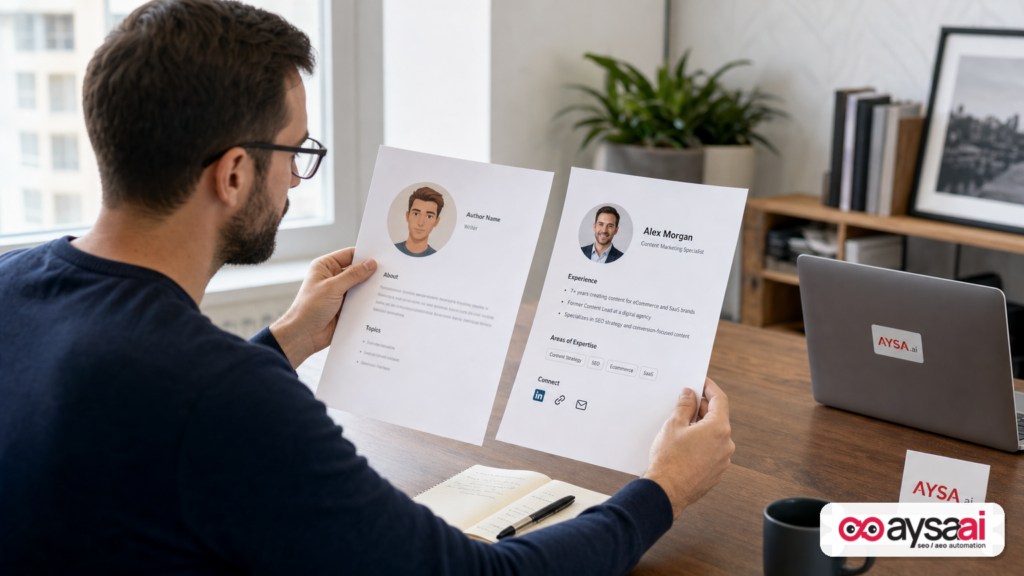
- What changed: Google’s people-first content guidance now explicitly warns against fake author profiles (AI headshots, invented names, false credentials) and labels them deception.
- Why it matters: Deception reduces trust for users and can be interpreted by Google’s automated quality systems as a low-quality signal, with potential impacts on rankings and AI citations.
- What to do: Audit author pages, bios, headshots, and credentials; fix or remove deceptive elements; build a consistent authorship workflow with verification and editorial accountability.
- Where AYSA fits: AYSA monitors the site for authorship risks, prepares safe updates, routes them for approval, and executes accepted changes—so you can clean up authorship at scale without breaking templates or publishing mistakes.
Key takeaways (for busy operators)

- Stop using “author theater.” A glossy author box with a synthetic headshot and a vague bio is now explicitly called out as deception.
- Don’t confuse “bylines” with “trust.” Google has previously indicated bylines themselves aren’t a ranking boost; the win comes from credibility and transparency.
- Fix the whole system, not one page. If your CMS generates author boxes across thousands of URLs, treat this like a sitewide compliance project.
- Use real expertise or be honest about process. Editorial teams are fine; fabricated individuals and credentials are not.
- Prepare for AI visibility. AI Search experiences and agents will increasingly prefer sources that can explain “who wrote this, and why should I trust them?”
Table of contents

- The Update: Google Now Labels Fake Author Profiles As “Deception”
- Context: Helpful Content Guidance, Rater Guidelines, And The Trust Layer
- Why Google Cares: Trust Signals Power Rankings, Conversions, And AI Citations
- What Actually Counts As “Fake” Authorship (And What Doesn’t)
- How Fake Authorship Backfires: SEO, Legal, Brand, And Operational Risk
- A Concrete SME Scenario: The Local Clinic With “Invented Experts”
- A Practical Audit: Find Fake, Vague, Or Risky Authorship Across Your Site
- Fixes That Work: Clean Profiles, Clear Accountability, Real Review Process
- What “Good” Looks Like: A Defensible Authorship System (Not A Bylines-For-SEO Hack)
- Structured Data & Templates: Don’t Let Schema And CMS Defaults Create Risk
- Agency Playbook: Scaling Authorship Fixes Without Breaking Trust
- Where AYSA Fits: Monitoring + Approved Execution For Authorship And Trust
- What to do next
- Sources and further reading
The Update: Google Now Labels Fake Author Profiles As “Deception”
Search Engine Journal reported that Google updated its people-first content guidance with a new warning: avoid deceptive authorship information, including AI-generated headshots, made-up names, and false credentials used to make content appear like it was created by human experts. Google’s guidance says deception makes a page untrustworthy to users and to Google’s automated quality systems—and it’s a signal of low quality.
Read the original reporting here: Search Engine Journal – Google Adds Fake Author Warning To Helpful Content Guidance.
Two important implications to internalize:
- This is aimed at site owners, not just internal rater docs. Google is making expectations explicit for publishers, SMEs, and brands.
- The framing is “trust”—not “spam.” This suggests broader enforcement and spillover effects. When trust is compromised, you don’t just lose one Keyword; you can lose confidence across a topic area.
Context: Helpful Content Guidance, Rater Guidelines, And The Trust Layer
Google’s “helpful, reliable, people-first content” guidance has long pushed publishers to answer a basic question: who created this content, and why should I trust it? The new fake-author paragraph appears in the “Who (created the content)” section—right where Google encourages accurate bylines and creator information.
SEJ’s reporting notes that Google’s Search Quality Rater Guidelines already treat fake creator profiles and false claims of expertise as deception and instruct raters to give the Lowest rating in those cases. The key nuance: quality raters don’t directly control rankings, but their guidelines shape what Google trains and evaluates. When Google copies themes from rater guidelines into site-owner documentation, it’s often a sign the company wants fewer “loophole” interpretations.
Google has also previously downplayed the idea that simply adding bylines will improve rankings. SEJ referenced a January 2024 statement from Google’s Search Liaison indicating bylines themselves aren’t a ranking factor. The takeaway is simple: authorship markup and author boxes are not magic SEO. They’re evidence—sometimes weak, sometimes strong—of real trust.
If you’re building a durable search strategy for 2026–2027, you need to treat authorship as part of your brand’s trust infrastructure, not as a WordPress plugin setting.
Why Google Cares: Trust Signals Power Rankings, Conversions, And AI Citations
When Google says “deception makes a page untrustworthy,” that’s not just moral language. It’s product language.
Google’s users have a problem: the web is increasingly full of content that looks professional but isn’t accountable to reality. AI makes it easy to generate plausible articles, plausible authors, and plausible credentials at scale. If Google can’t separate “real expertise” from “manufactured expertise,” users lose confidence in search results—and advertisers, too.
Now layer in AI search experiences. Even if you don’t follow every AI-search product change, the direction is obvious: more summaries, more citations, more agent-like behaviors. In that world, your brand’s chance of being cited is influenced by how verifiable and consistent your information appears across the site.
Authorship affects business outcomes in three practical ways:
- Search performance stability: Trust signals reduce the odds of topic-level demotion when quality systems get stricter.
- Conversion: People click “About the author” and “About the company” when stakes are high—health, finance, legal, expensive purchases, B2B contracts.
- AI citations and referrals: Systems that summarize the web need sources. They’ll often choose content that looks accountable and maintained.
This is where most teams get it wrong: they treat trust as design. Google is treating trust as verifiability and honesty.
What Actually Counts As “Fake” Authorship (And What Doesn’t)
The SEJ article highlights three examples Google names: AI-generated headshots, made-up names, and false credentials. Let’s translate that into real-world patterns I see across SMEs and agencies.
Clear deception (stop doing this)
- Invented experts: “Dr. Sarah K., Nutrition Scientist” with no real person behind it, used to publish supplement content.
- Fabricated credentials: claiming medical, legal, financial, or engineering credentials that no author actually holds.
- AI headshots used to imply a real person: even if the content itself is good, the “creator profile” is presenting a fictional identity.
- Fake author pages with generic bios and no way to verify identity, tied to sensitive topics.
Risky gray zone (depends on intent and execution)
- “Editorial Team” as a byline: can be fine for newsrooms, ecommerce blogs, and resource centers—if you explain the editorial process and accountability.
- Pseudonyms: sometimes valid for safety or privacy, but risky if used to create an illusion of credentials or experience.
- Stock photos as avatars: not necessarily “AI-generated,” but can still be misleading if it suggests a real author portrait.
What Google likely wants (and users definitely want)
- Accurate Attribution: real names where possible, or transparent team attribution with clear responsibility.
- Honest credentials: job titles and experience that can be backed up (even if not publicly linked, at least internally verifiable).
- Editorial accountability: “Reviewed by” and “Fact-checked by” workflows—when you actually do them.
Important: nothing in the change says “you must have individual bylines for every page.” The warning is about fabrication. You can be private. You can be a team. You can use contractors. But you can’t pretend.
How Fake Authorship Backfires: SEO, Legal, Brand, And Operational Risk
Most teams focus on “will this rank?” That’s too narrow. Fake authorship creates four categories of risk.
1) SEO risk: quality systems don’t need to “detect AI” to detect deception
Google doesn’t have to prove a headshot is AI-generated with 100% certainty. It can evaluate whether your site repeatedly uses low-verifiability creator identities, inconsistent bios, thin author pages, and exaggerated claims. When those patterns correlate with low user trust, the site becomes fragile.
And once a brand becomes “fragile,” even good pages can struggle to recover because trust is evaluated across topics and templates, not just individual URLs.
2) AI visibility risk: citations prefer sources that look accountable
When AI systems pick citations, they need stable, attributable sources. A site with inconsistent authorship and unverifiable bios looks risky. Even if your content is accurate, your presentation signals unreliability.
If your leadership team cares about future-proofing traffic, you should read up on AI search developments and SEO news (as a starting point, SEJ maintains an ongoing section on AI Search).
3) Brand and PR risk: customers and journalists notice
Fake profiles are a reputational time bomb. Users reverse-image-search headshots. Competitors call it out. Journalists love a “brand used fake experts” story. Even if the SEO impact is unclear, the brand impact can be immediate.
4) Legal/compliance risk: credentials claims can cross lines
I’m not a lawyer, but it’s obvious that false claims—especially in medical, financial, or legal contexts—can create consumer protection and regulatory exposure. If you’re in a regulated industry, treat this as compliance, not marketing.
A Concrete SME Scenario: The Local Clinic With “Invented Experts”
Let’s make this painfully practical.
Imagine a local clinic that hires a marketing vendor to “scale content.” The vendor publishes 200 blog posts on common symptoms and treatments. Each post has a byline: “Dr. Emily Hart, MD” with a polished headshot. The author page lists board certifications that don’t exist. None of it is real.
For a while, traffic goes up. Then:
- A patient asks at the front desk to book with Dr. Hart. Awkward moment.
- A competitor flags it publicly. Now it’s not just SEO—it’s reputation.
- Google’s systems (and users) interpret the mismatch as deception, and the entire health content folder becomes less trusted.
What should the clinic do instead?
- Use a real medical reviewer (even part-time) and state the scope of review.
- Attribute content to the clinic editorial team, with transparent process notes.
- Write within the clinic’s actual service area and expertise, linking to real staff pages and service pages.
This isn’t “less SEO.” It’s more durable marketing.
A Practical Audit: Find Fake, Vague, Or Risky Authorship Across Your Site
Here’s the audit approach I recommend for SMEs and agencies. This is structured to be executable—especially if you manage hundreds or thousands of pages.
Step 1: Inventory every place “authorship” appears
- Post bylines on articles, guides, and category content
- Author bio boxes on templates
- Dedicated author pages (/author/name/)
- “Reviewed by” modules and disclaimers
- Team pages and About page
- Schema markup (Person/Organization)
If you don’t know how to collect this, treat it as a technical + content collaboration. Technical SEO resources can help—SEJ’s Technical SEO section is a decent starting point for teams that need to level up.
Step 2: Flag obvious deception signals
- Names that don’t exist internally
- Headshots that are AI-generated or inconsistent with reality
- Credentials that cannot be verified (or aren’t true)
- Author bios that never mention real experience, role, or accountability
- YMYL content attributed to non-experts without review notes
Step 3: Classify content by risk level
- High risk: health, finance, legal, safety, major purchases, “how to treat,” “how to invest,” etc.
- Medium risk: product advice, comparisons, travel safety, business compliance
- Lower risk: brand story, simple how-tos, non-sensitive topics (still not an excuse for fake people)
Step 4: Decide remediation paths
There are only a few realistic outcomes:
- Replace with real author and real bio
- Convert to “Editorial Team” with transparent process
- Add “Reviewed by” with an actual reviewer
- Remove deceptive modules (headshot, credentials claims) until fixed
Step 5: Verify before publishing
This is where most organizations fail. They “fix” bios quickly and accidentally introduce new inaccuracies. Verification should include:
- Confirming names and roles with HR / leadership
- Confirming credentials claims are true and current
- Confirming headshot rights and authenticity
- Confirming schema matches on-page content
Fixes That Work: Clean Profiles, Clear Accountability, Real Review Process
Let’s talk solutions that don’t require a giant brand newsroom.
The “minimum viable” credible author page
For individual authors, aim for:
- Real name (or defensible alternative)
- Current role at the company (or relationship: contractor, contributor)
- Relevant experience (what they’ve done, not buzzwords)
- Scope: what topics they write/review
- Transparency: how content is created and reviewed
Notice what’s missing: “SEO fluff.” No exaggerated titles. No fake awards. No credential inflation.
When “Editorial Team” is the right answer
If your content is a collaborative effort, be honest:
- Use a team byline
- Explain the editorial process
- Name the accountable editor or department
- For sensitive topics, add an actual reviewer
For many SMEs, this is the cleanest and safest approach—especially if you can’t maintain individual bios responsibly.
Use a reviewer model without pretending
Many businesses don’t have a full-time expert writer. That’s normal. You can still publish helpful content if you implement a reviewer model:
- Content drafted by the marketing team or a writer
- Reviewed by a qualified internal/external expert
- Review scope stated clearly (“Reviewed for clinical accuracy on [date]”)
What you cannot do: list a reviewer who didn’t review.
What “Good” Looks Like: A Defensible Authorship System (Not A Bylines-For-SEO Hack)
Google’s change is a reminder that authorship is a system. Here’s what a defensible system includes.
1) A documented authorship policy (one page is enough)
Write down:
- Who can be listed as an author
- What counts as a credential worth mentioning
- When to use a team byline
- When review is required
- How often bios and pages are re-verified
2) Content briefs that force clarity on “who” and “why”
Every piece of content should answer:
- Who created it?
- Who reviewed it (if needed)?
- What experience or evidence supports the claims?
- What primary sources are cited where appropriate?
3) Maintenance cadence (trust decays)
Staff changes. Credentials change. Old content becomes outdated. If you don’t maintain authorship pages, they become wrong—then wrong becomes deceptive.
Build a quarterly or biannual check, especially for high-risk topics.
Structured Data & Templates: Don’t Let Schema And CMS Defaults Create Risk
Authorship problems often come from templates, not intent.
Common failure modes:
- A WordPress theme auto-generates author archives for every user, including fake placeholders.
- Schema markup declares
Personcredentials that aren’t visible on the page (or aren’t true). - Multiple plugins inject conflicting author data.
If you’re running WordPress, treat this as a templating and governance issue, not a “content team” issue. (If you need ongoing WordPress SEO context, SEJ also maintains a broader SEO section and a SEO News stream that can help teams keep pace.)
Two practical rules:
- Schema must match reality. If the page doesn’t support a claim, don’t put it in Structured data.
- Reduce unnecessary author pages. If you can’t maintain them, consolidate or remove them rather than leaving thin, questionable profiles live.
Agency Playbook: Scaling Authorship Fixes Without Breaking Trust
Agencies are under pressure to ship content faster than ever. This Google change is a reminder: speed without accountability will get punished—if not today, then eventually.
Agency step 1: Put authorship in your statement of work
Authorship is not a “nice-to-have.” It’s part of content production. Your SOW should define:
- Who provides author identities and bios (client vs agency)
- Who verifies credentials
- Who approves headshots
- Who owns legal risk
Agency step 2: Use a controlled author roster
Create a roster of approved authors/reviewers with:
- Verified bio copy
- Approved photos
- Credential language that’s accurate and consistent
- Topic coverage boundaries
This avoids the “each writer makes up a bio line” problem that spirals into inconsistency.
Agency step 3: Build a QA checklist that includes deception checks
Add explicit checks:
- No invented credentials
- No AI portraits used as real people
- No reviewer attribution without review
- High-risk topics require primary sourcing and review notes
Agency step 4: Treat remediation as a rollout, not a scramble
If you’re cleaning up a site with 1,000+ posts, don’t “edit live” without a plan. Use staged updates, approvals, and monitoring. That’s how you avoid breaking templates or creating new inconsistencies.
Where AYSA Fits: Monitoring + Approved Execution For Authorship And Trust
This is exactly the kind of work that fails when it lives in spreadsheets and Slack threads. You need a system that can:
- Monitor for risky patterns (thin author pages, mismatched schema, missing bios, template injections)
- Prepare recommended changes (bio templates, author page upgrades, internal linking improvements, policy blocks)
- Ask for approval before anything goes live (because authorship claims are sensitive)
- Execute accepted changes consistently across the site
That’s the AYSA model: an SEO/AEO/GEO execution system that helps teams move from “recommendations” to “approved implementation” without chaos.
Explore the building blocks:
- AYSA Monitoring to catch authorship and trust issues early
- AI Search Visibility to align your content and trust signals for AI-driven discovery
- AI SEO Tools to standardize audits and updates
- Pricing to see what fits your scale (SME vs agency)
- AYSA Blog for ongoing playbooks and updates
My POV: the winners in the next phase of search won’t be the teams who “know the most SEO.” They’ll be the teams who can execute trust consistently—with approval gates, governance, and maintenance built in.
What to do next
Use this as your immediate action list for the next 30 days.
- Run an authorship inventory: list every author name, author page, and template module on the site.
- Remove or replace deceptive elements: AI headshots used as real people, invented experts, inflated credentials.
- Decide your attribution model: real individuals where feasible, or a transparent editorial team model.
- Add review where stakes are high: health, finance, legal, safety, and expensive purchase advice.
- Align schema with reality: ensure Person/Organization markup matches what users can see and verify.
- Set maintenance cadence: quarterly checks for high-risk topics; at least biannual checks sitewide.
- Operationalize with approved execution: use a system so changes are prepared, reviewed, approved, and then deployed consistently.
Sources and further reading
- Search Engine Journal – Google Adds Fake Author Warning To Helpful Content Guidance
- Search Engine Journal – AI Search coverage (ongoing)
- Search Engine Journal – SEO (ongoing)
- Search Engine Journal – SEO News stream
- Search Engine Journal – Technical SEO
Note: SEJ’s report references updates to Google’s Search Central “people-first content” page and alignment with themes in the Search Quality Rater Guidelines. This editorial uses SEJ as the research source and focuses on practical implementation for SMEs and agencies without assuming access to additional primary documents beyond what was described in the provided source context.
Continue the AI search topic inside AYSA.
Use these pages to connect the article with AI SEO tools, AI visibility monitoring, AI Overviews and approved website execution.
Turn this topic into a website action plan.
Use these AYSA hubs to move from reading to technical fixes, AI visibility monitoring, research, glossary context and approval-first SEO execution.