Google’s New AI Content Rule: Manual Fact-Checks, Trackable Gemini Clicks, And The Analytics Reset Every Business Needs
Google now explicitly tells publishers to manually fact-check AI-written body copy and metadata. At the same time, Gemini is surfacing links with UTM parameters, and CTR benchmarks are shifting amid known Search Console measurement history. Here’s what changed, why it matters for SMEs and agencies, and a practical execution plan—built for an AI search world where “what’s written down” is only half the story.
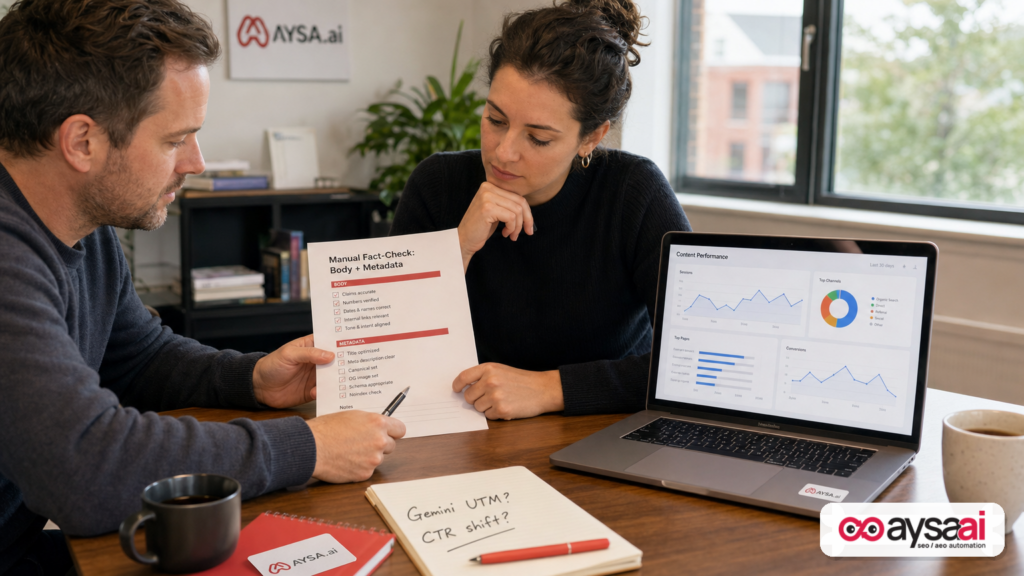
Search is in a weird phase right now: Google is telling everyone to use AI, but also quietly raising the bar on what “good” looks like. The most important recent signal isn’t a new ranking factor or another vague “helpful content” reminder. It’s procedural.
Google updated its AI content guidance to explicitly say you should manually fact-check AI-generated content before publishing—including metadata like titles, meta descriptions, Structured data, and image alt text. At the same time, Google’s Gemini is surfacing outbound links that appear to include UTM parameters, which could materially change how AI-driven visits show up in analytics. And CTR benchmarks are being discussed in a period where measurement history matters more than most people admit.
This editorial breaks down what changed, why it matters for real businesses (not just SEOs), and what to do next—especially if you’re an SME or an agency trying to scale output without shipping errors. I’ll also show where AYSA’s AI search visibility, monitoring, and “Approved Execution” model fit into this new reality: monitor, prepare, ask for approval, execute accepted website changes.
Concise summary

Google is moving the AI content conversation from “is AI allowed?” to “how do you control quality at scale?” Manual fact-checking (including metadata), improved Attribution for Gemini Clicks via UTMs, and cautious interpretation of CTR shifts are now operational necessities. Businesses that treat this as a workflow change—not a one-time SEO tweak—will be in the best position for both classic search and AI-driven discovery.
Table of contents

- Key takeaways (read this first)
- Context: the theme of 2026–2027 is “what’s written down” vs. what’s merely observed
- What changed: Google now says “manually fact-check” AI content (and metadata)
- Why metadata is the new AI risk surface
- A practical fact-check workflow SMEs can actually run
- Gemini links with UTM tags: attribution is changing (quietly)
- How to set up tracking without making your analytics worse
- Desktop CTR down, mobile CTR up: why benchmarks can mislead in 2026–2027
- AI Mode information monitoring: what it implies for discovery and demand
- AI Overviews lawsuits dismissed: what that does (and doesn’t) change
- Concrete SME scenario: an ecommerce brand avoids “AI errors at scale”
- What agencies should rethink: the product is execution, not advice
- Where AYSA fits: monitoring, preparation, approval, execution
- What to do next (action list)
- Sources and further reading
Key takeaways (read this first)

- Google’s AI guidance now explicitly requires manual fact-checking before publishing AI-generated content—and it applies to metadata too (titles, meta descriptions, structured data, alt text). This is a workflow requirement, not a writing tip.
- Gemini may add UTM parameters to outbound links, which can help identify AI assistant-driven sessions even when referrers are missing or bucketed incorrectly. But the behavior is not fully documented, so tracking needs redundancy.
- CTR comparisons across quarters can be fragile. If the underlying measurement changes (or has known anomalies), your “CTR is down” story might be a math artifact. Validate before you react.
- AI discovery is becoming “subscription-like” through features such as AI Mode information Monitoring. That means staying cited and linked is not only about ranking—it’s about being selected as an update source.
- Operational SEO wins in 2027 come from execution systems: constant monitoring, controlled updates, approvals, and fast implementation. That’s the gap AYSA is built to close.
Context: the theme of 2026–2027 is “what’s written down” vs. what’s merely observed
One of the best frames from this week’s SEO conversation is the difference between:
- Documented changes (written down in official guidance, changelogs, or public docs), and
- Observed changes (spotted in the wild by users, surfaced in forums, hinted at by a Googler on social).
This matters because businesses can build process around what’s documented. Observed behavior still matters, but it requires evidence gathering, monitoring, and a willingness to treat “we think this is happening” as a hypothesis, not gospel.
The source reporting that kicked off this editorial is the SEO Pulse update from Search Engine Journal, which covers Google’s updated AI content guidance, Gemini UTM tagging observations, CTR shifts reported by Advanced Web Ranking, AI Mode monitoring rollout, and recent AI Overviews lawsuits. Here is the primary source article for context: Search Engine Journal – SEO Pulse: Google Wants AI Content Fact-Checked, Gemini UTM Tags.
I’m going to go deeper than the news: what the operational implications are, what can go wrong, and how SMEs and agencies should build a system that doesn’t crumble under AI content volume.
What changed: Google now says “manually fact-check” AI content (and metadata)
Google’s AI content position has steadily evolved from a simple principle—“focus on helpfulness and quality regardless of how it was produced”—into more explicit guidance about AI’s limitations. The newest addition is straightforward: generative AI predicts word sequences; it does not reliably retrieve facts, so humans must verify accuracy before publishing.
According to Search Engine Journal’s coverage, Google updated its AI-generated content guidance by adding language that makes manual fact-checking “critical,” and clarifies that the same review applies to metadata fields including titles, meta descriptions, structured data, and image alt text. The practical takeaway is that your “AI policy” can’t stop at the writer’s draft. It must include the SEO layer.
From a business perspective, this update is more than compliance theater. Google is effectively telling the market: if you want the productivity benefit of AI, you need the accountability layer of a newsroom.
My point of view: this is Google quietly demanding governance. Not because they’re being nice, but because low-quality AI content is poisoning search results, user trust, and potentially their own AI answers. If you don’t add process, you’ll ship confident nonsense—at scale.
What “manual fact-checking” means in practice
Manual fact-checking isn’t “skim it for typos.” For most SMEs, it means:
- Verifying names, dates, prices, features, coverage areas, and availability
- Confirming product/service claims match actual inventory and policies
- Ensuring “helpful” explanations don’t drift into legal/medical/financial advice
- Reviewing metadata that influences clicks and interpretations (title tags, descriptions, schema)
And yes—this also includes content you didn’t think of as “content,” such as alt text and structured data that can be surfaced in search features.
Why metadata is the new AI risk surface
Metadata used to be seen as an SEO technician’s playground: titles, descriptions, schema, and image attributes. In an AI search era, metadata becomes a truth layer and a promise layer—it’s where you make precise claims quickly.
If an AI model writes your title tag, it may do what models do best: create plausible, persuasive phrasing that sounds right. That’s exactly the problem. A title tag that promises “24/7 Emergency Service” because the model saw that pattern elsewhere is not a minor mistake—it’s a trust breach and a customer support nightmare.
Common ways AI-generated metadata goes wrong
- Overclaiming: “best,” “#1,” “guaranteed,” “same-day” when you can’t support it
- Incorrect specifics: wrong prices, shipping windows, ingredients, compatibility, locations served
- Schema drift: structured data that doesn’t match the page (wrong Product vs Service type, wrong availability)
- Alt text hallucinations: describing what the model assumes is in the image, not what’s actually there
- Legal/compliance risk: healthcare/finance claims that cross a line
And here’s the bigger issue: metadata mistakes can scale faster than body-copy mistakes because teams often “bulk optimize” metadata across hundreds of pages at once. If AI is in that pipeline, your error multiplier is massive.
A practical fact-check workflow SMEs can actually run
Most small and mid-sized businesses don’t have a dedicated fact-checker. So “manual fact-checking” must be implemented as a role-based checklist tied to the people who already own the truth:
- Owner/GM owns prices, hours, service area, policies
- Ops lead owns availability, turnaround time, operational constraints
- Product lead owns features/specs and what’s actually shipped
- Marketing lead owns positioning, messaging, brand tone
The “two-lane review” model (fast + safe)
To keep velocity, split review into two lanes:
- Lane 1: Factual validation (must-pass)
- Every number (prices, dates, quantities)
- Every “availability” claim (in stock, appointment windows, shipping times)
- Every compliance-sensitive statement
- Structured data matches the page content
- Title/meta description reflect reality
- Lane 2: Editorial quality (should-pass)
- Tone, clarity, redundancy
- Does this answer the user’s question?
- Does it include proof points or references where appropriate?
Lane 1 is non-negotiable. Lane 2 can be improved iteratively.
Build a “metadata QA list” once, then reuse it
Your QA list should explicitly include:
- Title tag: accurate offer, no overclaims, matches page
- Meta description: accurate, not misleading, no invented promos
- H1: aligned with title, not spammy
- Schema: correct type, required properties accurate, no fake ratings
- Alt text: describes the image; avoid stuffing keywords
Whether you do this in a spreadsheet, a ticketing system, or an SEO platform, the key is: this is now a repeatable operating procedure.
AYSA’s role here is to operationalize this into an execution loop—monitor pages, prepare suggested changes, route them for approval, and then deploy the approved updates. If you want the overview of how AYSA approaches AI search work, start here: AYSA AI SEO tools and AYSA monitoring.
Gemini links with UTM tags: attribution is changing (quietly)
One of the biggest problems in the “AI search” era is that traffic attribution is messy. Many AI-driven visits don’t arrive with clean referrers. Some end up bucketed into ambiguous categories in analytics.
Search Engine Journal reports that a Reddit user observed UTM parameters on links from Google’s Gemini, and that Google’s John Mueller acknowledged seeing them too. The reporting also notes Google hasn’t clearly documented when and how Gemini adds these tags. (That “undocumented behavior” theme matters: you can’t build a perfect system off a rumor, but you can build monitoring to detect and use it.)
Why this matters for operators: UTMs offer a second signal to identify Gemini-originated sessions without depending entirely on referrers. If UTMs become more common, teams that set up campaign parsing and channel grouping properly will see a clearer picture of AI assistant performance.
What this could mean (without over-claiming)
Because the behavior isn’t fully documented, it’s best framed as a set of possibilities:
- Best case: Gemini consistently tags outbound clicks, giving you reliable attribution.
- Mixed case (more likely right now): some Gemini surfaces tag links, others don’t, or tags vary by device/experience/region.
- Worst case: tagging changes frequently, breaking dashboards unless you maintain flexible parsing.
The correct business posture is: treat Gemini UTMs as a helpful bonus signal, not the only way you measure AI discovery.
How to set up tracking without making your analytics worse
If you’re an SME, you don’t want to spend months perfecting attribution. You want actionable clarity: “Are AI assistants sending us customers?”
Here’s a pragmatic approach that won’t require hero-level analytics work.
1) Keep referrer-based tracking—but assume it’s incomplete
Continue to review traffic sources that indicate Google properties and AI experiences. But acknowledge the reality: referrers can be absent or obscured.
2) Capture and normalize UTMs in your analytics
If UTMs appear, you want them categorized consistently. This typically means:
- Ensuring your analytics setup preserves query parameters
- Avoiding filters that strip UTMs
- Creating a dedicated reporting view or exploration focused on AI-driven UTMs
Important caution: don’t create a dozen new “campaigns” that fragment reporting. Map UTMs into a small set of meaningful buckets (e.g., “gemini / ai-assistant”).
3) Compare UTM-detected sessions vs referrer-detected sessions
SEJ’s coverage suggests exactly the right analytical mindset: compare what UTMs catch vs what referrers catch. The gap between the two is the story.
4) Audit the landing pages that receive AI traffic
AI traffic often lands deeper in the site—FAQs, product detail pages, “best of” guides, location pages. Those pages must be:
- Accurate
- Up to date
- Clear about next steps (buy, book, call)
This is where an execution system matters. It’s one thing to notice that Gemini traffic lands on a page with outdated pricing. It’s another to get the fix live reliably. AYSA is designed for that: monitor, prepare changes, request approval, execute. If you want to see how we describe that workflow publicly, start at AYSA Monitoring and explore our approach to AI search visibility.
Desktop CTR down, mobile CTR up: why benchmarks can mislead in 2026–2027
Search Engine Journal also highlighted an Advanced Web Ranking (AWR) CTR report indicating that desktop click-through rates fell at top organic positions in Q2 while mobile CTR rose—opposite of Q1 findings. That’s the kind of headline that can trigger panic: “Desktop SEO is dying,” “Mobile is back,” etc.
But SEJ also includes a critical nuance: the comparison period spans the end of a Search Console impressions logging error (as described in the SEJ coverage), which could create a measurement break. CTR is clicks divided by impressions. If impressions were misreported and later fixed, the CTR line can move even if user behavior didn’t.
My point of view: CTR is becoming one of the most misused metrics in executive conversations. Not because CTR is useless, but because the ecosystem is changing (AI answers, new SERP layouts, reporting anomalies), and people still treat CTR like it’s a stable KPI across time and device.
How to use CTR responsibly right now
- Segment first. Brand vs non-brand. Mobile vs desktop. Country vs country. Search appearance types if available.
- Annotate known measurement breaks. Any reporting issue fix date belongs on your charts.
- Look at the full funnel. If CTR falls but qualified leads rise, don’t “fix CTR” as a vanity goal.
- Validate with other signals. Landing-page sessions, conversions, assisted conversions, call volume, bookings.
CTR in an AI-first SERP is not a pure “ranking” story
As AI experiences expand, more queries are resolved without a click, and when clicks happen, they may be distributed differently. So when CTR changes, ask:
- Did SERP layout change for our query set?
- Did AI Overviews appear more often?
- Did competitors add more structured data or richer snippets?
- Did our titles/descriptions become less accurate or less compelling after AI optimization?
That last question is uncomfortable: AI-written metadata can reduce CTR if it becomes generic, repetitive, or misaligned with intent. Manual review protects you.
AI Mode information monitoring: what it implies for discovery and demand
SEJ also noted that Google’s AI Mode “information monitoring” is rolling out more broadly, based on an announcement shared on X by a Google executive (as reported by SEJ). The core idea: users can ask AI Mode to monitor a topic, and Search continuously scans for updates and returns notifications or updates.
Even if you’re not using this feature today, the direction matters: Google is pushing search from “pull” to “pull + push.” Users won’t just search again; they’ll subscribe to a topic and expect updates.
What businesses should ask
- When AI Mode sends an “update,” does it link out—and to whom?
- What content formats are most likely to be selected as an update source?
- Do “monitoring” topics skew local, shopping, or informational?
SEJ’s coverage raises a fair point: the public posts don’t fully explain how sources are selected. So the only responsible approach is to treat this as another monitored surface: observe what appears in your vertical once you have access, and adjust content strategy based on evidence.
This is exactly why monitoring matters as much as content creation now. At AYSA, monitoring is a first-class capability because AI search surfaces are moving targets. Learn more: AYSA Monitoring.
AI Overviews lawsuits dismissed: what that does (and doesn’t) change
Another item in SEJ’s Pulse: a U.S. District Judge dismissed antitrust complaints from publishers related to AI Overviews, according to SEJ’s reporting. The judge’s rationale (again, as relayed by SEJ) included that plaintiffs failed to plausibly allege an agreement and lacked standing for certain monopoly claims, and that the court did not treat alleged harms lightly—but antitrust law is not a substitute for lawmakers addressing economic upheaval.
Whatever your stance on publisher rights and platform power, there’s a practical business takeaway:
- Don’t wait for court outcomes to define your distribution strategy.
- Assume AI-driven SERP features will persist and expand.
- Invest in being the best-cited, best-linked, most accurate source in your niche.
This is not about liking the situation. It’s about operating under the constraints of the market you’re in.
Concrete SME scenario: an ecommerce brand avoids “AI errors at scale”
Let’s make this real with a scenario that’s common in 2026–2027.
Scenario: a mid-sized ecommerce store scaling category pages with AI
A specialty ecommerce brand sells home fitness accessories—bands, mats, recovery tools. They have 400+ SKUs and dozens of near-duplicate category pages. Their team uses generative AI to rewrite product descriptions and generate SEO metadata faster.
What goes wrong without manual fact-checking:
- AI-generated titles promise “free returns” globally, but returns are only free in the U.S.
- Meta descriptions mention “BPA-free” for products where that claim is irrelevant or unverified.
- Product schema “availability” is set to InStock for discontinued colors because the model inferred it from similar items.
- Alt text states “includes carrying case” because that’s common in the category—leading to complaints.
What it costs: support tickets, refunds, chargebacks, negative reviews, and degraded trust. SEO doesn’t just become ineffective; it becomes harmful.
How the brand fixes it (the playbook)
- They define a fact set: shipping policy, returns policy, warranty language, material claims, and product attributes—pulled from the source of truth (inventory and policy docs).
- They implement a metadata QA gate: no page is published unless the title/meta/schema match verified facts.
- They monitor pages that receive AI assistant traffic: any page with AI-driven sessions gets prioritized QA and updates.
- They separate AI attribution signals: referrer-based and UTM-based, so they can measure the impact of improvements.
The result: fewer customer-facing errors and cleaner measurement of which pages are actually pulling demand from AI and search surfaces.
This is the heart of modern SEO strategy: accuracy, attribution, and execution speed.
What agencies should rethink: the product is execution, not advice
If you run an agency, the uncomfortable truth is that AI has commoditized a lot of traditional deliverables:
- Keyword lists
- Content briefs
- First drafts
- Basic on-page recommendations
But AI has not commoditized the ability to ship accurate changes reliably across a site, with governance, approvals, and auditability.
What clients will pay for in 2027
- Governed content production: fast output without factual risk
- Measurement clarity: separating AI assistant traffic from everything else
- Execution throughput: implementing fixes in days, not quarters
- Monitoring: knowing when an AI surface changes before traffic collapses
That’s why “approved execution” is becoming the model: the system proposes changes, humans approve, the system executes. Agencies can scale quality without scaling headcount linearly.
If you want to understand how AYSA approaches that as a productized capability, browse AI SEO Tools and see how our pricing aligns with execution outcomes rather than just reporting.
Where AYSA fits: monitoring, preparation, approval, execution
Let’s map the week’s changes directly to an execution system.
1) AI content governance: fact-checking as a built-in gate
Google’s guidance update effectively mandates a new standard operating procedure. AYSA’s model supports it by structuring work as:
- Monitor pages and templates that change frequently (product pages, service pages, location pages).
- Prepare proposed updates (content + metadata) based on the site’s truth sources and search intent.
- Ask for approval from the right business owner (ops, product, compliance).
- Execute the accepted changes consistently, with an audit trail.
This is how you scale AI output without scaling errors.
2) AI search visibility: measuring what AI assistants actually send
If Gemini UTMs become common, visibility becomes easier—but still not “easy.” You need monitoring and analytics hygiene to separate signals cleanly. AYSA’s emphasis on AI search visibility is built around a simple premise: you can’t improve what you can’t identify.
3) Monitoring AI surfaces: don’t treat undocumented behavior as noise
“What’s written down” is only part of the story. Gemini UTMs and AI Mode monitoring are examples of behavior that may emerge before full documentation. That’s exactly why monitoring has to be continuous: you want to detect patterns early, validate them with your own data, then adjust.
4) Keep your team educated (without doomscrolling)
The AI search environment changes quickly, but most business owners can’t track it daily. A practical approach is to centralize learning and translate it into process. For ongoing AYSA perspectives, you can follow updates on our blog.
What to do next (action list)
Here’s a concrete plan you can run this month—whether you’re an SME team or an agency.
Next 7 days: stabilize quality
- Create a one-page “AI Fact-Check Standard.” Include body copy + title + meta description + schema + alt text.
- Define the “truth sources” (pricing sheet, policy pages, inventory system, hours/location records).
- Pick an approver for each truth category (ops, product, owner).
- Audit your top 25 landing pages (by revenue/leads) for AI-generated overclaims and metadata drift.
Next 30 days: fix attribution and reporting
- Check if any inbound sessions contain Gemini-related UTM parameters. If yes, group them into a consistent “AI assistant” bucket.
- Compare referrer-based vs UTM-based AI session counts to estimate undercounting.
- Annotate your CTR dashboards with any known measurement breakpoints and stop making quarter-over-quarter CTR claims without segmentation.
Next 90 days: build an execution system
- Turn recurring SEO work into a queue. Content updates, metadata QA, schema cleanup, internal linking improvements.
- Implement “approved execution.” Changes get proposed, reviewed, then shipped—fast.
- Set up monitoring tasks for AI-driven discovery surfaces and the pages they cite/send traffic to.
- Invest in AI search visibility as a durable strategy, not a trend.
If you want to explore how AYSA supports this operational model, start with: AI search visibility, monitoring, and pricing.
Sources and further reading
- Search Engine Journal – Google Wants AI Content Fact-Checked, Gemini UTM Tags – SEO Pulse
- Search Engine Journal – AI Search coverage
- Search Engine Journal – SEO coverage
- Search Engine Journal – Technical SEO coverage
- Search Engine Journal – SEO News
Note: Some items discussed above (for example, the precise mechanics of Gemini UTM tagging and AI Mode monitoring source selection) are described in the SEJ coverage as not fully documented by Google at the time of writing. Where the ecosystem is unclear, the correct approach is to treat observations as hypotheses, validate in your own analytics, and rely on monitoring rather than assumption.
Continue the AI search topic inside AYSA.
Use these pages to connect the article with AI SEO tools, AI visibility monitoring, AI Overviews and approved website execution.
Turn this topic into a website action plan.
Use these AYSA hubs to move from reading to technical fixes, AI visibility monitoring, research, glossary context and approval-first SEO execution.