Shopify’s AI Shopping Auto-Enroll: The New Distribution Layer (And the Measurement Trap) for Ecommerce SEO
Shopify can now auto-enroll eligible stores into new AI shopping channels—sometimes with in-chat checkout that bypasses your site analytics. Here’s what changed, why it matters, what to monitor, and how to stay visible (and profitable) as “agentic storefronts” reshape ecommerce SEO.

By Marius Dosinescu (AYSA.ai)
Ecommerce is entering a distribution era where your “storefront” is no longer your website—it’s wherever an AI assistant decides to shop. Shopify’s latest move makes that shift feel less like a future trend and more like a default setting: eligible stores can be automatically enrolled into new AI shopping channels as Shopify adds them. Some of those channels support direct checkout inside the AI app, meaning customers can pay without ever visiting your site.
This is a gift and a warning at the same time.
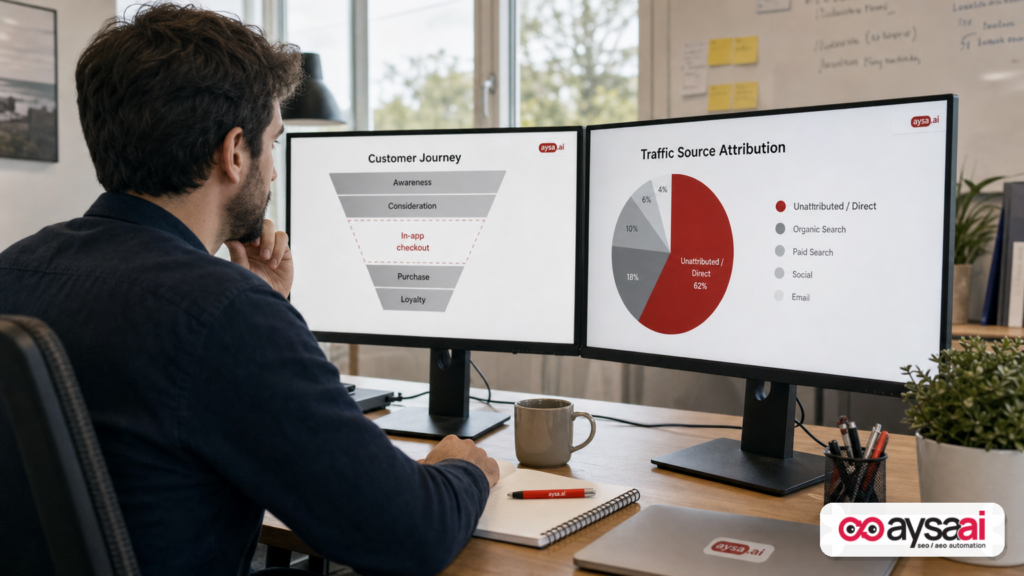
It’s a gift because it can create incremental revenue with almost no setup. It’s a warning because distribution you don’t actively manage can become margin risk, brand risk, and—most dangerously—measurement risk. When checkout happens off-site, the pixels and client-side analytics many merchants rely on simply don’t fire. You might end up making decisions based on incomplete data, while your real sales are happening in places your reporting doesn’t see.
This editorial uses reporting from Search Engine Journal as a starting point and expands it into a practical playbook for Shopify merchants, ecommerce marketers, and agencies. Source: Search Engine Journal coverage of Shopify’s AI shopping auto-enrollment.
Concise summary

- Shopify can auto-enroll eligible stores into every new “agentic storefront” (AI shopping) channel it adds—unless you turn that setting off.
- Some channels enable direct checkout inside the AI app, which can bypass your website and break client-side tracking (pixels, standard GA4 events, many ad platform tags).
- This changes what “SEO” means for ecommerce: you’re optimizing not only for Google rankings, but for catalog visibility, Structured data, and AI-ready product understanding.
- Merchants should treat this like a new revenue channel with a governance plan: measurement, product eligibility, feed quality, content quality, and margin protection.
- AYSA helps teams operationalize this shift with Monitoring and Approved Execution: we detect visibility changes, prepare fixes, ask for approval, and then implement accepted changes on your site.
Key takeaways (read this if you’re busy)
- Default-on distribution is still a strategy choice. Leave it on by default only if you have monitoring and reporting discipline.
- “No fees for now” is not a pricing model. Expect platform economics to evolve; track orders by channel and know your allowable cost per order.
- Direct checkout is an Attribution trap. If you can’t see it in GA4 or ad dashboards, you will under-invest in what’s working and over-invest in what isn’t.
- Feed-first doesn’t mean page-less. AI agents may shop from catalog data, but humans still need reassurance—policies, proof, clarity, and differentiation.
- Execution beats opinions. The winners will be the merchants who can ship iterative improvements weekly: product data, copy, structured data, measurement, and trust signals.
Table of contents

- What Shopify Actually Changed (And Why It’s Not “Just Another Channel”)
- Why This Matters: AI Shopping Channels Are a New Distribution Layer
- The Hidden Cost: When Checkout Moves Into the Chat, Your Tracking Breaks
- Merchant of Record, Customer Experience, and Brand Risk
- Feed-First Commerce: Why Your Product Page Still Matters (Even When Agents Read Catalogs)
- The New Visibility Stack: Catalogs, Merchant Feeds, and On-Site Signals
- What to Monitor Weekly (So “Auto-Enroll” Doesn’t Surprise You)
- An SME Scenario: The $79 Product That “Sells” Without Any On-Site Sessions
- What Agencies Need to Rethink: Reporting, Retainers, and Ownership
- 90-Day Action Plan for Shopify Merchants
- Where AYSA Fits: Monitoring + Approved Execution for AI Search Visibility
- What to do next
- Sources and further reading
What Shopify Actually Changed (And Why It’s Not “Just Another Channel”)
Historically, ecommerce “channels” were explicit integrations: you opted in, connected a feed, configured payment and shipping, and accepted each channel’s rules. That still exists—but Shopify’s “agentic storefronts” concept introduces a key difference: auto-enrollment into future channels.
As described in the Search Engine Journal report, Shopify has a setting in the admin under Sales channels → Agentic called something like “Allow Shopify to manage for me”. With that enabled, Shopify documentation states that agentic channels can access your products through Shopify Catalog and that stores may be auto-enrolled into new agentic storefront channels as Shopify adds them. (Primary reference in context: Shopify’s own help documentation is quoted and summarized by SEJ; if you’re a merchant, verify the latest wording inside your admin and help center.)
Two implications matter immediately:
- Distribution becomes “silent” unless you watch it. New exposure can turn on without a deliberate business decision.
- Checkout can move off your site. Some AI channels support direct checkout inside the app for qualifying stores.
The SEJ coverage also notes that this mechanism is how eligible products were shared with Meta on launch day for Meta’s AI agent, Muse, and that there’s an “Other channels” grouping described as experimental shopping agents from independent developers and startups (again, merchants should confirm current labels and descriptions in their own admin).
From a business perspective, that’s not a minor UI setting. It’s a governance choice: do you permit a platform to expand your distribution footprint automatically?
Why This Matters: AI Shopping Channels Are a New Distribution Layer
We’re watching the unbundling of the ecommerce funnel.
In classic ecommerce, the funnel looked like:
- Discovery (search, social, ads)
- Landing page (product/Category page)
- Cart + checkout (on your site)
- Post-purchase (email/SMS/CRM)
Agentic commerce changes steps 1–3:
- Discovery happens inside a conversation. The customer asks an assistant for “best options.”
- Selection happens via an agent. The agent compares products using catalog data and web signals.
- Checkout may happen inside the AI app. The customer pays without visiting your website.
That’s not “SEO is dead” territory. It’s “SEO is now one input into a larger machine.” Your product needs to be understandable, eligible, and safe to recommend. Your brand needs to be the low-risk option for an AI to surface. And your measurement stack needs to recognize revenue even when your site never loads.
This is also why AI Search, AEO (answer engine optimization), and GEO (Generative Engine Optimization) have moved from buzzwords to operational requirements. If your products aren’t described in the language real shoppers use—and structured in a way machines can interpret—agents will simply skip you.
For more on how we think about AI visibility, see:
The Hidden Cost: When Checkout Moves Into the Chat, Your Tracking Breaks
The SEJ article highlights a reality many merchants will learn the hard way: when checkout happens inside certain AI apps, your website tracking code doesn’t run. That means:
- Typical analytics events might not fire.
- Third-party pixels might not fire.
- Attribution can collapse into “Direct / Other.”
Even if Shopify records the order in your admin, your marketing stack may not connect the dots. And if you’re making budget decisions from ad dashboards or GA4 alone, you can misread reality.
Here’s what I want merchants to internalize:
- Revenue truth lives in your commerce platform. Shopify becomes the ground truth ledger.
- Analytics becomes an interpretation layer. Useful, but incomplete if it can’t see the checkout.
- Your job is to reconcile. Orders by channel + margin by channel + refund rate by channel + LTV by channel.
What should you do immediately?
Measurement checklist for AI/off-site checkout
- Establish “Shopify orders by channel” as a weekly report. This is your canary in the coal mine.
- Define a channel naming convention internally. Don’t let “Other” become a black hole—use operational notes and weekly review.
- Ensure server-side conversion capture where possible. The SEJ coverage notes that for some in-app checkouts, server-side tracking is the only reliable option.
- Reconcile refunds and support tickets by channel. The cheapest order is the one that doesn’t boomerang back as a chargeback.
This is also where monitoring becomes a competitive advantage. If you’re not watching your channel mix and attribution drift, you’re making decisions with lagging signals.
AYSA can help you operationalize monitoring as a habit instead of a quarterly scramble. Start here:
Merchant of Record, Customer Experience, and Brand Risk
One point emphasized in the SEJ report is that the merchant remains responsible for fulfillment, returns, and customer service. That’s critical: distribution can shift, but accountability often doesn’t.
When an AI assistant becomes the shopping interface, the customer’s expectations also change:
- They expect fewer surprises—shipping, returns, compatibility.
- They expect the assistant’s recommendation to be “safe.”
- They blame the brand when something goes wrong, even if the purchase happened elsewhere.
That creates a new category of ecommerce risk: recommendation risk. If your product data is vague, incomplete, or inconsistent (size charts, compatibility notes, ingredients, warranty), you increase the chance of mismatch—returns, negative reviews, and support load.
So, “leave it on” may be rational for many merchants, but only if you invest in:
- Clear product constraints (what it is and what it isn’t)
- Transparent policies (shipping, returns, warranty)
- Reliable inventory/availability signals
- Accurate variants and attributes
Feed-First Commerce: Why Your Product Page Still Matters (Even When Agents Read Catalogs)
A tempting conclusion is: “If agents read feeds, my product page doesn’t matter.” That’s a costly misunderstanding.
Yes, product catalogs and merchant feeds can become the primary input for AI shopping systems. But the product page still plays at least five roles:
- Verification: AI systems often cross-check claims with on-site text.
- Conversion: Not every channel will do direct checkout; many still send clicks.
- Trust: Policies, reviews, FAQs, and brand proof reduce hesitation.
- Disambiguation: Variant detail and use-cases prevent wrong matches.
- Support deflection: Clear answers reduce customer service costs.
In practice, the winning pattern is feed + page alignment:
- Your feed carries clean attributes and accurate availability/pricing.
- Your product page explains benefits in human language, includes compatibility constraints, and answers objections.
- Your structured data (where applicable) reinforces the same reality.
A simple way to rewrite product pages for AI + humans
If your product pages read like spec sheets, convert them into decision support:
- Lead with “who it’s for.” Example: “For small apartments and pet owners.”
- State the non-obvious constraints. Example: “Does not fit 2021–2022 models.”
- Add a short “Why this one?” section. 3–5 bullets, not fluff.
- FAQ that mirrors real questions. Shipping speed, sizing, returns, durability.
This is where execution systems beat strategy decks. If you need to update 150 product pages, you need a repeatable workflow to propose, approve, and implement improvements quickly and safely.
That’s exactly the kind of work AYSA is designed to support:
The New Visibility Stack: Catalogs, Merchant Feeds, and On-Site Signals
One detail in the SEJ report is especially important: different AI shopping surfaces may source product data differently. For example, the report notes Google as an exception, reading products from Google Merchant Center rather than Shopify Catalog (according to the context provided in the article).
That suggests a practical takeaway: you must treat your product visibility as a stack, not a single pipeline.
Three inputs that increasingly define “visibility”
- Your commerce catalog (Shopify Catalog and product data hygiene)
- Merchant feed ecosystems (e.g., Merchant Center workflows where applicable)
- Your website (copy, structure, internal linking, policies, FAQs, trust)
When these disagree, systems become cautious. In AI shopping, caution means you’re excluded. Your job is to make your product the easiest to understand and the safest to recommend.
Visibility basics most merchants still under-invest in
- Variant clarity: color/size/material/compatibility must be explicit.
- High-signal images: show scale, use-case, and “what’s included.”
- Policy visibility: shipping/returns/warranty should be easily accessible and consistent.
- Inventory accuracy: avoid “in stock” lies; nothing burns trust like cancellations.
If you’re an agency, the opportunity here is to productize this work: “AI-ready product data and trust optimization” as a package, not random SEO tasks.
What to Monitor Weekly (So “Auto-Enroll” Doesn’t Surprise You)
Shopify’s auto-enrollment dynamic means the channel list can evolve. Your job is to prevent “new channel drift” from becoming unobserved risk.
Weekly operations checklist
- Review Sales channel → Agentic settings. Confirm what’s enabled and whether new options appeared. (Verify inside your Shopify admin; labels can change.)
- Review orders by channel. Treat this as financial reporting, not marketing.
- Review refund/return rate by channel. Early signal of mismatch caused by vague product data.
- Spot-check top products in AI assistants. Ask the assistants the same customer questions and record what they recommend. (Do not treat this as scientific; treat it as qualitative QA.)
- Monitor pricing consistency. Misalignment across surfaces creates friction and support issues.
Risk management questions to ask before you scale spend
- Do we know our true CAC by channel if attribution is incomplete?
- Do we know our margin after potential platform cuts (if introduced later)?
- Are we prepared for customer support from off-site purchases?
- Do our policies reduce misunderstanding for agent-driven purchases?
The SEJ report mentions that, as of the time of reporting, certain AI channels did not charge fees beyond payment processing, and it also notes public comments that Meta may take a cut over time. Whether or when fees change isn’t something I can verify from within this research packet alone—so treat it as a scenario, not a guarantee. The point is: the economics of distribution always changes once a channel proves it can drive demand.
An SME Scenario: The $79 Product That “Sells” Without Any On-Site Sessions
Let’s make this real with a scenario that resembles what many Shopify merchants run.
Business: A small U.S.-based ecommerce brand selling a $79 home organization product (lightweight, easy to ship). The founder runs paid social, some Google Ads, and basic SEO. Reporting is mostly GA4 + ad dashboards. Shopify is checked but not treated as the “truth source” week to week.
What happens:
- A customer asks an AI assistant: “What’s a good under-sink organizer for a small bathroom?”
- The assistant surfaces a few options and enables checkout inside the app for eligible Shopify merchants.
- The customer buys without visiting the merchant’s website.
What the merchant sees:
- GA4 shows no corresponding session and no purchase event.
- Ad platforms show no conversion—so campaigns look worse.
- Shopify shows an order attributed to a sales channel the merchant hasn’t been actively watching.
What can go wrong next:
- The founder cuts the “underperforming” campaign that was actually contributing upstream demand.
- The team underinvests in the product page because “SEO isn’t converting.”
- Returns rise because product constraints weren’t clear and the AI summary oversimplified.
How to handle it correctly:
- Make Shopify order channel reporting a weekly habit.
- Improve the product page to reduce mismatch: clearer dimensions, “fits/doesn’t fit,” better imagery, real FAQs.
- Use monitoring to detect changes in AI visibility and channel behavior over time.
This is the shift: your site analytics is no longer the only map of reality. Your platform admin becomes the system of record, and your job is to align visibility, conversion, and customer experience across surfaces.
What Agencies Need to Rethink: Reporting, Retainers, and Ownership
If you run an agency or manage ecommerce SEO for clients, Shopify’s agentic channel model forces a reset in three areas.
1) Reporting must move closer to “commerce truth”
Agencies that report exclusively on rankings, sessions, and GA4 conversions will increasingly look wrong—because part of the funnel happens off-site. Your reporting needs to incorporate:
- Orders by channel (from Shopify)
- Revenue and margin by channel
- Refund rate and support burden by channel
- Qualitative visibility checks in AI assistants
2) Scope must include product data and trust—not just content
Classic SEO retainers often focus on blog content, on-page tweaks, and links. In AI shopping, product data and trust signals are “ranking factors” in disguise. Agencies should package:
- Product page overhaul (benefits language, FAQs, constraints)
- Catalog hygiene (variants, attributes, availability accuracy)
- Policy clarity (shipping/returns/warranty)
- Internal linking and collections strategy
3) Execution speed becomes the differentiator
When distribution changes can happen automatically, the team that can implement improvements weekly wins. Not quarterly. Not “after dev sprint.” Weekly.
This is why we built AYSA as an execution system, not a reporting toy. The workflow is simple in concept:
- Monitor for visibility and performance changes.
- Prepare fixes and improvements (content, technical, internal linking).
- Ask for approval so humans stay in control.
- Execute accepted changes reliably.
Learn more:
90-Day Action Plan for Shopify Merchants
If you do nothing else after reading this article, do this plan. It assumes you want the upside of new AI channels while staying in control.
Days 1–7: Get governance and measurement in place
- Audit your agentic storefront settings. Know what’s enabled, and decide whether auto-enroll should stay on.
- Create a weekly “Orders by channel” report. Put it on a calendar.
- Document your margin thresholds. Know what “a small cut” would do to profitability if fees change later.
- List your top 25 products. These get optimized first.
Days 8–30: Fix product understanding (feed + page)
- Rewrite product intros for decision clarity. Who it’s for, what problem it solves, key constraints.
- Add FAQs that mirror customer language. Shipping times, returns, sizing/fit, compatibility.
- Upgrade images for comprehension. Scale, included items, use-case, critical dimensions.
- Reduce ambiguity in variants. Names should be unmissable (e.g., “Black / 12-inch / Stainless”).
Days 31–60: Build trust layers that matter off-site
- Make policies easy to find and consistent. AI-referred shoppers are more sensitive to surprises.
- Improve collection/category structure. Make it easier for both humans and systems to understand your catalog.
- Identify return drivers. Rewrite copy where misunderstandings originate.
Days 61–90: Operationalize AI visibility as a weekly habit
- Run monthly channel performance reviews. Revenue, margin, refund rate, support volume.
- Perform qualitative AI shopping QA. Ask assistants the questions customers ask; record outcomes.
- Implement continuous improvements. Small weekly changes compound faster than big quarterly redesigns.
If you want this as an execution pipeline rather than a never-ending to-do list, AYSA is built for exactly that kind of continuous, approved change management:
Where AYSA Fits: Monitoring + Approved Execution for AI Search Visibility
Most businesses don’t fail because they lack ideas. They fail because they can’t execute consistently while the environment changes.
Shopify’s AI channel auto-enrollment is a perfect example: it’s not one project; it’s a moving system. You need a loop, not a checklist.
AYSA’s role in this loop:
- Monitoring: Keep an eye on visibility shifts and performance signals so you notice change early. AYSA Monitoring
- AI visibility strategy: Translate “AI search” into concrete priorities for pages, products, and site structure. AI Search Visibility
- Tools and execution workflow: Prepare improvements, present them for review, then implement accepted changes. AI SEO Tools
- Operational fit: Works whether you’re a founder doing this at night or a marketing team coordinating with an agency. AYSA Pricing
And importantly: the model is approved execution. AI prepares changes; humans stay in control. That matters when your catalog, policies, and brand promises are at stake.
What to do next
- Open Shopify and review your agentic storefront settings today. Decide whether auto-enroll aligns with your risk tolerance and monitoring maturity.
- Set a recurring weekly review of orders by channel. Make Shopify the source of truth for revenue.
- Pick 10 products and improve them for clarity and constraints. Make them easy for an AI to understand and safe to recommend.
- Fix your policy visibility. Reduce surprises—this lowers returns and increases AI confidence.
- Start a monitoring and execution loop. If you want a system that prepares improvements, requests approval, and executes accepted changes, explore AYSA: AI SEO Tools.
Sources and further reading
- Search Engine Journal — Shopify Now Enrolls Your Store In Every New AI Shopping Channel
- Search Engine Journal — AI Search coverage
- Search Engine Journal — SEO coverage
- AYSA.ai — AI Search Visibility
- AYSA.ai — Monitoring
- AYSA.ai — AI SEO Tools
- AYSA.ai — Blog
- AYSA.ai — Pricing
Continue the AI search topic inside AYSA.
Use these pages to connect the article with AI SEO tools, AI visibility monitoring, AI Overviews and approved website execution.
Turn this topic into a website action plan.
Use these AYSA hubs to move from reading to technical fixes, AI visibility monitoring, research, glossary context and approval-first SEO execution.