
How to Measure GEO Performance Without Fooling Yourself
GEO performance cannot be measured with one perfect KPI. Here is a practical five-layer model for tracking AI search visibility, answer quality, crawler activity, business impact and approved execution.
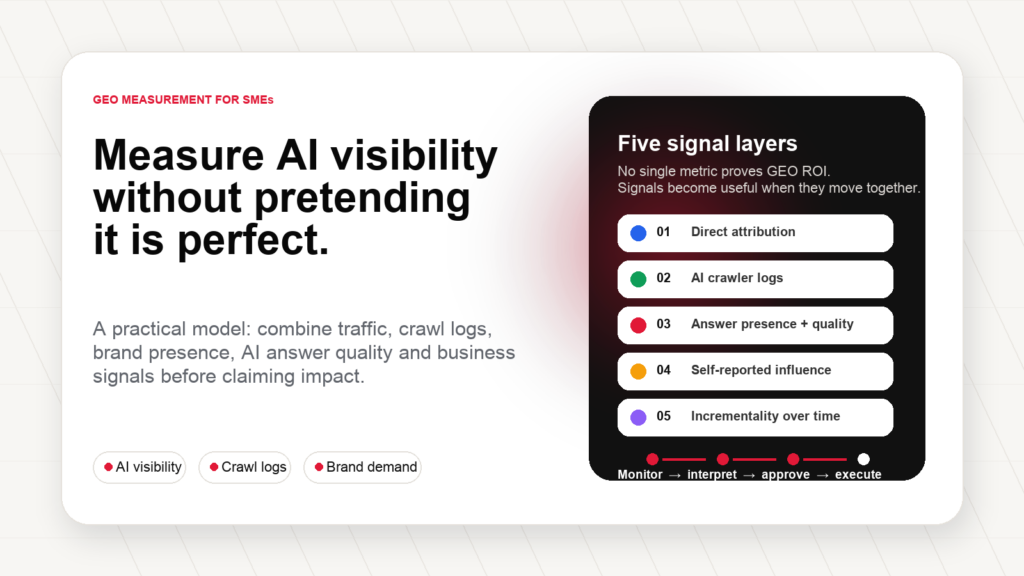
Short version: GEO performance is not one clean number. The useful way to measure it is to combine several imperfect signals: direct AI referrals, AI crawler activity, answer presence and quality, self-reported influence, branded demand, assisted conversions and long-term incrementality.
A recent Search Engine Land article proposes a five-layer framework for measuring GEO. I agree with the direction, with one important addition: measurement only matters if it creates an execution loop. If AI visibility data does not become better pages, clearer entities, stronger internal links, technical fixes and approved website changes, it becomes another report.
Why GEO measurement is harder than traditional SEO reporting
Generative Engine Optimization, or GEO, is the work of making a brand, website, product or service easier to retrieve, cite, summarize and recommend inside Generative answer systems. It overlaps with AEO, AI visibility, entity SEO, structured data, content quality, Authority Building and technical accessibility.
The measurement problem is obvious: traditional SEO sends you relatively visible signals. You can look at Google Search Console Impressions, clicks, CTR, Average position, indexed pages and queries. The data is imperfect, but the operating model is familiar. GEO is messier. The Answer engine may mention you without linking. It may use your content as background context but cite someone else. It may summarize competitors. It may send no visit at all. It may influence a buying decision days before the user searches your brand directly.
This is why “AI visibility score” as a single number is dangerous if it is treated as truth. It can be useful as a directional indicator, but it cannot carry the whole measurement story. The serious approach is triangulation: several signals, watched over time, connected to website execution.
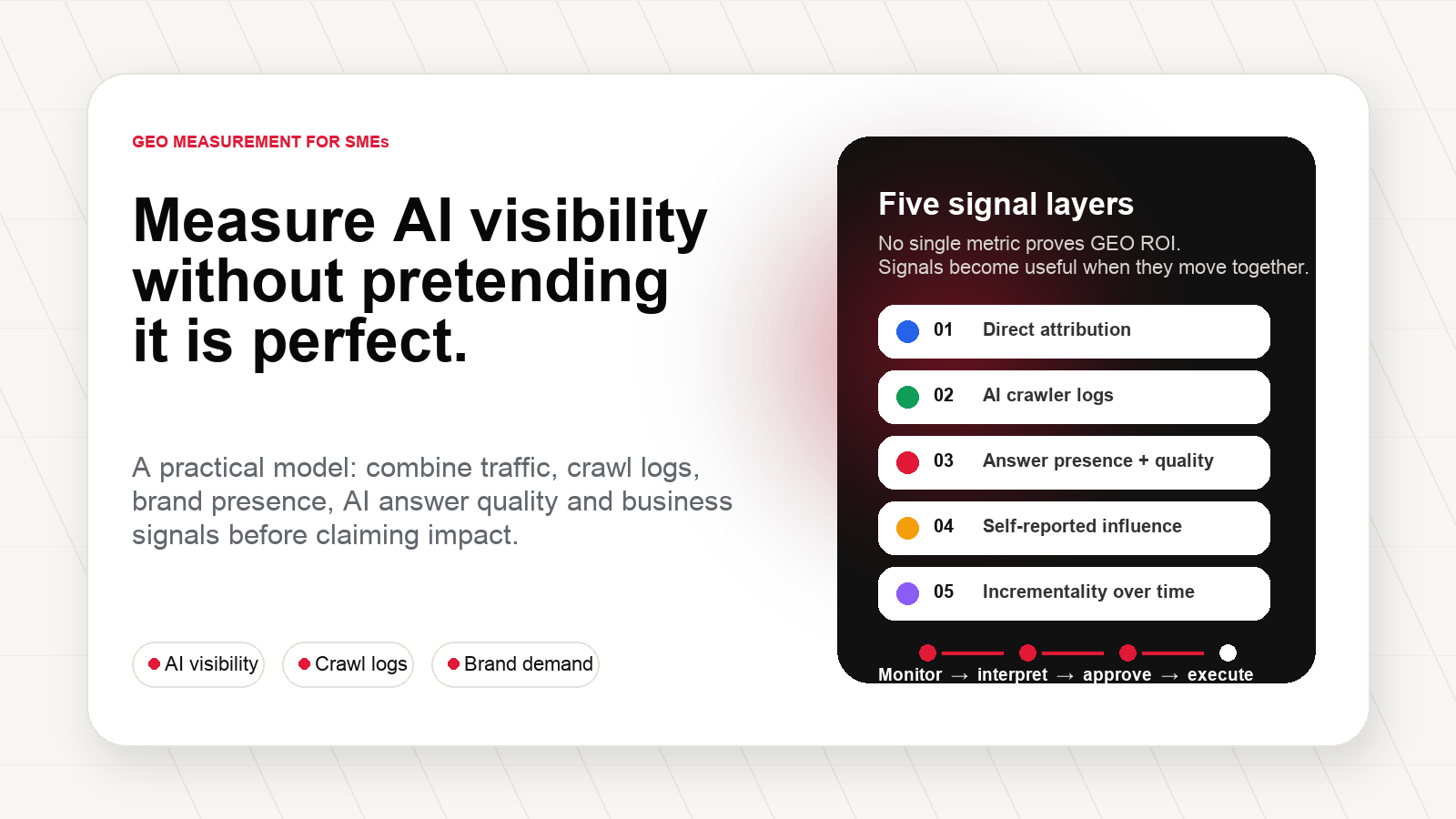
The five-layer model for GEO performance
The Search Engine Land framework is useful because it does not pretend that one tool can fully measure generative search. The five layers can be summarized like this: direct attribution, AI crawler logs, share of voice and answer quality, self-reported AI influence and incrementality. Together, they help separate real movement from noise.
In my opinion, this is the right direction for SMEs because it is practical. You do not need to wait for the perfect GEO analytics standard. You need a disciplined way to observe whether AI systems can discover, understand and recommend your business, then you need to improve the website areas that are weak.
One dashboard, too much confidence
- One AI visibility score is treated as the full truth.
- Mentions are counted without checking answer quality.
- Traffic is reviewed without business context.
- No one turns findings into website changes.
Multiple signals, one execution loop
- AI referrals, crawler logs and answer presence are watched together.
- Brand accuracy and recommendation quality are reviewed.
- Self-reported influence and branded demand are tracked.
- Accepted fixes are executed inside the website workflow.
Layer 1: Direct attribution from AI referrals
The first layer is the easiest to understand: visits that arrive from AI systems. You can look for referral traffic from surfaces such as ChatGPT, Perplexity, Gemini, Copilot or other AI answer engines. This is useful, but it is incomplete. Many AI interactions do not create a click. Some clicks may be hidden by privacy restrictions, app browsers or referrer behavior. Some influence may show up later as direct traffic or branded search.
For SMEs, the practical approach is to track direct AI referrals, but never treat them as the whole story. If your clinic, ecommerce store or B2B service appears in an AI answer and the user calls later, books through another channel or searches your brand name, direct attribution may miss the impact.
Layer 2: AI crawler logs and discoverability
The second layer is technical: can AI crawlers reach and understand your website? Server logs can show visits from known crawlers and user agents. OpenAI documents user agents such as GPTBot, ChatGPT-User and OAI-SearchBot, each with different purposes. This matters because GEO is not only about content writing. It is also about crawlability, response codes, speed, canonical clarity, robots rules, structured information and clean HTML.
Log data is not perfect proof of visibility, but it tells you whether your website is part of the discovery pipeline. If important pages are blocked, slow, thin, duplicated, canonicalized incorrectly or buried deep in the site, your AI visibility measurement will be weaker before the answer engine even evaluates the content.
Layer 3: Answer presence, share of voice and answer quality
Counting whether your brand appears in AI answers is useful, but quality matters more. Are you represented accurately? Are your services described clearly? Are competitors mentioned more often? Are the cited pages correct? Does the answer understand your locations, pricing, booking flow, product categories, guarantees, delivery areas, medical specialties or authority signals?
This layer is where many GEO tools stop too early. A mention is not always good. A hallucinated mention, outdated service description or wrong recommendation can be worse than no mention. GEO measurement should review presence, prominence, accuracy, citation quality and the business relevance of the prompt.
Google’s guidance for generative AI features points back to fundamentals: helpful content, crawlable pages, clear structure, good page experience and content that is useful for people. That is important. The goal is not to manipulate AI answers with tricks. The goal is to make the business easier to understand and trust.
Layer 4: Self-reported AI influence
Because AI answers often influence decisions without a trackable click, self-reported attribution becomes more valuable. Ask customers how they found you. Add “ChatGPT or another AI assistant” to contact forms, lead forms, booking forms and sales conversations. Train reception, sales and support teams to note when users mention AI recommendations.
This is not mathematically perfect. People forget, simplify or choose the easiest answer. But it adds another signal. If direct AI referrals are small, but more customers say they used ChatGPT, Google AI Mode or Perplexity during research, you are seeing influence that analytics alone may miss.
Layer 5: Incrementality over time
The fifth layer is the most strategic: does improved AI visibility correlate with real business movement over time? Watch branded search, direct traffic, assisted conversions, lead quality, sales conversations, category demand, returning users and conversion paths. GEO performance should eventually connect to business outcomes, even if the path is not clean.
Incrementality also protects you from vanity metrics. If AI visibility scores rise but nobody searches your brand, reads your pages, books a consultation, buys, calls or requests pricing, the measurement model needs deeper investigation. Good GEO should improve discoverability and decision confidence, not just create pretty charts.
The missing layer: approved execution
Here is where AYSA’s point of view becomes very clear: GEO measurement without execution is not enough. It is useful to know that your brand is missing from AI answers. It is useful to know that crawlers are not reaching important pages. It is useful to know that answer engines misunderstand your service area. But the business value appears only when the website improves.
That means measuring GEO should trigger work: rewrite weak pages, clarify service details, improve internal links, add missing FAQs, update schema where it matches visible content, fix crawl problems, strengthen topical authority, build legitimate authority signals and monitor changes over time. The problem for SMEs is that this work is usually scattered across SEO tools, agencies, spreadsheets, developers and manual approvals.
AYSA is built to close that gap. It monitors the website, prepares SEO, AEO and GEO actions, explains what matters, asks for approval and executes accepted changes inside the website workflow. In my opinion, this is where GEO measurement has to go: from observation to controlled execution.
What SMEs should do now
Start with the queries that matter commercially, not every possible prompt. A dental clinic should monitor local treatment, emergency, pricing and trust questions. A hotel should monitor location, amenities, direct booking, family and comparison prompts. An ecommerce store should monitor product category advice, alternatives, comparisons, product feed clarity and review signals.
Then build a simple measurement stack: analytics for referrals, server logs for crawlers, AI answer tracking for presence and quality, forms for self-reported influence and business dashboards for incremental movement. Keep it lightweight. The purpose is not to drown the business owner in measurement. The purpose is to identify what needs to change next.
Finally, connect every insight to an action. If the AI answer is wrong, improve the page that should clarify the truth. If the crawler cannot access the page, fix the technical problem. If competitors are recommended because they have clearer proof, improve your proof. If the website lacks topic coverage, build useful content. If the business is not cited, strengthen authority and relevance. GEO measurement should end with execution, not with a screenshot.
Sources and further reading
Turn GEO measurement into approved website action.
AYSA monitors your website, prepares SEO, AEO and AI visibility actions, asks for approval and executes accepted changes inside your website workflow.
Continue the AI search topic inside AYSA.
Use these pages to connect the article with AI SEO tools, AI visibility monitoring, AI Overviews and approved website execution.
Turn this topic into a website action plan.
Use these AYSA hubs to move from reading to technical fixes, AI visibility monitoring, research, glossary context and approval-first SEO execution.

