
Build A Measurement Framework Before GA4: The Only Way To Turn Analytics Into Action (And Make AI Search Accountable)
GA4 can capture clicks, scrolls, and conversions—but it can’t decide what matters. A practical measurement framework turns your business goals into questions, KPIs, and implementation rules so your data drives decisions, not dashboards. Here’s how SMEs and agencies can design it, validate it, and keep it aligned with AI-driven search.

By Marius Dosinescu (AYSA.ai)
GA4 can collect an ocean of behavioral data. It can’t tell you what to care about.
That sounds obvious—until you see how most analytics projects start: “Can someone set up GA4?” A property gets created, a tag gets installed, a handful of events get tracked, and then… nothing improves. Teams stare at dashboards that feel “data-driven” but don’t change decisions, budgets, or roadmaps.
The fix isn’t a better dashboard. It’s a measurement framework designed before you touch GA4—so the tool serves the business, not the other way around.
This editorial is inspired by and cites Search Engine Journal’s guidance on designing a measurement framework before implementation, which correctly frames GA4 as a collector of data, not a decider of what matters. See: Search Engine Journal – Designing A Measurement Framework Before You Touch GA4.
Concise summary

- A measurement framework is a business document that turns goals into questions, questions into KPIs, and KPIs into tracking requirements.
- Start with plain-language definitions of success, then define decision-driving questions, then map the minimum observable behaviors needed to answer them.
- Separate metrics into three layers: Outcomes (what the business wants), Performance Indicators (progress toward outcomes), and Diagnostic Signals (why it’s happening).
- Decide what not to measure to reduce noise, maintenance cost, and stakeholder confusion.
- GA4 is not your only source of truth; align it with CRM/ecommerce/product data rather than forcing “one truth” for everything.
- Measurement only pays off when it drives execution—this is where AYSA fits: monitor, prepare changes, ask for approval, and execute accepted website updates tied to the framework.
Table of contents

- Key takeaways for SMEs and agencies
- The problem with “just set up GA4”
- What changed: GA4, privacy, and AI search make measurement harder (and more important)
- What a measurement framework is (and what it is not)
- 1) Define success in plain language
- 2) Start with questions, not metrics
- 3) Map questions to observable behaviors
- 4) Use the three-layer model: outcomes, indicators, signals
- 5) Decide what not to measure
- 6) GA4 is not the whole measurement system
- 7) Turn the framework into an implementation brief
- 8) Validate before anyone uses the data
- A concrete SME scenario: “Why are leads down?” without guessing
- New reality: measuring SEO in AI search (AEO/GEO) without making stuff up
- Where AYSA fits: monitoring, preparation, approval, execution
- What to do next (action list)
- Sources and further reading
Key takeaways for SMEs and agencies
- If your analytics can’t answer a decision, it’s overhead. Measurement is not a reporting project—it’s a decision-support system.
- Every KPI should have an owner and a response plan. If a KPI moves up or down, someone should know what to do next.
- Framework first reduces implementation churn. Without a framework, teams keep rebuilding GA4 events and reports as leadership asks new questions.
- AI Search makes “visibility” less obvious. Traffic might not rise even when your brand is cited. Your framework must define what “success” means in a world of AI summaries and mixed Attribution.
- Execution is the multiplier. Insight without change is theater. Your measurement system must connect to a workflow that ships improvements.
The problem with “just set up GA4”
Most organizations treat GA4 like a camera: install it and it will “show what’s going on.” In reality, GA4 is closer to a warehouse. It stores what you send it. If you don’t define what questions matter, you will store a lot of things that feel specific (“event_count,” “engaged_sessions,” “scroll”) but don’t lead to action.
Tool-first measurement creates three recurring problems:
- Noise masquerading as insight. Teams track everything possible, then struggle to prioritize what’s meaningful.
- KPI inflation. Every tracked action becomes “important,” so nobody knows what to fix first.
- Endless rework. Leadership asks a new question; the team realizes they never tracked the behavior needed to answer it; implementation changes; reporting changes; trust erodes.
Search Engine Journal’s article nails the core principle: GA4 can collect the data, but it cannot decide what matters. The measurement framework provides that logic layer before implementation. (Source: SEJ.)
What changed: GA4, privacy, and AI search make measurement harder (and more important)
Even if your business has been using analytics for years, the environment has changed in ways that punish lazy measurement.
1) GA4 is event-first and flexible—so it’s easy to create chaos
GA4’s event model is powerful, but it’s also an invitation to track without thinking. Because you can create an event for almost anything, teams do—often without a naming convention, without documentation, and without clarity on which events are truly “key events” (what many still call conversions).
2) Consent, privacy, and platform rules mean data is never “complete”
Between consent requirements and user privacy choices, you will have gaps. The goal is not “perfect tracking.” The goal is decision-grade tracking: definitions clear enough, collection stable enough, and validation strong enough that the business can act with confidence.
3) AI-driven search changes what “performance” looks like
Search is increasingly mediated by AI experiences (summaries, assistants, “answer engines”), which can reduce direct Clicks even when your brand influences the decision. That pushes measurement away from single metrics like sessions and toward a portfolio of indicators across:
- Search visibility and demand capture (often via Search Console and rank/visibility tools)
- On-site behavior and conversion efficiency (GA4)
- Lead quality and revenue realization (CRM / ecommerce backend)
The measurement framework is the only way to keep these systems aligned without making up narratives to fit incomplete data.
What a measurement framework is (and what it is not)
A measurement framework is a short, explicit document that answers:
- What does success mean?
- What questions must we answer to improve success?
- What signals indicate progress or problems?
- What do we track, where, and why?
- Who owns each KPI and what actions follow?
What it is not:
- Not a dashboard specification.
- Not a list of GA4 events.
- Not “every metric we can get.”
- Not a one-time setup. It’s a living operating system for decision-making.
If you want a mental model: the framework is the blueprint; GA4 is one of the tools used to build what the blueprint describes.
1) Define success in plain language
Start with language that a non-analyst can understand and agree with. This is the fastest way to prevent KPI arguments later.
Examples of “success” definitions that are not specific enough:
- “Grow SEO.”
- “Increase conversions.”
- “Improve engagement.”
Better plain-language definitions:
- Lead gen: “Increase the number of inquiries that sales accepts, without increasing spam.”
- Ecommerce: “Increase profitable orders while reducing checkout drop-off.”
- SaaS: “Increase trial starts that activate (reach onboarding milestones) and convert to paid.”
- Local services: “Increase booked appointments from service-area pages, not just calls.”
SEJ’s original guidance makes the same critical point: the same GA4 data can be useful or misleading depending on the business context and what success means. (Source: SEJ.)
AYSA perspective: until success is plain and shared, “automation” becomes dangerous. Automated SEO changes, content updates, or conversion tweaks need a target definition. Otherwise, teams optimize what’s easiest to measure rather than what matters to the business. AYSA’s workflow is built to keep goals explicit while executing improvements: AI search visibility initiatives and classic SEO both benefit when success is defined upfront.
2) Start with questions, not metrics
Metrics are tempting because they’re available. Questions are harder because they force accountability: if we know the answer, what do we do?
Decision-grade questions look like this:
- “Where do users abandon the lead process—and is it worse on mobile?”
- “Which landing pages bring qualified leads (not just form fills)?”
- “What content reliably moves users from informational pages to commercial intent?”
- “Which product categories have interest but fail to convert due to UX or trust gaps?”
A useful exercise (also aligned with SEJ’s framing): list every question leadership would ask if they had perfect data, then compare that to what your current setup can answer. The gap is your framework’s job.
Business rule: If a question does not imply a future action, it’s trivia. Trivia can be interesting; it rarely grows revenue.
3) Map questions to observable behaviors
Once you have questions, you need observable signals that can answer them. This is where many frameworks fail: they jump from “question” to “KPI” without mapping what users actually do.
Example question: “Why are users dropping off before submitting an inquiry?”
Observable behaviors that could help answer it:
- Do users reach the call-to-action section?
- Do they start the form but not submit?
- Is the drop-off concentrated on a device type or browser?
- Does it happen more from specific sources (organic vs paid vs referrals)?
- Do certain pages trigger high exits after pricing or FAQ views?
Notice what we did: we turned a vague business complaint into specific things that can be observed and instrumented. That’s what a framework should do—translate the business into measurement logic.
4) Use the three-layer model: outcomes, performance indicators, diagnostic signals
One of the most practical ideas in the SEJ piece is that analytics gets confusing when every metric is treated like a KPI. The fix is a hierarchy.
Layer A: Business outcomes (the scoreboard)
These are the results the company ultimately cares about:
- Revenue
- Orders
- Qualified leads accepted by sales
- Subscriptions or renewals
- Customer acquisition cost and payback (if you have the data)
Rule: Outcomes belong in executive dashboards. They should be few, stable, and hard to “game.”
Layer B: Performance indicators (the leading indicators)
These indicate whether the system is moving toward outcomes:
- Lead-to-qualified-lead rate (or lead-to-sale rate, if you can connect it)
- Checkout completion rate
- Trial start → activation rate (SaaS)
- Return visitor Conversion rate
- Content-to-commercial navigation rate (how often content sessions reach key pages)
Rule: Indicators tell teams where to focus. They should be actionable within weeks, not quarters.
Layer C: Diagnostic signals (the “why”)
These help you troubleshoot:
- Form abandonment points
- CTA clicks by device
- Internal search usage and “no results” rate
- Filter usage on category pages
- Scroll depth or engagement on key templates (used carefully)
Rule: Diagnostic signals should mostly live with practitioners (marketing, product, UX, analytics). They’re vital, but not executive KPIs.
SEJ frames this as three layers: business outcomes, performance indicators, and diagnostic signals. (Source: SEJ.) I agree with the model because it prevents KPI sprawl and makes reporting role-based.
5) Decide what not to measure
Most analytics programs fail from accumulation, not absence.
Every event you track has a cost:
- Implementation time
- QA and validation
- Documentation
- Ongoing maintenance when the site changes
- Stakeholder interpretation and reporting overhead
A ruthless test (also aligned with the SEJ piece):
- If this number changed meaningfully, would we do anything differently?
If the answer is “no,” don’t track it in your core setup. You can always add it later when a real decision depends on it.
My addition: “Not tracking” is also a governance decision. It tells the organization what won’t be debated this quarter. That reduces the reporting tax that kills focus.
6) GA4 is not the whole measurement system
A common trap is forcing GA4 to be the “single source of truth” for everything. In practice, each system has blind spots. SEJ references the idea (credited there to Rémi Kerhoas) that a single-source approach can become an attribution trap because platforms model reality differently. (Source: SEJ.)
A more resilient approach is: define the source of truth by question type.
Common “source of truth” patterns
- GA4: on-site behavior, funnels, content paths, device differences, landing page engagement.
- Google Search Console: organic search queries, Impressions, clicks, and how Google surfaces your pages. (Primary product source: Google Search Console.)
- CRM (e.g., HubSpot, Salesforce): lead quality, pipeline stages, sales acceptance, revenue attribution (as your business defines it).
- Ecommerce platform / backend: orders, refunds, true revenue, SKU-level accuracy.
Practical governance tip: document which system wins when numbers disagree. If you don’t, the loudest stakeholder wins—and your measurement program becomes political.
7) Turn the framework into an implementation brief
This is the moment GA4 enters the room.
Once success, questions, and layers are defined, implementation becomes a straightforward translation exercise:
- Which events must exist?
- Which events are “key events” (your primary conversions)?
- Which parameters are needed to segment outcomes (e.g., lead type, page category, form ID)?
- Which audiences/segments matter (new vs returning, logged-in vs anonymous, location, device)?
- Which reports should exist and who uses them?
- What is explicitly out of scope for now?
This matches SEJ’s “framework becomes the brief” idea: technical setup stops being guesswork and becomes execution against agreed logic. (Source: SEJ.)
Where teams go wrong: they begin inside GA4, make decisions inside the tool UI, and then retrofit a story later. That reverses cause and effect.
8) Validate before anyone uses the data
Implementation is not the finish line. Validation is what earns trust.
Common failure modes:
- Events fire twice (inflating conversions or engagement).
- Events fire too early (e.g., “form_submit” on click instead of successful submit).
- Consent settings cause partial tracking, changing trendlines unexpectedly.
- Cross-domain flows break sessions and attribution.
SEJ emphasizes that “an event appearing in GA4 does not automatically mean it is reliable,” and that the goal is not perfect data but data trusted enough to support decisions. (Source: SEJ.)
My rule: never launch a dashboard without a written data definition and a validation note. If the business is going to argue about the numbers, you want the argument to be about actions—not about whether the numbers are real.
A concrete SME scenario: “Why are leads down?” without guessing
Let’s make this real with a scenario that looks like thousands of SMEs.
The business
A regional dental clinic group (3 locations) invests in SEO and paid search. They have:
- Service pages (implants, invisalign, emergency dentistry)
- Appointment requests via form
- Phone calls (some tracked, some not)
- A CRM or patient intake system that marks inquiries as “scheduled,” “no-show,” “not qualified,” etc.
The complaint
“Leads are down.”
In a tool-first world, the team checks:
- Sessions down? up?
- Engagement rate down? up?
- Form submissions down? (maybe)
But none of that answers the real business question: are we losing qualified appointments—or just seeing measurement drift?
Framework-first diagnosis
Start with plain-language success:
- Outcome: “Increase scheduled appointments from organic and paid search, while maintaining quality (insurance accepted, service match, location match).”
Then define questions:
- Are appointment requests down, or are scheduled appointments down?
- Which service pages generate scheduled appointments (not just form fills)?
- Where does the funnel break: landing page → CTA → form start → form submit → scheduled?
- Is the drop localized to a specific location, device, or channel?
Then map signals:
- Performance indicators: form-start rate, form-submit rate, call-click rate, booking completion rate.
- Diagnostic signals: errors on form fields, time-to-complete, page speed issues on mobile (if measured elsewhere), CTA visibility.
And finally define sources of truth:
- GA4: landing pages, CTA clicks, form start/submit events, device split.
- CRM/intake system: scheduled appointments and qualified outcomes.
- Search Console: changes in organic query impressions/clicks by service.
Now when “leads are down” happens, you can answer:
- If form submits are stable but scheduled appointments dropped, it’s a quality problem or intake problem—not an SEO traffic problem.
- If Search Console impressions fell for “emergency dentist near me,” it’s demand or visibility, and you look at SEO/local pack factors.
- If mobile CTA clicks dropped sharply while sessions stayed flat, it’s likely UX or template changes.
This is what a framework gives you: the ability to stop guessing.
New reality: measuring SEO in AI search (AEO/GEO) without making stuff up
Here’s the uncomfortable truth: the more AI mediates discovery, the more tempting it becomes to invent KPIs that look impressive but don’t drive decisions.
You’ll hear terms like AEO (answer engine optimization) and GEO (generative engine optimization). Whether you use those labels or not, the measurement challenge is real: AI experiences can influence users without producing a clean click path into GA4.
What to do instead
Don’t force GA4 to measure what it can’t. Use your framework to define a portfolio of accountable signals:
- Demand capture signals: Search Console performance on priority queries and pages (primary source: Google Search Console).
- Site efficiency signals: conversion rate by landing page type, device, new vs returning visitors (GA4).
- Business truth signals: qualified leads, pipeline, revenue (CRM/ecommerce backend).
If you’re going to add AI-search-specific indicators (like “brand mentions” or “citations”), keep them in the framework as diagnostic or directional unless you can connect them to outcomes. Don’t let novelty become the KPI.
Where AYSA fits: AYSA’s focus is operationalizing search visibility with monitoring and execution workflows, not just reporting. If AI search changes what users see, you need a system that can monitor visibility signals and then ship improvements to pages, schema, internal linking, and content structure—after approval. See: AI Search Visibility and AI SEO Tools.
A practical framework template you can steal (and adapt in an hour)
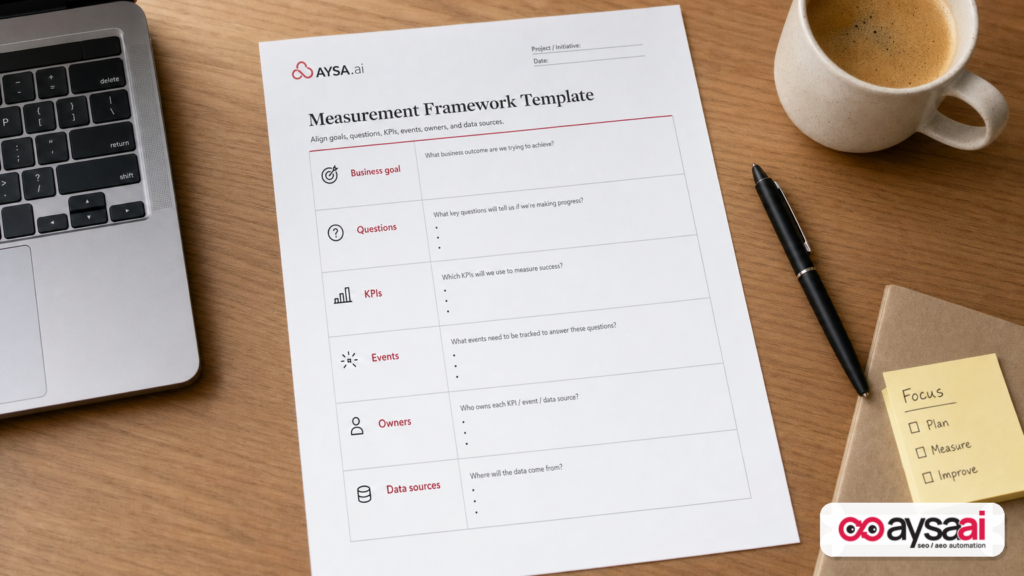
You don’t need a 40-page deck. For many SMEs, a one-page framework is enough to transform measurement from noise into leverage.
One-page measurement framework (recommended fields)
- Business goal (plain language): What does success look like?
- Primary outcomes (2–4): What’s the scoreboard?
- Key questions (5–10): What must we answer to improve outcomes?
- Performance indicators (5–12): Leading indicators tied to questions.
- Diagnostic signals (as needed): Signals used for troubleshooting.
- Data sources: GA4, Search Console, CRM, ecommerce backend, etc.
- Tracking requirements: Events, parameters, content groupings, key events.
- Owners: Who is accountable for each KPI and for data quality?
- Cadence: Weekly ops review vs monthly exec review.
- Action rules: If X drops, we investigate Y and ship Z.
Pro tip for agencies: build this as a signed deliverable. Not because you want paperwork—because you want alignment. Misalignment is the hidden cost center in analytics.
What agencies should rethink: measurement as a product, not an add-on
Agencies often inherit a client’s analytics mess. The temptation is to “fix GA4” as a technical project. But the real opportunity is to sell and deliver a measurement framework as the first milestone.
Why this matters:
- It prevents scope creep (“Can you also track…” forever).
- It anchors SEO reporting in outcomes rather than vanity metrics.
- It makes retention easier because you’re tied to decision-making, not dashboards.
If you run an agency, your best differentiator in 2026 is not that you can install tags—it’s that you can define what matters, measure it, and then execute improvements quickly.
Where AYSA fits: monitoring, preparation, approval, execution
A measurement framework is only valuable if it changes what you do next. That’s why I care about “execution systems” more than reporting systems.
AYSA is built to close the loop between measurement and action:
- Monitor: track the visibility and site signals that matter to your framework (Monitoring).
- Prepare: generate recommended website changes tied to those signals (content updates, internal links, structured improvements, page enhancements)—prepared for review.
- Ask for approval: keep humans in control so changes align with brand, compliance, and business priorities.
- Execute accepted changes: ship improvements fast, so measurement becomes a growth engine instead of a monthly report.
That’s the difference between “analytics maturity” as a concept and analytics maturity as an operating habit: measurement drives a backlog; the backlog ships; the business learns.
If you’re evaluating whether AYSA is a fit, start here:
What to do next (action list)
- Write a one-sentence success definition that a non-marketer can understand (and agree to).
- List 10 decision questions leadership would ask if they had perfect data.
- Assign each question a layer: outcome, indicator, or diagnostic.
- Decide sources of truth by question type (GA4 vs Search Console vs CRM vs ecommerce backend).
- Kill 30% of your tracked events (or planned events) using the “would we act?” test.
- Turn the framework into a GA4 implementation brief: event names, key events, parameters, audiences, reports, owners.
- Validate before reporting: test event firing, duplication, consent impacts, and funnel logic.
- Connect measurement to execution: create a monthly “insight → backlog → shipped changes” loop (this is where AYSA can help).
Sources and further reading
- Search Engine Journal: Designing A Measurement Framework Before You Touch GA4 (primary research input for this editorial)
- Search Engine Journal: SEO section (context on SEO strategy topics referenced in the source page)
- Search Engine Journal: SEO News (context and ongoing changes affecting measurement and search)
- Google Search Console (primary product page; essential complement to GA4 for organic search measurement)
Note on sources: The supplied research context included one primary SEJ article and a set of SEJ navigation links. Where official sources (e.g., GA4 developer docs, Consent Mode documentation) would strengthen implementation details, they were not provided in the context, so this editorial avoids pretending to cite them.
Continue the AI search topic inside AYSA.
Use these pages to connect the article with AI SEO tools, AI visibility monitoring, AI Overviews and approved website execution.
Turn this topic into a website action plan.
Use these AYSA hubs to move from reading to technical fixes, AI visibility monitoring, research, glossary context and approval-first SEO execution.

