Claude Can Learn Your Job From a Video: What “Recorded Skills” Mean for SEO, Ops, and the Next Wave of AI Work
Anthropic’s “Record a Skill” signals a shift from chat-based help to teachable, repeatable AI workflows. Here’s what changes for SMEs, agencies, and SEO teams—and how to stay in control with approved execution.

By Marius Dosinescu (AYSA.ai)
There’s a quiet shift happening in AI right now, and it’s bigger than “a model got smarter.” Anthropic announced a new capability in Claude’s desktop app—Record a Skill—that lets a person record their screen while doing a task, narrate it, and then have Claude turn that walkthrough into a repeatable skill it can run again. Search Engine Journal covered the announcement and the immediate reaction: excitement, limits frustration, and a very real fear from workers that “this is the easiest way to be replaced.”
This is the moment AI stops being primarily a conversation and starts becoming a captured operational process.
For businesses, especially SMEs and agencies, that has two implications:
- Opportunity: You can standardize and scale the best way your team does work—SEO tasks, reporting, listing updates, content QA, operational checklists—without hiring another pair of hands every time.
- Risk: If you “record” bad habits, missing context, or unsafe actions, you can scale mistakes just as efficiently—and cause brand damage, search visibility loss, compliance issues, or outages.
In this editorial, I’ll break down what changed, why it matters for SEO and AI Search visibility, what can go wrong, and how to respond with the right governance. I’ll also show where AYSA fits as an Approved Execution system: we monitor, prepare recommended changes, ask for approval, and execute the accepted updates—so automation doesn’t mean losing control.
Concise summary
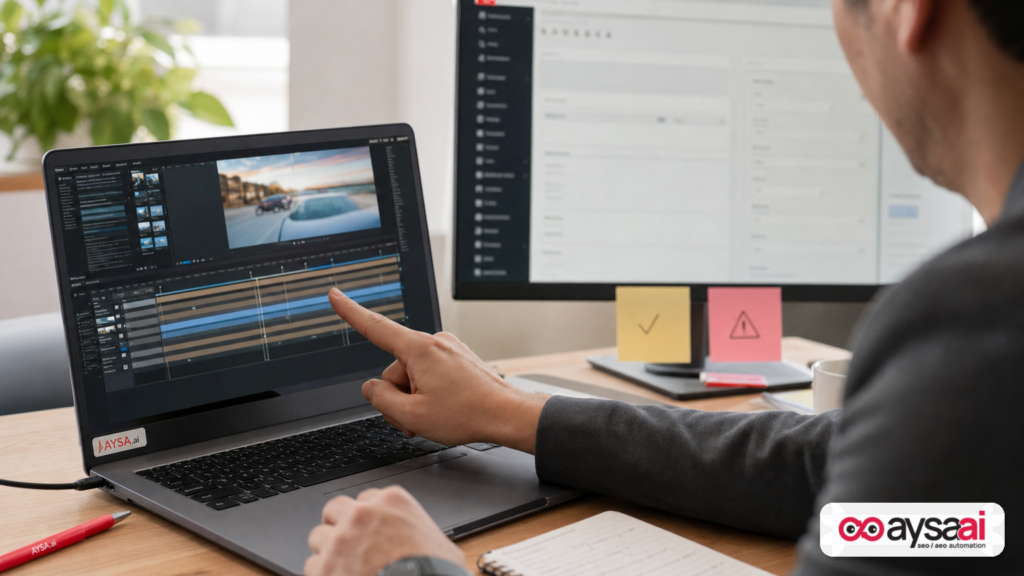
- Anthropic’s Claude “Record a Skill” indicates a shift toward AI that learns operational workflows from screen recordings and narration, then repeats them.
- This accelerates the move to agentic work (AI doing tasks across tools), not just content generation or Q&A.
- SEO will become more workflow-driven: consistent technical hygiene, content updates, Internal linking, schema, and Monitoring—executed reliably—will separate winners from everyone else.
- The business risk is governance: permissions, approvals, audit trails, QA, rollback, and “human-in-the-loop” design become core capabilities.
- AYSA’s approach matches this future: continuous monitoring, change preparation, explicit approvals, and safe execution. (No “black box autopilot.”)
Table of contents
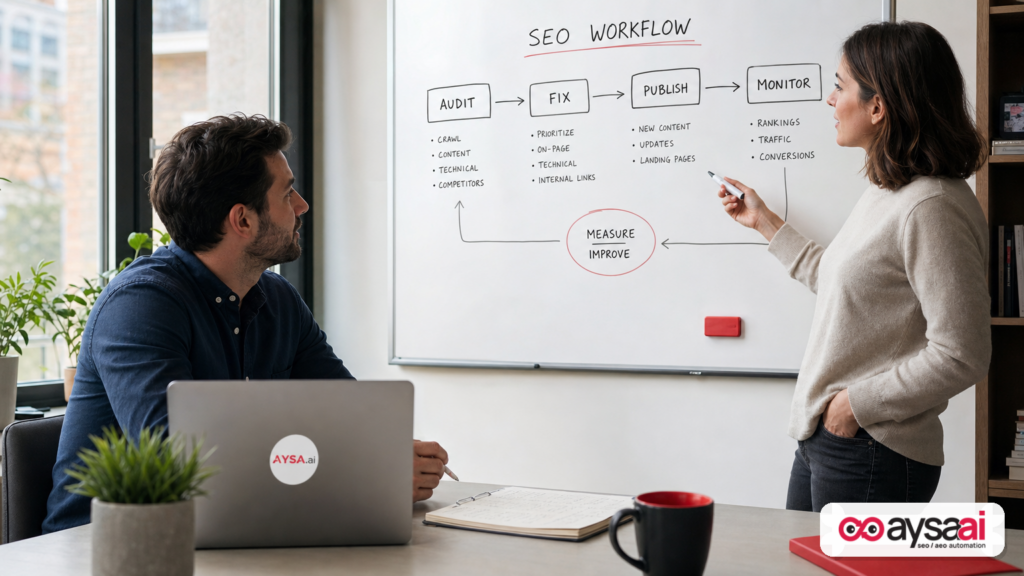
- What changed: From “chat with AI” to “teach AI your workflow”
- What Search Engine Journal reported (and what people reacted to)
- Why this matters for SEO now: Search visibility is becoming workflow-driven
- Recorded skills vs. automation: the difference is compounding
- Where skill-recording can help SEO teams (real tasks, real constraints)
- What can go wrong: scaling errors, not just output
- Governance: The difference between “automation” and “accountability”
- The SME scenario: A clinic that “records” its marketing ops (and what can go wrong)
- Agency implications: productize outcomes, not hours
- AEO/GEO reality: citations are earned through execution
- What SMEs should monitor weekly in 2026 (even with AI helpers)
- A practical action plan: adopt skill-based AI without losing control
- Where AYSA fits: monitoring + prepared changes + approved execution
- What to do next
- Sources and further reading
What changed: From “chat with AI” to “teach AI your workflow”

Most businesses adopted generative AI in two waves:
- Drafting wave: write emails, blog drafts, ad copy, social captions—faster.
- Answer wave: ask questions, get guidance—faster.
But the next wave is different: capture the steps of work. Not “what should I do?” but “watch me do it—then do it this way again next time.”
That matters because operational work is where businesses actually win or lose:
- Did the right page get updated?
- Was the redirect correct?
- Did schema validate?
- Did the change break rendering?
- Did you measure the impact and roll back if needed?
Recording a skill implies the AI isn’t only generating text—it’s learning how your organization uses tools, navigates interfaces, and sequences decisions. That turns “AI use” from a personal productivity trick into institutionalized process.
The real innovation isn’t the video—it’s the standardization
A screen recording is just a wrapper. The business value is that a demonstrated workflow can become:
- Repeatable (less variance across staff)
- Delegatable (not tied to a specific employee)
- Auditable (in theory—if the system logs steps and permissions)
- Scalable (run it 50 times, not once)
And yes, that threatens certain kinds of work—specifically work that is purely procedural and doesn’t require judgment. But it also elevates the value of people who can design good processes, define constraints, and enforce quality.
What Search Engine Journal reported (and what people reacted to)
According to Search Engine Journal’s coverage, Anthropic announced that users on paid plans can teach Claude Cowork a skill by recording a walkthrough of a task, speaking through it, and letting Claude turn it into a skill it can run later. The feature is called Record a Skill and appears in the Claude desktop app’s “+” menu.
SEJ also noted that OpenAI’s Codex had a similar “Record and Replay” capability available earlier for some users, with platform and regional limitations mentioned in the coverage.
The immediate reaction online was predictable and revealing:
- Replacement anxiety: some people interpreted “record your job” as “teach the system to remove you.”
- Access friction: others complained about usage limits—because the business value of these tools only exists if they’re reliable enough to be operational.
My takeaway: the fear is real, but it’s often misdirected. The bigger risk for most companies isn’t that AI will suddenly do everything. The risk is that competitors will use workflow-level AI to become more consistent, faster to ship, and better at measurement. In SEO, that consistency wins.
Primary source for the announcement context: Search Engine Journal: “Anthropic’s Claude Can Now Watch A Video And Learn Your Job”.
Why this matters for SEO now: Search visibility is becoming workflow-driven
SEO used to be framed as a set of “tactics”:
- Find keywords
- Write pages
- Get links
- Wait
That model is outdated for two reasons:
- Search experiences are fragmenting. People still use Google, but they also ask ChatGPT-style systems, AI Overviews, and answer engines that synthesize results. Your job is no longer “rank #1 for Keyword X.” It’s “be the referenced source when decisions get made.”
- Operational excellence is now a ranking factor in practice. Not a single Google metric called “operational excellence,” but the compounding effect of clean technical foundations, fast updates, Structured data hygiene, consistent internal linking, and monitoring.
Workflow-learning AI changes the cost of operational excellence. The teams that can bottle their best processes into repeatable skills will ship more improvements with fewer mistakes.
SEO is a system; AI is becoming a system operator
In the real world, SEO success is less about one brilliant idea and more about doing the basics relentlessly:
- Fix indexation issues quickly
- Prevent accidental noindex tags and canonical mistakes
- Keep category pages updated
- Refresh top pages before they decay
- Maintain schema validity
- Reduce duplication
- Monitor changes so problems don’t linger for weeks
That’s not glamorous work. It’s process work. Exactly what “recorded skills” are designed to scale.
If you want to see how we frame this shift at AYSA, start here: AI Search Visibility.
Recorded skills vs. automation: the difference is compounding
Businesses have automated tasks for decades. So what’s different now?
Classic automation requires one of these:
- an engineer writing scripts
- a tool with a prebuilt integration
- a rigid workflow engine
Skill recording implies:
- Lower barrier to automation: fewer engineering hours
- More “human-shaped” steps: it follows what people actually do in messy UIs
- Faster iteration: update the skill by re-recording or refining
The compounding effect is the real story. If you can reduce the time to ship safe website changes, you can run more improvement cycles per quarter. In SEO, cycles are leverage.
Why compounding wins in search
Search visibility isn’t a one-time project. It’s maintenance plus incremental gains. When your competitors can:
- publish refreshes weekly, not quarterly
- fix technical regressions within hours, not weeks
- standardize internal linking across new pages
- maintain cleaner structured data
…they don’t need to be “more creative.” They just need to be more operationally consistent.
Where skill-recording can help SEO teams (real tasks, real constraints)
Let’s translate this into the work that actually happens inside SMEs and agencies. Here are areas where workflow capture could matter—along with the constraints you should enforce.
1) Content updates and refresh routines
Many organizations have a repeatable refresh pattern:
- pull the page list (top traffic or top revenue)
- check decay in impressions/clicks
- update outdated sections
- improve headings and internal links
- republish and annotate changes
A recorded workflow can standardize this. The danger: refreshing content without product accuracy, legal review, or brand tone can create liability. The fix: an approval gate and a QA checklist.
2) Technical hygiene checks
Technical SEO includes recurring checks that are procedural but high-impact:
- spot-check templates for unintended noindex/canonical behavior
- verify sitemap updates
- monitor for sudden spikes in 404/500
- confirm robots.txt didn’t change unexpectedly
These tasks are perfect for “skills.” But only if you treat them like operational controls: they need logs, alerts, and clear thresholds for when a human must intervene.
This is one reason we emphasize monitoring as a first-class feature at AYSA: AYSA Monitoring.
3) Structured data (schema) maintenance
Schema is often implemented once and forgotten. Then templates change, fields go missing, markup becomes inconsistent, and citations in AI answers become less likely because your content is harder to interpret.
A repeatable skill could:
- check key templates for schema presence
- validate for obvious formatting issues
- flag missing required fields for your business type
But be careful: schema mistakes can scale quickly and create sitewide confusion. This is a “prepare → review → execute” domain, not “auto-run daily.”
4) Internal linking at scale (the boring advantage)
Internal linking is consistently undervalued because it’s operational work. A workflow skill can help implement your linking rules:
- link from high-authority pages to new product/service pages
- standardize breadcrumb structure
- ensure category-to-subcategory linking
The risk is over-optimization or irrelevant linking that confuses users. Governance matters.
5) Reporting that actually drives decisions
Most reporting is busywork because it’s not connected to action. Skill recording could automate:
- pulling weekly performance snapshots
- annotating anomalies
- creating a change log that ties actions to outcomes
The key is that reports must lead to execution. Otherwise you’re just generating nicer PDFs.
What can go wrong: scaling errors, not just output
When you record a task, you’re not only capturing steps. You’re capturing assumptions.
Common failure modes I expect as “recorded skills” spread:
1) You scale a bad process
If your current workflow includes workarounds, shortcuts, or tribal knowledge (“we always click that because…”) then the AI will reproduce them. That’s not automation—it’s institutionalizing debt.
2) You remove context that humans silently apply
Humans constantly apply judgment without narrating it:
- “This redirect is okay because this product is discontinued.”
- “We can’t change that copy because it’s legally reviewed.”
- “Don’t touch that template—it affects checkout.”
If context isn’t explicit, a recorded skill can become dangerous.
3) Permission sprawl and accidental access
Operational AI raises a basic question: whose credentials is it using, and what can it do?
In SEO, the highest-risk actions are often simple:
- publishing a global template change
- editing robots.txt
- changing canonical tags sitewide
- mass redirect updates
You need least-privilege access, approvals, and audit trails—especially when “skills” may be shared across a team.
4) Workflow drift when tools change
UIs change. Platforms update. A recorded workflow can silently degrade and start producing partial results or wrong outcomes. If you don’t have monitoring, you won’t notice until traffic drops.
5) Automation without measurement becomes superstition
The worst possible outcome is a company that “automates SEO” but can’t answer:
- What changed?
- When did it change?
- Why did we change it?
- Did it help?
- Can we roll it back?
If recorded skills accelerate execution, they must also accelerate traceability.
Governance: The difference between “automation” and “accountability”
Skill-based AI forces leadership to confront an uncomfortable truth: if you don’t have governance, you don’t have automation—you have a faster way to break things.
Here’s the governance stack I recommend for any business using agentic or skill-based AI on business-critical systems (including websites):
1) Approval gates by risk tier
- Low risk: draft content, propose titles, flag broken links → can be more automated
- Medium risk: edit existing content, change internal links, update meta data → should require review
- High risk: templates, robots, canonicals, redirects, checkout pages → require explicit approval + rollback plan
2) Audit trails (who, what, when, why)
If you can’t reconstruct what happened, you can’t learn—or defend decisions when something goes wrong.
3) QA checklists that are actually used
Not “we have a checklist somewhere.” A real QA mechanism that blocks execution until complete.
4) Rollback capability
Every automated change should have a rollback strategy. In practice, this means you need versioning and clear change boundaries.
5) Monitoring tied to outcomes
Automation should increase the speed of feedback. If you don’t monitor indexing, traffic, and key page behavior, you are flying blind. This is why we built AYSA around monitoring-first workflows: AYSA Monitoring.
The SME scenario: A clinic that “records” its marketing ops (and what can go wrong)
Let’s make this concrete with a realistic scenario.
Business: a multi-location dental clinic with a small marketing team.
Current reality:
- Front desk staff occasionally update hours on the website
- Marketing publishes blog posts irregularly
- Location pages drift (old phone numbers, outdated services)
- When a page breaks, it’s discovered weeks later
The tempting move: record a skill called “Update location page” and another called “Publish a weekly post.”
The good outcome:
- Consistent updates to hours, services, bios, and FAQs
- Standardized internal linking from blog to services
- Better patient experience and fewer wrong calls
- Improved visibility for local intent searches over time
The bad outcome (and it happens fast):
- The recorded skill updates the wrong location template
- It republishes a page with a noindex setting copied from a staging workflow
- It changes medically sensitive copy without review
- It overwrites structured data fields inconsistently
Same technology. Two futures. The difference is governance, approvals, and monitoring.
This is the mentality shift: AI doesn’t remove the need for process—it makes process the differentiator.
Agency implications: productize outcomes, not hours
Agencies are about to feel pressure from both sides:
- Clients will expect faster execution because “AI can do it.”
- Margins will compress if agencies continue selling labor while tools reduce labor time.
The agencies that win will shift to:
- Outcome packaging: measurable improvements tied to business goals
- Governance-as-a-service: approvals, QA, change logs, compliance workflows
- Operational SEO: monitoring + continuous improvements, not quarterly audits
Recorded skills can be an internal efficiency tool for agencies, but the real unlock is building a repeatable delivery system that clients trust. Trust comes from transparency and controlled execution.
This is also where an execution platform matters. If you want to see how AYSA positions as an operational system rather than a content generator, start here: AI SEO Tools.
AEO/GEO reality: citations are earned through execution
Whether you call it AEO (Answer Engine Optimization) or GEO (Generative Engine Optimization), the practical goal is similar: become the source that AI systems and search experiences reference.
That doesn’t happen because you “prompted better.” It happens because:
- Your pages are accurate, up-to-date, and well-structured
- Your brand is consistent across the web
- Your site is crawlable and indexable without surprises
- Your expertise is demonstrated clearly
- Your content answers questions in a way that can be extracted and cited
Skill-based AI can help you maintain that consistency. But the winner won’t be the company that automates the most. It’ll be the company that automates safely while shipping more high-quality improvements.
More on how we think about AI-era visibility: AI Search Visibility.
What SMEs should monitor weekly in 2026 (even with AI helpers)
If you’re an owner or operator and this all feels abstract, here’s a grounded list. You don’t need to become an SEO. You need a rhythm.
Weekly must-haves
- Indexing health: Are your important pages still indexable?
- Template changes: Did anything global change (headers, footers, canonical logic, navigation)?
- Top page performance: Are your top 10–50 pages stable, improving, or decaying?
- Error spikes: Any jump in 404s/500s after deployments?
- Content freshness: Which key pages are now outdated (pricing, features, policies, service availability)?
Monthly must-haves
- Content consolidation: Where do you have duplicate or overlapping pages?
- Internal linking review: Are new pages connected to authority pages?
- Structured data spot checks: Are core templates still emitting the expected markup?
- Change log review: What did we ship, and what moved as a result?
In a world where AI can execute tasks, monitoring becomes your steering wheel. AYSA’s monitoring is designed to keep that feedback loop tight: AYSA Monitoring.
A practical action plan: adopt skill-based AI without losing control
If you’re considering tools that “learn your workflow,” here’s a step-by-step approach that works for SMEs and agencies.
Step 1: Start with one workflow that is repetitive and low-risk
Good candidates:
- weekly performance snapshot + anomaly flagging
- content inventory + freshness checklist
- broken link discovery + ticket creation (not auto-fixing)
Avoid starting with high-risk actions like redirects, robots, canonicals, or template edits.
Step 2: Define “done” and “do not do” rules before recording
Before you record anything, write the constraints:
- What counts as successful completion?
- What should the skill never touch?
- What needs approval?
- What gets logged?
Step 3: Build a review checklist that matches the workflow
Example for on-page updates:
- does the page still target the right intent?
- are claims accurate and current?
- are internal links relevant?
- did the URL change?
- did schema remain valid?
Step 4: Instrument monitoring so you can catch regressions fast
Any automation should shorten time-to-detection, not lengthen it.
Step 5: Only then expand into higher-impact workflows
Once you trust the governance, then you can scale into:
- content refresh pipelines
- internal linking programs
- schema maintenance routines
- release QA checks for technical SEO
Where AYSA fits: monitoring + prepared changes + approved execution
At AYSA.ai, we agree with the direction of travel: businesses need AI that helps them operate. But we’re opinionated about how.
The dangerous version of this future is “AI autopilot”:
- changes happen without clear approval
- no one can explain why something changed
- results are measured loosely, if at all
The durable version is approved execution:
- Monitor what matters continuously
- Prepare recommended website changes with reasoning
- Request approval so humans stay accountable
- Execute accepted changes safely and consistently
That’s the core of AYSA’s model. If you want to explore it:
- AI SEO tools and execution system
- AI search visibility (AEO/GEO) approach
- Monitoring
- Pricing (for SMEs and teams)
- Blog (tactics and playbooks)
How to think about “AI coworkers” in marketing
If Claude (or any system) can record a skill and re-run it, the leadership question becomes:
Do we want to scale tasks, or scale outcomes?
Scaling tasks without a quality system gives you more motion, not more progress. Scaling outcomes requires:
- clear definitions of success
- guardrails and approvals
- measurement
- a tight feedback loop
That’s why our focus at AYSA isn’t “generate more.” It’s “ship better changes, faster, with control.”
What to do next
- Inventory your workflows: list the top 10 repeatable marketing/SEO operations your team performs monthly.
- Assign risk tiers: label each workflow low/medium/high risk based on what it can break.
- Pick one low-risk workflow to standardize: start with reporting, auditing, or content inventories before sitewide technical actions.
- Document constraints: write “never do” rules and required approvals before you automate.
- Implement monitoring: set up detection for regressions so you don’t discover issues late.
- Adopt approved execution: keep humans accountable for the final publish step, especially for high-impact changes.
- Evaluate an execution platform: if you want a system designed for monitoring + prepared changes + approval-based publishing, review AYSA: AYSA Pricing.
Sources and further reading
- Search Engine Journal: Anthropic’s Claude Can Now Watch A Video And Learn Your Job
- Search Engine Journal: Latest News
- Search Engine Journal: SEO section
- AYSA: AI Search Visibility
- AYSA: AI SEO Tools
- AYSA: Monitoring
- AYSA Blog
Note: The SEJ coverage references a similar capability in OpenAI Codex and includes platform/regional limitations. For primary documentation, consult the official vendor documentation directly when evaluating operational automation; this editorial does not assume details beyond what was included in the provided source context.
Continue the AI search topic inside AYSA.
Use these pages to connect the article with AI SEO tools, AI visibility monitoring, AI Overviews and approved website execution.
Turn this topic into a website action plan.
Use these AYSA hubs to move from reading to technical fixes, AI visibility monitoring, research, glossary context and approval-first SEO execution.