
A Shared AI Training Opt‑Out Is Coming To robots.txt — What SMEs Should Do Before 2027
Google, Microsoft, and OpenAI say they plan to honor a shared robots.txt opt‑out for AI training—yet they interpret it differently, especially around “grounding” vs. “training.” Here’s what changed, why it matters for visibility in AI answers, and a practical action plan SMEs and agencies can execute now (with AYSA monitoring + approved changes).

By Marius Dosinescu (AYSA.ai)
For years, “Robots.txt” meant one thing to most business owners: keep certain pages out of search crawlers. Now it’s becoming something else too—an early policy layer for how your content can be used by AI systems.
Google, Microsoft, and OpenAI have indicated they plan to honor a shared robots.txt line that would let publishers express a single preference to opt out of AI training across multiple providers. But the fine print matters: each company is approaching the shared signal differently, especially when it comes to “grounding” (using your content to answer questions) versus “training” (using your content to improve a model).
This isn’t a small technical footnote. It’s the beginning of a standardized vocabulary for AI content usage—one that will influence your brand’s presence in AI answers, not just classic rankings.
Below is a practical, SME-friendly editorial guide: what changed, why it matters, what can go wrong, and what to do next. I’ll also explain where AYSA fits as an execution system: we monitor, prepare recommended changes, ask for approval, and then execute accepted updates on your site—because policy without execution is just a document.
Concise summary
- A shared
robots.txtpolicy token for AI training opt-out has been proposed and multiple major AI/search providers say they plan to honor it. - It’s not an official standard yet; timelines mentioned publicly point to staged support over the coming months (some providers) and into 2027 (others).
- Google plans to map the shared opt-out to its existing Google-Extended control (which affects both training and grounding in Gemini contexts, per Google’s description).
- Microsoft is separating training preferences from grounding preferences, with a transition away from older controls like Noarchive and NoCache on a stated timeline.
- OpenAI says it aims to honor the shared signal soon, but unresolved conflicts (shared signal vs. existing rules) are a risk area you should plan for.
- For SMEs and agencies, the winning move isn’t “block everything.” It’s define policy intentionally, implement it cleanly, and monitor for visibility changes in AI answers over time.
Table of contents
- What Changed: A “Shared” robots.txt AI Training Preference (But Not A Standard Yet)
- Why This Is Happening Now: AI Answers Are Becoming The Front Door
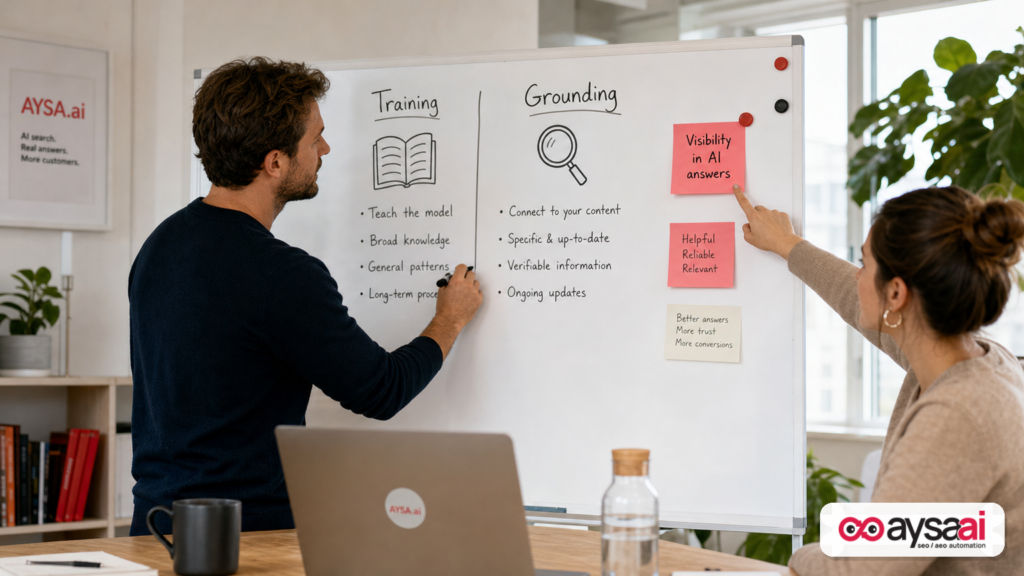
- The Real Business Issue: Training vs. Grounding vs. “Being Visible”
- How The Shared Line Works (In Plain English)
- Google’s Approach: It Ties Back To Google-Extended
- Microsoft’s Approach: Separate Knobs For Training And Grounding
- OpenAI (And Anthropic) Signals: What We Know vs. What We Don’t
- What Can Go Wrong: The Failure Modes I’d Plan For
- Concrete SME Scenario: A Local Clinic vs. “AI Answers” Visibility
- A Practical Action Plan (SMEs + Agencies): What To Implement Now
- Where AYSA Fits: Monitoring + Approved Execution For AI Search Policies
- What to do next
- Sources and further reading
What Changed: A “Shared” robots.txt AI Training Preference (But Not A Standard Yet)
The headline idea is simple: instead of writing separate robots.txt rules for each AI crawler (and trying to keep up as names and behaviors change), publishers could declare a single preference for “AI training usage” that multiple providers agree to interpret.
This concept was reported by Search Engine Journal in the context of announcements and working-group activity around AI preferences and robots directives. The shared line described there comes from an Internet Draft submitted to an IETF working group process, described as an individual draft rather than official standardization activity at this stage.
What matters for operators: you’re seeing the early formation of a common vocabulary. Even if the exact token or behavior changes, this is a directional signal: AI platforms want a scalable way to read publisher intent.
Search Engine Journal coverage is the best single summary in the provided research context of how Google, Microsoft, and OpenAI say they intend to handle this shared opt-out.
Why This Is Happening Now: AI Answers Are Becoming The Front Door
Historically, your web content had two primary discovery paths:
- Direct traffic (people typing your URL, email links, social links).
- Search traffic (ranking pages in Google/Bing and earning Clicks).
Now there’s a third path growing fast: AI-mediated discovery—a person asks a question and an AI system answers. Sometimes that answer includes citations and links. Sometimes it doesn’t. Sometimes it paraphrases your content without sending a click at all.
For SMEs, this shift is both opportunity and threat:
- Opportunity: you can show up as “the recommended provider” in an AI answer even if you don’t rank #1 traditionally—especially for long-tail and “how do I choose” questions.
- Threat: you can lose visibility even while your classic rankings look stable, because the customer never reaches the results page in the same way.
That’s why policy controls around AI usage are becoming business-critical. But they’re also becoming more complex because “AI usage” is not one thing.
The Real Business Issue: Training vs. Grounding vs. “Being Visible”
Most of the confusion—and most of the bad decisions I see—come from mixing up three separate concepts:
1) AI training
As described in the working vocabulary referenced in the reporting, “training” means using content to modify a generative model’s learned parameters. Put plainly: your content becomes part of what the model learns from.
Some businesses object on principle. Others care because of competitive sensitivity (pricing pages, proprietary processes). Publishers often care because of value capture: “If an AI trains on my content, will that reduce subscriptions or ad revenue?”
2) Grounding
“Grounding” is different. Grounding typically means: the AI model uses external sources—often from a search index—to help answer the user’s question more accurately, sometimes with citations.
From a brand perspective, grounding can be a visibility engine. It’s how you can be referenced in AI answers when the model doesn’t have enough certainty on its own.
3) Visibility in AI answers
This is the business outcome: does the AI system mention you, cite you, recommend you, or link to you?
You can opt out of training and still want grounding. Or you can allow training but restrict grounding in third-party contexts. The point is: the best policy depends on your business model—and the provider controls don’t line up neatly.
This mismatch is explicitly highlighted in the SEJ reporting: Google’s mapping is tied to Google-Extended (covering both training and grounding in Gemini contexts), while Microsoft is splitting training and grounding into separate preferences.
How The Shared Line Works (In Plain English)
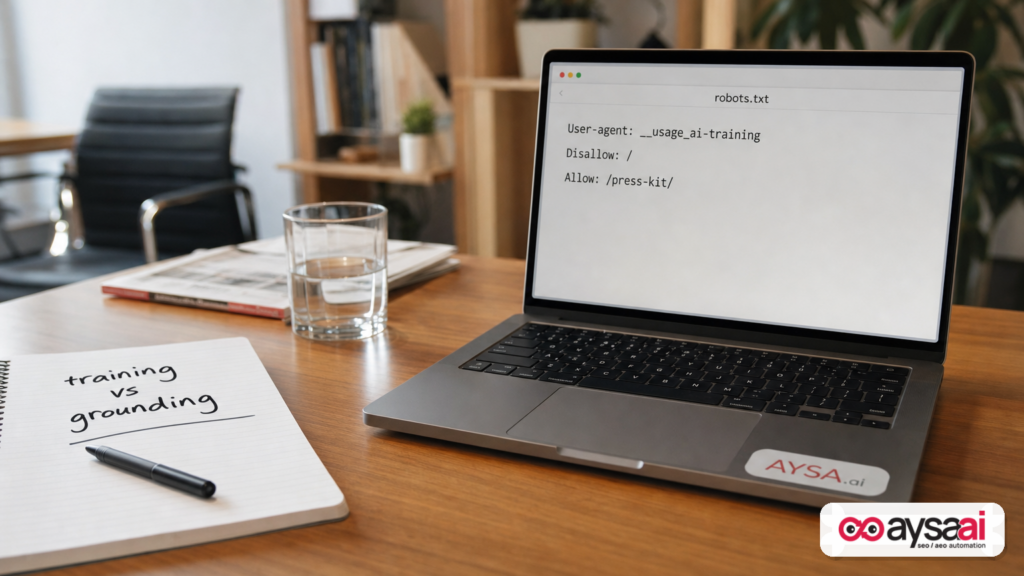
The shared approach described in the reporting doesn’t add a brand-new robots.txt directive; it uses a conventional group with Allow and Disallow under a specific policy token (shown as __usage_ai-training in the draft referenced).
What that means operationally:
- You’d add a dedicated group to your
robots.txt. - You’d declare what paths are allowed or disallowed for the defined usage (“AI training”).
- This is separate from Crawling control. It’s meant to express a usage preference, not necessarily whether a crawler can fetch the page.
Important nuance from the described draft: existing robots groups (including wildcard User-agent: *) would not automatically apply to this token; absence of the token group indicates “no preference.” That’s a big deal because it means most sites today are implicitly “no preference expressed” under this approach—even if they block certain bots for crawling.
If you’re an operator, the lesson is not “rush to add a token.” The lesson is: this will likely become a new checklist item in Technical SEO governance, similar to how we treat sitemaps, canonical tags, and indexation controls.
Google’s Approach: It Ties Back To Google-Extended
Per the SEJ reporting, Google’s stated plan is to interpret the shared opt-out signal as if the publisher disallowed Google-Extended—unless the publisher explicitly specifies Google-Extended.
Why that matters:
- Google-Extended has already been positioned as a control for whether content can be used to train future Gemini models and whether it can be used for grounding in Gemini Apps and related contexts (as described in the reporting).
- From a publisher standpoint, the tie between training and grounding can create a policy tradeoff: you might want to opt out of training while still allowing grounding to earn visibility and citations in AI answers.
It’s also critical not to over-assume. The reporting notes that Google Search inclusion is not impacted by Google-Extended (per Google’s documentation as referenced there), and that other experiences (like AI Overviews / AI Mode) have separate controls described as being in Search Console.
Practical takeaway: if your business wants to manage training and grounding separately, Google’s current framing (as described) may not offer that separation through the shared line mapping. That means you’ll need a provider-by-provider policy plan, not just “set it and forget it.”
Microsoft’s Approach: Separate Knobs For Training And Grounding
Microsoft’s approach, as summarized in the SEJ reporting, is more granular: it adopts the shared line for training, and introduces a separate preference for AI grounding that can be set at the page level. It also supports page-level overrides via meta tags or HTTP Headers.
For businesses, this is both good and messy:
- Good because it aligns with how many brands think: “Don’t train on my stuff, but do cite me and send me traffic.”
- Messy because granular controls create implementation debt. If you’re setting page-level headers, templates, and robots preferences, you need governance and monitoring.
The SEJ reporting also notes a transition away from older controls like NoArchive and NoCache, with Microsoft telling sites to switch to new preferences by a stated deadline. Any forced migration matters: if you’re using legacy controls, you can’t ignore this without risking an unintended default behavior.
Practical takeaway: Microsoft’s implementation direction increases the importance of page-level policy management. This is where SMEs typically struggle—because “policy” lives in engineering, but the business impact shows up in marketing results.
OpenAI (And Anthropic) Signals: What We Know vs. What We Don’t
Based on the SEJ reporting:
- OpenAI aims to honor the signal in the next few months, while maintaining its current robots policy in the interim.
- Anthropic is mentioned in connection with the draft submission and stated development efforts, but broad implementation across services is described as taking time.
The biggest operational gap called out in the reporting is conflict handling: what happens if your site has a shared-line rule and a provider-specific rule that disagree? For example, a shared opt-out for training but an existing bot-specific allow (or vice versa). The reporting notes that, as of the check described there, OpenAI’s materials didn’t clarify how conflicts would be resolved.
Practical takeaway: until conflict resolution behavior is explicitly documented per provider, the safe approach is to avoid contradictory directives—or at least treat them as a high-risk configuration that you test and revisit.
What Can Go Wrong: The Failure Modes I’d Plan For
When new policy controls appear, the first wave of implementations tends to be sloppy. Not because people are careless—because operations are complex and incentives are misaligned.
Here are the most likely failure modes for SMEs and agencies as shared AI usage preferences roll out:
1) Treating “AI training opt-out” as “AI visibility opt-out”
If a provider maps training controls to grounding controls (or vice versa), you can reduce your presence in AI answers without realizing it. The SEJ reporting highlights this mismatch between providers explicitly.
Business symptom: leads dip from “messy” informational queries, while your top commercial rankings look unchanged.
2) Conflicting directives across bots and tokens
Many sites already have a patchwork of rules: bot blocks, crawl-delay hacks, legacy tags, CDN rules, security middleware, and CMS-level meta tags. Adding one more layer can introduce contradictions.
Business symptom: teams argue about why AI systems cite competitors while your content “should be allowed,” and no one can prove what is actually being honored.
3) Over-blocking that breaks legitimate use cases
Some businesses will panic and disallow everything sitewide. For publishers, that may align with business goals. For local services and ecommerce, it’s often counterproductive because it reduces discovery at the exact moment buyers are asking AI tools “who should I choose?”
4) Under-blocking sensitive content
The opposite happens too: sites forget that policy should be content-type-specific. Press kits, job postings, and public documentation may be fine to allow. Pricing experiments, gated resources, proprietary how-to content, or patient/customer portals are not.
5) “Set it once” with no monitoring
Even if the directive is correct today, interpretation can change as drafts evolve, companies adjust definitions, and bots update. If you don’t monitor, you’ll discover the impact months later—when the pipeline is already affected.
This is exactly why we built the monitoring-to-approved-execution loop at AYSA: policy changes require continuous verification, not one-time edits.
Concrete SME Scenario: A Local Clinic vs. “AI Answers” Visibility
Let’s make this real with a scenario that mirrors how SMEs actually operate.
Business: a multi-location dental clinic.
- They publish educational content: “Do I need a root canal?”, “What does Invisalign cost?”, “Emergency tooth pain steps.”
- They have strong Google rankings in their city for a few key terms.
- They rely on a mix of calls, form fills, and direction requests.
What changes in an AI-first discovery world:
- Potential patients ask AI tools: “How do I know if I need emergency dental care tonight?”
- The AI responds with a short checklist and often includes a short list of suggested local providers or cites authoritative sources.
The clinic’s concern: “We don’t want our content used to train models.”
The clinic’s hidden risk: if their opt-out implementation also reduces eligibility for grounding/citation in AI answers (depending on provider interpretation), they may lose the most valuable stage: the moment a patient is deciding who to call.
A better approach:
- Opt out of training where appropriate, but keep grounding open for public educational pages that serve as top-of-funnel demand capture.
- Restrict sensitive pages (patient portal, internal policies, experimental pricing pages) aggressively.
- Monitor brand visibility in AI answers over time, not just rankings.
This is what AEO/GEO looks like in practice: not “write for bots,” but “be the source that AI systems are comfortable citing when the customer asks.”
A Practical Action Plan (SMEs + Agencies): What To Implement Now
If you’re waiting for a final standard before taking action, you’re already behind—because the work isn’t the token; it’s the policy design and execution discipline.
Step 1: Decide your content policy by content type (not by emotion)
Create a simple matrix. Example categories:
- Public marketing pages (home, services, categories): usually allow grounding; training preference depends on your risk tolerance.
- Public informational content (blog, guides, help center): often the best grounding candidates.
- Press kit / media assets: typically safe to allow (and beneficial).
- Proprietary content (research, paid templates, premium resources): consider restricting training and possibly grounding.
- User/private areas (account, cart, patient portal): restrict everything; also ensure you’re handling indexation properly beyond AI policy.
Step 2: Inventory what you already have
Before adding new controls, document the current state:
- Your existing
robots.txtgroups and bot rules. - Any meta tags or HTTP headers you use (especially if you’ve used
NoArchiveorNoCachehistorically, as Microsoft’s transition plan described in the reporting suggests). - Any CMS template logic that applies tags automatically.
- Any WAF/CDN rules that might block crawlers regardless of robots preferences.
At AYSA, this is where we start: monitoring and baseline capture. See AYSA Monitoring.
Step 3: Avoid contradictory directives (until conflict handling is clearly documented)
Because the SEJ reporting highlights uncertainty about conflicting signals (especially for OpenAI’s handling when shared and bot-specific rules disagree), keep configurations clean:
- If you adopt a shared training opt-out, align your provider-specific rules to match wherever possible.
- If you need exceptions (e.g., allow /press-kit/), document them and keep them consistent across signals.
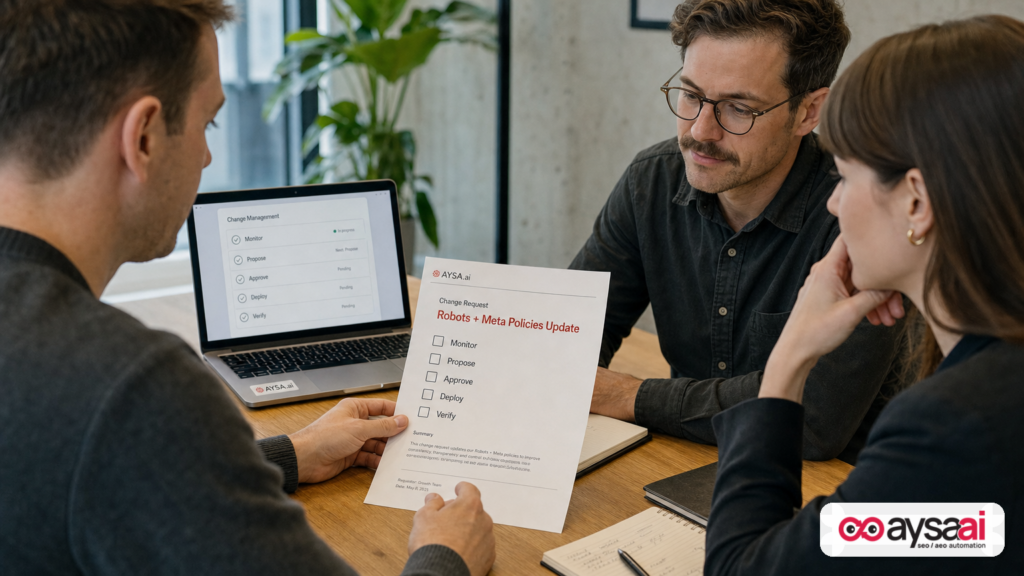
Step 4: Implement with guardrails (staging, approvals, rollback)
Even small robots.txt edits can have large consequences. Treat changes like releases:
- Make edits in a controlled workflow.
- Require approval from both marketing (business intent) and technical owner (implementation correctness).
- Have a rollback plan.
This is a core design principle in AYSA: we prepare changes, ask for approval, then execute accepted updates—so decisions are auditable and reversible. Learn more at AYSA AI SEO tools.
Step 5: Monitor outcomes in AI visibility, not just rankings
Rankings still matter. But they’re no longer sufficient as the only KPI. You need to track:
- When and where your brand is cited or referenced in AI answers (where measurable).
- Traffic quality shifts (are you losing early-funnel discovery?).
- Indexation stability (did a policy change accidentally affect crawl/index rules?).
AYSA’s positioning here is AEO/GEO execution: AI Search Visibility is the outcome, not “we updated a file.”
Step 6: Plan for 2027 like it’s tomorrow
The SEJ reporting includes multiple timelines that point into 2027 for broader support and for Microsoft’s migration away from legacy tags. The mistake SMEs make is treating future deadlines as distant—then scrambling when teams are busy and something breaks.
Put this into your quarterly technical SEO governance:
- Policy review
- Implementation review
- Monitoring review
Where AYSA Fits: Monitoring + Approved Execution For AI Search Policies
Most tools can tell you what changed. Fewer can actually help you do something about it safely.
AI usage preferences in robots and page-level controls are a perfect example of where execution friction kills outcomes:
- Marketing knows the intent (“opt out of training, keep visibility”).
- Engineering owns the files/headers but has other priorities.
- Agencies can recommend changes but often can’t deploy them directly.
AYSA bridges that gap with a practical loop:
- Monitor your current technical state and visibility signals (Monitoring).
- Prepare recommended changes (robots groups, meta/header policies, CMS template updates) based on your business policy.
- Ask for approval so stakeholders control risk.
- Execute accepted changes and verify outcomes.
If you’re an SME, this means you can move without becoming an expert in evolving drafts and crawler politics. If you’re an agency, it means fewer stalled recommendations and a clearer, auditable delivery process.
If you want to see how AYSA is packaged, start at Pricing or browse implementation-focused posts on our blog.
What to do next
- Write a one-page policy: what content types you’re okay with for training vs grounding, and what content must be restricted.
- Audit your current controls: robots.txt groups, legacy meta tags/headers, and any AI bot-specific rules already in place.
- Remove ambiguity: align shared signals and provider-specific signals to avoid conflicts until conflict resolution is explicitly documented.
- Implement with approvals: treat robots and header changes like releases, not quick edits.
- Set a quarterly review: providers will evolve these controls; your governance needs to keep up.
- Operationalize monitoring: measure what matters—AI visibility and lead impact, not only classic SERP positions.
Sources and further reading
- Search Engine Journal: Google, Microsoft & OpenAI Plan To Honor Shared AI Training Opt-Out
- SEJ topic hub: AI Search
- SEJ topic hub: Technical SEO
Note: The supplied research context references multiple provider documents and draft materials. Where primary documentation links are not provided directly in the context, I’ve avoided claiming I reviewed them firsthand. As providers publish more explicit documentation on conflict handling and exact directive behavior, your implementation should be revisited and validated.
Continue the AI search topic inside AYSA.
Use these pages to connect the article with AI SEO tools, AI visibility monitoring, AI Overviews and approved website execution.
Turn this topic into a website action plan.
Use these AYSA hubs to move from reading to technical fixes, AI visibility monitoring, research, glossary context and approval-first SEO execution.