Meta’s Live Shopping Ads + Virtual Card Checkout: What It Really Changes for Conversion, Measurement, and SEO in 2026
Meta is expanding live shopping ads and adding virtual card checkout to reduce purchase friction inside Facebook and Instagram. Here’s what that means for SMEs and agencies: creative strategy, feed quality, measurement, trust, and how to adapt your website + SEO so discovery turns into revenue—even when the sale happens off-site.

By Marius Dosinescu (AYSA.ai)
Meta is making a very clear bet: the next wave of ecommerce growth happens when product discovery, persuasion, and purchase happen without leaving Facebook and Instagram.
According to Search Engine Land, Meta is (1) expanding live shopping ad formats across Facebook and Instagram, (2) making product data a core input to “Sales” campaigns where AI assembles ads from feeds + creative, and (3) rolling out a virtual card checkout option intended to improve confidence and reduce payment friction.
This isn’t just “another ad product.” It’s a structural shift in how demand gets created and captured—one that impacts your creative process, your product feed discipline, your onsite SEO, and even how you think about measurement and customer ownership.
Concise summary
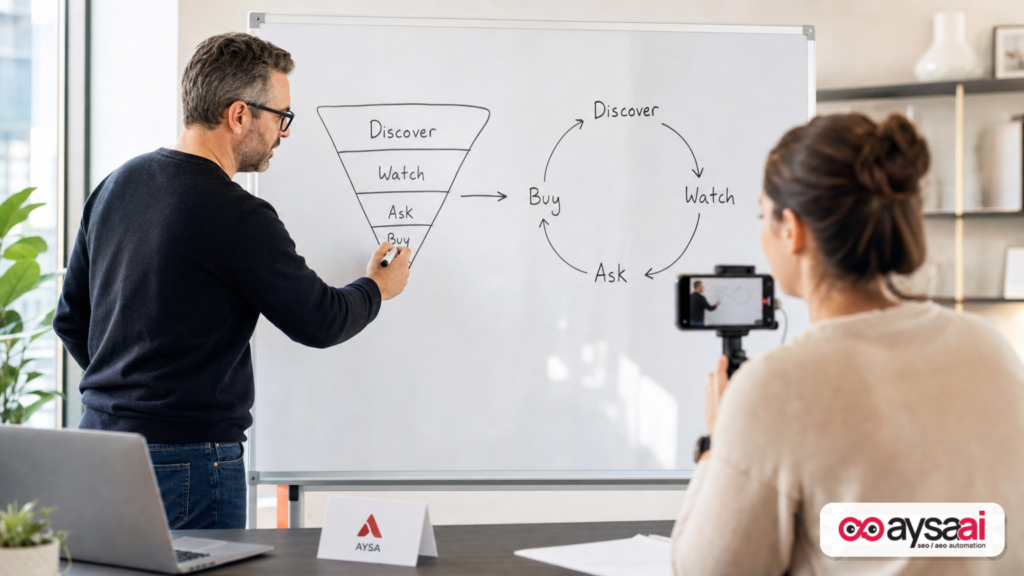
- Meta is compressing the funnel: discovery → consideration → checkout is moving inside the feed, powered by AI recommendations and richer product data.
- Live shopping is becoming an ad primitive, not just an organic tactic. That changes production cadence, creative testing, and budget allocation.
- Virtual card checkout is a trust feature that can remove a major “I don’t know this merchant” barrier—especially for first-time purchases.
- Your product catalog becomes performance infrastructure. Bad titles, missing attributes, inconsistent prices, and out-of-stock issues will quietly tax ROAS.
- SEO still matters—but it must connect to paid social and in-app conversion paths. The brands that win will align feeds, landing pages, schema, and inventory messaging across channels.
Table of contents

- What changed on Meta (and what didn’t)
- The real story: Meta is collapsing the funnel into the feed
- Live shopping ads: why the format is expanding now
- Trust and friction: why virtual card checkout is more than a payments tweak
- Product data becomes the new creative brief
- Measurement reality: attribution gets harder (and more important)
- What this means for SEO, AEO, and GEO
- What can go wrong (common failure modes)
- The SME scenario: a $2M/year niche ecommerce brand running one live show per week
- What agencies should rethink in 2026
- Where AYSA fits: monitoring + approved execution that keeps revenue systems aligned
- 90-day action plan
- What to do next
- Sources and further reading
What changed on Meta (and what didn’t)

Let’s separate the announcements into three buckets—because each one affects a different part of your revenue system.
1) Live Video Ads expansion (Facebook globally, Instagram added)
Meta is expanding “Live Video Ads” more broadly, and bringing the concept to Instagram, enabling brands to promote livestreams and reach audiences beyond the people who already follow them. In the U.S., Meta is also working with specific live commerce providers (as reported by Search Engine Land) to turn eligible livestreams into ads.
Editorial take: live commerce is moving from “content experiment” to “paid distribution unit.” That changes the economics: you don’t need viral luck; you need repeatable production and a measurable offer.
2) A new checkout experience using virtual card numbers
Meta is rolling out a virtual card payment option on Facebook and Instagram, in partnership with major card networks, that uses temporary, one-time card numbers connected to a shopper’s existing card. The intent is to reduce risk perception and increase conversion confidence.
Editorial take: security is marketing. When buyers feel safer, they abandon less. That’s not hype; it’s basic behavioral economics applied to ecommerce.
3) “Product data as foundational” for Sales campaigns
Meta is treating product data (price, availability, descriptions) as a core signal across more campaign formats. Advertisers provide product feeds plus creative assets; Meta’s AI assembles the best ad combination for each user.
Editorial take: your catalog is now part of your creative strategy—and part of your measurement strategy. If your catalog is messy, your ads will be messy, even if your creative team is world-class.
The real story: Meta is collapsing the funnel into the feed
Historically, ecommerce growth looked like this:
- Search or social discovery
- Click to website
- Browse
- Checkout
- Post-purchase email/SMS retention
Meta’s direction suggests a different future:
- Discovery inside content feeds (including recommendations, creators, and conversations)
- Persuasion inside native formats (live video + product surfacing)
- Checkout without leaving the app (reduced friction + more trust)
Meta itself frames AI as changing how products are discovered—less like traditional search and more like recommendations inside feeds and conversations (per the Search Engine Land coverage). Whether you love that or not, it matches what most consumers already do: they “bump into” products while scrolling.
What this means for businesses:
- Your website is no longer the only “storefront.” Your catalog and creative are storefronts too.
- Your Conversion rate is influenced by platform UX choices you don’t control.
- Your SEO strategy must connect to a world where the purchase may happen off-site.
Live shopping ads: why the format is expanding now
Live shopping isn’t new. The difference is what happens when it becomes ad inventory and is connected to product feeds and more seamless checkout options.
Live commerce solves a specific problem: explaining “why this, why now”
For many categories, the main conversion blocker isn’t awareness—it’s confidence.
- Does this fit?
- What does it look like in real life?
- Is this seller legitimate?
- How do I use it?
Live video handles these objections in a way static ads rarely can. It’s closer to in-store retail: demonstration, social proof, and Q&A in real time.
Why Meta wants live shopping ads
Meta’s incentives are straightforward:
- More time in app (live is sticky)
- More commerce events (signals)
- More ad spend justified by sales (closed-loop, even if imperfect)
What SMEs should understand before betting on live
Most small businesses approach live shopping like a “marketing moment.” The winners treat it like an operational cadence:
- A weekly run-of-show
- Repeatable product segments
- A consistent offer framework
- A backlog of product clips repurposed into short-form
The goal isn’t one huge live event. The goal is a machine that produces learnings and assets.
Trust and friction: why virtual card checkout is more than a payments tweak
There’s a conversion truth most teams underestimate: buyers don’t abandon because they hate your product. They abandon because something feels uncertain, annoying, or risky.
Meta’s virtual card checkout approach—temporary card numbers tied to a user’s existing card—targets a specific fear: “I don’t want to share my real card with a merchant I don’t know.” If Meta reduces that fear, it can lift conversion rates for first-time purchases, especially from impulse-driven discovery.
Why this matters even if you already have a great website checkout
If you’ve invested in a fast, clean, optimized website checkout, you might feel like: “Great, we’re already good.” But if the customer is buying in-app, your website checkout quality doesn’t help that transaction.
So what’s your move?
- Make sure the in-app offer and product details match your site (no surprises).
- Use your site to build the brand and the repeat-purchase engine (email/SMS, content, support).
- Make SEO and content do what platforms won’t: answer deeper questions, rank for comparison intent, and build authority.
Product data becomes the new creative brief
Meta’s push to make product data foundational for Sales campaigns is one of those changes that sounds technical but has huge practical impact. When AI assembles ads from your feed and your creative assets, the feed becomes part of the message.
Catalog quality is performance marketing now
If your feed has:
- unclear titles
- missing variants
- inconsistent pricing
- stale availability
- thin descriptions
…then you’re asking Meta’s system to do magic with bad ingredients.
The “feed + creative” operating model
Expect a shift in internal workflows:
- Merchandising owns catalog completeness and accuracy.
- Creative owns asset coverage (angles, use cases, objections).
- Performance marketing owns the testing framework and budget pacing.
- Web/SEO owns landing page parity and Structured data consistency.
When these teams operate in silos, you get mismatches that erode conversion: the ad shows one promise; the product page shows another; the live host says a third thing.
Practical checklist: the minimum viable “product data readiness”
Without inventing platform-specific requirements, here’s a practical, cross-platform readiness standard that helps regardless of channel:
- Titles that match how customers describe the product (not internal SKU language).
- Descriptions that answer “what it is,” “who it’s for,” and “why it’s different.”
- Accurate availability (especially for hero products featured in live segments).
- Pricing parity across feed, site, and live offer language.
- Variant clarity (sizes, colors, bundles) so users don’t hit a dead end.
- High-quality images that show scale, use, and details.
Measurement reality: attribution gets harder (and more important)
When commerce happens inside platforms, measurement can feel easier (“Meta shows purchases”)—but it also becomes more fragile.
Why it becomes fragile
- Black-box optimization: AI assembles ads dynamically, making it harder to isolate “what worked.”
- Creative fragmentation: more placements, more formats, more combinations.
- Cross-channel overlap: the same buyer may discover on Meta, research on Google, then buy in-app or on-site.
What to do instead of chasing perfect attribution
Most SMEs don’t need perfect Attribution. They need decision-grade measurement:
- Are we growing new customers profitably?
- Are repeat purchases increasing?
- Are we over-discounting to buy revenue?
- Are support tickets/returns rising because we sold the wrong expectations?
Even if the platform reports conversions, your business still needs an independent view: overall revenue, margin, return rate, and customer lifetime behavior.
What this means for SEO, AEO, and GEO
It’s tempting to read Meta’s announcement and conclude: “SEO matters less because people will buy inside apps.” That’s the wrong takeaway.
What’s changing is where the demand is created and how users move between systems. Your job is to keep your brand and product truth consistent across all surfaces.
SEO still compounds—but its job shifts
Your site increasingly becomes:
- The truth layer: canonical specs, shipping/returns, guarantees, compliance.
- The deep answer layer: comparisons, compatibility guides, sizing, FAQs.
- The brand layer: story, trust, press, testimonials (with appropriate claims discipline).
- The retention layer: email capture, support, how-to content, account area.
AEO/GEO: being cited and recommended when users ask AI systems
We’re also living through a shift where users consume more AI-mediated answers in search experiences. Search Engine Land’s broader coverage frequently tracks these shifts, including how AI summaries change click behavior and traffic patterns (see their reporting on AI summaries and AI Overviews in their newsroom list, e.g., Pew: 60% of Americans read AI summaries in search results and Google AI Overviews cite self-serving listicles…).
Whether a purchase happens on Meta or your site, AI discovery changes how people form opinions. For SMEs, the practical takeaway is simple:
- Write and structure content so it can be understood and reused by machines (clear entities, clear claims, clear FAQs).
- Keep product facts consistent (feeds, pages, schema, support docs).
- Invest in proof: policies, documentation, and reviews that establish trust.
If you want a practical overview of how we think about this at AYSA, start here: AI Search Visibility.
What can go wrong (common failure modes)
Whenever a platform reduces friction, brands rush in. The failures are predictable—and avoidable.
1) You treat live shopping like a one-off campaign
Live shopping works when it’s operationalized: scheduling, scripting, inventory planning, and post-live follow-up. If you do one live, learn nothing, and disappear for two months, you won’t build an audience or a creative feedback loop.
2) Your catalog lies (even accidentally)
Out-of-stock items promoted in a live show, mismatched variants, or stale pricing destroys trust. It also creates customer support load and returns—quiet costs that don’t show up in ad dashboards.
3) You over-discount to “force” conversion
Discounting can spike conversion while eroding brand and margin. Live formats amplify urgency; be careful not to train customers to wait for live-only deals unless that’s your deliberate strategy.
4) You optimize to platform metrics, not business outcomes
Platforms reward activity they can measure. Your job is to connect that to profit: contribution margin, return rates, and repeat purchase behavior.
5) Your website becomes inconsistent with your platform storefronts
Even if checkout happens in-app, customers still Google you, check your policies, and look for reassurance. If your site is outdated, slow, or inconsistent, you’ll lose the sale anyway—just earlier.
The SME scenario: a $2M/year niche ecommerce brand running one live show per week
Let’s make this concrete with a realistic setup.
Business: A niche ecommerce brand selling premium home organization products. Small team: founder, one marketer, one ops person. Roughly $2M/year revenue. Strong repeat purchase potential, but most growth comes from new customers.
Goal: Use live shopping ads to acquire new customers profitably, while protecting brand and building a retention engine on owned channels.
Week 1–2: Set the foundation
- Pick one hero collection for the first four lives (don’t rotate everything).
- Create a run-of-show template: intro → problem → demo → FAQs → offer → recap.
- Confirm inventory depth for featured SKUs.
- Audit product pages for parity: price, shipping, returns, variant clarity.
Week 3–6: Build the asset machine
- Run one live per week.
- Clip 10–20 short segments into ad creatives (objection handling, demos, before/after).
- Update product descriptions and FAQs based on real questions asked during lives.
Week 7–12: Scale what’s repeatable
- Turn the best-performing segments into a predictable cadence.
- Test offers that don’t destroy margin (bundles, free accessory, limited-time shipping upgrade).
- Improve catalog data where AI assembly shows weak spots (e.g., ambiguous titles).
What success looks like: not one viral day. Success is a stable acquisition channel that produces reusable creative, improved product pages, and fewer customer objections over time.
What agencies should rethink in 2026
If you’re an agency, Meta’s changes are both an opportunity and a trap.
The opportunity: agencies can own the “commerce operating system”
As AI assembles ads dynamically and checkout friction decreases, the differentiator becomes:
- catalog discipline
- creative volume + testing system
- cross-channel consistency
- measurement that the CFO trusts
The trap: selling “ad management” while ignoring the infrastructure
In 2026, “we manage your Meta ads” is increasingly commoditized. The premium service is: “we make your product data, creative system, and onsite truth layer work together.”
This aligns with a broader paid media trend toward AI-assisted optimization in multiple ecosystems, as Search Engine Land continues to cover in areas like Google’s bidding and campaign automation (e.g., Google expands Smart Bidding Exploration… and the evolving automation landscape around campaign types).
Where AYSA fits: monitoring + approved execution that keeps revenue systems aligned
Here’s the uncomfortable truth: most ecommerce growth problems are not “strategy problems.” They are execution drift problems.
When you add live shopping ads, AI-assembled sales ads, and new checkout paths, the number of moving pieces multiplies:
- product pages
- inventory status
- structured data
- collections
- shipping/returns language
- site performance
- content and FAQs
AYSA is built to help teams manage that reality with an Approved Execution system: we monitor, prepare changes, ask for approval, and then execute accepted improvements—so your website stays aligned with what your ads and feeds are promising.
Relevant starting points:
- AYSA Monitoring (catch drift before it costs revenue)
- AI SEO tools (execution-oriented, not “insights only”)
- AI search visibility (AEO/GEO readiness perspective)
- Pricing (understand how teams adopt AYSA operationally)
- Blog (ongoing playbooks and updates)
What AYSA would monitor for a brand leaning into Meta commerce
Without pretending to “see inside” Meta’s systems, we can still protect the business by monitoring what we control: the site as the truth layer.
- Indexability and crawl health for product and collection pages
- Out-of-stock and discontinued product handling (avoid dead-end discovery)
- Duplicate/variant canonicalization (reduce messy indexing and confusion)
- Structured data consistency (product information clarity)
- Performance regressions on PDP templates (speed is conversion)
- Broken internal links from evergreen content to revenue pages
- Policy page visibility and clarity (shipping/returns/trust)
Then we do what most teams struggle with: turn findings into approved changes that get implemented—without weeks of backlog and handoffs.
90-day action plan (practical, SME-friendly)
If you’re an SME, here’s a plan you can execute without building a media empire.
Days 1–15: Choose a narrow wedge
- Pick 10–30 products that are (a) in-stock reliably, (b) easy to demo, (c) have solid margin.
- Write a one-page “offer policy” for live shopping (what you will and won’t do with discounts).
- Decide your cadence (weekly is better than monthly if you can sustain it).
Days 16–45: Fix the truth layer
- Update product pages to reduce uncertainty: sizing, compatibility, what’s included, shipping/returns.
- Make FAQs real: use the questions that come from DMs, comments, and support tickets.
- Ensure pricing and availability messaging is consistent across your site and your product data sources.
Days 46–90: Build the creative + learning loop
- Turn each live into a set of reusable assets (clips by objection and use case).
- Track outcomes that matter: new customers, margin, return rate, customer support volume.
- Improve one thing per week based on evidence (catalog clarity, page copy, live script, bundling).
What to do next
- Audit your product data and onsite parity: do your product pages match what your ads and live hosts say?
- Pick one repeatable live format (not a one-off “event”).
- Design for trust: clear policies, clear product facts, and less uncertainty at every step.
- Set measurement that your business can trust: profit-aware metrics, not just platform ROAS.
- Operationalize execution: use monitoring and approved implementation so your site doesn’t drift while your paid social evolves.
If you want AYSA’s help keeping your website aligned as your paid social and in-app commerce strategies expand, start with Monitoring and then explore the broader toolkit at AI SEO Tools.
Sources and further reading
- Search Engine Land: Meta expands live shopping ads and virtual card checkout to drive more purchases
- Search Engine Land: Google expands Smart Bidding Exploration, adds Promotion Mode
- Search Engine Land: Pew: 60% of Americans read AI summaries in search results
- Search Engine Land: Google AI Overviews cite self-serving listicles…
- AYSA: AI search visibility
- AYSA: Monitoring
- AYSA: Pricing
Note on sourcing: The supplied research context includes Search Engine Land coverage and related internal links. For deeper technical specifics (e.g., exact implementation details, eligibility constraints, or rollout timelines beyond what’s reported), consult Meta’s official product documentation and announcements directly; those primary sources were not included in the provided context, so I’m not asserting additional details here.
Continue the AI search topic inside AYSA.
Use these pages to connect the article with AI SEO tools, AI visibility monitoring, AI Overviews and approved website execution.
Turn this topic into a website action plan.
Use these AYSA hubs to move from reading to technical fixes, AI visibility monitoring, research, glossary context and approval-first SEO execution.