Less Traffic, Better Buyers: How AI Search Is Rewriting B2B (And What to Do About It)
B2B organic traffic is slipping, yet many teams are seeing stronger, more sales-ready leads. AI Overviews and answer engines are compressing the research phase into the SERP and rewarding credibility over visibility. Here’s a practical playbook to earn citations, protect pipeline quality, and operationalize AEO/GEO with approved execution.

B2B marketing is going through an uncomfortable transition: many teams are getting less Organic traffic, but the leads that do show up often look more “ready to buy.” If you’re staring at declining sessions while sales says, “Actually… pipeline feels healthier,” you’re not imagining things.
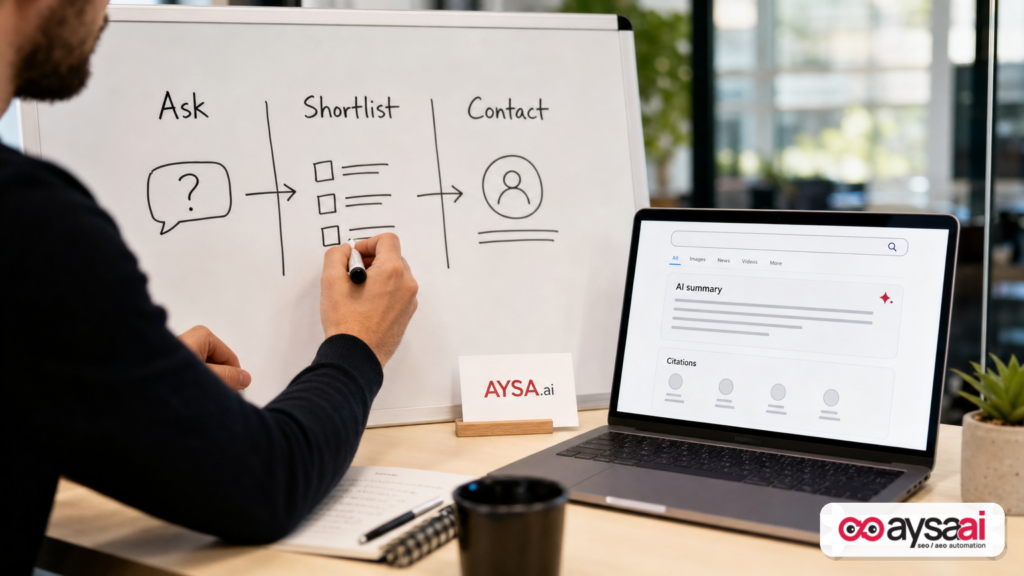
The simplest explanation is also the most disruptive one: the early research phase of B2B buying has moved off your website and into AI-generated answers. In Google, that shows up as AI Overviews (and similar answer experiences in other tools). Buyers ask a question, get a synthesized shortlist, form a preference, and only then click—if they click at all.
That change doesn’t mean SEO is dead. It means SEO is evolving into something closer to digital credibility engineering: structured proof, third-party validation, and author identity that AI systems can confidently cite. The winners won’t necessarily be the brands with the most content. They’ll be the brands with the most corroborated presence.
This editorial is my practical, opinionated playbook for what to do next—especially if you run an SME, a growth team, or an agency and you need a plan you can execute without a research lab.
Concise summary
- Why traffic is down: AI answers are absorbing top-of-funnel research that used to drive Clicks.
- Why leads can be better: Buyers arrive after being pre-qualified by AI’s “credibility filter.”
- What wins now: Being a cited source through readable case studies, verifiable authors, reviews on cited platforms, and trusted third-party mentions.
- What to do: Audit where you appear in AI answers, fix proof assets (case studies), build author identity, expand third-party validation, and measure the right KPIs.
- Where AYSA fits: Monitoring + preparing changes + asking for approval + executing accepted website updates—so your AI-search strategy becomes a repeatable system.
Table of contents
- The context: why “more traffic = more revenue” stopped working
- What actually changed: the research phase moved off your website
- Why fewer leads can be better leads (and when it’s a problem)
- The new KPI stack: from sessions to “being the cited source”
- How AI systems decide what to cite (and what they ignore)
- Common pitfalls that quietly kill AI visibility
- A concrete SME scenario: B2B service firm with shrinking traffic
- Step 1: Run an AI visibility + credibility audit
- Step 2: Upgrade proof assets AI can parse (case studies + service pages)
- Step 3: Earn third-party mentions AI trusts
- Step 4: Build review signals on platforms AI cites
- Step 5: Make authors verifiable across the web
- A practical 90-day action plan (SME-friendly)
- Where AYSA.ai fits: monitoring + approved execution for AI search
- What agencies should rethink (business model + deliverables)
- What to do next
- Sources and further reading
The context: why “more traffic = more revenue” stopped working
For years, inbound marketing had a clean mental model:
- Publish content → rank for keywords
- Get more clicks → collect more leads
- Nurture leads → close more revenue
That model assumed the web’s primary interface was a list of links. If a buyer had a question, your goal was to be one of the best links.
Now, the interface is shifting. In many searches—especially informational, comparison, and early vendor-discovery queries—buyers get an answer first. Links become supporting detail. And in B2B, where research is heavy and stakes are high, that “answer-first” pattern is accelerating.
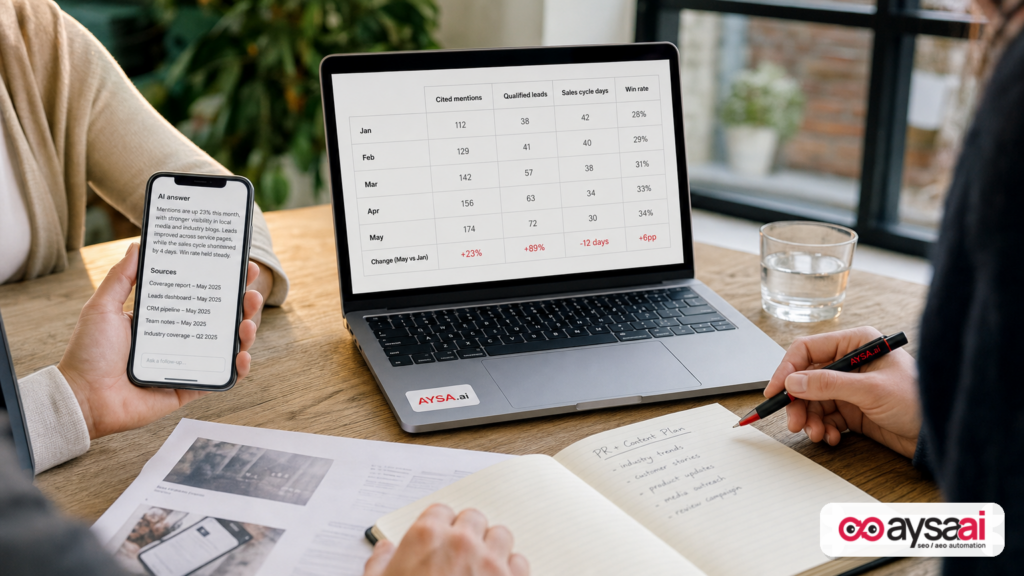
The result is counterintuitive: you can lose a meaningful percentage of top-of-funnel organic traffic and still see a healthier pipeline, because the people who do click are further along and more confident.
This dynamic is discussed clearly in the Search Engine Journal piece, “Less Traffic, Better Leads: Is Google Fixing B2B Marketing?” (sponsored, but still a useful framing) which argues that AI is compressing early research into the SERP and rewarding credible vendors with citations and downstream clicks. Read the original on Search Engine Journal.
What actually changed: the research phase moved off your website
In traditional search, a buyer might query:
- “best payroll software for 200 employees”
- “SOC 2 compliance consulting timeline”
- “top customer support outsourcing firms for SaaS”
Historically, those searches produced a list of articles, vendor pages, directories, and maybe a few review sites. If you ranked, you got clicks. If you got clicks, you got a chance.
In AI-powered search experiences, the buyer often gets:
- A synthesized overview
- A shortlist of options
- Pros/cons and “who it’s best for” framing
- Citations (sometimes visible, sometimes implicit)
That means the buyer can progress from “I’m exploring” to “I have a shortlist” without opening ten tabs. The browsing still happens—it’s just happening inside the Answer engine’s aggregation layer.
In the SEJ source, this is framed as generative AI “absorbing the early research phase.” Whether you call that absorption, compression, or re-bundling, the practical outcome is the same: your website is no longer guaranteed to be the first meaningful touchpoint.
Why fewer leads can be better leads (and when it’s a problem)
If your top-of-funnel gets thinner, you might assume your business is in trouble. Sometimes that’s true. But sometimes it’s simply the market filtering harder.
When it’s a healthy shift
- You’re getting fewer form fills, but demos have higher show-up rates.
- Sales cycles are shorter because buyers arrive educated.
- Inbound inquiries reference specific outcomes (“I saw you helped X reduce onboarding time…”) instead of generic asks (“What do you do?”).
When it’s a warning sign
- Branded search drops alongside non-branded (could indicate demand loss).
- Pipeline quality doesn’t improve—everything declines.
- You’re missing from AI answers entirely, while competitors appear consistently.
The strategic mistake is to panic and “pump content” to restore old traffic patterns. The better move is to ask: Where did the research go, and what evidence does AI need to include us in the shortlist?
The new KPI stack: from sessions to “being the cited source”
Traffic still matters, but it can’t be your only scoreboard. In AI search, you need a layered KPI stack that connects visibility → credibility → pipeline outcomes.
Tier 1: Visibility (classic SEO metrics)
- Impressions and clicks (Google Search Console)
- Query themes, not just keywords
- CTR changes on pages that used to be TOFU magnets
Tier 2: AI visibility (new reality)
- Do you appear in AI answers for category queries?
- How are you described (positioning can be as important as presence)?
- What sources are cited when competitors are mentioned?
Tier 3: Credibility signals (the citation substrate)
- Case studies with measurable outcomes
- Third-party editorial mentions
- Reviews on reputable platforms
- Author identity (real people, consistent profiles)
Tier 4: Business outcomes (the only thing that ultimately counts)
- Qualified lead rate
- Sales cycle length
- Win rate by inbound source
- Average contract value / expansion potential
Notice what’s missing: “total blog sessions.” That metric isn’t useless; it’s just insufficient. Your job is no longer only to earn clicks—it’s to earn inclusion.
How AI systems decide what to cite (and what they ignore)
Let’s be careful here: AI ranking and citation systems are not fully transparent, and anyone claiming complete certainty is selling something. But we can still reason about inputs AI systems tend to rely on, based on what they display and the kinds of sources they cite in practice.
The SEJ source emphasizes a handful of credibility inputs that matter in B2B:
- Corroborated proof: case studies with specifics, not vague claims
- Third-party citations: reputable publications, analyst mentions, directories
- Reviews: especially on platforms AI references
- Verifiable authors: real subject-matter experts with identity trails
In other words, AI systems don’t just need content. They need content that appears trustworthy, consistent, and externally validated.
What gets ignored (even if it ranks sometimes)
- Anonymous “we helped a leading enterprise” case studies with no numbers
- Thin pages built for keywords rather than decisions
- Unverifiable authors (or no authors) on important claims
- Site-wide fluff that repeats what everyone else says
AI can summarize generic content. It can’t confidently recommend you without evidence.
Common pitfalls that quietly kill AI visibility
Most teams don’t fail because they “did nothing.” They fail because they do the wrong work—work that produces activity without improving credibility.
1) Mistaking visibility problems for credibility problems
If you have high impressions on commercial queries but low CTR, your issue may not be ranking—it may be trust. That’s directly aligned with the SEJ source’s point: in AI-shaped SERPs, some brands get the clicks because they’re the ones cited or pre-validated.
2) Publishing case studies that read like press releases
Case studies are often written to avoid risk (“We achieved significant improvement”), which also avoids meaning. AI can’t cite “significant.” Buyers can’t buy “significant.”
3) Treating authoring as a brand voice exercise, not an identity system
In classic SEO, brand-author pages were a nice-to-have. In AI search, author identity can become a trust signal: consistent profiles, external bylines, and on-site bios that connect the dots.
4) Doing PR without an AI-citation strategy
PR is often measured in placements and vanity metrics. But the more practical question now is: Are you getting mentioned where AI systems and buyers look for validation?
5) Failing to operationalize reviews
Reviews tend to be episodic—someone remembers to ask when things are going well. That creates an inconsistent signal. You want a steady drumbeat, tied to delivery milestones.
A concrete SME scenario: B2B service firm with shrinking traffic
Let’s ground this in a realistic situation.
Scenario: You run a 25-person B2B services company (agency, dev shop, compliance consultancy, outsourcing provider). You used to get 40,000 monthly organic sessions across blogs and guides. Over the last year, you’re down to 22,000. Everyone is alarmed.
But your sales team notices something else:
- Fewer “tire-kicker” leads
- More inbound messages that name competitors (“We’re comparing you vs. X and Y”)
- Higher conversion from demo to proposal
What likely happened?
- Your TOFU guides still rank, but AI answers now satisfy many basic questions.
- Buyers are building shortlists earlier, based on third-party signals you may or may not control.
- If you’re not cited, you may be invisible during the most influential moment: shortlist creation.
What this company should do is not “write 20 more blog posts.” It should build a credibility footprint that increases the probability of being included in AI answers and shortlists.
Step 1: Run an AI visibility + credibility audit
You can’t improve what you don’t measure. Your first deliverable is a repeatable audit that answers: “Where are we missing, and why?”
1) Start with Google Search Console (GSC)
Export your top landing pages over the last 90 days and review:
- Which pages have high impressions but falling CTR?
- Which queries are informational vs. commercial?
- Which commercial pages are underperforming relative to impressions?
This approach is consistent with the SEJ source’s recommendation to pull top organic landing pages and look for “high impressions + low CTR on transactional queries” as a credibility issue. If you need the official product reference for GSC, see Google’s Search Console resource hub: Google Search Console.
2) Inventory third-party mentions (and classify them)
You don’t need perfect tooling to start; you need a classification system:
- Earned: editorial mentions, reputable directories, analyst-style writeups, credible reviews
- Unearned/noisy: scraped listings, low-quality syndications, spammy directories
Your goal is to understand the ratio. If most of your web footprint is “noisy,” AI systems may discount it.
3) Manually check AI answers (quarterly)
Run the same 6–10 buyer-style queries across the major AI answer experiences you care about and capture:
- Whether you appear
- How you’re described
- Which competitors appear repeatedly
- What sources are cited or referenced
Even a simple spreadsheet and screenshots folder creates a baseline you can improve.
4) Build a competitor credibility gap list
Pick 3–5 competitors and list:
- Publications that mention them but not you
- Review platforms where they have a footprint and you don’t
- Types of proof assets they publish that you avoid (named case studies, benchmarks, etc.)
This “gap table” becomes your execution roadmap for the next 90 days.
Step 2: Upgrade proof assets AI can parse (case studies + service pages)
In B2B, your strongest on-site assets are rarely blog posts. They’re the pages that prove you can deliver.
The SEJ source lays out a practical standard for credibility-grade case studies. I agree with the core premise and would add: case studies are not marketing collateral anymore—they’re machine-readable trust objects.
What a “machine-readable” case study looks like
- A specific client (named when possible) or a clearly described segment (industry, size, constraints)
- Baseline metrics (what was true before)
- Intervention (what you actually did, including decisions/tradeoffs)
- Timeline (how long it took and why)
- Outcomes in absolute terms (not only percentages)
- A client quote tied to outcomes (not generic praise)
- Named author + author bio link
Turn vague claims into cite-worthy statements
Instead of:
- “We improved onboarding by 40%.”
Write:
- “Onboarding time dropped from 14 days to 8 days over 10 weeks after implementing X and removing Y.”
Not because it “sounds better,” but because it’s verifiable and specific.
Add structured data where appropriate
Schema isn’t a magic key, but it helps clarify meaning. The SEJ piece references publishing with Schema.org markup; that’s a reasonable best practice when implemented correctly and honestly. For official documentation, see Schema.org and Google’s guidance on structured data in Search: Google Search: Structured data.
Focus on clean, accurate markup that reflects what’s on the page. Avoid “markup theater” where the structured data claims things the page does not support.
Don’t forget your service pages
Service pages often underperform because they’re written for internal stakeholders, not buyers (or AI):
- Too much “we’re a full-service partner” language
- Not enough “who it’s for / who it’s not for” specificity
- Few real constraints, tradeoffs, benchmarks, or processes
Make service pages decision-grade: scope, process, proof, FAQs, and next steps.
Step 3: Earn third-party mentions AI trusts
Here’s the uncomfortable truth: in AI search, you’re not only competing on your website. You’re competing on the web’s memory of you.
The SEJ source recommends building a target list based on real bylines in the last 90 days (not generic PR databases). That’s a strong approach because it maps to what is actively being published and referenced.
How to make this practical for SMEs
- Pick 10–20 niche publications your buyers actually read.
- Identify 2–3 recurring themes you can contribute to with original perspective or data.
- Pitch with specificity: why now, why them, what you’re offering.
What “AI-trustworthy” mentions look like
- Clear attribution to a real person
- Contextual expertise (not a generic quote)
- Links or references that connect back to proof assets (case studies, methodology)
Also: maintain a simple press/mentions page that lists external coverage and links out. It’s not about vanity—it’s about creating a coherent footprint.
Step 4: Build review signals on platforms AI cites
Reviews are one of the simplest credibility signals to understand—and one of the hardest to operationalize because they require coordination and consistency.
The SEJ source’s advice is tactically sound:
- Prioritize platforms that show up in your category’s AI answers
- Have account managers ask (relationship owners get better response)
- Make it easy (direct link to the submission flow)
- Don’t incentivize (risk of removal or policy violations)
- Respond to reviews quickly, including negative ones
My additional take: treat reviews like a delivery milestone, not a marketing campaign.
Operational review workflow (simple, repeatable)
- At day 90: request a “mid-engagement feedback review”
- At completion: request an “outcome review” referencing specific results
- Quarterly: run a “review refresh” for your top 20 clients
You’re not chasing stars—you’re building corroboration.
Step 5: Make authors verifiable across the web
If AI search is moving toward credibility-weighted recommendations, who is speaking matters almost as much as what is said.
The SEJ source describes building an author identity trail (LinkedIn → author bio page → consistent linking → external bylines). This is not about influencer culture. It’s about making expertise legible.
A practical author system for SMEs
- Choose 2–5 real experts in your org (delivery lead, founder, product lead).
- Create author pages that list: specialties, years of experience, notable projects, and links to external profiles.
- Ensure every major piece of content has a named author and reviewer when appropriate.
- When you publish externally, link back to your author bio (where allowed).
This aligns with Google’s general emphasis on helpful content and trustworthy presentation. While Google’s systems are complex, their public guidance consistently emphasizes people-first, helpful content. See: Google: Creating helpful, reliable, people-first content.
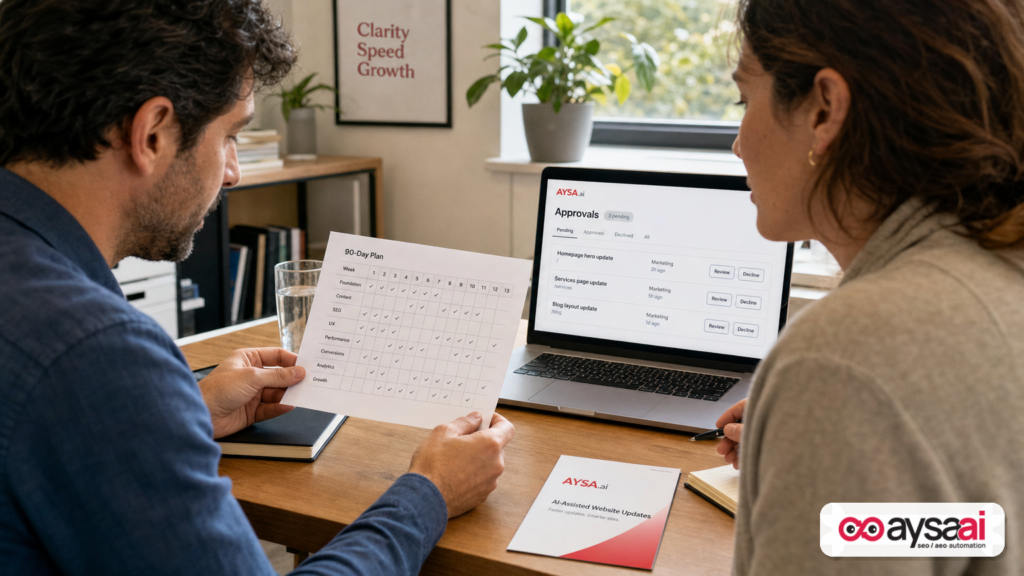
A practical 90-day action plan (SME-friendly)
Most teams fail here because they try to do everything at once. The trick is to sequence the work so you can measure impact and keep momentum.
Weeks 1–2: Establish baselines
- GSC export: top landing pages, high-impression/low-CTR pages
- AI answer audit: 6–10 key queries, screenshot + notes
- Third-party footprint inventory: mentions + review platforms
- Competitor gap list: publications, reviews, proof assets
Weeks 3–6: Fix proof assets
- Pick 3–5 case studies to rebuild into “credible, cite-worthy” format
- Update 2–3 core service pages with specifics: process, timeline, constraints, proof
- Add/clean structured data where relevant
Weeks 5–10: Build external validation
- Pitch 15–30 targeted bylines/placements (one-by-one, not blast)
- Publish 2–4 expert articles externally if possible
- Launch review workflow and request reviews from recent happy clients
Weeks 8–12: Author identity + internal coherence
- Create/upgrade author pages and bylines
- Improve internal linking between proof assets, service pages, and author bios
- Re-run the AI answer audit and compare changes in presence/description
What you’re looking for by day 90 is not “traffic back to normal.” You’re looking for:
- More inclusion in AI answers (or more favorable descriptions)
- Better conversion rate from the traffic you do receive
- More leads that arrive with context and intent
Where AYSA.ai fits: monitoring + approved execution for AI search
Strategy is not the hard part. Execution is.
Most SMEs and agencies have a familiar problem:
- Insights live in tools and spreadsheets.
- Changes require tickets, handoffs, and developer time.
- By the time the update ships, the moment has passed.
That’s exactly the gap AYSA is built to close. AYSA is an execution system for modern SEO/AEO/GEO work:
- Monitors what’s happening (visibility signals, site changes, performance shifts)
- Prepares recommended website updates
- Asks for approval (human-in-the-loop, so you stay in control)
- Executes accepted changes on your site
If you want the conceptual overview, start here: AYSA AI search visibility and AYSA monitoring. For the tool set angle, see AYSA AI SEO tools.
What AYSA helps you operationalize in this playbook
- Keeping your key pages (service + case studies) continuously improved instead of “one-and-done.”
- Maintaining internal linking and author bio consistency as content grows.
- Reducing the lag between insight → action through approved execution.
If you’re evaluating what this looks like for your team, pricing and packaging are here: AYSA pricing. And if you want more strategy resources, see the AYSA blog.
What agencies should rethink (business model + deliverables)
If you’re an agency, AI search changes what clients expect—and what you should sell.
Old deliverables that are losing power
- “We published X blog posts”
- “We built Y backlinks” (without relevance/credibility context)
- Traffic reports without pipeline linkage
New deliverables that clients will pay for
- AI visibility audits and quarterly re-audits
- Proof asset production (case studies that can be cited)
- Author identity systems and editorial governance
- Review operations (process + compliance)
- Third-party credibility roadmap (where to be mentioned and why)
The operational issue is that many agencies can recommend these things, but they can’t execute quickly on client sites. Approved execution models (like AYSA’s) reduce that friction: changes can be proposed, reviewed, and shipped without weeks of ticket limbo.
What to do next
- Stop using traffic as your only truth. Add AI visibility and credibility metrics to your weekly review.
- Run the audit. GSC → AI answers → third-party footprint → competitor gap list.
- Rebuild 3–5 case studies. Specifics, numbers, timelines, named authors.
- Upgrade service pages. Decision-grade content that reflects how buyers choose.
- Systematize reviews. Make requests part of delivery, not marketing.
- Invest in authorship. Real experts, consistent identity across web properties.
- Operationalize execution. Use monitoring and approved execution so improvements compound.
Sources and further reading
- Search Engine Journal: Less Traffic, Better Leads: Is Google Fixing B2B Marketing? (research input)
- Google Search Console
- Schema.org
- Google Search Central: Intro to structured data
- Google Search Central: Creating helpful, reliable, people-first content
AYSA.ai related: AI search visibility · AI SEO tools · Monitoring · Pricing · Blog
Note on verification: The SEJ source references third-party studies (e.g., Seer Interactive and Forrester) in its narrative. Those primary links were not included in the supplied research context, so I’m treating the specific figures as directional context rather than repeating them as verified facts here. If you want those numbers included in an AYSA edition, we should add the primary URLs and cite them directly.
Continue the AI search topic inside AYSA.
Use these pages to connect the article with AI SEO tools, AI visibility monitoring, AI Overviews and approved website execution.
Turn this topic into a website action plan.
Use these AYSA hubs to move from reading to technical fixes, AI visibility monitoring, research, glossary context and approval-first SEO execution.