Outcomes, Not Hours: The New Standard for AI SEO Deliverables (and How to Price, Trust, and Execute)
AI is making SEO work faster—but speed isn’t the problem. The real issue is whether deliverables are defensible, accountable, and tied to business outcomes. Here’s how SMEs and agencies should judge AI-assisted SEO work, restructure pricing, and build an approval-first execution system that protects trust while shipping real results.

AI didn’t just speed up SEO work. It exposed an uncomfortable truth: many businesses and agencies still judge deliverables by visible effort instead of business outcomes.
If two deliverables create the same result, should you care whether one took 20 hours or 20 minutes? That question—framed sharply in Search Engine Land’s discussion on judging AI deliverables by outcomes, not effort—is now a practical problem for every founder, CMO, and agency owner. Not because AI is “taking over,” but because AI makes the old pricing and accountability habits impossible to defend.
My view (Marius Dosinescu, AYSA.ai) is simple: outcomes are the only sustainable standard—but only if they’re paired with trust, defensibility, and Approved Execution. “The AI did it” is not an answer when something breaks, rankings drop, policy is violated, or a regulated claim makes it onto your website.
This editorial is a practical framework you can use to evaluate AI-assisted SEO deliverables, restructure how work is priced and managed, and build a system that ships measurable outcomes without gambling with your brand.
Concise summary

- Speed is not the enemy. The real questions are accuracy, usefulness, and whether the work is defensible and accountable months later.
- Outcomes-based evaluation requires governance. You need clear acceptance criteria, risk checks, and a documented approval path—not just “faster outputs.”
- Pricing must separate execution from judgment. AI compresses production time; it does not replace responsibility, taste, prioritization, and decision-making.
- SMEs should buy “wins,” not hours. But they must also buy a process that prevents hallucinations, brand mistakes, and technical regressions.
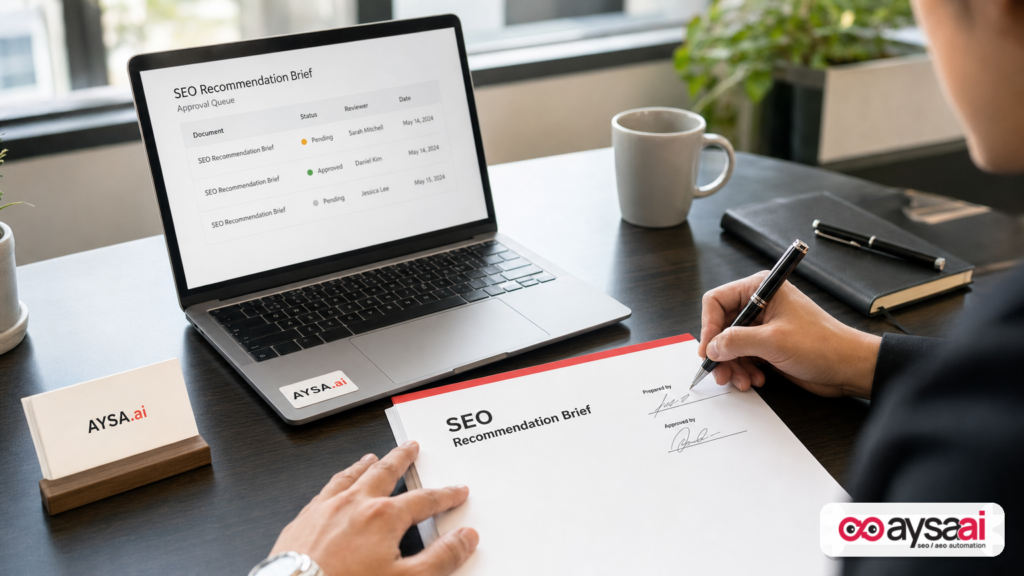
- AYSA fits as an execution system. Monitor opportunities and issues, prepare proposed changes, ask for approval, then execute accepted updates—so outcomes improve without losing control.
Table of contents
- The outcomes-over-effort shift: what AI made impossible to ignore
- Why we equated effort with value for so long
- The objections that actually matter: trust, risk, and accountability
- The Outcome Test: a defensible way to judge AI deliverables
- Pricing in an AI world: what you should pay for now
- What changed in search: from ranking pages to being cited by AI
- A concrete SME scenario: the ecommerce brand that “saved time” and lost money
- What agencies must rethink: deliverables, packaging, and accountability
- What SMEs should monitor weekly (not obsess over daily)
- Execution is the moat: why outcomes require shipping
- Where AYSA fits: outcomes-driven SEO execution with human approvals
- What to do next: an outcomes-first action plan
- Sources and further reading
The outcomes-over-effort shift: what AI made impossible to ignore

Before AI, a lot of marketing work was hard to compress. Writing, auditing, researching, formatting, and reporting took time. That time became a proxy for value—especially when clients couldn’t easily evaluate quality.
AI changes the economics of “making things.” It doesn’t automatically make them better, but it absolutely makes them faster to produce. That forces a new conversation: if a deliverable works, why do we care how it was made?
The uncomfortable part is that many businesses have been buying the appearance of work. Long decks. Long audits. Long spreadsheets. Weekly calls. A “busy” agency. AI makes it obvious how much of that was ceremony rather than impact.
But there’s also a second-order effect: because deliverables are faster to produce, the bottleneck moves. The bottleneck is no longer “creating the document.” It becomes:
- Choosing what matters.
- Validating claims.
- Balancing tradeoffs (SEO vs. legal, SEO vs. conversion, SEO vs. engineering capacity).
- Getting approvals.
- Executing changes without regressions.
- Measuring outcomes correctly.
That’s why AI makes humans more important in the parts of the workflow that actually create durable advantage: judgment, prioritization, and accountability. Search Engine Land’s piece lands on the core truth: quality debates are secondary. The primary debate is whether the work is trustworthy enough to stand behind.
Why we equated effort with value for so long
Effort is visible. Outcomes take time and are messier.
If you’ve ever hired an agency, you’ve probably felt the difference:
- Effort-based comfort: “They sent a 60-page audit and spent 40 hours.”
- Outcome-based clarity: “We increased qualified leads from organic and reduced technical issues.”
One is easy to justify internally. The other requires measurement, patience, and ownership of tradeoffs.
The classic “knowing where to tap” story gets repeated for a reason: people don’t pay for the tap; they pay for the expertise behind it. Whether the anecdote is literal doesn’t matter—the lesson is accurate in business. AI simply compresses the tap. So the question becomes: are you buying taps, or expertise?
Here’s the nuance many miss: outcome-based does not mean cheap. In many cases it means the opposite. If a consultant can reliably produce outcomes faster than everyone else, you are not entitled to the time savings. You are paying for:
- Experience and pattern recognition.
- Risk management and constraints.
- A system that prevents “fast mistakes.”
- Accountability if it goes wrong.
The same logic applies to AI-assisted work. If the deliverable is trustworthy, accurate, and effective, speed is a feature—not a pricing argument by itself.
The objections that actually matter: trust, risk, and accountability
When clients push back on AI, they often frame it as a quality issue. In practice, it’s a trust issue.
These are the objections that actually matter—because they are operational and reputational risks:
1) Hallucinations and ungrounded claims
If an AI-assisted deliverable contains a false claim (about products, returns, pricing, medical outcomes, legal terms, or competitor comparisons), it’s not “a small mistake.” It’s a brand risk.
AI can accelerate drafting—but it can also accelerate confidently wrong assertions. The only responsible posture is: assume outputs are untrusted until verified.
2) Compliance, privacy, and security
Many businesses operate with constraints that don’t show up in a prompt:
- Healthcare clinics with regulated claims.
- Financial services with strict disclosures.
- Ecommerce brands with pricing rules, MAP policies, and warranty language.
- Local service businesses with licensing limitations.
Even if you’re not regulated, privacy and security matter. What data was used? Where did it go? Who can access it later? The fastest deliverable is worthless if it violates your internal policies.
3) Bad recommendations that look “professional”
The danger isn’t that AI produces gibberish. The danger is that it produces plausible recommendations that a non-expert accepts.
In SEO, this often shows up as:
- Overconfident technical changes that break templates.
- Content updates that degrade conversions.
- Internal linking “fixes” that create cannibalization.
- Schema markup suggestions that are incorrect or misleading.
4) Accountability when something goes wrong
This is the point Search Engine Land nails: when something goes wrong, nobody blames the AI. They blame the business, the employee, the consultant, or the agency. That reality doesn’t change just because the production method did.
The standard therefore must be: can someone defend this deliverable later? Defensible means documented assumptions, sources when needed, and a rationale that withstands scrutiny.
The Outcome Test: a defensible way to judge AI deliverables
“Was AI used?” is a weak question. The better questions are outcome-based and accountability-based.
Here’s a practical evaluation framework you can adopt immediately. I call it the Outcome Test. A deliverable passes only if it meets all four layers.
Layer 1: Accuracy
- Are the facts correct?
- Are the recommendations technically valid for our CMS/stack?
- Do they reflect our actual products/services and policies?
If you can’t verify a claim, it must be labeled as a hypothesis, not presented as truth.
Layer 2: Usefulness
- Can a non-expert act on it?
- Does it specify the “what,” “where,” and “how”?
- Does it include acceptance criteria (how we know it worked)?
Usefulness is not “more pages.” It’s reducing ambiguity.
Layer 3: Outcome linkage
- What business outcome is it intended to influence (leads, revenue, retention, margin, support tickets, brand search demand)?
- What SEO/AEO/GEO mechanism connects the change to that outcome?
- What will we measure, and over what time window?
This is where many deliverables fail. They describe work, not impact.
Layer 4: Defensibility and ownership
- Would you put your name on it?
- If questioned in six months, can you explain why you recommended it?
- Are risks and tradeoffs documented?
If the answer is no, you don’t have a deliverable—you have a draft that needs governance.
A simple rule for SMEs
Buy deliverables you can execute safely. If a deliverable is “smart” but not safe, it’s a liability disguised as expertise.
Pricing in an AI world: what you should pay for now
Let’s talk about the hard part: money.
AI compresses production time. That breaks the traditional “hours = value” model in two ways:
- Buyers feel overcharged when they learn something was produced quickly.
- Sellers feel punished for investing in better systems, better prompts, better QA, and better workflows.
The way out is to price what still matters: outcomes, risk, and accountability.
What you’re actually buying (even when AI is used)
- Diagnosis: identifying the real bottleneck (technical debt, content mismatch, internal linking, brand authority, Site architecture).
- Prioritization: selecting the few actions that move the business, not the many actions that fill a roadmap.
- Quality control: validation steps that prevent hallucinations, compliance issues, and technical regressions.
- Execution: implementing changes correctly in the CMS, templates, and data layers.
- Measurement: proving effect with appropriate metrics and time horizons.
- Ownership: the willingness to stand behind the change.
Better packaging models than “billable hours”
Not every business can jump straight to performance pricing (and not every agency should). But most can move away from hours as the primary unit.
Here are pragmatic models that align incentives better in an AI era:
- Fixed fee per outcome-aligned initiative: e.g., “Fix indexation + template metadata,” “Build programmatic location pages,” “Re-architect internal linking for top categories.”
- Retainers tied to a shipping cadence: e.g., “X approved changes executed per month + Monitoring + reporting.”
- Value-based tiers with governance levels: higher tiers include deeper QA, compliance review coordination, and post-launch monitoring.
- Hybrid: fixed baseline + variable bonus based on agreed outcome metrics (with caveats).
What matters is not the label. It’s whether the model rewards shipping defensible changes that drive outcomes.
What changed in search: from ranking pages to being cited by AI
The deliverables conversation can’t be separated from what’s happening to search itself.
Traditional SEO was largely about:
- Ranking web pages for queries.
- Winning clicks.
- Converting traffic.
That still matters. But it’s increasingly incomplete. AI-driven experiences are changing how people discover brands and how answers are assembled. Search Engine Land has been tracking multiple shifts across AI in search and ads, including experiments like AI-generated summaries in Search ads (reference) and changes in how brands get cited in ChatGPT “thinking” experiences (reference).
You don’t need to be an SEO professional to understand the implication: visibility is no longer only about blue links. It’s also about whether AI systems choose to reference you, summarize you, or recommend you.
That’s where terms like AEO (answer engine optimization) and GEO (generative engine optimization) show up in real boardroom conversations. Regardless of terminology, the operational reality is:
- You need content that is easy to interpret and extract.
- You need consistent entity signals (who you are, what you do, where you operate).
- You need trustworthy sourcing and proprietary information where possible.
Search Engine Land also highlights the defensibility of proprietary data as a citation asset (reference). That idea matters because it reframes “content” from words to assets that can be cited: datasets, benchmarks, unique inventory, internal policies, expert commentary, case process, and operational facts.
In this environment, deliverables must evolve. A deliverable is no longer “a blog post.” It might be:
- A cleaned and structured FAQ that reduces support tickets and increases AI citations.
- A set of category templates that improve discoverability across classic search and AI summaries.
- A location-page system with consistent service definitions, pricing boundaries, and proof points.
- A technical fix that improves crawlability and indexing reliability.
The point: outcomes are expanding beyond rankings into brand presence across AI-mediated discovery.
A concrete SME scenario: the ecommerce brand that “saved time” and lost money
Let’s make this real with a scenario I’ve seen repeatedly across ecommerce and DTC.
Business: a growing ecommerce brand selling a curated product line (think home goods, beauty, specialty food, or supplements).
The situation: the team needs to update 150 product pages and 20 category pages. They decide to “move faster” using AI to generate:
- Product descriptions
- FAQs
- Comparison tables
- Shipping/returns language tweaks
The good news: the work gets produced fast. Everyone celebrates the time saved.
The bad news: within weeks, the business experiences issues that can be hard to attribute if you’re not monitoring properly:
- Support tickets increase (“Is this ingredient safe?” “Does this fit X model?”) because AI introduced vague or incorrect claims.
- Returns rise because descriptions overpromised or misrepresented size/material/spec details.
- Organic traffic doesn’t improve because the pages became more generic and less distinctive (AI often converges toward average wording).
- Brand trust erodes subtly: customers notice inconsistencies across pages.
No single problem is catastrophic. That’s why it’s dangerous. It looks like “marketing noise” rather than an execution failure.
The root cause is not “AI wrote the words.” The root cause is that the business treated the output as the deliverable, rather than treating the defensible, approved, measured update as the deliverable.
What would have prevented it?
- A content change checklist: policy constraints, claims restrictions, product truth source (PIM), tone rules.
- A sampling QA process before full rollout.
- An approval gate with owners from brand + support + ops for sensitive sections.
- Monitoring that flags anomalies after release (indexing, traffic shifts, conversion shifts, support volume).
The lesson: if AI makes it easy to publish at scale, it also makes it easy to publish errors at scale. Outcomes-based work demands a system, not just a tool.
What agencies must rethink: deliverables, packaging, and accountability
If you run an agency, AI is not just a productivity upgrade. It’s a business model challenge.
Here’s what breaks first when you keep selling “hours” in an AI world:
- Clients start questioning invoices when they see fast outputs.
- Your best operators (who build efficient systems) get penalized.
- You’re incentivized to hide AI use, which erodes trust long-term.
- You produce more deliverables than you can execute, increasing “shelfware.”
Stop selling deliverables. Sell shipped changes.
Most SEO programs fail for a boring reason: the work doesn’t get implemented.
An audit that sits in a folder is not a deliverable. It’s documentation of intent.
In 2026 and beyond, agencies that win will increasingly sell:
- Monitoring + diagnosis
- Prioritized backlog
- Prepared changes (ready for implementation)
- Approval workflows
- Executed updates
- Outcome reporting
This is why I like “approved execution” as a discipline. It respects governance while avoiding paralysis.
AI disclosure: stop making it weird
Businesses have different comfort levels with AI. But hiding it is usually worse than using it.
A practical approach is to disclose process, not tools:
- What was generated vs. what was verified.
- What sources were used.
- What QA checks were applied.
- Who is accountable for sign-off.
Clients don’t actually want a lecture about models. They want assurance that the work is safe, accurate, and owned.
Your new SLA isn’t “hours.” It’s response time and shipping cadence.
When execution accelerates, clients care about:
- How quickly issues are detected.
- How quickly a fix is prepared.
- How quickly it’s approved.
- How cleanly it’s executed.
That’s the operational layer that AI enables—if your business model supports it.
What SMEs should monitor weekly (not obsess over daily)
Outcomes-based judgment requires measurement. But measurement doesn’t mean drowning in dashboards.
If you’re an SME (or a lean marketing team), here’s a practical weekly monitoring set that keeps you outcome-focused:
1) Search visibility (classic + AI)
- Are key pages being indexed?
- Are important queries trending up or down?
- Are you appearing in AI-mediated answers or citations where relevant?
AYSA’s positioning here is straightforward: monitor, then translate signals into proposed actions you can approve and ship. Start with AI search visibility and monitoring as the foundation.
2) Site health and technical regressions
- Sudden drops in indexed pages
- Template errors (titles, canonicals, noindex issues)
- Broken internal links or navigation changes
Search Engine Land recently noted fixes and changes around Google Search Console reporting (reference). The tactical takeaway: reporting surfaces are imperfect, and you need consistent monitoring habits rather than one-off panic checks.
3) Business metrics tied to SEO changes
- Leads, booked calls, demo requests
- Ecommerce revenue and conversion rate
- Support tickets and return rates (often the hidden “content quality” KPI)
Outcomes aren’t only traffic. Traffic is a means, not an end.
4) A change log you can defend
If you’re using AI for SEO, you need a record of what changed, when, and why. Not because it’s bureaucratic—but because it’s how you debug outcomes.
When someone asks, “Why did rankings drop?” you can’t answer, “We published a bunch of AI content.” You need to know which pages changed, what the intent was, and what the expected outcome was.
Execution is the moat: why outcomes require shipping
Many teams confuse “strategy” with “results.” Strategy is not a deliverable. It’s a hypothesis until executed.
This is where AI’s biggest advantage can be wasted. If AI helps you produce recommendations faster, but you still can’t get changes shipped, you haven’t improved anything—you’ve just increased the backlog.
The companies that win will be the ones that:
- Turn insights into queued actions.
- Route actions through approvals quickly.
- Implement safely.
- Measure outcomes and iterate.
That’s not “AI content.” That’s operational excellence.
Approved execution is the missing middle
Most organizations live at one of two extremes:
- Manual forever: slow changes, high friction, lots of meetings, limited throughput.
- Auto-publish chaos: fast changes, low governance, high risk.
The middle path is where real businesses should land: approved execution.
Approved execution means:
- Systems monitor and detect issues/opportunities.
- AI helps prepare recommendations and draft changes.
- Humans review and approve with context.
- Accepted changes are executed reliably (not copied into tickets and forgotten).
This is the difference between “AI as a writer” and “AI as an operations multiplier.”
Where AYSA fits: outcomes-driven SEO execution with human approvals
AYSA is built around the reality that outcomes come from shipped work, not from documents.
In practical terms, AYSA acts as an execution system for SEO/AEO/GEO:
- Monitors your site and search presence for issues and opportunities.
- Prepares proposed website changes (content, technical, structured recommendations) based on those signals.
- Asks for approval before anything meaningful changes.
- Executes accepted changes on your website—closing the loop from insight to outcome.
This model is intentionally designed to match the Outcome Test: accuracy and usefulness are addressed by preparation and validation; outcome linkage is clarified through measurable goals; defensibility is handled through approvals and traceability.
If you want to explore the toolset side, start here:
Why this matters now
As AI changes how visibility works, businesses will demand faster iteration. But faster iteration without control is how brands create self-inflicted wounds.
AYSA’s “monitor → prepare → approve → execute” approach is designed to keep the speed benefits of AI while preserving the accountability that businesses require.
What to do next: an outcomes-first action plan
Whether you’re an SME buying SEO or an agency delivering it, you can apply the outcomes-over-effort shift immediately.
1) Rewrite your definition of a “deliverable”
New definition: a deliverable is a defensible change (or change plan) that links to a measurable outcome.
If it can’t be executed or defended, it’s not done.
2) Adopt the Outcome Test as your acceptance criteria
Require every recommendation to include:
- What is changing
- Where it changes
- Why it should improve outcomes
- Risks and constraints
- How you’ll measure success
- Who signs off
3) Separate “drafting speed” from “decision quality”
Let AI accelerate drafting, summarization, and preparation. But do not let it skip:
- Validation
- Brand and legal constraints
- Technical feasibility
- Post-launch monitoring
4) Implement an approval workflow that matches your risk level
Examples:
- Low risk: internal links, minor on-page improvements → marketing approval.
- Medium risk: template changes, schema updates → marketing + dev approval.
- High risk: pricing, medical/financial claims, policies → marketing + legal/compliance + exec approval.
The approval workflow is not red tape. It’s how you prevent expensive “fast” errors.
5) Measure outcomes that reflect the business, not just SEO theater
Pick a small set of KPIs that connect to revenue or operational wins. Then measure consistently.
6) If you want speed without chaos, use an execution system
If you’re tired of audits that don’t get implemented, consider a system built for shipping. AYSA’s model is designed to reduce the “insight-to-live” gap while keeping humans in control via approvals.
What to do next (checklist)
- Define 3 business outcomes SEO should influence in the next 90 days.
- List your top 20 revenue-driving pages and confirm they’re indexed and accurate.
- Adopt the Outcome Test as your acceptance criteria for all SEO work.
- Create an approval matrix (who approves what) based on risk.
- Start weekly monitoring for visibility, technical regressions, and outcome KPIs.
- Move from “deliverables” to “approved changes executed per month.”
- If helpful, explore AYSA’s monitoring and AI visibility capabilities: AYSA Monitoring and AI Search Visibility.
Sources and further reading
- Search Engine Land: Why AI deliverables should be judged by outcomes, not effort
- Search Engine Land: Why proprietary data is your most defensible AI citation asset
- Search Engine Land: Google tests AI-generated summaries in Search ads
- Search Engine Land: ChatGPT Thinking mode changes which brands get cited
- Search Engine Land: Google indexing report in Google Search Console fixed
- AYSA: AI SEO tools
- AYSA: AI search visibility
- AYSA: Monitoring
- AYSA: Pricing
- AYSA: Blog
Note on sourcing: This editorial draws on the provided Search Engine Land context as the primary research input. Where additional official sources would strengthen specific claims (e.g., exact AI citation mechanics across platforms), they are not included in the supplied context; rather than speculate, I’ve kept those points framed as analysis and operational guidance.
Continue the AI search topic inside AYSA.
Use these pages to connect the article with AI SEO tools, AI visibility monitoring, AI Overviews and approved website execution.
Turn this topic into a website action plan.
Use these AYSA hubs to move from reading to technical fixes, AI visibility monitoring, research, glossary context and approval-first SEO execution.