
SERP Remonetization: Why Organic SEO Must Adapt to Ads, AI Answers and Shrinking Click Surfaces
A practical AYSA analysis of SERP remonetization: ads, AI answers, shrinking organic click surfaces and what SMEs should do to protect SEO business impact.
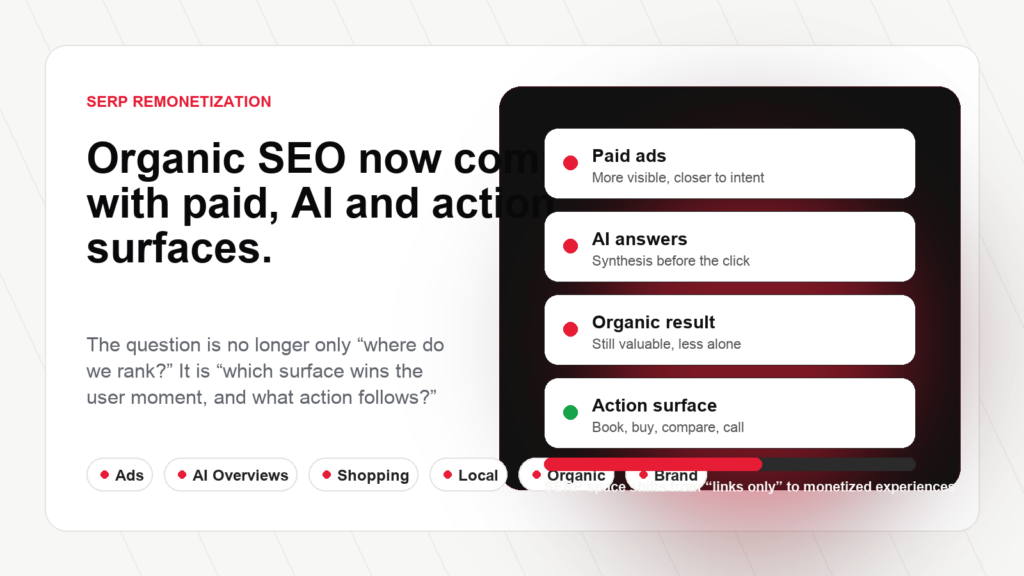
Executive summary: Google’s search results are not just changing because of AI. They are also being remonetized. More search journeys now include ads, AI answers, shopping modules, local packs, video, forums, product feeds, brand panels and action surfaces before a user reaches a classic organic result. This does not mean organic SEO is dead. It means organic SEO can no longer be managed as a simple ranking game.
This article builds on Aleyda Solis’ analysis of SERP shifts and remonetization, Google’s own documentation about ads in AI Overviews, and recent zero-click research. The AYSA position is simple: SMEs should stop measuring SEO only as “rank position” and start managing search as an operating system: monitor the surfaces, diagnose why traffic changes, prepare actions, approve what matters and execute quickly.
What SERP remonetization means
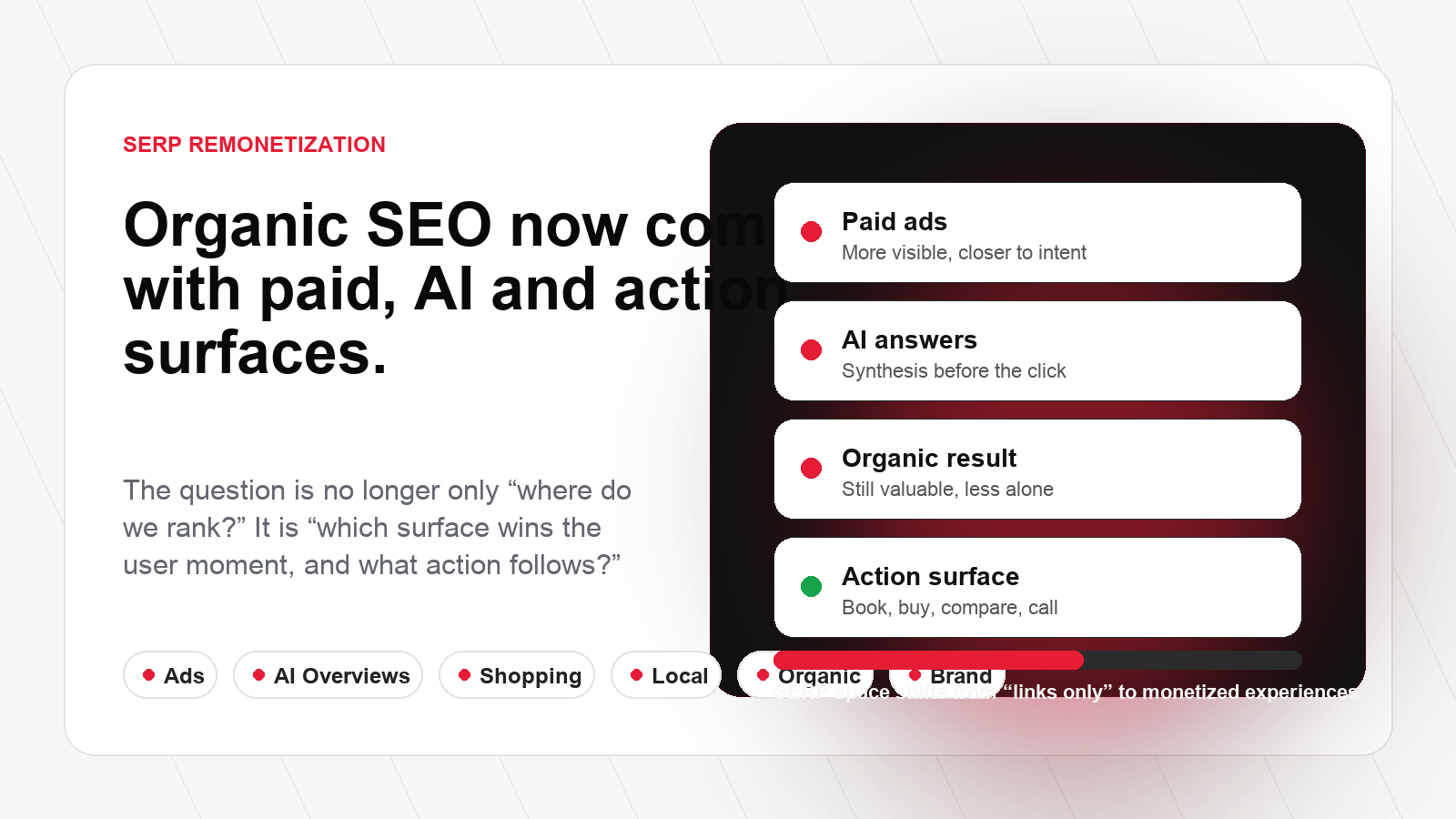
SERP remonetization is the process by which the search results page becomes a more commercial, more productized and more controlled environment. The classic search results page used to feel easier to explain: a few ads, ten blue links, maybe a Map pack or a Featured snippet. That version of search has been fading for years. Today, many queries produce a layered experience: sponsored results, product units, local listings, Rich results, image carousels, video, discussions, AI summaries, comparison modules and sometimes direct action paths.
Aleyda Solis describes this shift as an important strategic reality for SEO: organic visibility is still valuable, but the surface around organic results is changing. The page is not only a list of answers. It is increasingly a marketplace of attention, action and monetized placement.
For a business owner, this distinction matters. If Impressions are stable but Clicks fall, the website may not have “lost SEO” in the traditional sense. The SERP may have changed around it. A paid module may take more visual space. An AI answer may satisfy part of the query before the click. A map pack may move the decision into Google’s interface. Shopping or product experiences may create comparison without a visit. The same ranking can produce a different business outcome.
That is why the question “Where do we rank?” is no longer enough. A more useful question is: “What does the user see before reaching us, and what action are they encouraged to take?”
Why it matters for organic SEO
The old SEO reporting model often treated rankings as the core truth. If a page ranked third, the team assumed visibility was strong. If rankings improved, the campaign looked healthy. If rankings fell, the team looked for technical issues, content quality problems, algorithm updates or backlinks.
That model still has value, but it misses the modern SERP environment. A result can rank high and still receive fewer clicks because the page is dominated by ads, AI answers, local packs or shopping modules. A business can rank lower but still win demand because it owns the brand, appears in maps, has better reviews, earns citations in AI answers or has stronger authority across the web. A website can gain impressions while losing revenue because the query mix is more informational and less transactional.
In my opinion, this is where many SMEs get hurt. They pay for SEO, ask for ranking reports, and then wonder why the phone is not ringing. The answer is not always that the SEO provider did bad work. Sometimes the market changed, the SERP changed, ads became more aggressive, AI answers intercepted the question, competitors built stronger entity signals, or the page no longer matched the user’s decision stage.
This does not excuse poor SEO execution. It means execution has to become more complete. A modern organic strategy must include technical SEO, content quality, brand/entity clarity, local proof, review strategy, authority building, AI visibility, conversion paths, internal links and a real measurement model. “We rank for the keyword” is not enough when the search page is monetized and fragmented.
AI Overviews, AI Mode and ads
AI Overviews and AI Mode add another layer to this remonetized SERP. They do not simply create a new kind of organic result. They create a new answer layer where sources, citations, ads, product information and follow-up exploration can coexist.
Google’s Ads Help documentation states that ads may appear above or below AI Overviews in more than 200 countries and territories. It also explains that, in the United States and other English-speaking countries and territories, Search, Shopping and Performance Max ads may be eligible to appear directly within AI Overviews on desktop and mobile. That is a very important commercial signal. AI answers are not only an informational surface. They are also becoming a monetized surface.
There is another important detail: Google’s help page says ads in AI Overviews do not currently have segmented reporting. Performance is included in total campaign reporting, but advertisers cannot isolate AI Overview ad performance as a separate segment. For marketers, that means the reporting layer is not as transparent as the experience layer. The user sees a new surface, but the dashboard does not fully separate it yet.
This matters for SEO as well. If paid surfaces inside or around AI answers expand, organic teams should not only ask whether they appear in the AI answer. They should ask what else appears near that answer, which competitors are present, whether ads are compressing attention, whether product data influences the answer and whether the user still has a reason to visit the website.
Google’s Search Central AI features guidance remains grounded in familiar principles: create helpful, reliable, people-first content, make it accessible to Google, keep technical foundations clean, use structured data where appropriate and avoid blocking important resources. In other words, there is no secret “AI SEO trick” that replaces fundamentals. But fundamentals must now support more surfaces than classic blue links.
Old reporting habit
Track a keyword, see a rank position, assume the result explains the business outcome.
Modern SERP reality
The zero-click pressure
Zero-click behavior is not new. Featured snippets, knowledge panels, local packs and instant answers have influenced clicks for years. But AI-assisted search makes the discussion more urgent because the answer layer can become more complete and conversational.
SparkToro and Datos’ 2024 zero-click study estimated that, for every 1,000 Google searches in the United States, only 374 clicks went to the open web. In the European Union, the estimate was 360 clicks. The study is not a perfect model for every niche, country or query type, but it makes the direction clear: many searches do not become website visits.
This is uncomfortable for SEO because traditional organic traffic was easier to explain. Create useful content, rank, receive clicks, convert. Now some content still creates value even when it does not receive the click. It can influence brand recognition, AI answers, comparison decisions, local demand or later branded searches. At the same time, some content may receive impressions without meaningful business value.
The practical implication is not “ignore traffic.” Traffic still matters. Leads, sales, calls and revenue still matter. The implication is that SEO teams need to measure more than sessions. They need to understand visibility surfaces, brand demand, assisted influence, local actions, conversion rates and execution velocity.
For SMEs, this is especially important. A small business does not need a 100-page dashboard that proves search is complicated. It needs to know what changed, what matters, what to approve and what gets executed next.
The SME risk: paying more and understanding less
The biggest risk for SMEs is not that SEO disappears. The biggest risk is that the business ends up paying more for less clarity. Paid acquisition gets more expensive. Organic reporting becomes harder to interpret. AI search introduces new visibility questions. Agencies and freelancers may still send ranking reports that do not explain why sales are down. Business owners are left with uncertainty and blame.
There is a delicate truth here. Agencies are not automatically the enemy. Many agencies do good work. But the traditional agency model often struggles with speed and volume. A modern website may need constant monitoring, technical fixes, content refreshes, internal link improvements, schema updates, local proof, Google Business Profile improvements, product feed cleanup, authority opportunities and AI visibility checks. Doing all of that manually, consistently and affordably for a small business is difficult.
That is why remonetization changes the economics of SEO. If the SERP is more competitive, the website cannot wait three months for a static audit to become a task list. If AI answers change how people discover brands, the business cannot rely only on old keyword reports. If ads compress organic space, every organic page must be more useful, more trustworthy and better connected to conversion.
SMEs need execution systems, not only expert opinions. They need a way to transform search changes into website improvements without hiring a full SEO department.
What to measure now
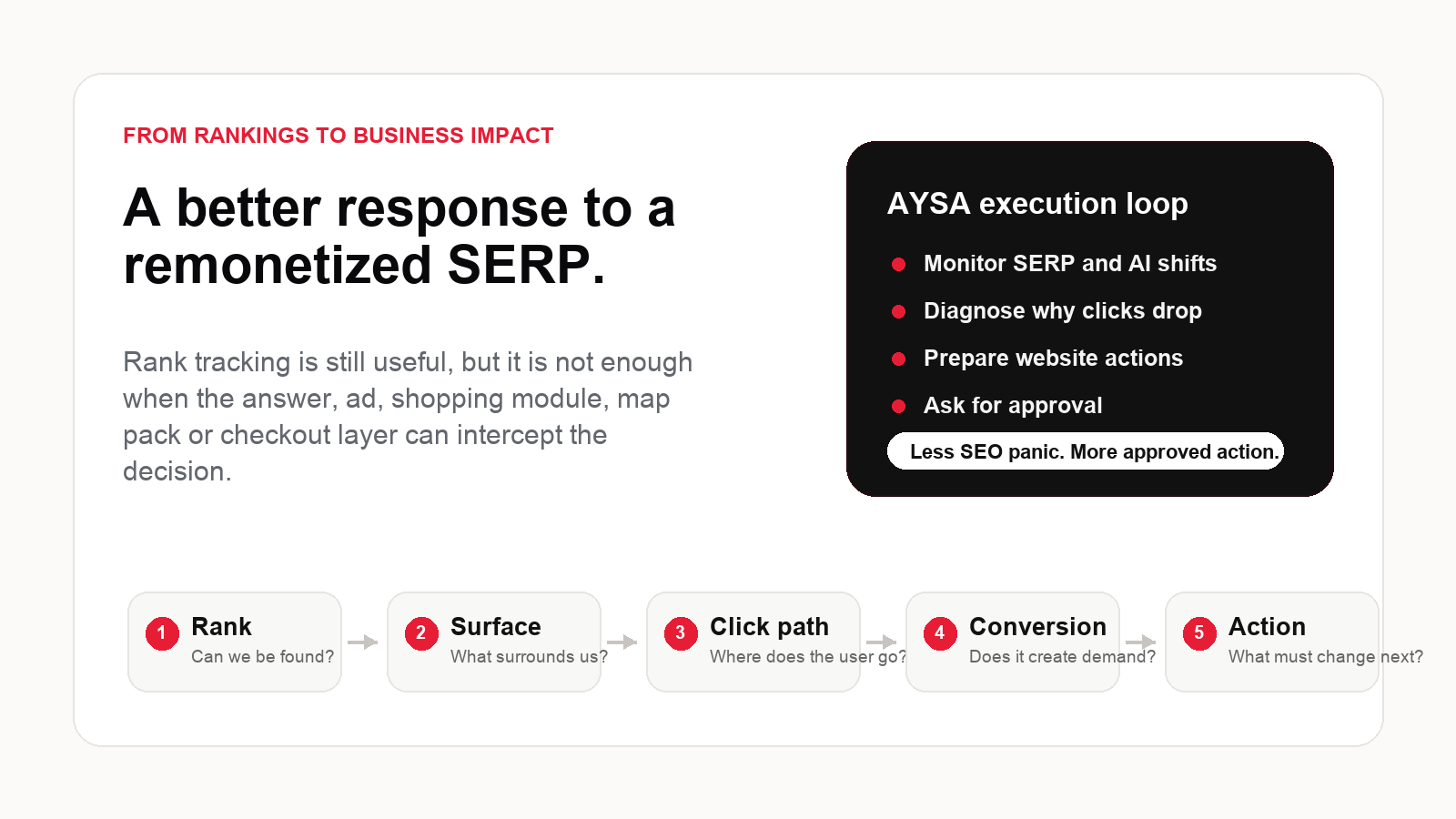
The first measurement layer is still classic SEO: rankings, impressions, clicks, CTR, indexed pages, crawl errors, Core Web Vitals, structured data, internal links, backlinks, conversions and revenue. Do not throw this away. It remains the foundation.
The second layer is SERP surface measurement. For important query groups, track what appears above, beside and around organic results. Are there ads? AI Overviews? Shopping results? Local packs? Forums? Videos? Product units? People Also Ask? Brand panels? Competitor comparison blocks? This context helps explain why rank and traffic may disconnect.
The third layer is AI visibility. Track whether the brand is mentioned, cited or recommended in AI-assisted search experiences. As we explained in our article on AI search measurement, presence alone is not enough. You need to separate presence, readiness and business impact.
The fourth layer is business impact. Look at leads, calls, bookings, ecommerce revenue, branded search demand, direct traffic, assisted conversions, CRM notes and sales feedback. A ranking report that does not connect to business outcomes is incomplete.
The fifth layer is execution velocity. How long does it take to turn a finding into a published improvement? How many recommendations are waiting for approval? How many approved changes were actually executed? How many technical issues remain unresolved? In a remonetized SERP, slow implementation becomes a competitive disadvantage.
What to do next
First, classify your important queries by intent and surface type. Do not treat all keywords equally. A high-intent service query with ads, maps and AI answers deserves different treatment than a broad informational query. A product comparison query deserves different treatment than a brand query.
Second, strengthen pages that still deserve the click. If a user reaches your website after seeing ads and AI summaries, the page must be worth the visit. It should answer the query clearly, show evidence, explain the offer, reduce uncertainty and make the next step obvious. Quality content is not “long content.” It is content that helps a specific user make progress.
Third, improve entity clarity. Make it easy for search systems and users to understand who you are, what you offer, where you operate, which audience you serve, why you are credible and what action the user can take. This matters for classic SEO, local SEO, AEO and AI search. It is also one of the themes in our article on the characteristics of brands that win in AI search.
Fourth, build supporting sources. AI systems and users do not evaluate only your landing page. They may consider reviews, publisher mentions, product data, business profiles, social proof, documentation, author profiles and external authority. This does not mean buying random links. It means building a credible source ecosystem.
Fifth, reduce technical friction. Crawlability, indexability, performance, schema, canonical rules, redirects, internal links and clean HTML all matter more when multiple systems need to understand and retrieve your content. As search becomes more complex, technical hygiene becomes less optional.
Sixth, create a faster approval loop. The business owner should not approve every small detail manually, but important changes should remain controlled. A good system prepares the work, explains the reason, asks for approval and executes accepted changes.
The AYSA view: remonetization requires operational SEO
AYSA exists because search is becoming too dynamic for static reporting. SERP remonetization, AI answers, Google updates, paid surfaces, local packs, product data and authority signals all change the business outcome of SEO. A company that only receives a monthly report is always late.
In this environment, SEO should operate more like a continuous execution layer. The website must be monitored. Opportunities must be prepared. Technical issues must be translated into actions. Content gaps must become page improvements. AI visibility findings must become entity and source improvements. Authority opportunities must be reviewed safely. The user should approve important work, then the system should execute.
For SMEs, this is the difference between “I have an SEO tool” and “SEO work is actually happening.” Tools show data. Agencies interpret and implement manually. AYSA is designed to sit between those worlds: an AI SEO agent that monitors, prepares, asks for approval and executes accepted actions inside the website workflow.
In my opinion, SERP remonetization makes this model more necessary, not less. When the search page becomes more crowded and monetized, the business cannot afford slow SEO. It needs better pages, stronger evidence, cleaner technical foundations, clearer entities, stronger internal links and faster implementation. That is not panic. That is operational SEO.
Organic visibility needs execution, not panic
Tired of watching ads, AI answers and SERP changes squeeze your organic traffic?
Try AYSA: an AI SEO agent that monitors visibility shifts, prepares SEO, AEO and AI search actions, asks for approval and executes accepted changes inside your website workflow.
Sources and further reading
This article cites and builds on Aleyda Solis’ analysis of SERP remonetization, Google Ads Help documentation about ads in AI Overviews, Google Search Central’s AI features optimization guide, and SparkToro and Datos’ 2024 zero-click search study. The AYSA sections are our author and product perspective. We do not claim guaranteed rankings, guaranteed AI Overview inclusion, guaranteed AI citations or guaranteed revenue from organic search.
Continue the AI search topic inside AYSA.
Use these pages to connect the article with AI SEO tools, AI visibility monitoring, AI Overviews and approved website execution.
Turn this topic into a website action plan.
Use these AYSA hubs to move from reading to technical fixes, AI visibility monitoring, research, glossary context and approval-first SEO execution.

