
The Shrinking Search Window: How to Win Traffic Before Google AI Overviews Collapse the Click
Google’s AI Overviews are showing up faster for developing stories, compressing the time businesses have to earn a click. Here’s how to adapt your content, technical stack, and execution workflow—so you get discovered before the summary does.
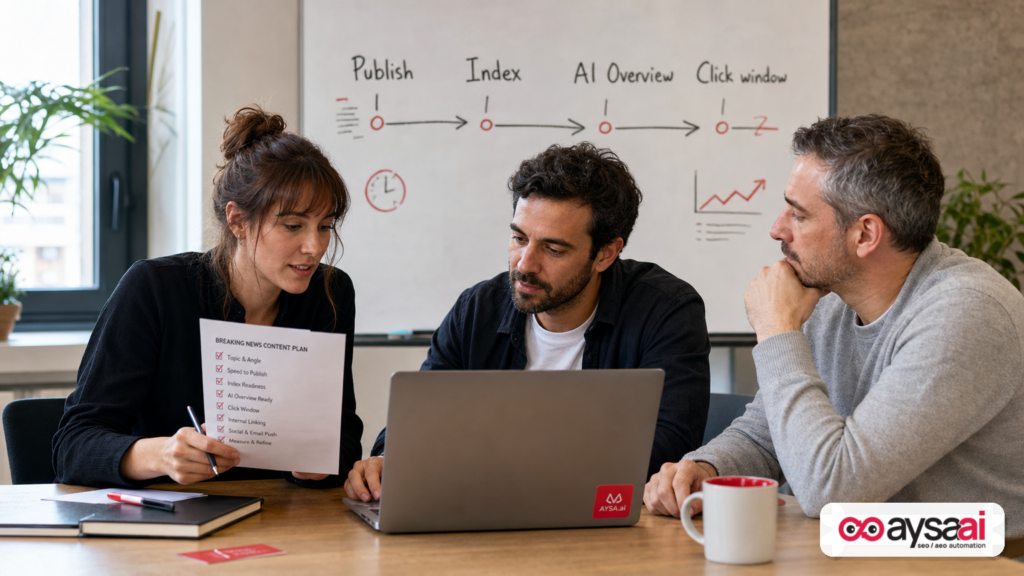
Google is getting faster at answering. Businesses need to get faster at being the answer—or at least being the source that gets cited before the click disappears.
That’s the real lesson behind USA Today’s new workflow for breaking sports coverage: as Google’s AI Overviews appear earlier for developing stories, the “search window” for earning traffic is shrinking. Publishers are reacting with pre-built story shells, tighter editorial operations, and more original reporting. Non-media businesses should take this as a warning shot, not a publisher-only problem.
This editorial explains what changed, why it matters to SMEs and agencies, and what to do now—practically—so you can compete in AI-shaped discovery without turning your site into a low-quality content factory.
Concise summary

- The click window is shrinking: AI Overviews can appear quickly for emerging topics, which reduces the time your page has to win early Clicks.
- Speed is now an SEO input: “How fast can we publish and get indexed?” is becoming as important as “How well does this page rank?”
- Templates beat improvisation: Pre-built content shells, modular sections, and update cadences help you publish fast without publishing sloppy.
- Originality is your moat: If your content is generic, AI systems can summarize it. If your content is first-hand, local, or proprietary, it’s harder to replace.
- Execution is the differentiator: Strategy without a change pipeline loses. You need Monitoring, preparation, approvals, and implementation—reliably.
Key takeaways (what to do this quarter)
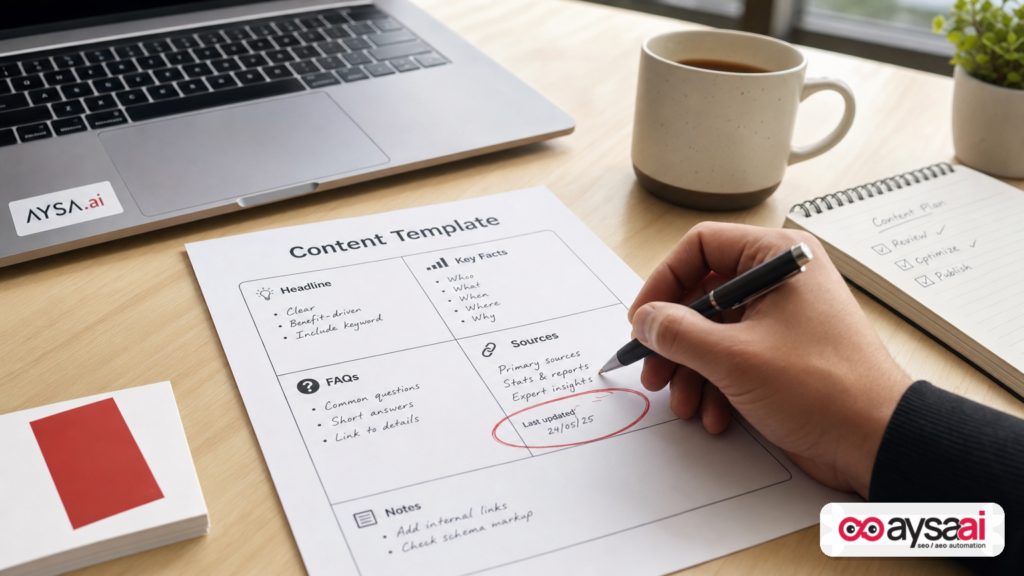
- Adopt an “index-first” workflow: content templates + rapid publish + frequent updates + visible timestamps.
- Build “source-worthy” pages: clear authorship, citations, proof, and unique value so you’re more likely to be referenced.
- Monitor AI-shaped visibility: not only rankings—track Impressions, Indexing latency, and whether your brand appears in AI results.
- Invest in operational speed: approvals, CMS friction, and dev queue delays are now revenue constraints.
- Use automation with guardrails: AI can draft shells and assemble modules, but humans must own accuracy, tone, and accountability.
Table of contents

- What changed: AI Overviews don’t just answer—they accelerate the news cycle
- The USA Today lesson: pre-built shells to beat the summary
- Why SMEs should care (even if you don’t publish “news”)
- The new playbook: from SEO publishing to “index-first operations”
- What content is most vulnerable to AI Overviews—and what still wins clicks
- Trust, entities, and “teaching AI who you are”
- Technical foundations: speed-to-index, crawlability, and update signals
- Workflow design: templates, roles, approvals, and QA for speed
- A concrete SME scenario: a local clinic competing with AI answers
- What agencies must rethink: reporting, retainers, and proof of impact
- Measurement in the AI era: beyond clicks, without making up metrics
- Where AYSA fits: monitoring + preparation + approved execution
- What to do next (action list)
- Sources and further reading
What changed: AI Overviews don’t just answer—they accelerate the news cycle
For two decades, SEO strategy had a reliable rhythm:
- A topic breaks or a trend starts.
- Publishers and brands publish pages quickly.
- Google crawls, indexes, and ranks results.
- Users click through to read, compare, and decide.
AI Overviews disrupt that rhythm by compressing the research phase. When Google can confidently synthesize multiple sources, it can answer queries directly on the results page. The critical change isn’t only “fewer clicks.” It’s less time before the SERP becomes self-contained—especially for fast-developing topics.
Search Engine Land’s reporting highlights that AI Overviews are arriving more quickly for developing stories and publishers are adjusting workflows to capture search interest earlier (Search Engine Land). That is a tactical observation with strategic consequences: time-to-publish and time-to-index are becoming competitive advantages.
Even if you never cover the World Cup, your business has “breaking news” moments:
- An ecommerce brand launches a limited drop.
- A clinic updates policies or a seasonal service line.
- A SaaS product ships a new feature or a pricing change.
- A hotel responds to a local event surge.
In each case, the market’s questions surge quickly—then normalize. If AI Overviews can answer the basics, the remaining clicks concentrate on the fastest, clearest, most trustworthy sources.
The USA Today lesson: pre-built shells to beat the summary
The case described by Search Engine Land is straightforward but revealing: USA Today created AI-assisted “shell files” for likely breaking events, using archived assets (subheads, photos, links) so editors and reporters can publish quickly and then update as details emerge (source). The reported motivation is equally revealing: publish while interest is rising, before Google has enough information to generate an AI Overview.
What’s important here is not whether “shell files” are the perfect tactic. It’s what the tactic implies:
- Speed is operational, not inspirational. The newsroom didn’t “try harder.” They changed their system.
- Publishing is modular. They pre-assemble reusable components to reduce time-to-live.
- Updates are the product. In fast-moving stories, the first publish is not the final article. It’s the start of a managed update cadence.
That operational mindset is exactly what most SMEs lack. They still treat SEO like a quarterly initiative instead of a living pipeline. In 2026 and beyond, that mismatch becomes expensive.
Why SMEs should care (even if you don’t publish “news”)
“AI Overviews vs. publishers” is an easy headline. But the real shift is “AI answers vs. everyone who relied on informational clicks.” If your funnel has any step where users previously clicked to learn the basics, expect pressure.
Here are three common SME patterns that get squeezed:
Pattern 1: Top-of-funnel explainer content
If your blog is mostly definitional—“what is X,” “benefits of Y,” “how does Z work”—you’re competing with the exact category of content that AI can summarize. That doesn’t mean you delete it. It means you upgrade it so it becomes source-worthy and brand-specific.
Pattern 2: Comparison and “best of” content without proof
If your pages read like generic listicles, you’re exposed to a double risk: AI can summarize you, and AI can cite someone else. Search Engine Land has also highlighted concerns about AI Overviews citing self-serving listicles while recommending competitors a meaningful portion of the time (Search Engine Land). You don’t need to agree with the framing to accept the implication: visibility becomes less predictable if your content lacks unique signals.
Pattern 3: “Slow update” industries
Local services, healthcare, legal, finance, and B2B manufacturing often have slow content cycles and cautious approvals. But users’ questions can spike instantly due to events, regulation changes, viral posts, weather, or a competitor going out of business. If your site can’t publish or update quickly, you miss the moment—and AI answers may fill the gap.
The new playbook: from SEO publishing to “index-first operations”
Traditional SEO advice emphasizes ranking factors: keywords, links, content quality, page speed. All still matter. But AI Overviews add a more operational question:
Can your organization reliably produce, publish, and update credible pages fast enough to be included in the system’s understanding of the topic?
I call this index-first operations. It’s not about publishing junk quickly; it’s about building a workflow where speed and quality coexist.
Index-first operations: the components
- Pre-built templates for the page types you publish repeatedly (guides, FAQs, product updates, policy pages, comparison pages, landing pages).
- Modular sections that can be assembled quickly (definition, who it’s for, pricing, steps, risks, FAQs, glossary, “last updated,” sources).
- Update cadence that matches how the topic changes (daily during an event, weekly during a launch, monthly for evergreen).
- Clear ownership for accuracy, compliance, and final approval.
- Technical readiness so indexing isn’t bottlenecked by site issues.
USA Today implemented a version of this in a newsroom setting. SMEs can implement a version of it in a business setting without turning into a publisher.
What content is most vulnerable to AI Overviews—and what still wins clicks
Let’s be honest: if a page’s value is “summarize publicly known basics,” AI systems are increasingly good at replacing that page in the user journey.
But not all content is equally vulnerable. Here’s a practical segmentation you can use in planning.
High-risk: content that’s easy to summarize
- Pure definitions with no original examples, no local context, no evidence.
- Generic “how-to” that could apply to anyone, anywhere.
- Thin comparisons with no methodology or criteria.
- Templatized “best X” content that looks like affiliate SEO with minimal expertise.
If you must publish these, treat them as supporting assets that feed internal links to higher-value pages—and upgrade them with specificity.
Medium-risk: content that can be summarized, but still benefits from trust
- Industry explainers in regulated categories (health, finance, legal) where authority and accountability matter.
- Buyer guides that include first-hand testing, photos, or explicit criteria.
- Local service pages where proximity, availability, and real customer outcomes matter.
Lower-risk: content that remains click-worthy
- Original reporting and first-hand experience (what you observed, measured, built, shipped, treated, repaired, installed).
- Proprietary data (even small datasets) with methodology and limitations.
- Unique tools (calculators, selectors, configurators, quizzes) that create personalized outcomes.
- High-intent pages (pricing, booking, product pages, demos) where the user must take action.
- Trust-centric pages (credentials, safety, policies, warranty, returns, compliance) that reduce risk.
The goal is not to “avoid AI.” It’s to build assets AI can’t fully replace, while still being discoverable in AI results.
Trust, entities, and “teaching AI who you are”
One of the most under-discussed impacts of AI Overviews is the shift from keyword matching to entity understanding: who you are, what you do, whether you’re credible, and what you’re known for.
Search Engine Land points to this direction explicitly in another related piece: Google’s LLM patent suggests a new SEO goal is “teaching AI who you are” (Search Engine Land). You don’t need to become a patent reader to act on the principle: if you want to show up in AI answers, you must make your identity machine-readable and consistent.
A practical entity checklist for SMEs
These are non-negotiables if you want to be a “source” rather than a generic page:
- Clear About/Company page with what you do, where you operate, who leads, and how to contact you.
- Author attribution for advice-like content (who wrote it, why they’re qualified, how to verify).
- Editorial policy and corrections approach (even a simple one) for businesses publishing advice.
- Consistent NAP (name, address, phone) for local businesses.
- Structured data where appropriate (Organization, LocalBusiness, Product, FAQPage, Article/BlogPosting). Implementation must be accurate—don’t spam it.
- Credibility proof: licenses, certifications, memberships, case studies, and verifiable testimonials (where allowed).
In AI search, trust isn’t only a branding concept; it’s a retrieval concept.
Technical foundations: speed-to-index, crawlability, and update signals
If the window is shrinking, you can’t afford technical friction. Indexing delays and crawl inefficiencies aren’t “technical SEO chores.” They are time penalties that reduce your odds of being included in what AI systems summarize.
1) Optimize for speed-to-index (not just page speed)
Many teams obsess over Core Web Vitals while ignoring whether Google can discover and index their new or updated pages quickly.
Practical steps:
- Ensure clean internal linking so new pages are reachable from relevant hubs.
- Maintain a valid XML sitemap and submit it in Google Search Console.
- Use strong canonicalization so duplicates don’t dilute crawling.
- Avoid thin tag pages that waste crawl budget.
- Use “last updated” timestamps where editorially honest, and actually update the content.
Google Search Console remains the primary tool for understanding indexing and performance, and Search Engine Land notes AI performance reporting is rolling out more broadly (Search Engine Land). Even without relying on new reports, Search Console is still where SMEs can monitor indexing and query visibility.
2) Decide how you want AI crawlers to use your content
Publishers are increasingly seeking control over AI crawling and usage. Search Engine Land also covered Cloudflare and beehiiv providing new AI crawler controls (Search Engine Land).
For SMEs, the key decision is strategic, not ideological:
- If AI-driven discovery sends qualified traffic and leads, you want visibility and citations.
- If AI systems consume your content without attribution or value exchange, you may want tighter controls.
Most businesses will land in the middle: allow discoverability, protect truly proprietary assets, and ensure the public site reflects what you’re comfortable having summarized.
3) Preserve update integrity (don’t break URLs)
When the pressure to publish fast rises, teams sometimes create chaos: multiple URLs for the same topic, inconsistent slugs, repeated near-duplicate posts. That is exactly how you slow indexing and confuse retrieval systems.
Instead:
- Prefer one authoritative URL per topic, updated over time.
- Use redirects when consolidating duplicates.
- Maintain a hub page for major initiatives (launches, events, seasonal services).
Workflow design: templates, roles, approvals, and QA for speed
Most SEO advice assumes you can publish when you want. In real businesses, you can’t. Legal needs a look. The founder wants to approve. A developer is required to create a new template. Someone needs to find images. And suddenly your “fast” content takes three weeks—which is an eternity in AI search.
Here’s a practical workflow that works for SMEs and agencies without turning your org into a newsroom.
Step 1: Build “shells” for predictable spikes
USA Today pre-created shells for likely World Cup moments. SMEs can do the same for predictable demand:
- Ecommerce: seasonal sale pages, product drop pages, restock announcements, “shipping cutoff” updates.
- Local services: emergency service pages for weather season, holiday hours, “now accepting new patients,” “same-day appointments.”
- SaaS: release notes hub, integration pages, pricing FAQ updates.
The shell includes: URL, headline options, internal links, FAQ blocks, a “what’s new” section, and a source list.
Step 2: Assign roles that minimize handoffs
Speed dies in handoffs. For each shell, define:
- Owner (one person accountable for publishing)
- Approver (one person who can greenlight quickly)
- Subject expert (optional, for accuracy)
- Editor (tone, clarity, brand)
If “everyone” is an approver, no one is.
Step 3: Use AI for assembly, not authority
AI can help draft, reformat, summarize internal docs, and propose FAQs. But SMEs should treat AI output as a draft that requires human ownership.
Guardrails to keep quality high:
- Require sources for factual claims; link out when appropriate.
- Prohibit invented numbers and “confident but vague” claims.
- Keep a change log on high-impact pages.
- Maintain a style guide so speed doesn’t erode brand voice.
Step 4: Plan an update cadence (and show it)
One of the smartest parts of the “breaking news” mindset is accepting that the first publish is not the end. For businesses, that means:
- Publish early with what you know.
- Update as new info is verified.
- Display “last updated” honestly.
- Improve the page as questions emerge (especially FAQs).
This is how you remain competitive as AI summaries evolve with the available corpus.
A concrete SME scenario: a local clinic competing with AI answers
Let’s take a realistic example: a local physical therapy clinic in a mid-sized American city. They rely on organic search for new patient inquiries. Historically, their blog drove a steady stream of traffic for queries like:
- “what causes shoulder pain”
- “how long does sciatica last”
- “is physical therapy covered by insurance”
In an AI Overview world, the first two are likely to be answered directly on the SERP with generic guidance and safety disclaimers. The clinic sees impressions but fewer clicks. Panic ensues, and they consider “doing more blog posts.” That’s the wrong move.
What the clinic should do instead
- Upgrade to local, actionable pages: “Shoulder pain treatment in [City]—what to expect at your first visit,” with intake steps, timelines, and clinician bios.
- Create decision-support content: “When to see a PT vs. when to see an orthopedic specialist,” including red flags and referral pathways.
- Add proof: anonymized outcomes, clinician credentials, and treatment approach—information AI can’t fully replace.
- Build a fast update pipeline: if a local sports event spikes injuries, publish a tailored guide and appointment availability update immediately.
Notice the shift: from “information” to “decision + action.” AI can answer basics. Your site should help people choose you and take the next step.
What agencies must rethink: reporting, retainers, and proof of impact
Agencies and consultants are being forced into an uncomfortable truth: the deliverable can’t just be “content” or “rankings.” In AI search, clients want outcomes—and outcomes are shaped by execution speed and site-wide trust.
Shift deliverables from outputs to capabilities
Instead of selling “8 blog posts per month,” sell:
- Topic coverage systems (hubs, templates, internal linking plans)
- Entity and trust upgrades (authorship, about, policies, schema)
- Indexing readiness (technical audit + remediation pipeline)
- Update operations (cadences, alerts, refresh cycles)
Reset expectations about traffic ceilings
Search Engine Land’s piece notes USA Today expects AI Overviews may lower the traffic ceiling compared with prior years (Search Engine Land). SMEs should internalize the broader point: you may do everything “right” and still see fewer clicks for certain informational queries because the SERP satisfies the intent earlier.
Agencies should proactively reframe success metrics toward:
- Qualified leads and revenue contribution
- Brand inclusion in AI answers (where measurable)
- Share of voice across classic results + AI features
- Conversion rate improvements on the clicks you still get
Close the execution gap
Most agencies can recommend fixes. Fewer can implement them quickly because they don’t control the CMS, dev resources, or approvals. But AI search punishes slow implementation.
This is where execution systems—and approved execution in particular—become a strategic advantage.
Measurement in the AI era: beyond clicks, without making up metrics
AI search creates a measurement trap: teams notice fewer clicks and declare SEO “dead.” That’s a misunderstanding of what’s happening. The channel is changing shape.
What to measure now (practically):
1) Impressions and query mix shifts
If impressions remain strong but clicks fall, you’re likely seeing more SERP satisfaction. That doesn’t mean you stop. It means you identify where you can still earn action-oriented clicks (pricing, booking, product comparisons with proof).
2) Indexing latency for new/updated pages
If your page isn’t indexed quickly, you don’t even get a chance to compete in the early window. Track “published at” vs. “indexed/visible” as an operational KPI.
3) AI visibility where available
As platforms introduce AI performance reports (as Search Engine Land notes for Google Search Console’s AI performance reporting rollout), businesses should treat AI visibility as its own layer of discovery—not a replacement for classic search reporting (Search Engine Land).
4) Conversion outcomes on reduced traffic
Fewer clicks means every click matters more. Improve:
- page clarity
- CTA placement
- trust blocks
- speed and mobile experience
AI Overviews can reduce low-intent browsing clicks, leaving more “ready to decide” visitors. That can be good—if your site is built to convert.
Where AYSA fits: monitoring + preparation + approved execution
Most teams don’t lose to AI because they lack ideas. They lose because they can’t execute consistently. In a world where AI Overviews compress the window, execution speed becomes a compounding advantage.
AYSA is designed as an AI-powered SEO/AEO/GEO execution system that:
- Monitors what’s changing (visibility, indexing, pages, opportunities)
- Prepares recommended actions (content improvements, internal linking, technical fixes, on-page updates)
- Asks for approval before changes go live
- Executes accepted changes on your website—turning strategy into implementation
This is the missing layer for many businesses and agencies: a reliable pipeline that converts insights into shipped improvements.
How to explore AYSA capabilities
- AI SEO tools overview: AI SEO Tools
- AI search visibility (AEO/GEO): AI Search Visibility
- Monitoring (alerts, changes, opportunities): AYSA Monitoring
- Pricing: AYSA Pricing
- More editorials and playbooks: AYSA Blog
Why “approved execution” matters specifically for AI search
AI search increases the cost of delay. But many businesses can’t let automated systems publish unchecked. They need governance. That’s where approved execution becomes the practical compromise:
- You still move quickly.
- You keep human accountability.
- You avoid rogue changes and brand risk.
That’s how you build the operational speed USA Today is pursuing—adapted for SMEs, ecommerce, SaaS, and agencies.
What to do next (action list)
If you only do one thing after reading this: stop treating SEO as publishing and start treating it as operations.
In the next 30 days
- Identify 10 “spike moments” in your business (launches, seasonal services, policy changes, events, promotions) and create page shells for them.
- Choose 5 priority pages that should be “source-worthy” and upgrade them: authorship, proof, FAQs, clear CTAs, and honest update timestamps.
- Audit indexing friction: internal links, sitemap health, canonical consistency, duplicate content.
- Define a two-person approval path for rapid updates (owner + approver).
In the next 60–90 days
- Build a hub strategy for your top 3 commercial topics, with one authoritative URL per topic and supporting articles.
- Implement entity fundamentals: About page, author bios, Organization/LocalBusiness schema, contact clarity.
- Set monitoring alerts for: indexing anomalies, page changes, sudden query impression spikes, and drops on key pages.
- Operationalize refresh cycles for your money pages and your most visible informational pages.
How AYSA helps execute this plan
- Use AYSA Monitoring to detect visibility shifts early.
- Use AI search visibility to align your content with AI-driven discovery outcomes.
- Use AYSA tools to prepare changes and then approve/execute them—so implementation doesn’t lag behind insight.
Sources and further reading
- Search Engine Land (primary source): USA Today vs. Google AI Overviews: A World Cup battle for breaking news traffic
- Search Engine Land (related): Google AI Overviews cite self-serving listicles, but recommend competitors 69% of the time
- Search Engine Land (related): Google’s LLM patent suggests a new goal for SEO: Teaching AI who you are
- Search Engine Land (related): Google Search Console AI performance reports rolling out to more users
- Search Engine Land (related): Cloudflare and beehiiv give publishers new AI crawler controls
- Search Engine Land (context): AI search adoption rises as consumer trust declines: Study
Note: This editorial uses the Search Engine Land reporting and related links as research leads and context. Where specific numbers or timelines are not independently verifiable within the provided research context, this piece treats them as directional observations and focuses on operational, repeatable actions rather than unverifiable claims.
Continue the AI search topic inside AYSA.
Use these pages to connect the article with AI SEO tools, AI visibility monitoring, AI Overviews and approved website execution.
Turn this topic into a website action plan.
Use these AYSA hubs to move from reading to technical fixes, AI visibility monitoring, research, glossary context and approval-first SEO execution.

