Text-Only Isn’t Machine-Ready: Why AI Agents Need Your Website’s Structure And Actions (Not Just Words)
Markdown mirrors and text-only views help AI read your pages—but they often remove the very layer agents need to complete tasks: structure, forms, and callable actions. Here’s how to rebuild for “doable” web experiences with semantic HTML, accessibility, and emerging tool surfaces—plus how AYSA monitors, prepares, and executes approved fixes.
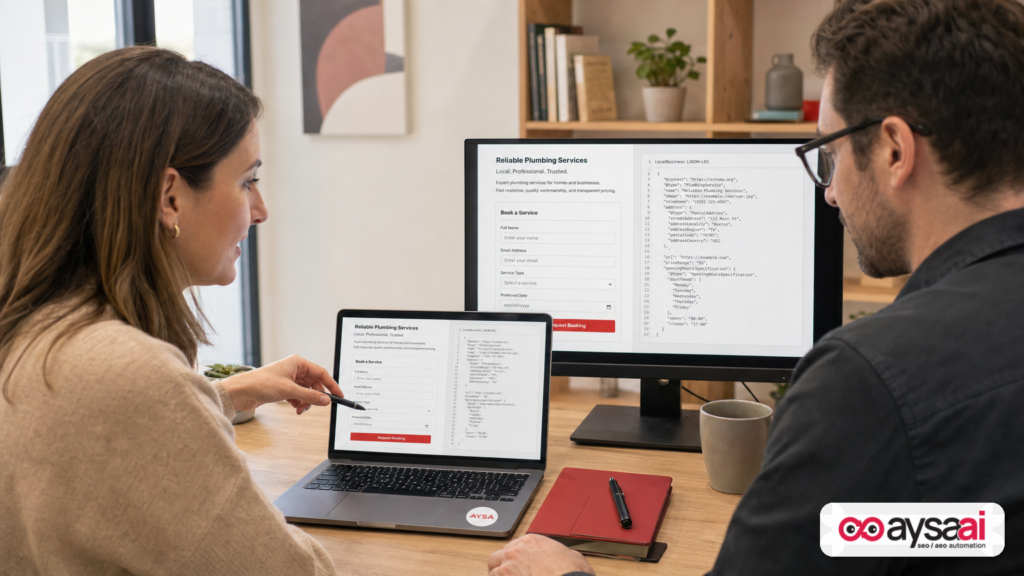
Search is changing in a way most businesses still don’t have language for. For twenty years, our websites were built for humans to read and then click. Now, the systems that bring customers to us can increasingly read and act—and that second verb is where many “AI-ready” website initiatives quietly fail.
A growing trend is to publish a “text-only” version of your website (often as markdown) for AI crawlers and agents. The idea sounds logical: if the machine can parse the page more easily, you’ll be discovered and cited more often. But there’s a fundamental problem: most text-only versions strip out the wrong layer.
Remove visuals? Fine—machines don’t need your typography. Remove the structural layer where actions live—forms, inputs, buttons, validation, confirmations, and machine-readable states—and you don’t get an AI-friendly website. You get a brochure. And you’re serving that brochure to the “user” most eager to take action: an AI system tasked with booking, buying, comparing, subscribing, or submitting.
This editorial is my practical, business-first guide to what’s actually changing, what can go wrong, and what to do now—especially if you’re an SME that needs results, not theory. I’ll build from the thinking shared by Search Engine Journal in The Text-Only Version Of Your Website Strips Out The Wrong Layer (and related context they publish on AI Search and Technical SEO), then go a step further with an Execution Plan you can implement—using AYSA as the system that monitors, prepares, asks for approval, and executes the changes you accept.
Concise Summary

Text-only website versions can help machines read your content, but they often remove what machines increasingly need to do: structured, accessible actions (forms, buttons, states) and reliable feedback (success/error). In an AI Search world where assistants and agents will attempt tasks, businesses need to prioritize semantic HTML, accessibility fundamentals, and machine-readable outcomes—and treat tool surfaces/APIs as an emerging “ceiling,” not a shortcut around broken basics. AYSA helps by Monitoring action-critical pages, generating prioritized fixes, routing them for approval, and executing accepted changes.
Key Takeaways
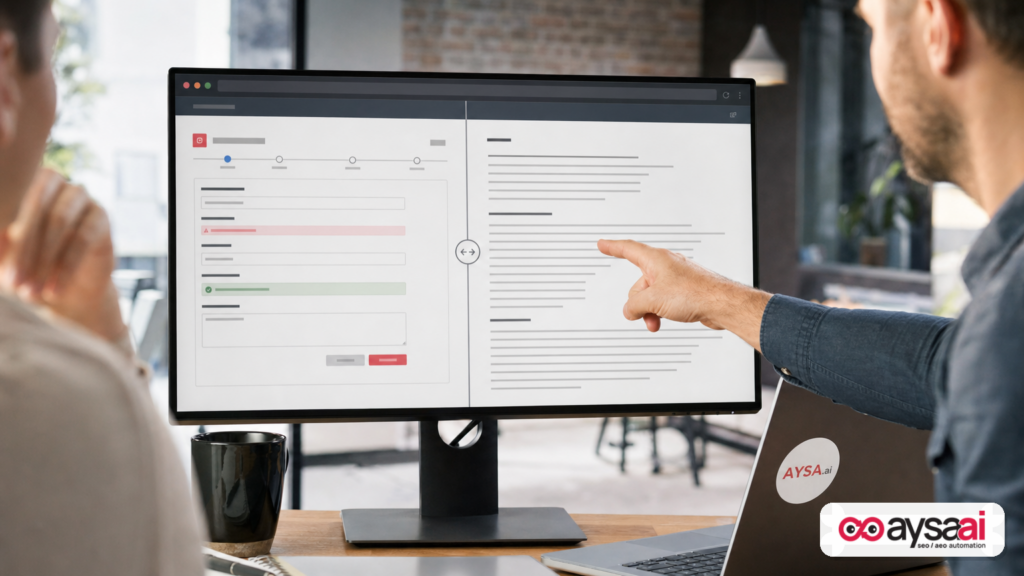
- Text-only is not machine-ready. It can remove the interactive layer that enables transactions and lead capture.
- AI search is shifting from “find answers” to “complete tasks.” Websites must become “doable,” not just “describable.”
- Semantic HTML and accessibility are the floor. If your forms and buttons aren’t programmatically clear, agents (and assistive tech users) struggle.
- Machine-readable feedback matters. If success is communicated only visually, agents may retry—causing duplicates and support issues.
- Tool surfaces are the ceiling. Platform-level moves (like Shopify enabling agent tools) hint at the future, but most sites must fix fundamentals first.
- Execution is the bottleneck. The winning teams will be the ones who can monitor, prioritize, approve, and ship improvements continuously.
Table of Contents

- The Real Shift: Search Is Becoming “Read + Do”
- Why Text-Only And Markdown Mirrors Strip The Wrong Layer
- The Three Layers Of A Website (And Where Actions Live)
- Describable vs. Doable: A Simple Model To Prioritize Work
- Structured Data: Helpful, But Not Your Transaction Layer
- The “Floor”: Semantic HTML + Accessibility Is How Agents Actually Operate
- Critical Missing Piece: Machine-Readable Success And Error Feedback
- JavaScript, Rendering, And The Myth That Agents Need Your Front-End App
- The “Ceiling”: Declared Tool Surfaces And The Shopify Signal
- Where GEO Fits (And Where It Doesn’t)
- SME Scenario: A Clinic, A Form, And The Duplicate-Submission Problem
- What Agencies Should Rethink: From Rankings To Task Completion
- A Practical Action Plan (90 Days) For “Doable” Websites
- Where AYSA Fits: Monitoring + Approved Execution For AI Search Readiness
- What To Do Next
- Sources And Further Reading
The Real Shift: Search Is Becoming “Read + Do”
Most business owners still think of “search” as a discovery channel. Someone searches. They land on your site. They read. They decide. They take action.
That mental model is already outdated. We’re entering a world where:
- Customers ask AI systems to compare options and summarize tradeoffs.
- Those systems cite sources (this is where GEO/AEO lives).
- And increasingly, those systems attempt to complete tasks: fill a form, request a quote, add to cart, schedule, pay, cancel.
Even when the AI isn’t directly transacting, it’s “simulating” the path to transaction to decide what to recommend. If the agent can’t reliably interpret your actions, your business can be incorrectly filtered out, downgraded, or represented with uncertainty.
This is why “AI visibility” is quickly splitting into two overlapping goals:
- Being referenced (citations, mentions, inclusion in AI answers).
- Being usable (task completion: conversion, purchase, booking, support actions).
At AYSA, we think of this as a practical operational shift: your web presence must be optimized not only for interpretation (SEO) but also for execution (agent usability). That is the crux of this entire conversation.
Why Text-Only And Markdown Mirrors Strip The Wrong Layer
Text-only versions and markdown mirrors are pitched as a way to make your content “easy for AI to consume.” That part is frequently true: clean text reduces parsing complexity.
But the wrong thing gets removed.
In many implementations, the markdown mirror isn’t a “machine-ready representation of the page.” It is a rewrite of the page as prose. When you do that, you typically drop:
- Forms and form constraints
- Button labels and accessible names
- Input relationships (label ↔ field)
- Error states and validation messages
- Success confirmations and next-step prompts
- Navigation logic that’s still meaningful to machines (even without visuals)
Search Engine Journal’s piece makes the core point clearly: removing visuals is usually safe for machines; removing structure is not. That’s the inversion many teams are making when they ship “AI versions” as markdown: they keep content and throw away the part that enables action.
And in business terms, that’s upside down. The AI visitor is not the least valuable visitor. It may become the most valuable because it arrives with intent and delegated authority: “book this,” “order this,” “find the cheapest option and buy it.”
The Three Layers Of A Website (And Where Actions Live)
If you want a simple model that a non-technical business owner can use in meetings, it’s this:
- Content layer: the words, the meaning, the product details, the policies, the FAQs.
- Structure layer: how content and actions are represented in HTML: headings, lists, tables, forms, buttons, labels, states, relationships.
- Visual layer: CSS, layout, design system, imagery treatments—what humans see and how they emotionally interpret it.
The action lives in the structure layer. That’s where the “do” is expressed.
If you strip out visuals but keep structure and content, a machine can still use the page. If you strip out structure and keep only content, you haven’t made the site machine-ready—you’ve made it machine-readable. That’s not the same thing.
In the agent era, the question isn’t “Can a model summarize our pricing page?” It’s “Can a system reliably complete the action that pricing page is meant to drive?”
Describable vs. Doable: A Simple Model To Prioritize Work
Here’s a practical exercise I recommend for SMEs and agencies because it immediately reveals reality.
Make Two Piles: Describable And Doable
Pick your top 10 high-intent pages (the ones that make money):
- Contact / request a quote
- Book a consultation
- Add to cart / checkout
- Demo request
- Subscription management / cancel
- Returns / refund request
- Support ticket submission
Now classify what you currently provide to machines into two piles:
- Describable: a machine can extract the facts, summarize, and cite.
- Doable: a machine can reliably take the intended action and confirm the result.
Most businesses have a full describable pile and an empty doable pile.
That’s not a moral failure. It’s simply the web we inherited: optimized for reading and clicking, not for delegated execution. But this is exactly what you need to see so you can invest correctly.
Why This Prioritization Matters More Than Another Content Sprint
In many orgs, “AI readiness” is being routed to content teams: create an AI FAQ, publish a markdown mirror, expand glossary pages, add more copy.
That can help citations. But if your form is ambiguous, unlabeled, or provides confirmation only visually, you’ll generate attention that converts poorly—and your team will blame AI, or traffic quality, or “people not ready to buy.”
Often, the problem is simpler: your website is not reliably operable by non-visual systems.
Structured Data: Helpful, But Not Your Transaction Layer
It’s worth separating two concepts that are getting mixed in the market:
- Structured data (schema markup): machine-oriented metadata that describes what a page is about.
- Action surfaces: machine-oriented mechanisms that enable tasks (forms, APIs, tools).
Structured data is useful. It can clarify meaning, entities, and relationships. It can support rich results and improve how systems interpret your pages.
But it’s not, by itself, a doing layer.
Search Engine Journal’s source article points out that structured data is already widespread (it references adoption via W3Techs). I can’t verify the exact percentage without pulling that dataset directly, so I’ll treat the number as directional rather than repeat it as fact. The business takeaway is still correct: many sites already publish some machine-oriented metadata, and it doesn’t automatically translate into machine-operable actions.
If you’re investing in schema while your forms are missing labels or your buttons are unnamed, you’re polishing the sign on a door that an agent can’t open.
The “Floor”: Semantic HTML + Accessibility Is How Agents Actually Operate
When people hear “accessibility,” they often think it’s a compliance topic or a charitable initiative. It’s neither. Accessibility is a business capability: it makes the structure and actions of your site machine-readable and machine-operable.
The source article highlights a key reality: agents operate through the same kinds of programmatic surfaces used by assistive technology—what many refer to as the accessibility tree. If your markup doesn’t express roles, names, states, and relationships, the agent is effectively operating blind.
Even if you never care about “AI agents,” you should care about this because it affects:
- real customers who use assistive technologies
- QA automation
- conversion rate optimization (CRO) clarity
- future-proofing for machine-driven browsing
What The Accessibility Data Suggests (And What To Do With It)
The Search Engine Journal piece references WebAIM’s annual evaluation of accessibility errors across top pages, including common failures like missing form labels and empty links/buttons. That report is a reputable signal for how widespread the “floor problem” is, but I’m not linking it directly here because it wasn’t provided as a direct URL in the supplied context. If your team wants the original, look for WebAIM’s annual “Million” report and verify the specific year cited.
Regardless of the exact counts, the pattern is consistent across audits: action-critical elements are frequently ambiguous.
From a practical standpoint, here’s what “fix the floor” means for an SME site:
- Every input has a programmatic label (not just placeholder text).
- Every button has a clear accessible name (not just an icon).
- Error messages are associated with the fields they relate to.
- Success confirmations are programmatically detectable (not only a green box).
- Interactive elements are actually interactive elements (button is a
<button>, not a styled<div>).
Why Agents Care About This (Even If Humans Don’t Notice)
Humans are resilient. If a form field has no label, a human can infer it from layout. If a button is an icon, a human can guess. If a confirmation is a color block, a human can feel relief and stop.
Agents can’t rely on those cues. They need declared meaning. If your UI is mostly inference, you’re building a maze that only humans can solve.
Critical Missing Piece: Machine-Readable Success And Error Feedback
One of the most important ideas from the Search Engine Journal source is also the most operationally overlooked: after a machine does something, it has to be told what happened in a format it can read.
Think about what happens when a system tries to submit your form:
- It fills fields.
- It clicks submit.
- It waits for evidence of success (or failure).
If your site only communicates success visually (a toast notification, a green highlight, a subtle text change that isn’t programmatically exposed), you create a dangerous ambiguity: the agent may not know whether it succeeded. When systems don’t know, they often retry.
That can cause very real business harm:
- duplicate orders
- duplicate bookings
- duplicate support tickets
- duplicate email signups
This isn’t “AI being dumb.” It’s our websites being non-verifiable. Humans verify through sight; machines verify through structured signals.
Practical Ways To Provide Verifiable Outcomes
You don’t need to wait for new standards to improve this.
- Return clear server responses for form submissions (success/failure with a distinct state).
- Use accessible status messages where appropriate (e.g., ARIA live regions) so state changes are detectable programmatically.
- Provide a confirmation page with a unique heading and reference ID after critical actions (order number, ticket number, booking reference).
- For ecommerce, ensure checkout steps are deterministic and not ambiguous when JS fails or when the UI is interacted with non-visually.
Again, this benefits humans too. Clear confirmations reduce anxiety and support tickets.
JavaScript, Rendering, And The Myth That Agents Need Your Front-End App
Many teams are over-invested in front-end complexity. If your website is not a full web app, heavy JavaScript is often unnecessary—especially for the pages that drive leads and sales.
The source article makes a strong point: a website no human will ever open would need no visual layer and no heavy JS. That’s not an invitation to remove your UI; it’s a reminder that your core business actions should not depend on fragile presentation logic.
From a technical SEO standpoint, the more your actions depend on client-side rendering and JS-only behaviors, the more edge cases you create for:
- crawlers
- assistive tech
- automation
- agentic browsing systems
If you want a related research path, Search Engine Journal also publishes practical guidance on performance and rendering issues, such as how to identify and reduce render-blocking resources. The key is not “remove JavaScript.” The key is: don’t make your revenue actions depend on brittle layers.
The “Ceiling”: Declared Tool Surfaces And The Shopify Signal
Now for the future-facing part.
The Search Engine Journal piece points to a meaningful platform move: Shopify enabling a declared “tool surface” (via WebMCP tools) across stores built on its theme system. I’m not going to restate operational claims beyond what’s in the supplied context because I can’t verify implementation details from here. But conceptually, the signal matters: platforms are experimenting with a formal contract where a page (or site) declares what functions an agent may call, rather than forcing the agent to infer actions from markup.
Think of this as the difference between:
- Inference model: “Find the Add to Cart button visually and click it.”
- Declared model: “Call
add_to_cart(product_id, quantity).”
The declared model is more reliable, auditable, and scalable.
But—and this is critical—declared tools don’t magically fix a broken floor. If the tool hands the agent back to a checkout page that is ambiguous or non-verifiable, you still have a problem.
A Hard Business Reality: Platforms Will Move Faster Than Custom Sites
If you run on a major platform (Shopify, WordPress, major booking engines, major CRM forms), you may benefit from ecosystem-level improvements sooner than custom-coded sites. That’s not “unfair.” It’s the economics of shared infrastructure.
If you run a custom stack, you need an internal plan: how will you expose actions and outcomes reliably without waiting for the market to standardize?
This is where technical SEO becomes product work.
Where GEO Fits (And Where It Doesn’t)
GEO (Generative Engine Optimization) has emerged as a discipline focused on being cited or recommended in LLM answers. That’s a rational focus because citations are one of the most visible and measurable outputs today.
But it’s incomplete.
The “new” power of these systems is not only that they summarize. It’s that they can increasingly act—or attempt to act. If your GEO strategy stops at “get cited,” you’ve optimized the top of the funnel for a future where the bottom of the funnel is delegated to machines that can’t use your site.
In other words: GEO can increase demand. But it doesn’t guarantee you can capture it.
At AYSA, we treat GEO/AEO as a visibility layer that must be paired with transaction readiness. If you’re only doing one side, you’re creating an operational imbalance.
If you want broader context on how the industry is tracking these shifts, SEJ’s “State of Search 2027” hub is a relevant research lead: State Of Search 2027.
SME Scenario: A Clinic, A Form, And The Duplicate-Submission Problem
Let’s make this concrete with a scenario I see all the time.
Business: A regional clinic with multiple locations.
Primary conversion: “Request an appointment” form.
Current site behavior:
- The form uses placeholder text instead of proper labels.
- The submit button is an icon with no text.
- On success, the site shows a green toast message that disappears after 3 seconds.
- No dedicated confirmation page, no reference ID.
What happens in the agent era:
- An AI assistant tries to book for a user. It fills and submits.
- It cannot reliably detect success (toast disappears, not programmatic).
- It retries submission to be safe.
- The clinic receives duplicates, staff calls the customer, customer loses confidence.
Business consequence: more admin cost, more no-shows, weaker brand trust—while marketing celebrates “AI traffic growth.”
Fix: This is not a “markdown mirror” problem. It’s a structure and feedback problem:
- Real labels tied to fields
- Submit button with accessible name
- Persistent confirmation state and/or confirmation page
- Machine-readable status messaging
This is the work that improves human UX, accessibility, and AI task completion at the same time. That’s what makes it such a high-ROI technical SEO investment.
What Agencies Should Rethink: From Rankings To Task Completion
If you’re an agency, you may feel the ground moving under your services. That’s real. The value chain is shifting from “rank and click” to “visibility and completion.”
Here are the changes I’d push agencies to make now:
1) Expand deliverables from content to capability
Content and citations matter, but so do operational capabilities:
- Can a machine identify the primary CTA?
- Can it submit the form without guesswork?
- Can it verify success?
- Can your client’s platform support tool surfaces, or will it require custom work?
2) Update measurement beyond sessions
Traffic will become a noisier metric as AI answers absorb discovery. You’ll need to track:
- mentions/citations (where measurable)
- conversion rate on high-intent pages
- form completion quality (duplicates, errors, partials)
- crawlability and “action usability” regressions after site releases
SEJ has been framing this broader measurement shift in its editorial ecosystem; their SEO and Ask An SEO sections are useful reading lists for how questions are evolving at practitioner level.
3) Solve the execution gap, not just the strategy gap
Most technical recommendations die in Jira.
In the agent era, the execution gap becomes more expensive because action failures create immediate business damage (lost leads, duplicate orders, broken booking flows). Agencies that can reliably ship improvements—without breaking things—will win.
This is a major reason AYSA exists as an execution system, not just a reporting layer.
A Practical Action Plan (90 Days) For “Doable” Websites
Here is a realistic plan for an SME that wants to get ahead without boiling the ocean.
Days 1–14: Inventory The Money Actions
- List your top 5–10 revenue actions: book, buy, quote, subscribe, cancel, return, support.
- Identify the exact URLs where those actions happen.
- Document expected outcomes (what “success” looks like) and failure modes.
- Decide what matters most: fewer duplicates, higher conversion, fewer drop-offs.
Days 15–30: Fix The Floor (Semantic + Accessibility Basics)
Prioritize fixes that make actions disappear when broken:
- Missing labels on form inputs
- Empty links and empty buttons (icon-only without accessible naming)
- Incorrect interactive elements (divs pretending to be buttons)
- Focus management issues that break keyboard-only flows
The Search Engine Journal piece references using WebAIM’s tooling approach (WAVE) as a checker. Again, I’m not linking WAVE directly because a URL wasn’t provided in the research context; but it’s a well-known lead for teams to find and validate independently.
Days 31–60: Make Outcomes Verifiable
- Add persistent confirmation states (confirmation pages when appropriate).
- Expose error/success messages programmatically.
- Ensure emails/receipts/reference IDs align with what the page shows.
- Confirm that server responses aren’t ambiguous.
Days 61–90: Strengthen The Machine Surface (Without Falling For Shortcuts)
- Audit your structured data for correctness and relevance (don’t spam).
- Check if your platform provides any native tool surfaces or integrations.
- If you’re on a platform ecosystem, track vendor announcements and defaults.
- Don’t ship markdown mirrors as a substitute for structural fixes.
If you want to go deeper into AI visibility context, AYSA’s resources are built to be practical and implementation-oriented:
- AI search visibility (what to measure and why)
- AI SEO tools (execution-oriented toolchain)
- Monitoring (catch regressions before they cost revenue)
Where AYSA Fits: Monitoring + Approved Execution For AI Search Readiness
Most businesses don’t lose because they don’t know what to do. They lose because they can’t reliably ship what they already know they should do.
That’s the core reason we built AYSA as an execution system for SEO/AEO/GEO—not just another dashboard.
1) AYSA monitors action-critical pages continuously
AI search readiness isn’t a one-time project. Sites change. Themes update. Plugins break. A “minor” front-end tweak can remove a label or rename a button.
AYSA helps you stay ahead by monitoring the pages that matter, not just reporting rankings. Start here: AYSA Monitoring.
2) AYSA prepares fixes you can approve
Whether it’s missing semantic structure, content gaps that reduce clarity, or technical issues that interfere with rendering and interaction, AYSA prepares recommended changes—then routes them for approval.
This matters because businesses need control. You shouldn’t have an automated system pushing risky changes to your checkout without human review.
3) AYSA executes accepted changes (and documents what happened)
Execution is where most initiatives die. AYSA’s model is built around approved execution: we prepare work, you approve what’s acceptable, then we execute consistently. This reduces the cycle time between “we found a problem” and “the problem is fixed.”
If you want to understand fit and budgets, see AYSA pricing.
4) Build internal muscle with ongoing education
For teams building internal capability, we publish practical guidance and operational frameworks on the AYSA blog: AYSA Blog.
What To Do Next
- Stop treating “text-only” as the solution. If you’re shipping markdown mirrors, treat them as a content convenience—not an action layer.
- Pick your top 5 money actions and map the URLs that perform them.
- Run a “floor audit” on those pages: labels, buttons, empty links, keyboard usability.
- Fix success/error feedback so outcomes are verifiable programmatically.
- Audit what your platform already gives you (tools, APIs, built-in structured data) before building custom solutions.
- Set monitoring for regressions because these issues reappear after redesigns and plugin updates.
- Adopt an execution system so fixes get shipped with approvals—start with AYSA AI SEO tools and AI search visibility.
Sources And Further Reading
- Search Engine Journal: The Text-Only Version Of Your Website Strips Out The Wrong Layer
- Search Engine Journal: AI Search category
- Search Engine Journal: Technical SEO category
- Search Engine Journal: How To Identify & Reduce Render-Blocking Resources
- Search Engine Journal: State Of Search 2027 hub
- AYSA: AI Search Visibility
- AYSA: AI SEO Tools
- AYSA: Monitoring
- AYSA: Pricing
- AYSA: Blog
Note on verification: Several numeric claims and specific third-party report details referenced in the source (e.g., adoption rates and annual accessibility error statistics) were not provided with direct primary URLs in the supplied research context. In this editorial, I’ve treated those as directional signals and focused on implementable, verifiable actions you can validate on your own site.
Continue the AI search topic inside AYSA.
Use these pages to connect the article with AI SEO tools, AI visibility monitoring, AI Overviews and approved website execution.
Turn this topic into a website action plan.
Use these AYSA hubs to move from reading to technical fixes, AI visibility monitoring, research, glossary context and approval-first SEO execution.