
TikTok Search Ads Are Growing Up: What PPC Teams Must Rethink When “Search” Moves Into Social
TikTok search advertising now looks more like Google Ads: match types, negatives, keyword bids, and impression share. But the similarities can trick teams into applying old playbooks where TikTok’s objectives, automation defaults, creative constraints, and reporting limits change what “good” looks like. Here’s how to adapt—without losing measurement discipline or brand control.
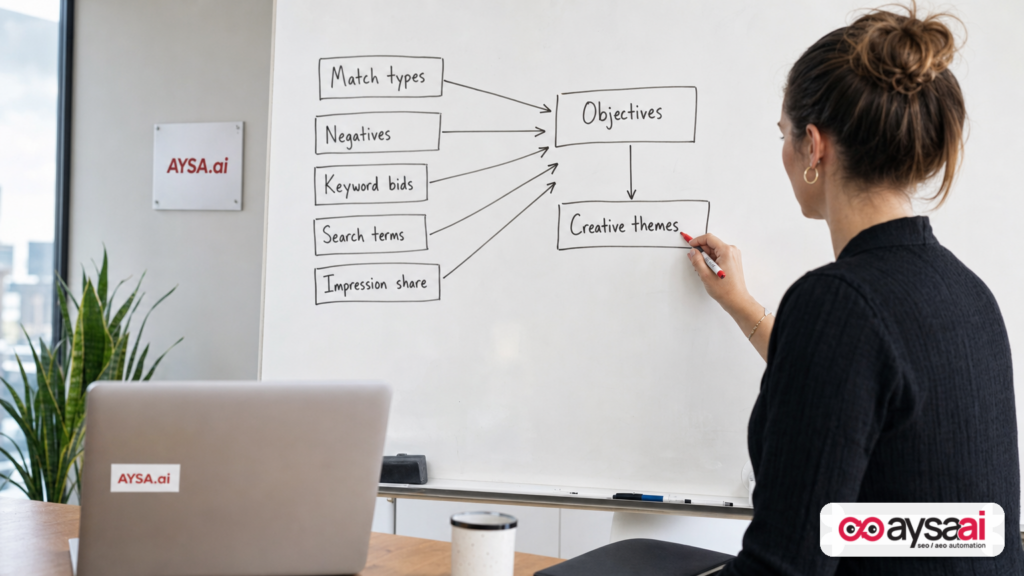
Search advertising is expanding into places most businesses used to call “social.” TikTok is the clearest example: its search ads are no longer just a placement extension. They now include familiar search mechanics—match types, negative keywords, Keyword-level bidding (in specific cases), a search terms report, and impression share-style metrics.
That sounds comforting if you’ve spent years in Google Ads. But comfort is where teams get sloppy. TikTok’s version of “search” is wrapped in different objectives, heavier automation defaults, creative constraints (everything is effectively a piece of content), and reporting limitations that can break classic PPC workflows if you port them over unchanged.
This editorial is my practical take on what’s changed, why it matters, and how SMEs and agencies should adapt. I’ll also show where AYSA fits: not as “another dashboard,” but as an Approved Execution system that monitors visibility, prepares changes, asks for approval, and executes accepted website updates—because TikTok search performance doesn’t live inside the ads platform alone.
Concise summary
- TikTok Search Ads are becoming “real search” with match types, negatives, search terms reporting, and impression share-style metrics—per reporting and product documentation summarized by Search Engine Journal.
- The trap: PPC teams assume they can run TikTok search like Google search. Similar controls exist, but workflows, objectives, automation, and reporting differ in ways that can change outcomes and accountability.
- Big operational shift: TikTok search demands creative mapped to keyword themes, and it often forces analysis up a level (ad group/campaign) because keyword-level and creative-level query reporting may be limited.
- What to do now: audit automation defaults, build a keyword-to-creative matrix, structure ad groups to reflect creative themes, run disciplined negative keyword reviews, and fix your site experience so TikTok search traffic converts.
Key takeaways (for busy operators)
- If you manage Google Ads, you can manage TikTok Search Ads—but only if you accept four “catches”: objective constraints, automation defaults, creative requirements, and reporting gaps.
- Don’t judge TikTok search solely by last-click ROAS in week one. Treat it as a hybrid: demand capture for some queries, demand creation assist for others.
- Your website and analytics stack must be “search-ready” for social-search traffic. The fastest ad optimizations won’t save a slow, unclear landing page or weak onsite proof.
- AYSA’s advantage is execution discipline: monitor visibility and demand signals, generate prioritized on-site improvements, get approval, then ship changes—so ads and site evolve together.
Table of contents

- What TikTok search ads changed (and why it’s not just “another placement”)
- How TikTok built search ads: a quick evolution timeline
- What transfers from Google Ads (and what doesn’t)
- The four catches PPC teams run into (and how to plan around them)
- Measurement reality: what TikTok reporting can’t (and won’t) show
- Creative is the ad: building keyword-to-creative systems that scale
- Account structure: how to build TikTok search campaigns without copying Google
- A concrete SME scenario: local clinic + ecommerce add-on (how it plays out in a real month)
- What agencies should rethink: staffing, reviews, and client communication
- Where AYSA fits: approved execution for the messy middle between ads and outcomes
- What to do next (action list)
- Sources and further reading
What TikTok search ads changed (and why it’s not just “another placement”)
For years, marketers treated TikTok as a top-of-funnel discovery machine: great for reach, great for culture, tricky for intent. Search existed, but advertising against search queries didn’t look like classic search advertising.
That line is blurring fast. Based on TikTok product documentation and platform behavior summarized by Search Engine Journal, TikTok search ads now include:
- Keyword match types that look familiar to Google Ads users (broad, phrase, exact)
- Negative keywords with match-type options
- A search terms report—the practical “truth serum” of search marketing
- Keyword-level bidding in certain campaign configurations
- Impression share-style metrics (including a top-position variant)
- Keyword suggestion tooling, including pre-built keyword packs
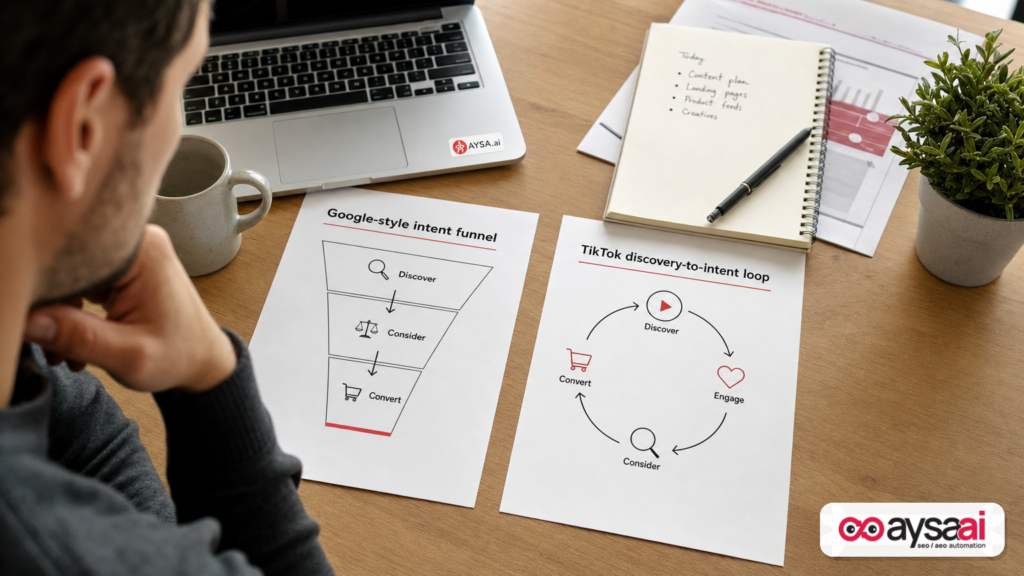
On the surface, it reads like TikTok copied the Google playbook. The deeper story is that TikTok is “productizing intent” inside a content-first environment. The user might start with a curiosity (“best winter skincare routine”), see a creator video, and then search a brand name, a specific product type, a competitor, or a local provider. Search is still search—but the journey into it is different.
That’s why I don’t think teams should frame this as “TikTok added a new placement.” The more accurate framing is: search is becoming a behavior across platforms. TikTok is meeting it with real controls, and businesses need to treat it like a channel with its own operating rules.
Primary research input: Search Engine Journal coverage of TikTok Search Ads evolution.
How TikTok built search ads: a quick evolution timeline
Understanding TikTok search ads is easier if you see them as layered products rather than one monolithic “search campaign.” The SEJ source text summarizes TikTok’s search ads evolution as sequential, spanning multiple years, including:
- Search ads beta (reported in 2022) with select partner accounts
- Search placement toggle / automatic search placement (2023), extending in-feed ads into search results (but not a traditional keyword product)
- Keyword-based Search Ads Campaign launch (U.S., 2024) with objectives like Traffic and Web Conversion and the addition of negative keywords and keyword suggestion tools
- Brand-owned search experiences (Search Hubs, announced 2026) for approved keywords
- Top-of-search auction format (TopSearch, documented 2026) sold on an impression basis for reach-type goals (as described in SEJ’s summary of TikTok help pages)
The business takeaway: TikTok is not experimenting; it’s building a ladder. Each rung adds more control for advertisers and more predictability for budgets. But those rungs are not identical to Google’s mature search auction model, and the gaps matter operationally.
What transfers from Google Ads (and what doesn’t)
If you’re a paid search team, your instincts are useful here. Several “muscle memories” transfer well, according to the SEJ summary of TikTok’s help center pages and reporting guides:
1) Match types and the discipline of query control
TikTok uses match type names that will feel familiar: broad, phrase, exact. What matters is the nuance: TikTok phrase/exact matching is described as being based on meaning rather than strict word order (per the SEJ-cited documentation). In practice, that implies you must expect wider semantic matches than a literalist would assume.
Operational translation: you still need tight theming, negatives, and search terms review. But you should assume TikTok’s matching may behave more like “intent clustering” than classic string matching.
2) Negative keywords still do the heavy lifting—maybe more than ever
Negatives are where PPC adults separate themselves from PPC tourists. TikTok supports negative keyword match options similar to classic search platforms, but the SEJ source notes a crucial gotcha: TikTok negatives may not automatically block misspellings, singular/plural variations, or synonyms; you may need to add variants explicitly.
Operational translation: build negative libraries aggressively and treat them as living assets. The “set it and forget it” approach is expensive on a platform where language trends evolve weekly.
3) Search terms report workflow transfers well
If you have a weekly habit of pulling search terms, spotting junk, and adding negatives, you already have a useful playbook. The SEJ source emphasizes that TikTok’s search terms report is located where a search manager would expect and supports performance views at multiple levels (search term, keyword, ad group) in TikTok reporting guides.
Operational translation: keep your cadence: weekly reviews for most accounts; 2–3x weekly during launches or seasonal spikes.
4) Keyword bidding exists—but not always where you expect it
TikTok supports keyword-level bidding in specific objective configurations (SEJ notes it is documented for Traffic campaigns using a cost-cap style bid). When keyword bids aren’t set, they can inherit from the ad group bid (per the optimization guidance referenced by SEJ).
Operational translation: don’t build a reporting deck that assumes keyword bidding is universal across objectives. On TikTok, objective choice can change which levers exist.
5) Impression share is arriving—use it carefully
TikTok has introduced impression share definitions and a top-position impression share variant (as summarized in SEJ, based on TikTok help pages). That’s meaningful because impression share lets you talk about “missed opportunity” instead of only “what happened.”
Operational translation: use impression share as directional, not absolute parity with Google. The SEJ source itself flags that definitions and eligibility baselines may not be identical to Google’s impression share methodology, and public documentation may not show they’re counted the same way.
The four catches PPC teams run into (and how to plan around them)
The SEJ article frames “skills transfer” with multiple caveats. I want to make those caveats concrete—because they’re where teams lose money or lose credibility with stakeholders.
Catch #1: Objectives change the rules (and remove levers)
In Google Ads, campaign type and bidding strategy matter, but the underlying search mechanics stay fairly stable. In TikTok, according to the SEJ source, keyword-level bidding and match-type reporting may only show under certain objectives (notably Traffic), and other objectives may not expose the same knobs.
What can go wrong: a team chooses “Web Conversion” (because that’s what leadership wants), then discovers it can’t operate the account the way it planned—no keyword bid controls, reduced match-type reporting visibility, or limitations that force them to optimize at higher levels.
How to plan around it:
- Start with the business outcome, then confirm which controls you’ll actually have under that objective.
- If you need a learning phase, consider whether a Traffic objective is a deliberate temporary step—as SEJ notes TikTok guidance suggests switching temporarily to build volume and then returning once stable.
- Write your internal “definition of done” by objective. Don’t let reporting templates assume features that may disappear when you change objectives.
Catch #2: Automation defaults can silently expand your targeting
Automation is not evil; silent automation is. The SEJ source highlights TikTok’s Automated Keywords feature, including that it may be enabled by default for SMB accounts and that advertisers might not be notified when new automated keywords are added (per TikTok help documentation summarized by SEJ).
What can go wrong: you think you’re running a controlled keyword list, but spend drifts into automated expansions. Your brand safety, query relevance, and measurement narrative all get harder.
How to plan around it:
- Make “check automation toggles” a day-one checklist item.
- Create a governance rule: when automation is on, who reviews it, how often, and what’s the escalation path?
- Build negative keyword coverage to constrain automation (SEJ notes negatives can be used as a control mechanism).
Catch #3: Creative isn’t an accessory—it’s the mechanism
Google search ads can be mostly text plus assets. TikTok is video-first (with carousel and certain catalog formats). The SEJ source notes TikTok scores relevance for each keyword and creative pair, emphasizing the need to produce assets that fit keyword themes.
What can go wrong: teams treat TikTok search as “keywords + bids,” push generic video, and then wonder why Conversion rate is erratic. The ad is content; the content must match the query’s intent.
How to plan around it:
- Build a keyword-to-creative matrix (more on this below) so every theme has at least 2–4 creatives.
- Run creative refreshes on a calendar, not as a reaction to performance collapse.
- Use search terms to inform creative briefs, not only negatives.
Catch #4: Reporting limitations force different accountability
SEJ summarizes multiple reporting constraints: limited disclosure for low-conversion keywords/search terms, inability to break search terms/keywords out by creative, conversion metric lag, and missing iOS SKAdNetwork data for certain search campaign metrics.
What can go wrong: your stakeholder expects Google-level transparency (“show me ROAS by keyword by creative by audience”) and you can’t deliver. That gap becomes a trust issue.
How to plan around it:
- Define “reporting truth” upfront: what you can show weekly vs monthly, and what is directional vs definitive.
- Move performance storytelling up one level: ad group themes, landing page performance, and blended assisted conversions (where feasible).
- Build measurement redundancy on your site (events, call tracking where relevant, lead quality tagging).
Measurement reality: what TikTok reporting can’t (and won’t) show
When a platform becomes more “search-like,” stakeholders assume measurement will also become more “search-like.” That’s not guaranteed. The SEJ source calls out multiple areas where TikTok reporting can be limited or delayed. Let’s translate that into business implications.
Privacy thresholds change what you can see
According to the SEJ summary of TikTok reporting documentation, some low-conversion keywords and search terms may not be disclosed individually, which can create discrepancies in totals. This is increasingly common across platforms as privacy safeguards and aggregation thresholds grow.
Implication: If your optimization approach depends on Long-tail keyword precision, you may have to accept a “head terms + theme” mindset on TikTok—while still using search terms to control waste and guide creative.
No query-by-creative breakout changes testing discipline
SEJ notes that advertisers may not be able to report search terms or keywords broken out by creative due to privacy. In Google, you often analyze ad copy and landing pages against queries. On TikTok, you might need to infer creative impact through controlled experiments: rotate creatives within tightly themed ad groups and watch aggregate movement.
Implication: Creative testing becomes more like product experimentation: isolate variables, maintain clean control groups, and avoid changing bids, budgets, and creative all at once.
Conversion lag should change how you run weekly meetings
SEJ highlights that TikTok search metrics can lag by hours and that conversions may appear partially after multiple days. That means the “Monday morning optimization” can become a “Monday morning overreaction” if you don’t adjust expectations.
Implication: Build a two-speed cadence:
- Fast loop (daily/near-daily): spend pacing, glaring irrelevance in search terms, broken landing pages, tracking outages.
- Slow loop (weekly): conversion efficiency, true CPA/ROAS, theme expansion decisions.
Impression share without loss breakdown is still useful—but incomplete
In Google Ads, lost impression share can be split by budget and rank. SEJ notes TikTok documentation may not provide a comparable breakdown. Even so, impression share is valuable as a directional indicator: “are we showing up when we’re eligible?”
Implication: You’ll rely more on secondary evidence to diagnose loss:
- Budget pacing (did we cap out?)
- Bid changes vs impression share shifts
- Creative refresh impacts
- Search demand volatility (seasonality, trends)
Creative is the ad: building keyword-to-creative systems that scale
The most underrated difference between Google search and TikTok search is production. In Google, you can ship new text ads fast. In TikTok search, production is the bottleneck—and therefore the competitive advantage.
Build a keyword-to-creative matrix (not a “pile of videos”)
Here’s a simple way to structure it:
- Rows: keyword themes (not every keyword) – e.g., “emergency dentist,” “teeth whitening,” “invisalign price,” “dental anxiety,” “near me” variations
- Columns: creative angles – “doctor explanation,” “patient story,” “price/offer,” “myth-busting,” “tour of clinic,” “before/after (where compliant)”
- Cells: 1–2 creatives per theme-angle pair
That matrix gives you scale without chaos. It also supports a predictable refresh cycle: you can replace the worst-performing cell in each theme every two weeks rather than “redo everything.”
Turn search terms into creative briefs
Search term reviews shouldn’t end with negatives. They should generate content ideas:
- Questions (“does whitening hurt?”) become FAQ-style videos.
- Comparisons (“aligners vs braces”) become side-by-side explainers.
- Price anxiety (“cost,” “insurance,” “financing”) becomes a transparent offer narrative.
This is where TikTok search can outperform classic search: you can answer the query with a human, not just a headline.
Don’t forget the landing page: the ad promise must continue
Paid media teams often treat landing pages as “owned by web.” That’s outdated. If TikTok search is capturing higher intent queries, the landing page needs to match the theme quickly: proof, pricing clarity, next step, and trust signals Above The Fold.
This is also where AYSA is useful beyond PPC: Monitoring and executing onsite improvements without turning every change into a three-week backlog fight. See: AYSA Monitoring and AYSA AI SEO tools.
Account structure: how to build TikTok search campaigns without copying Google
If you copy/paste your Google Ads structure into TikTok, you’ll likely end up with either (a) too many ad groups with not enough creative, or (b) too broad a theme with irrelevant matches. The right structure is somewhere in between, designed around production reality and reporting constraints.
Theme-first ad groups (because creative reporting is limited)
Because keyword-by-creative reporting can be limited (per SEJ’s summary), structure ad groups so that the ad group itself represents a coherent promise:
- Theme: “luxury fragrance” is too broad unless all creatives fit luxury positioning.
- Better: split by sub-intent: “luxury fragrance gift,” “long-lasting perfume,” “fresh clean scent,” “niche perfume brands.”
Then make sure creatives in that ad group don’t contradict each other. When performance moves, you’ll know which promise moved.
Keyword quantity: avoid thin lists, but don’t chase 1,000
SEJ notes TikTok allows up to 1,000 keywords per ad group and recommends at least 20. That’s a good reminder: thin keyword lists are fragile. But “keyword dumping” is also a trap—especially if automation is on or match meaning is broader.
My practical rule: start with 20–80 keywords per ad group tied to a single theme, then scale by adding new themed ad groups as search terms reveal new pockets of intent.
Build negative keyword libraries by business risk
Negatives aren’t only performance tools; they’re brand safety tools. Build shared lists (or the TikTok equivalent in your operational process) for:
- Job seekers: “careers,” “salary,” “jobs,” “internship”
- Support seekers: “customer service,” “refund,” “complaint” (unless you want to handle this intentionally)
- DIY intent: “how to make,” “recipe,” “free,” “template” (depends on your model)
- Competitor or brand defense: handled intentionally, not accidentally
Use objectives strategically, not politically
Leadership often demands “conversion objective” because it sounds mature. But per the SEJ source, some controls and reporting are objective-dependent. That suggests a more mature answer is:
- Choose the objective that fits the current maturity of the campaign and tracking.
- Have a planned migration path: Traffic for learning → Web Conversion for efficiency (where appropriate), consistent with TikTok guidance cited by SEJ.
A concrete SME scenario: local clinic + ecommerce add-on (how it plays out in a real month)
Let’s make this real. Imagine a local dermatology clinic that also sells a small ecommerce line of dermatologist-approved skincare products. They’ve historically relied on Google Search for “dermatologist near me” and Instagram for brand awareness.
Now they notice TikTok searches for skincare routines and local providers are rising (anecdotally, many businesses see this behavior even without a hard number). They want to test TikTok Search Ads without blowing up their measurement discipline.
Week 1: Build the foundation (don’t optimize yet)
- Campaign goal: start with a Traffic objective if needed to build learnings and access certain controls (SEJ notes some features are Traffic-only), but set expectations internally that conversions will be evaluated on a lag.
- Ad groups:
- “Acne treatment local” theme
- “Chemical peel / facial” theme
- “Skincare routine product set” theme
- Creative matrix: 2–3 videos per theme: doctor explains, patient testimonial style, simple routine demo.
- Automation governance: check whether automated keywords are enabled (SEJ notes SMB defaults may be on). Decide intentionally.
- Measurement: ensure forms, calls, and purchases are tracked on-site. If you can’t verify Attribution quality, you’ll need conservative claims in reporting.
Week 2: Search terms review + negative expansion
- Run a search terms review and add negatives for “free,” “at home,” “jobs,” “school,” “how to become a dermatologist.”
- Identify new content opportunities: “best skincare for oily skin” becomes a new creative angle and maybe a new ad group later.
Week 3: Landing page iteration (where most SMEs win)
This is where a lot of small businesses waste the opportunity. They keep sending traffic to a generic homepage.
Instead, build 2–3 dedicated landing pages:
- Acne: clear next step (consult), proof (before/after where allowed), pricing guidance, insurance info
- Peels: safety + suitability checklist, booking CTA, FAQs
- Products: bundles, routine guide, subscription option (if relevant)
With AYSA, this is the kind of workflow you want: monitor performance signals, propose on-page changes, get approval, and then execute without waiting for a quarterly redesign. See: AI search visibility and Monitoring.
Week 4: Decide what TikTok search is for (in your business)
At this point, you decide whether TikTok search is:
- Demand capture: local intent and branded queries that behave more like Google
- Assist / influence: category education that turns into later conversion
You don’t need perfect keyword-level transparency to make this call. You need consistent theme-level outcomes, lead quality feedback from the clinic, and onsite behavior (time on page, booking funnel completion).
What agencies should rethink: staffing, reviews, and client communication
Agencies and in-house teams that succeed with TikTok search will look less like a “search pod” and more like a “search + creative + site” pod. That’s not hype; it’s a response to constraints.
1) Pair a search operator with a creative operator
On Google, the search operator can carry a lot alone. On TikTok search, the creative pipeline determines iteration speed. Someone must own:
- Brief generation from search terms
- Creative rotation schedule
- Theme alignment checks
2) Change the meeting cadence to match data lag
If conversions appear after days (as SEJ notes TikTok reporting may lag), don’t run client calls that demand daily ROAS explanations. Instead:
- Daily internal checks for spend control and relevance
- Weekly client summaries with theme-level outcomes
- Monthly deep dives with creative refresh and landing page changes documented
3) Update your client language: “search behavior” not “search platform”
Clients don’t care about match types; they care about predictable growth. Explain TikTok search as:
- People searching inside TikTok for solutions, brands, and comparisons
- Your ads showing up at the moment they seek answers
- Your creative answering the query in a native format
4) Budget ownership will get political—be ready
The SEJ source mentions how industry forecasts categorize TikTok spending differently depending on whether it’s considered search-like or social-like. In real companies, this becomes a budget fight: does TikTok search spend come from the search budget or the paid social budget?
My view: the budget should follow accountability. If the search team owns it, the search team must commit to creative production and landing page alignment. If the social team owns it, they must commit to query control discipline and measurement truthfulness. Either way, somebody has to own the full loop.
Where AYSA fits: approved execution for the messy middle between ads and outcomes
TikTok search ads becoming more “real” is good news. But it also exposes a reality many businesses try to avoid:
You can’t buy your way out of a weak website experience.
If TikTok search is capturing mid- and lower-funnel intent, your site must do three things consistently:
- Answer the query fast (message match, clear offer, clear next step)
- Build trust fast (proof, policies, reviews, credentials)
- Convert cleanly (speed, mobile UX, frictionless checkout/forms)
AYSA is designed for the execution gap between insight and shipping. The model is simple:
- Monitor what matters (visibility signals, content/technical issues, page performance). See Monitoring.
- Prepare prioritized recommendations (what to change, where, and why).
- Ask for approval so humans keep control (especially important in regulated industries).
- Execute accepted changes so improvements don’t die in tickets and backlog.
This is particularly relevant when TikTok reporting limits reduce your ability to prove “keyword X did Y.” In that world, the competitive edge often comes from faster iteration across:
- creative theme →
- landing page promise →
- onsite content that supports trust and conversions.
If you want to explore whether AYSA fits your team’s workflow, start here:
- AYSA AI SEO tools (what the system can execute)
- AI search visibility (how visibility is measured and monitored)
- Pricing (to scope the right tier)
- Blog (implementation playbooks and updates)
What to do next (action list)
Use this as a practical checklist for the next 30 days:
- Audit your TikTok search setup for automation defaults. Confirm whether automated keywords are enabled and define governance (review frequency, negative keyword policy). (Context from SEJ: automated keywords may be enabled by default for SMB accounts.)
- Choose your objective based on what controls you need. If keyword-level bids or match reporting are required for your learning phase, confirm whether Traffic is necessary (as described in the SEJ summary of TikTok documentation).
- Build theme-based ad groups. Design around creative and reporting reality, not around “every keyword gets an ad group.”
- Create a keyword-to-creative matrix. Ensure every theme has 2–4 relevant creatives and a refresh calendar.
- Run weekly search term reviews. Add negatives aggressively, including variant spellings/forms when needed (SEJ notes TikTok negatives may require explicit variants).
- Fix landing pages for message match and trust. Create dedicated pages for top themes; improve speed, clarity, and conversion paths. Use AYSA to monitor and execute approved changes: AYSA Monitoring.
- Reset stakeholder reporting expectations. Document what TikTok can’t show (e.g., keyword-by-creative breakouts) and report at the theme/ad group level with lag-aware timelines (based on SEJ’s summary of TikTok reporting limitations).
Sources and further reading
- Search Engine Journal: TikTok Search Ads Are Becoming Real Search Advertising
- Search Engine Journal: Paid Media category
- Search Engine Journal: AI Search coverage (context on how search behavior is evolving across platforms)
- Search Engine Journal: SEO category (broader context for visibility and measurement)
Note: The SEJ source references TikTok help center pages (match types, negatives, reporting, impression share, automated keywords). If you’re operationalizing this at scale, your next step should be to cross-check the latest official TikTok Ads Manager documentation for your market and account type, because availability and defaults can vary by objective and geography (as SEJ also notes in its discussion of differing availability lists).
Continue the AI search topic inside AYSA.
Use these pages to connect the article with AI SEO tools, AI visibility monitoring, AI Overviews and approved website execution.
Turn this topic into a website action plan.
Use these AYSA hubs to move from reading to technical fixes, AI visibility monitoring, research, glossary context and approval-first SEO execution.