Why AI Visibility Monitoring Matters
AI visibility monitoring helps businesses understand mentions, citations, answer readiness and search changes beyond classic rankings.
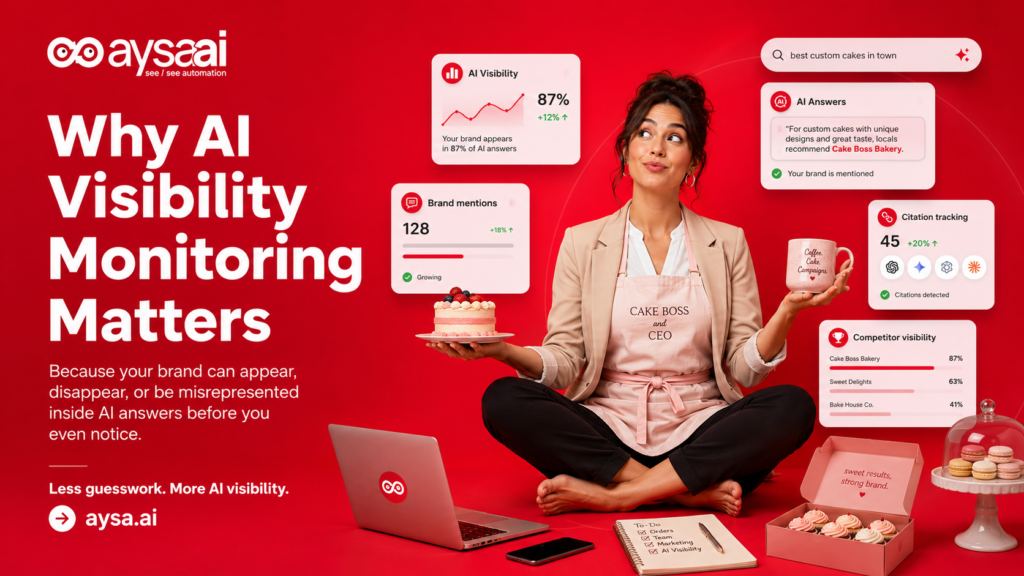
For years, SEO monitoring focused mainly on rankings, Impressions, Clicks and traffic. Those metrics still matter. But search is changing. Users now discover information through AI Overviews, answer engines, assistants and Generative search experiences.
This means visibility is no longer only about where a page ranks. It is also about whether a business is understood, mentioned, cited, compared or recommended in AI-assisted search contexts.
What AI visibility means
AI visibility describes how discoverable and understandable a website or brand is across AI-assisted search surfaces. It includes classic SEO foundations, but also looks at answer clarity, entity consistency, topical coverage, authority signals and whether the site provides useful information that can be extracted or summarized.
It is not a magic score. It is a practical way to ask: can search systems understand this business well enough to include it in modern search experiences?
Why rankings are not enough
A page can keep a similar ranking while the search result changes around it. AI Overviews, rich results, local packs, People Also Ask, comparison modules and answer surfaces can affect how users interact with search.
If a business only watches rank position, it may miss changes in how users actually discover answers.
What should be monitored
AI visibility monitoring may include:
- Brand and product mentions in AI-assisted search contexts.
- Pages that need clearer direct answers.
- Topics where competitors are more visible.
- Entity inconsistencies across the website.
- Missing FAQ, comparison or definition sections.
- Technical issues that reduce eligibility.
- Authority gaps that make a source less trustworthy.
- Market shifts and Google changes that require updates.
Monitoring without execution creates noise
It is easy to create another dashboard. It is harder to create a workflow that does something useful with the signal.
AYSA is designed to turn monitoring into next actions. If a page has weak answer coverage, AYSA can prepare an FAQ section. If a topic gap appears, it can prepare a content brief. If a technical issue affects crawlability, it can queue a fix for approval.
AI visibility depends on the whole website
AI search readiness is not isolated to one page. It depends on the website’s technical foundation, internal links, content depth, topical authority, brand entity clarity and external references.
This is why AYSA connects monitoring to research, technical SEO, on-page SEO, authority building and execution history.
What AYSA does when something changes
When AYSA detects an opportunity or issue, the workflow should be simple:
- Explain what changed.
- Show why it matters.
- Prepare the recommended action.
- Ask for approval.
- Execute accepted changes.
- Keep monitoring the result.
This keeps the user out of dashboard overload while preserving control.
No guaranteed citations
AI visibility monitoring cannot guarantee that a website will be cited by an answer engine or included in AI Overviews. Search systems decide what appears. The goal is to improve clarity, usefulness, technical accessibility and authority signals over time.
The business benefit
Businesses need to know where organic discovery is moving. AI visibility monitoring helps them respond earlier, improve content with purpose and keep their website aligned with how people search today.
Less dashboard watching. More approved execution.
Explore Monitoring & AI Visibility or read glossary entries for AI visibility, answer engines and AI Overviews.
Continue the AI search topic inside AYSA.
Use these pages to connect the article with AI SEO tools, AI visibility monitoring, AI Overviews and approved website execution.
Turn this topic into a website action plan.
Use these AYSA hubs to move from reading to technical fixes, AI visibility monitoring, research, glossary context and approval-first SEO execution.