
YouTube Just Became the UK’s Top Podcast Platform: What That Really Means for Search, Discovery, and SME Growth
New UK data shows YouTube edging past Spotify as the most-used podcast service. The real story isn’t a one-point lead—it’s the platform shift from audio-only distribution to video-native discovery, with big implications for SEO, brand demand, and how SMEs should structure content for AI-driven search.

Podcasting in the UK just hit a milestone that looks small on paper but massive in practice: YouTube edged past Spotify as the most-used podcast service among weekly podcast listeners. A one-point lead doesn’t sound like a revolution. But the underlying shift is exactly that—podcasts are becoming a video-discovered medium, and YouTube is where “podcast growth” increasingly starts.
As a business operator, marketer, or agency, you should read this as a distribution and discovery change—not a media trivia fact. When YouTube becomes the primary “podcast platform,” it rewires how people find shows, how brands earn awareness, and what kinds of content end up being cited (or ignored) across modern search experiences.
This editorial breaks down what changed, why it matters for SMEs, how to build a demand system (not a “podcast strategy”), and how AYSA fits as an execution engine that monitors, prepares, requests approval, and then implements the site changes that turn attention into compounding organic growth.
Concise Summary
- What changed: UK listeners now report YouTube as their top podcast service by a narrow margin over Spotify, based on Edison Research’s UK podcast metrics as reported by Search Engine Journal.
- Why it matters: YouTube is not just a player in podcasting; it’s a discovery engine that blends Search intent, recommendations, and video consumption habits.
- Business impact: If your content plan assumes “audio-first,” you’ll likely underinvest in video packaging, metadata, and owned-asset capture (site pages, FAQs, internal links) that convert demand into revenue.
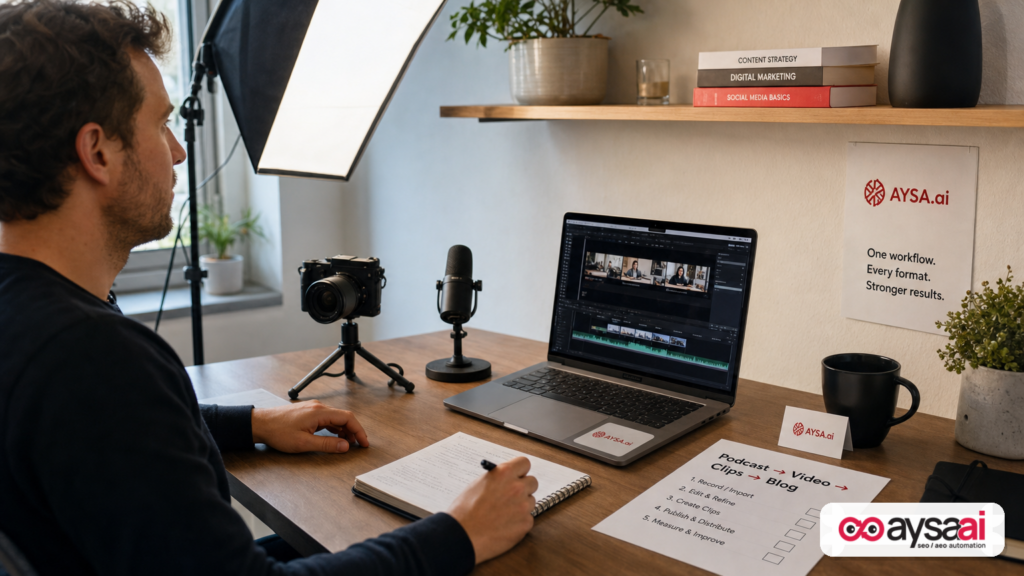
- What to do: Build one episode as a content system: video episode → clips → transcript → site article → FAQ → Internal linking → schema → measurement.
- Where AYSA fits: AYSA helps you operationalize this by Monitoring visibility and content health, preparing prioritized changes, asking for approval, and executing accepted improvements on your website—so your podcast isn’t just “content,” it’s compounding search equity.
Table of Contents
- The Crossover: YouTube Overtakes Spotify in the UK (And It’s Not Just a Podcast Story)
- What the UK Data Actually Signals (Beyond the 1-Point Margin)
- Why YouTube Wins in 2026: The Discovery Stack (Search, Recommendations, and “Good Enough” Audio)
- UK vs. US: Why the UK Trailed (And Why That Matters for Your Strategy)
- The New SEO Reality: YouTube is a Search Engine, Your Site is the Asset
- What Can Go Wrong: Platform Dependence, Measurement Traps, and Content Waste
- The SME Reality: You Don’t Need a “Podcast Strategy.” You Need a Demand Strategy.
- An Execution-First Playbook: Turn One Episode Into an Owned Content System
- Agency Implications: New Deliverables, New Reporting, and Faster Iteration
- Where AYSA.ai Fits: Approved Execution for SEO/AEO/GEO
- What to Do Next (Action List)
- Sources and Further Reading
The Crossover: YouTube Overtakes Spotify in the UK (And It’s Not Just a Podcast Story)

According to Edison Research’s UK podcast metrics preview (as covered by Search Engine Journal), YouTube became the top-cited primary podcast platform for UK weekly listeners aged 15+—29% for YouTube vs 28% for Spotify. It’s described as the first time YouTube has led “on record,” and the lead is narrow—so the responsible read is not “Spotify is dead,” but “the center of gravity is moving.”
That gravity shift matters because YouTube changes the default user journey:
- Spotify behaves like a library (even with recommendations): people often come with listening intent and then choose content.
- YouTube behaves like a discovery engine: people arrive via search, home feed, suggested videos, and shorts—and only then decide what becomes a habit.
When podcasts become a YouTube-native consumption pattern, the biggest winners are not necessarily the “best audio producers.” They’re the operators who understand packaging, metadata, retention, and how to convert attention into owned audiences and owned assets.
What the UK Data Actually Signals (Beyond the 1-Point Margin)
Here’s the part that too many marketers gloss over: the headline is not the 1-point gap—it’s the trend line.
As reported by Search Engine Journal’s summary of Edison’s data:
- YouTube grew from 19% (2023) to 29% (Q1 2026) among UK weekly podcast listeners naming their primary platform.
- Spotify moved the other way, from 33% (2023) to 28% (Q1 2026).
- BBC Sounds held a meaningful share (reported at 15% in recent readings), which is structurally different from the US market.
Edison’s UK Podcast Metrics are based on a large annual interview set (8,000 UK podcast listeners aged 15+ per year, per the SEJ report). The Q1 2026 sample size wasn’t specified in the extracted text, so treat the exact one-point gap cautiously—yet the multi-year direction is hard to ignore.
From a strategy standpoint, “direction plus compounding behavior” beats “snapshot plus hot take.” And the direction is clear: the podcast category is being absorbed into YouTube’s broader video ecosystem.
Why YouTube Wins in 2026: The Discovery Stack (Search, Recommendations, and “Good Enough” Audio)
YouTube’s advantage isn’t that it suddenly became a better audio app. It’s that YouTube bundles three growth engines that audio-first platforms rarely match simultaneously:
1) YouTube is a search engine (not just a player)
On YouTube, “podcast discovery” is often just “search discovery.” People type questions, topics, and comparisons. They don’t need to know a show exists to find it.
That matters for SMEs because a discovery engine rewards problem-first content:
- “How do I choose X?”
- “What does Y cost?”
- “Best way to fix Z?”
If your show is built around solving specific customer problems, YouTube search can become a top-of-funnel machine. If it’s built around insider chatter, it might only serve existing fans.
2) Recommendations create compounding reach
Spotify and Apple have recommendation layers, but YouTube’s entire product is optimized for session continuation. This is why “good packaging” (title, concept clarity, thumbnail discipline, and watchability) can outperform legacy brand recognition.
For operators, this is uncomfortable but valuable: you can’t brute-force YouTube with just distribution. You win by aligning with how audiences choose, skim, and commit.
3) Video is now the default “proof of presence”
Edison’s US findings cited in the SEJ coverage connected YouTube’s rise to younger listeners and video habits, including a stat about Gen Z monthly podcast listeners engaging with video components. That’s not a UK-specific claim we can extend without the underlying UK dataset, but directionally it matches what every operator sees: video is now the easiest way to communicate authenticity and expertise at scale.
In practical terms: a video podcast can function like a weekly set of sales calls your prospects watch when it’s convenient.
UK vs. US: Why the UK Trailed (And Why That Matters for Your Strategy)
One of the most interesting points in the SEJ report is Edison’s interpretation of why the UK trend lagged the US: the UK has a strong public-media presence in podcast listening, with BBC Sounds holding a meaningful share. That changes the competitive landscape.
Why this matters to your business planning:
- If you run UK campaigns and copy/paste a US playbook, you can underweight the role of BBC Sounds in certain demographics.
- If you run multi-market content, you should expect platform mix differences and measure each market rather than assuming one “global truth.”
In other words: strategy should follow behavior, not brand lore.
The New SEO Reality: YouTube is a Search Engine, Your Site is the Asset
Here’s my operating principle (and it’s the one we build around at AYSA): platforms create reach; websites create equity.
YouTube can be your best discovery channel. But your website is still where you control:
- Conversion paths (leads, bookings, carts, demos)
- Messaging consistency
- Structured information (FAQs, pricing, service definitions, location details)
- Internal linking and topical Authority Building
- Measurement continuity over time
If YouTube is where podcasts are increasingly found, then the SEO strategy is not “rank the video” alone. The SEO strategy is:
- Use YouTube to win discovery
- Use your site to capture and compound demand
- Use monitoring + iteration to keep assets accurate, interlinked, and AI-citable
This is where the conversation moves from traditional SEO into AEO/GEO realities—where engines and assistants synthesize answers and choose what to cite. You can’t rely on a single platform listing to do all the work.
If you want a starting point on the visibility side, see AYSA AI Search Visibility and our AI SEO tools approach to keeping content structured, measurable, and execution-ready.
What Can Go Wrong: Platform Dependence, Measurement Traps, and Content Waste
When teams hear “YouTube is #1,” they often sprint into production and skip the part that makes it profitable. Here are the common failure modes I see (especially with SMEs and time-strapped agencies):
1) You build on rented land and forget the asset
It’s easy to measure views. It’s harder to measure qualified demand, assisted conversions, and the content that actually drives high-intent actions. If all your value lives inside YouTube, you’re exposed to shifts in recommendations, monetization priorities, and category competition.
2) You mistake “attention” for “incremental growth”
A podcast can inflate Branded Search and direct traffic without increasing net-new demand. That’s not bad—brand is valuable—but you need to know if you’re expanding the market or just entertaining your existing buyers.
At minimum, you should be able to answer:
- Are we gaining impressions for non-branded problem queries?
- Are we earning new email subscribers or leads tied to episodes?
- Are we seeing assisted conversions increase?
3) You create content that can’t be reused
If your episodes are not designed to be repurposed (clear segments, named questions, crisp takeaways), your team ends up with a pile of video files and no scalable system. The content dies in the platform feed instead of becoming an owned library of answers.
4) You publish, but you don’t maintain accuracy
This is the silent killer in AI-era discovery: outdated pricing pages, inconsistent service descriptions, stale location details, conflicting FAQs. If your show drives people to a site that’s messy or inconsistent, you lose trust—and you reduce your chances of being cited correctly across AI-driven experiences.
That’s why ongoing monitoring matters as much as publishing. AYSA’s monitoring is built for this operational reality: AYSA Monitoring.
The SME Reality: You Don’t Need a “Podcast Strategy.” You Need a Demand Strategy.
Let’s make this real with an SME scenario that doesn’t require a media team.
Scenario: A UK dental clinic expanding into high-margin treatments
A clinic wants more bookings for implants and Invisalign-type services. They’re considering “starting a podcast” because competitors are posting reels and patient stories.
The wrong plan is: Record 45-minute chats and upload them somewhere weekly.
The right plan is: Create a demand system that answers high-intent questions and turns attention into bookings. For example:
- Episode concept: “Implants vs bridges: cost, timeline, and who qualifies”
- Video episode on YouTube: The clinician explains options plainly, with a simple on-screen list (no patient data, no overpromises)
- Clips: 3 short segments: “timeline,” “pain & recovery,” “financing questions to ask”
- Website asset: A structured guide page with FAQs and clear calls to action (consultation booking)
- Measurement: Track booked consultations that land on that guide page; watch non-branded query impressions in Google Search Console; monitor engagement
Notice what’s happening: YouTube creates discovery. The website creates conversion and compounding organic visibility. This is the pattern SMEs can win with—even with small teams—because it’s not “more content,” it’s “better reuse plus better structure.”
An Execution-First Playbook: Turn One Episode Into an Owned Content System
If you only take one thing from this article, take this: every episode should ship with a website change list. Otherwise, you’re spending production dollars without building durable search equity.
Here’s a practical playbook you can repeat weekly or biweekly.
Step 1: Choose episode topics that map to revenue intent
Topic selection should start with your sales conversations, not your creative impulses. Common SME intent buckets:
- Cost and pricing explanations (within compliance and policy limits)
- Comparison content (“X vs Y”)
- Process and timeline content (“what happens next”)
- Risk and troubleshooting (“what can go wrong and how to avoid it”)
- Buyer checklists (“how to choose a provider/vendor”)
Step 2: Record video-first (even if audio matters)
You don’t need a studio. You need:
- Clean audio
- Stable framing
- Good lighting
- A structure that produces reusable segments
Video-first matters because the UK data signals YouTube is becoming the default podcast destination. Even if your audience listens, video is often the discovery mechanism.
Step 3: Produce a transcript and turn it into an article that can rank
A transcript alone is not an article. The “owned asset” version needs:
- A clear page purpose (what question it answers)
- Headings that reflect real queries
- Short answers (for extractable snippets) plus deeper explanations
- FAQs that match what prospects actually ask
This is where many teams stop too early. They paste a transcript into a blog post and call it done—then wonder why it doesn’t perform.
Step 4: Add internal links like you mean it
Internal linking is how you turn a collection of posts into a knowledge system. Each episode-article should link to:
- The primary service/product page
- A “how it works” explainer
- A pricing or cost guidance page (when appropriate)
- A related comparison page
And those core pages should link back to your best episode-articles. This is basic, but it’s also where execution breaks down because it’s tedious. That’s exactly the kind of work an execution system should handle.
Step 5: Structure the page for humans and machine interpretation
Whether you think in terms of SEO, AEO, or GEO, the same truth holds: machines prefer structured clarity. That means:
- Clear definitions
- Consistent terminology
- FAQ formatting
- Accurate business details (especially for local SMEs)
If you want to explore how we approach this operationally, start at AI SEO Tools and AI Search Visibility.
Step 6: Measurement that ties content to outcomes
You don’t need an enterprise stack to measure whether this is working. You do need discipline.
At a minimum, track:
- Landing page performance of episode-derived articles (engagement + conversions)
- Search impressions for non-branded queries related to each episode topic
- Lead quality notes from sales/support (“people mention the episode”)—simple but powerful
The reason measurement matters in this specific “YouTube #1” moment: YouTube can deliver views without delivering customers. Your website and analytics are how you keep the business honest.
Agency Implications: New Deliverables, New Reporting, and Faster Iteration
If you run an agency, the UK platform shift should change how you package services and how you prove value.
Deliverables are shifting from “content pieces” to “content systems”
Clients don’t need 12 videos. They need a repeatable system that generates:
- Videos that earn discovery
- Site pages that capture intent
- Internal links that build topical authority
- Monitoring that keeps everything accurate and updated
Reporting should separate platform lift from business lift
It’s fine to report YouTube metrics. But you also need to show:
- Organic search growth tied to episode topics
- Conversions from owned assets
- Increases in non-branded visibility (the hardest, most valuable kind)
Speed of iteration becomes a competitive advantage
In a YouTube-driven discovery world, content cycles are faster. The agencies that win will be the ones that can:
- Publish
- Measure
- Update pages
- Improve internal linking
- Adjust titles/packaging
…without waiting weeks for dev tickets.
That’s why an approval-based execution model matters. Done right, it gives clients control while removing bottlenecks.
Where AYSA.ai Fits: Approved Execution for SEO/AEO/GEO
At AYSA, we built for the part most teams struggle with: turning “we should” into “it shipped.” The modern content operator has no shortage of ideas. The shortage is operational capacity—and the confidence that changes won’t break the site.
AYSA works as an execution system that:
- Monitors your site’s SEO/AEO/GEO health and visibility signals
- Prepares recommended changes (prioritized and specific)
- Requests approval so you stay in control
- Executes accepted website changes so improvements actually go live
In the context of the YouTube-as-podcast-leader shift, AYSA supports the “owned asset” side of the equation:
- Keeping episode-derived articles structured and internally linked
- Maintaining accuracy across key pages (services, locations, FAQs)
- Operationalizing updates instead of letting content rot
Explore:
The point isn’t to “do YouTube SEO” in isolation. The point is to build a system where YouTube drives discovery and your site compounds the value—measurably, repeatably, and with execution discipline.
What to Do Next (Action List)
- Audit your last 5 pieces of content: Did any of them create a durable site asset (guide, FAQ, comparison page), or did they die in the feed?
- Pick 3 revenue-intent questions: Cost, comparison, timeline, mistakes to avoid—questions your customers ask before buying.
- Plan one video-first episode: Break it into 3–5 named segments so it can be repurposed.
- Create the owned page first: Outline the site article and FAQs before you record. Let the page structure guide the episode.
- Link intentionally: Add internal links from the new article to the service/product page, and link back from the service page to the new article.
- Measure outcomes: Track conversions on the owned page and watch non-branded impressions tied to the topic.
- Operationalize updates: Use monitoring to keep the content accurate; schedule quarterly refreshes.
If you want this as a managed system—with monitoring, prepared changes, approvals, and execution—start with AYSA Monitoring and then review pricing based on your site footprint and operational needs.
Sources and Further Reading
- Search Engine Journal: YouTube Moves Ahead of Spotify As UK’s Top Podcast Service (primary source for the UK crossover summary and Edison-reported figures in this editorial)
- Search Engine Journal: Latest News (context and continued coverage)
- Search Engine Journal: SEO (broader search strategy context)
- Search Engine Journal: Webinars (where the referenced Edison webinar was promoted in the page context)
Note: This editorial relies on the extracted source context above and does not claim to have reviewed Edison’s full underlying UK report beyond what was described in the SEJ coverage. Where specific platform shares were referenced, they were attributed to the SEJ summary of Edison’s findings.
Continue the AI search topic inside AYSA.
Use these pages to connect the article with AI SEO tools, AI visibility monitoring, AI Overviews and approved website execution.
Turn this topic into a website action plan.
Use these AYSA hubs to move from reading to technical fixes, AI visibility monitoring, research, glossary context and approval-first SEO execution.

