Accountable AI in Search: When “The Model Wrote It” Stops Being a Defense
A German court reportedly treated Google’s AI Overviews as Google’s own content—signaling a shift where AI-generated errors can create real liability. Here’s what changes, why it matters for SMEs and agencies, and how to build an accountable AI search workflow with monitoring + approved execution.

AI Search is moving from an “interesting feature” to a high-stakes publishing layer. The same system that can summarize your brand in one sentence can also misstate your policy, misquote your pricing, or synthesize a claim that never existed in your source material. And courts may increasingly treat that output like content with an owner—not a neutral tool result.
This editorial was inspired by Search Engine Land’s discussion of a German court reportedly holding Google accountable for errors in AI Overviews. The important takeaway isn’t “Google is in trouble.” It’s that the old internet posture—distance yourself from the words, keep the upside—is weakening in an AI-first world.
I’m writing this from the perspective of building AYSA.ai: an execution system for SEO/AEO/GEO where Monitoring finds issues, AI prepares changes, humans approve, and then the system executes the accepted work. That “Approved Execution” loop isn’t a product detail anymore. It’s the foundation of accountable AI operations.
Concise summary
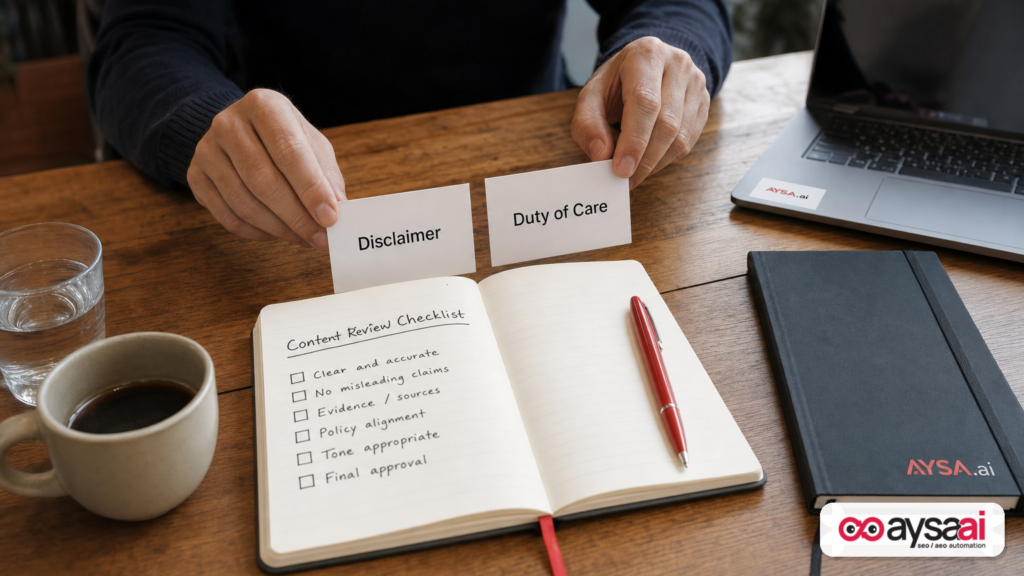
- What changed: AI-generated answers in search are increasingly being treated as publisher output, not just “a tool suggestion,” and disclaimers (“AI can make mistakes”) may not protect companies when harm occurs.
- Why it matters: AI now touches support, product content, local listings, reporting, and even hiring. The errors won’t stay internal—they become public, citable, and legally meaningful.
- What to do: Treat AI as a content production system that requires guardrails, approvals, logs, and monitoring. Build a workflow that is fast and accountable.
- Where AYSA fits: AYSA helps teams monitor for AI-search visibility issues, prepare improvements, route them for approval, and execute changes—so you can move quickly without “letting the model publish.”
Table of contents

- The shift: AI output is being treated like publisher content
- Why “AI can make mistakes” is no longer a strategy
- What actually changed in search behavior (and why it’s different from classic SEO)
- Where this hits businesses first: five high-risk AI touchpoints
- A concrete SME scenario: the clinic that let AI improvise
- What agencies must rethink: from deliverables to accountable systems
- SEO, AEO, GEO: the new triangle of responsibility
- Measurement: what to monitor when clicks disappear but influence grows
- The accountable AI search operating system (AASOS): monitor → prepare → approve → execute
- Implementation playbook: policies, approvals, and logs that don’t slow you down
- How AYSA supports accountable AI search execution
- What to do next (action list)
- Sources and further reading
The shift: AI output is being treated like publisher content

For most of the modern web, platforms survived by being “just the intermediary.” Users posted; algorithms ranked; nobody wanted to be the publisher. That line was never clean, but it was useful.
Generative AI blurs it completely. When a system synthesizes an answer—especially one that introduces new claims not present in sources—the output looks and feels like authored content. The reader doesn’t experience it as “a list of documents you can evaluate.” They experience it as: the answer.
Search Engine Land’s piece points to a German court reportedly rejecting the idea that users should be responsible for fact-checking AI Overviews, and instead treating those AI summaries as Google’s content (source). If that direction continues, the question for every business becomes simple:
If AI is speaking in your name—or influencing decisions about your brand—who owns the consequences?
This isn’t only about courts. It’s also about customers, partners, regulators, and the market’s tolerance for “oops, the model hallucinated.”
Why “AI can make mistakes” is no longer a strategy
Disclaimers were always a temporary bridge. They helped platforms ship quickly while models were immature. But disclaimers can’t carry the weight of a business reality where:
- AI is marketed as reliable enough to trust,
- AI is deployed in workflows that impact money, health, safety, or reputation, and
- AI outputs are presented with confident tone and “answer-shaped” UX.
You can’t build a growth engine on “trust the output” and a risk posture on “don’t trust the output.” Eventually those collide.
For SMEs, the practical interpretation is this: your disclaimer is not your process. Your process is your defense. Governance, approvals, and logs are your defense. Clear sourcing and careful claims are your defense.
What actually changed in search behavior (and why it’s different from classic SEO)
Classic search was (mostly) a referral system. You earned visibility, got the click, and then controlled the narrative on your site. If Google misinterpreted a Page title, you tweaked metadata. If rankings changed, you improved content and links.
AI search changes the “moment of truth.” The user can get a synthesized answer without visiting your website. That impacts:
- Brand framing: The first impression may be an AI-generated summary.
- Eligibility: You may or may not be cited, mentioned, or recommended.
- Conversion path: The path could shift from “search → click → site” to “search → AI answer → call/book/buy.”
This is where SEO expands into AEO (answer engine optimization) and GEO (generative engine optimization). Whether you use those labels or not, the operating reality is that you’re optimizing not just for rankings, but for being understood and correctly represented.
The Search Engine Land ecosystem has been tracking this shift from multiple angles, including AI Overviews behavior and visibility tooling (e.g., Google Search Console AI performance reports rolling out to more users) and how AI Overviews cite sources in practice (e.g., AI Overviews citing listicles while recommending competitors). The theme: AI layers introduce new surfaces where brand truth can drift.
Where this hits businesses first: five high-risk AI touchpoints
Most companies think of “AI risk” as something that happens in marketing content. That’s only one slice. The first wave of real damage usually starts in operational areas—because that’s where people rely on outputs to make decisions quickly.
1) Customer support and success (AI responses become policy)
If your AI support assistant says, “Yes, refunds are available after 60 days,” but your policy says 30 days, you’ve created a promise. Even if you add a footer that says “AI may be wrong,” your customer will treat the answer as a commitment.
Accountability move: hard-limit the assistant to your verified policy content, require citations, and implement an escalation rule for policy-sensitive topics.
2) Product and service descriptions (misleading claims)
AI loves filling blanks. It will “helpfully” add superlatives, guarantees, comparisons, and implied outcomes. In ecommerce and services, that’s where misrepresentation risk lives.
Accountability move: treat product/service copy as “claims-controlled.” Build a claim library (what you can say, what you cannot say, what requires proof).
3) Local business listings and hours (small errors, big fallout)
Wrong hours, wrong phone number, wrong holiday schedule—these are “tiny” errors that translate into immediate revenue loss and reputation hits (bad reviews, angry calls, missed appointments).
Accountability move: set monitoring for critical business info across the web and schedule verification workflows—especially around holidays.
4) Reporting and analytics summaries (bad data becomes bad decisions)
AI-generated reporting can confidently state causal relationships that aren’t true. If leadership believes the narrative, budget shifts happen. People get hired or fired. Channels get cut.
Accountability move: require that AI summaries link to underlying metrics and queries. If it can’t show the source, it can’t make the claim.
Search Engine Land has also highlighted how bad data increasingly affects not only reports but ad delivery decisions (source). That’s the same accountability pattern: errors propagate into automated systems.
5) Reputation and competitive statements (defamation-by-synthesis)
Even if your business never publishes an AI-generated takedown of a competitor, you can still be impacted when AI systems synthesize negative claims—about you or others—from weak sources.
Accountability move: proactively strengthen your brand’s factual footprint: clear “About,” policies, author bios, citations, structured data where appropriate, and consistent entity signals. This is also where monitoring for brand mentions in AI answers starts to matter.
A concrete SME scenario: the clinic that let AI improvise
Let’s make this real with a scenario I’ve seen variations of across categories (clinics, legal services, home services):
Scenario: A regional clinic chain uses AI to “refresh” service pages. The model rewrites the copy to sound more helpful and authoritative. It adds a line like: “Most patients feel results within 24 hours.” No one intended to make that promise; it’s not supported; it’s not universally true.
What happens next:
- A patient books expecting that outcome.
- A complaint follows when reality differs.
- The clinic now has a reputational and possibly regulatory issue, plus a trust problem that spreads via reviews.
The operational failure wasn’t “using AI.” It was letting AI publish without a claims review step and without an approval trail.
What the accountable version looks like:
- The AI drafts changes, but every page is tagged with a risk level.
- “Outcome claims” require a clinician or compliance approval.
- The system stores a log: what changed, who approved, what sources were used.
- Monitoring detects when external AI answers misstate services or policies, triggering a correction workflow.
This is the heart of the editorial: speed without governance is just faster failure.
What agencies must rethink: from deliverables to accountable systems
Agencies are under pressure. Clients want more content, more landing pages, more “AI visibility,” and faster timelines. AI makes that possible—until it becomes the reason trust breaks.
If you run an agency, the shift you need to make is from selling outputs to selling operations:
- Not “50 AI articles/month,” but “a claims-controlled content system with approvals and monitoring.”
- Not “we optimized your pages,” but “we can show who approved what, why, and what changed.”
- Not “rankings,” but “accurate brand representation in AI answers plus measurable demand capture.”
It’s also a margin protection move. When AI mistakes happen, clients don’t blame “the model.” They blame the vendor relationship: the agency, the software, the consultant. Accountable workflows reduce the surface area of those disputes.
SEO, AEO, GEO: the new triangle of responsibility
Traditional SEO taught businesses to think in rankings and clicks. AI search requires thinking in interpretation and attribution:
- SEO: Can your pages be found and indexed? Do they rank and earn links?
- AEO: Can your content be extracted into correct answers? Is it unambiguous, well-structured, and well-sourced?
- GEO: Does the generative layer mention or recommend you appropriately? Are your brand/entity signals consistent across the web?
Search Engine Land has run adjacent pieces that hint at where this goes, like how Google’s LLM patent suggests a goal of “teaching AI who you are” (source) and how brands are dealing with being represented by AI systems at scale (source).
Whether every detail of those discussions plays out exactly as predicted isn’t the point. The point is the operational reality: AI systems need to reliably identify your business, your offerings, and your boundaries—or they’ll fill gaps with guesswork.
Measurement: what to monitor when clicks disappear but influence grows
AI answers can reduce clicks while increasing “pre-click decisions.” That breaks the привычный (familiar) KPI stack for many SMEs:
- “Organic sessions” may drop even when demand stays stable.
- Phone calls and bookings may shift in ways analytics can’t attribute cleanly.
- Brand perception is shaped upstream in the AI layer.
So what do you monitor?
AI visibility and brand representation
- Are you mentioned for your core category queries?
- Are your policies summarized correctly?
- Are competitors being recommended in contexts where you should be?
This is exactly why we built dedicated monitoring into AYSA. If you wait for a traffic report to tell you something’s wrong, the narrative may already be established.
Start here: AI Search Visibility and Monitoring.
Content integrity signals
- Which pages contain claims that require substantiation?
- Which pages have unclear authorship, weak sourcing, or confusing structure?
- Where are you repeating “AI-shaped” fluff that doesn’t add meaning?
Technical and indexation stability
Even in an AI world, basics matter. If your pages aren’t reliably indexed or are spam-flagged, you don’t get a seat at the table. Search Engine Land’s coverage of spam updates (e.g., release and rollout completion) reinforces a recurring truth: low-quality, scaled content strategies get riskier over time.
The accountable AI search operating system (AASOS): monitor → prepare → approve → execute
Here’s my strong take: accountable AI isn’t primarily a model problem. It’s a workflow design problem.
Most organizations are doing some version of this today:
- Someone prompts a model.
- Someone pastes output into a CMS.
- It ships.
That works right up until it doesn’t. And when it doesn’t, you discover you have:
- no record of what was generated,
- no record of who approved it,
- no consistent standard for claims, tone, or sources, and
- no monitoring to catch drift in AI answers across the web.
The AASOS loop looks like this:
1) Monitor: detect AI/SEO issues early
Monitoring isn’t just uptime. It’s brand truth in the market. You want alerts for:
- critical business info changes (hours, phone, address),
- new AI answer patterns that exclude or misrepresent you,
- content quality regressions, and
- technical/indexation problems that reduce your eligibility.
AYSA’s monitoring is designed to surface those issues so you don’t find out through a customer complaint.
2) Prepare: generate fixes and improvements (but don’t publish)
AI is excellent at drafting and formatting improvements:
- rewrite unclear copy into factual, structured language,
- create FAQ sections aligned to real questions,
- propose internal links and information architecture updates,
- identify thin pages that should be consolidated or removed.
But “prepare” is different from “publish.” Prepared work should be reviewable, comparable, and reversible.
See tools context: AYSA AI SEO Tools.
3) Approve: a human signs off (with the right expertise)
Approvals aren’t bureaucracy. They’re specialization. The right person should approve the right kind of risk:
- Policy claims → legal/compliance or leadership
- Medical/financial outcomes → licensed expert or compliance
- Pricing/promos → sales/ops owner
- Brand voice and competitive positioning → marketing lead
The goal is to build a lane where low-risk edits flow quickly and high-risk edits get real scrutiny.
4) Execute: ship changes with logs and rollbacks
Execution is where most teams fall apart. Drafts pile up. Tickets linger. “We’ll update it next sprint.” Meanwhile the AI layer keeps learning from whatever is live today.
AYSA’s model is to connect the loop: once approved, changes can be executed on-site in a controlled way. That’s the difference between “AI suggestions” and an operational system.
For implementation and commercial considerations: Pricing. For ongoing education and updates: Blog.
Implementation playbook: policies, approvals, and logs that don’t slow you down
Most SMEs hear “governance” and think “meetings.” Don’t do that. Do design.
Define your AI publishing policy in one page
It should answer:
- Where is AI allowed to draft?
- Where is AI not allowed (or must be heavily constrained)?
- What categories of claims require citations?
- Who is the approver for each risk category?
- Where are logs stored and for how long?
Keep it short. Make it enforceable.
Use approval tiers instead of “approve everything”
- Tier 0 (auto): spelling, formatting, internal links—low risk.
- Tier 1 (marketing approve): copy clarity updates, FAQs, page structure.
- Tier 2 (domain expert approve): outcomes, comparisons, compliance-sensitive topics.
Most teams fail because they treat every change as Tier 2. That makes people bypass the process.
Keep an “accountability log” for AI-assisted changes
At minimum, log:
- what page/asset changed,
- what the change was (diff),
- who requested it,
- who approved it,
- when it shipped, and
- what sources/policies it relied on.
This is not just for legal defense. It’s for operational sanity—so you can learn, rollback, and iterate.
Audit and remove “AI-shaped” content that increases risk
AI slop isn’t just low-quality. It’s content that creates ambiguity, weakens expertise signals, and invites the model (and search systems) to guess.
Do a cleanup pass:
- Consolidate overlapping articles into one authoritative page.
- Remove pages that exist only to target a keyword but add no unique value.
- Rewrite “confident but empty” sections into concise, factual statements.
- Add explicit boundaries (“We do not offer X,” “Available in Y states only”).
This aligns with broader industry thinking around pruning and consolidation for AI-era search (Search Engine Land has discussed content pruning in AI search contexts, though that specific article isn’t included in the extracted text here; treat this as a general best practice rather than a claim about any single method).
How AYSA supports accountable AI search execution
Accountable AI isn’t a feature you toggle on. It’s an operating model. Here’s how AYSA is built to support that model without forcing SMEs to become SEO experts:
Monitoring that watches the right problems
Instead of waiting for traffic loss, you monitor for conditions that cause AI misrepresentation and lost eligibility. Start with: AYSA Monitoring.
AI search visibility as a first-class KPI
If AI answers are the new homepage, you need to know whether you show up and how you’re framed. Explore: AI Search Visibility.
AI-assisted preparation that doesn’t bypass review
AYSA uses AI to prepare changes (drafts, fixes, enhancements), but the workflow is designed for review and approval—so businesses don’t “let the model ship.” Tools context: AI SEO Tools.
Approved execution: shipping changes without chaos
The bottleneck in SEO/AEO/GEO is rarely “ideas.” It’s execution. AYSA is built to prepare work, request approval, and then execute accepted website changes—creating a clean line between draft and publish.
A system you can actually run
SMEs don’t need another dashboard. They need a system that turns visibility into actions and actions into shipped improvements. Commercial overview: AYSA Pricing.
What to do next (action list)
- Inventory where AI writes or speaks for you. Support, site content, ads, listings, reporting, emails—make a list.
- Assign risk tiers. Identify what could create legal/regulatory exposure or reputation damage if wrong.
- Define approvers by category. Marketing approves marketing; domain experts approve claims.
- Implement an accountability log. If it’s AI-assisted, it gets logged.
- Start monitoring AI search visibility. Track how your brand is represented for your money queries.
- Clean up “AI-shaped” pages. Consolidate, clarify, add boundaries, and remove thin content.
- Adopt an execution loop. Monitor → prepare → approve → execute. Tools are optional; the loop is not.
Sources and further reading
- Search Engine Land: What if you were held accountable for your AI slop? (research inspiration for this editorial)
- Search Engine Land: Google’s LLM patent suggests a new goal for SEO: Teaching AI who you are
- Search Engine Land: Google Search Console AI performance reports rolling out to more users
- Search Engine Land: Google AI Overviews cite self-serving listicles, but recommend competitors 69% of the time
- Search Engine Land: Google releases June 2026 spam update
- Search Engine Land: Google June 2026 spam update done rolling out
- Search Engine Land: Bad data used to mean bad reports, now it means poor ad delivery
- Search Engine Land: Your AI salesforce is already selling your brand. The question is who trained it.
Note on verification: This editorial references Search Engine Land’s reporting and commentary about a German court decision. I’m not reproducing legal specifics beyond what’s stated in that source. If you need legal advice for your jurisdiction, consult counsel—then design your workflow so you’re not relying on disclaimers as your only line of defense.
If you want to operationalize accountable AI search execution, start by reviewing: AI Search Visibility, Monitoring, and AYSA AI SEO Tools.
Continue the AI search topic inside AYSA.
Use these pages to connect the article with AI SEO tools, AI visibility monitoring, AI Overviews and approved website execution.
Turn this topic into a website action plan.
Use these AYSA hubs to move from reading to technical fixes, AI visibility monitoring, research, glossary context and approval-first SEO execution.