Query Expansion Is the New Keyword Research: How to Turn “Accidental Rankings” Into AI Search Visibility
Google already expands queries behind the scenes, which means your pages can rank for searches you never targeted. The opportunity: find those “accidental” queries in Search Console, decide which ones matter, and upgrade content so it wins in classic search and gets pulled into AI Overviews and AI Mode fan-outs—without keyword stuffing.

By Marius Dosinescu (AYSA.ai)
For years, SEO teams treated Keyword research like a grocery list: pick the terms you want, write pages for those terms, and wait for rankings. That model wasn’t perfect, but it was predictable.
Now it’s not.
Google doesn’t just match pages to a typed query. It interprets what the searcher likely means, expands the query with related concepts, and increasingly answers with AI-generated summaries that pull supporting context from multiple sources. The practical result is both frustrating and full of opportunity:
- Your pages may already be surfacing for searches you never planned for.
- Some of those “accidental rankings” are your next best growth lever.
- Some are a warning sign that Google misunderstood your page—or that your page is unfocused.
This editorial is a playbook for turning query expansion from a hidden mechanism into a repeatable growth process—one that helps you win in traditional search and in AI surfaces like AI Overviews and AI Mode.
Primary research input: Search Engine Land’s guide to Google query expansion and visibility opportunities (June 2026). Read the original.
Concise summary
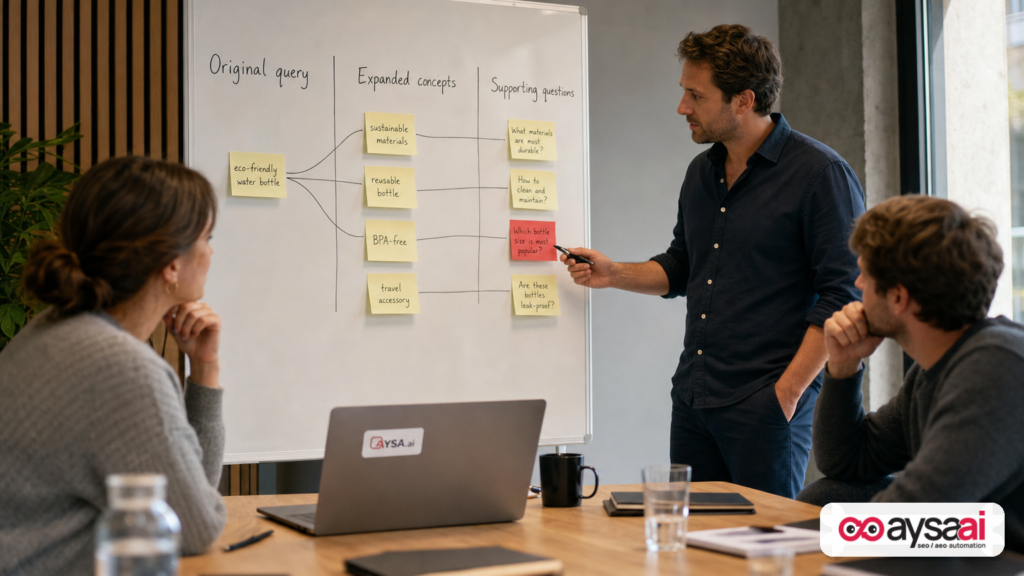
- Query expansion is Google broadening a search (synonyms, intent interpretation, related topics) so the user gets results even if they didn’t type the “perfect” words.
- AI Mode fan-outs (mentioned in Search Engine Land’s framing) are related but different: AI breaks a query into multiple sub-questions while generating an answer—then retrieves sources across those sub-questions.
- The business opportunity: Use Google Search Console (GSC) to find queries your pages already earn Impressions for, then upgrade content to better satisfy those expanded intents.
- The risk: Chasing every query creates bloated, unfocused pages and mismatched intent—traffic that doesn’t convert and brand trust that erodes.
- Where AYSA fits: AYSA continuously monitors your visibility, prepares suggested content and site changes, asks for approval, and executes the approved updates—so query expansion becomes a reliable operational workflow, not a quarterly scramble.
Table of contents
- What changed: from single-intent keywords to expanded answers
- Why query expansion matters more in the AI Overviews era
- Definitions that matter: query expansion vs. fan-outs
- How query expansion works (in plain English)
- A Search Console workflow to uncover your “accidental rankings”
- How to prioritize expansions: which queries to keep, which to ignore
- Content upgrades that capture expansion (without stuffing)
- Information architecture and internal links: the underrated multiplier
- Using query expansion to increase AI Overviews inclusion (AEO/GEO)
- The SME scenario: a local clinic that keeps losing clicks
- What agencies should rethink: deliverables, reporting, and accountability
- The AYSA approach: monitor → prepare → approve → execute
- What to do next (action list)
- Sources and further reading
The new reality: Google answers with context, not just links
Even before AI Overviews, Google wasn’t “ten blue links.” SERPs became answer-first: featured snippets, People Also Ask boxes, local packs, shopping grids, video carousels. But the underlying mental model for many businesses stayed the same: one query → one intent → one page.
AI Overviews pushes the SERP further toward an assembled response that includes definitions, supporting concepts, comparisons, and next-step recommendations. That changes the stakes for content:
- You’re competing on completeness (coverage of the topic ecosystem), not just “did I include the Keyword.”
- You’re competing on retrieval: can Google and its AI systems confidently pull your page as a supporting source?
- You’re competing on trust signals: clarity, specificity, and consistency across your site matter more when AI is stitching together answers.
Query expansion is the bridge between classic SEO and AI search. It’s Google’s long-running system for mapping language to meaning. And it’s exactly where most SMEs have blind spots.
Why query expansion matters more in the AI Overviews era
If query expansion is “old,” why spend time on it now?
Because query expansion reveals how Google already understands your content. In practice, it’s the fastest way to answer three questions that now determine visibility:
- What does Google think my page is about? (Look at the unplanned queries you get impressions for.)
- Which adjacent questions does Google believe my page can answer? (These often resemble “supporting topics” that show up in AI summaries.)
- Where am I close—but not winning? (High impressions, low clicks; top 10 but not top 3; ranking but not included in AI Overviews.)
Search Engine Land’s piece highlights the key advantage: expansion is happening whether you manage it or not. The only decision is whether you’ll use it as strategic input—or leave it to chance.
Definitions that matter: query expansion vs. fan-outs
Let’s simplify terms without overcomplicating the tech.
Query expansion (classic search behavior)
Query expansion is Google broadening or interpreting a search query so it can return relevant results even when the user’s wording is imperfect or too narrow. The Search Engine Land workflow describes expansion through:
- Synonyms (e.g., “budget” vs. “affordable”)
- Intent expansion (what the person meant, not what they typed)
- Related topic expansion (adjacent concepts based on similar searches)
That’s why a page can rank for a phrase that doesn’t literally appear on the page—Google has linked the semantics.
Query fan-outs (AI Mode behavior)
Search Engine Land distinguishes fan-outs as something that happens when AI Mode generates an answer: the system breaks the user’s question into multiple sub-questions (subqueries) and retrieves information across those threads.
You don’t need to know the internal mechanics to benefit. You need to understand the implication:
- If your page covers the supporting subtopics, it becomes a stronger candidate for retrieval.
- If your page only covers the head term, it’s easier to exclude—even if it ranks.
How query expansion works (in plain English)
Query expansion is Google doing what a good salesperson does when a customer uses vague language.
When someone says, “I need an affordable CRM,” the salesperson hears:
- Price sensitivity
- Probably a small team
- Likely wants quick setup and easy migration
- May need comparisons and best-value options
Google does a version of that. It:
- Maps words to related words (“affordable” → “budget,” “low cost,” “pricing”)
- Maps words to intents (“pricing” could mean cost, value, plan tiers, or negotiation)
- Maps queries to topic neighborhoods (implementation, migration, integrations, ROI)
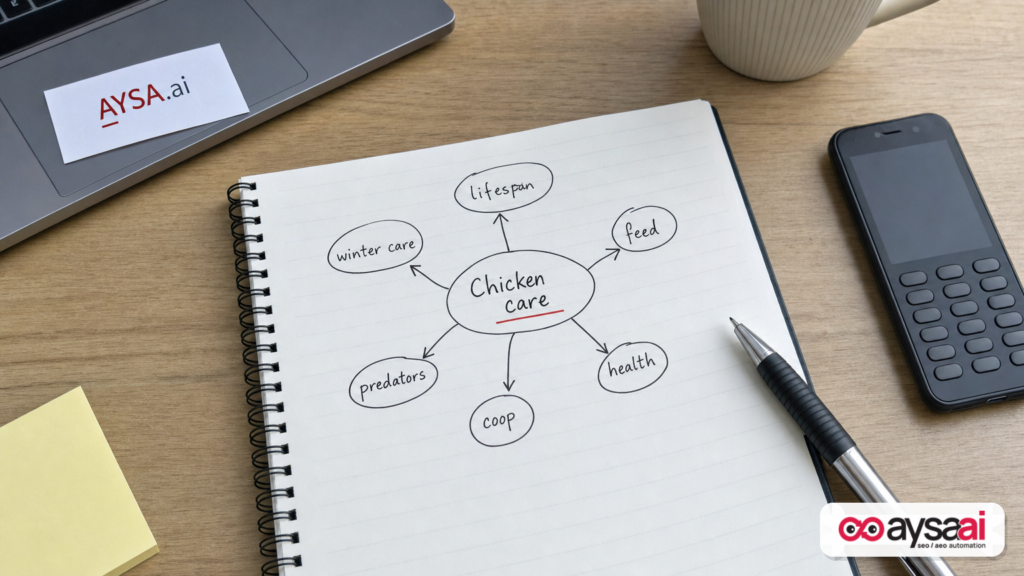
The Search Engine Land example of an article about backyard chicken care surfacing for “average lifespan of a chicken” illustrates the key point: semantic relevance can outrun literal phrase matching.
Editorial takeaway: Your content strategy shouldn’t start with “Which keyword do we want?” It should start with “Which customer questions exist around this topic—and which of those does Google already associate with us?”
A Search Console workflow to uncover your “accidental rankings”
Google Search Console is still the most honest dataset most SMEs have. It doesn’t show everything, but it shows enough to build a repeatable expansion workflow.
Search Engine Land’s suggested flow is solid. Here’s the AYSA-style operational version you can run every month (and a deeper review quarterly):
Step 1: Pick one page (not your whole site)
Start with a page that matters commercially: a service page, a category page, a lead-gen article, a “money” comparison page.
Why page-first? Because query expansion is easiest to interpret in context. Site-wide exports turn into noise fast.
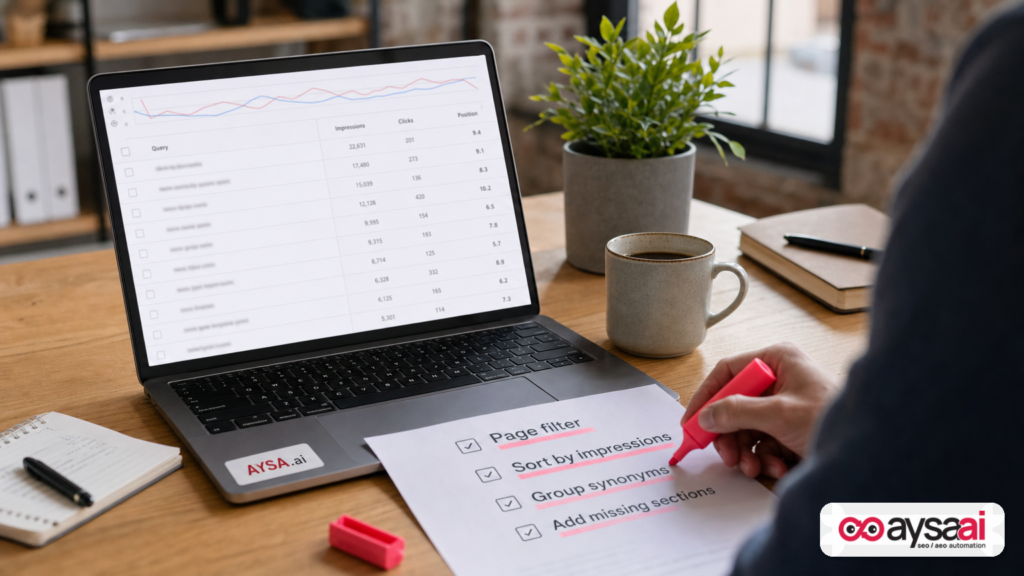
Step 2: In GSC, filter by page and pull queries
- Go to Performance → Search results
- Filter by Page (exact URL)
- Review the Queries list
(If you can’t find it, Google’s own Search Console documentation is the official place to start: Search Console Performance report.)
Step 3: Sort by impressions and flag the “non-obvious” queries
High-impression queries are Google telling you, “I consider this page potentially relevant.” Your job is to decide if Google is right.
Create a shortlist of:
- Synonyms you didn’t use explicitly but match your offering
- Question-form queries (“what is…”, “how much…”, “does … work”, “vs”)—these tend to align with AI summary behavior
- Broader category terms that suggest you’re being tested for a higher-level intent
Step 4: Classify each query into one of four buckets
- Core intent: belongs on the page; must be satisfied
- Supporting intent: belongs as a section, FAQ, comparison, definition, or short explanation
- Adjacent intent: belongs on a new page; add internal links
- Off-topic: ignore, or fix the page to reduce confusion
This is where most SEO advice stops—but it’s the part that saves you from writing bloated pages that don’t convert.
Step 5: Turn buckets into edits, not “ideas”
For each supporting query, define the minimum viable content addition:
- Add a definition block (“What does X mean?”)
- Add a comparison table (“X vs Y”)
- Add a short explainer (“Why it matters,” “How it works,” “Who it’s for”)
- Add a troubleshooting section (“Common issues,” “Symptoms,” “Fixes”)
For each adjacent query, define:
- New page brief (intent, outline, conversion goal)
- Where to link from the original page (contextual internal link)
Step 6: Validate against the SERP (carefully)
Search the query and look at what Google rewards. You’re not copying competitors; you’re checking intent signals:
- Do results skew informational or transactional?
- Do you see definitions, listicles, comparisons, local packs?
- If AI Overviews appears, what supporting concepts does it include?
Caution: Don’t claim “Google always shows AI Overviews” or that you can force inclusion. Treat it as pattern recognition, not a guarantee.
How to prioritize expansions: which queries to keep, which to ignore
Here’s the hard truth: most SMEs don’t have a traffic problem. They have an attention allocation problem.
Query expansion can explode your backlog with “opportunities.” If you pursue them without a filter, you’ll:
- Stuff pages with tangents
- Attract visitors who don’t convert
- Confuse Google about what the page is meant to rank for
Use a simple prioritization score. You can do this in a spreadsheet or your project tool.
Four filters that keep you honest
- Commercial relevance: Does this query align with how you make money (leads, bookings, sales, retention)?
- Decision proximity: Is the query early education, mid-funnel comparison, or purchase-ready?
- Content fit: Can the existing page satisfy the query without becoming a “junk drawer”?
- Authority fit: Are you a credible source for this angle, or would it be a stretch for your brand?
Red flags: expansion you should probably avoid
- High impressions but unrelated intent (Google is testing you; you shouldn’t always cooperate)
- Queries that invite legal/medical/financial risk if you can’t cover them responsibly
- “Definition” queries that belong on a glossary page, not on every service page
- Competitor-name queries that you can’t address ethically or accurately
Expansion is not permission to become generic. The goal is to become more helpful within your lane.
Content upgrades that capture expansion (without stuffing)
If you remember one thing from this article, make it this:
Query expansion rewards pages that answer the next question before the user has to ask it.
That doesn’t require 3,000 more words on every page. It requires the right 300–800 words, in the right sections, with clear formatting.
Upgrade #1: Add “meaning” and “definition” blocks where ambiguity exists
Many industries have jargon. Users search for meaning. Google expands meaning queries into broader topic sets.
Examples:
- Trucking: “tandem truck meaning” (similar to the Search Engine Land example context)
- Healthcare: “difference between urgent care and ER”
- Home services: “what is hydro jetting”
- SaaS: “SOC 2 type 2 vs type 1”
A short definition block with a plain-English explanation and one practical implication often outperforms a paragraph buried mid-page.
Upgrade #2: Add comparison sections (“X vs Y”) to catch mid-funnel expansion
Comparisons are expansion magnets because they reflect decision-making. If you’re showing up for comparison queries but not winning, the fix is often structural:
- A simple table (differences, best for, cost range, timeline)
- A “Which should you choose?” summary
- Links to deeper pages (so you don’t overload the main page)
Upgrade #3: Add adjacent-question FAQs (but keep them disciplined)
FAQ sections can help capture question-form expansions—but only when they’re curated. Three rules:
- Only include FAQs you can answer with authority
- Keep answers concise (2–6 sentences) and link to deeper sections where needed
- Avoid “SEO theater” FAQs that repeat the same answer with different wording
If your FAQs become a keyword list, they stop being helpful and start being a liability.
Upgrade #4: Add “supporting information” that increases retrieval confidence
AI Overviews and similar systems tend to prefer sources that include supporting context: definitions, steps, caveats, and clear structure.
Supporting info examples:
- Step-by-step process
- Common mistakes and how to avoid them
- Constraints (“This applies if…”, “This does not apply if…”)
- Plain-language summary for non-experts
This is not about writing like a textbook. It’s about removing ambiguity.
Upgrade #5: Update the page title and headings to reflect real demand
If GSC shows that users strongly associate your page with a synonym or a question form, consider modest adjustments:
- Add the synonym in an H2 (not five times in body text)
- Add a clarifying phrase in the title tag if it fits naturally
- Add a “What is…” section early if that intent is prominent
Don’t chase every variant; choose the ones that improve clarity for humans first.
Information architecture and internal links: the underrated multiplier
Query expansion is often a signal that your site needs better structure—not just better writing.
If your page is getting impressions for an adjacent topic, you have two choices:
- Force everything into one mega-page, or
- Create a clearer content cluster and connect it with internal links.
For SMEs, the second option is usually better. Why?
- It keeps each page focused on a single conversion goal.
- It creates a network of relevance that supports broader rankings.
- It gives AI retrieval systems more precise sources (each page answers a distinct subquestion).
Practical approach:
- Keep the main page as the “hub” (core intent).
- Create 2–6 “spoke” pages for adjacent intents (comparisons, definitions, troubleshooting, pricing details).
- Add internal links both ways, using natural anchor text.
If you’re a business owner, think of this as turning one brochure into a small, organized help center—built around how customers actually decide.
Using query expansion to increase AI Overviews inclusion (AEO/GEO)
Let’s be careful with language: nobody can promise you “AI Overview placement.” But you can absolutely improve your eligibility by aligning content with the supporting concepts AI systems look for.
Search Engine Land’s framing is the right mindset: the same semantic relationships that power expansion can influence retrieval during fan-outs.
What AI Overviews needs from sources
AI summaries are assembled from sources that:
- Answer the question directly
- Provide supporting context without contradicting themselves
- Use clear structure (headings, lists)
- Match the likely follow-up questions
So the most practical tactic is:
Cross-reference your GSC query expansions with the supporting subtopics you see in the SERP.
If your query expansion list includes terms that resemble “supporting topics,” add those sections—especially definitions, comparisons, or short explanations that make your page more quotable and extractable.
Where GEO fits (and why SMEs should care)
Whether you call it AEO (Answer Engine Optimization) or GEO (Generative Engine Optimization), the operational reality is similar: you’re optimizing content to be retrieved and cited in AI-generated answers.
Query expansion data is one of the few grounded ways to understand what Google already associates with your page—without guessing.
The SME scenario: a local clinic that keeps losing clicks
Here’s a realistic scenario I see constantly.
A local clinic has a page for “knee pain treatment.” They used to get steady traffic and a decent stream of appointment requests. Then AI Overviews appears more frequently for symptom queries. Clicks drop, even when rankings don’t move much.
The clinic assumes SEO “stopped working.” It didn’t. The SERP changed.
What Search Console often shows in this scenario
When you filter GSC by that knee pain page, you may find impressions for queries like:
- “knee pain when walking upstairs”
- “knee pain swelling no injury”
- “meniscus tear vs arthritis symptoms”
- “when to see a doctor for knee pain”
- “physical therapy for knee pain how long”
Some of those are pure informational queries. But they’re also the questions that drive real appointments—if the content builds trust and offers a clear next step.
The content upgrade (without turning the page into WebMD)
Instead of “adding keywords,” the clinic adds:
- A short “When to seek care” section (with cautious language)
- A comparison explainer (“common causes we evaluate”)
- A “What your first visit looks like” section
- Internal links to related pages (PT, imaging, sports medicine)
- A clear CTA with availability and insurance info
That’s query-expansion-driven content strategy: meet the expanded intent, then provide the conversion path the AI Overview can’t provide as effectively.
What agencies should rethink: deliverables, reporting, and accountability
Agencies that still sell “10 keywords per month” are selling a shrinking abstraction.
In a query expansion + AI Overviews world, clients don’t care about a keyword list. They care about:
- Visibility across the topic ecosystem
- Presence in AI summaries when it matters
- Qualified leads and revenue
- Operational speed: how fast can you update content when the SERP shifts?
A better deliverable: “Expansion coverage” per priority page
Instead of reporting 50 keywords, report:
- Top expansion queries by impressions
- Which ones are now covered on-page
- Which ones were split into new pages
- How internal links were updated
- What changed in clicks/leads after deployment
This is also easier to explain to non-SEO stakeholders: “We expanded your service page to answer the questions Google already associates with it.”
The accountability shift: bad content hurts more now
AI surfaces amplify mistakes. If your page is unclear, contradictory, or overly salesy, you may still rank—but you become a weaker source candidate and a weaker trust signal.
And if your site’s data and tracking are messy, you can end up optimizing the wrong pages for the wrong queries. (Search Engine Land has also been emphasizing the broader theme that “bad data” creates downstream performance issues in modern marketing operations; treat that as a strategic warning even if you’re focused on content.)
The AYSA approach: monitor → prepare → approve → execute
Most businesses don’t fail at SEO because they lack ideas. They fail because execution is fragmented:
- Search Console lives in one place.
- Content lives in docs.
- Website updates wait on developers.
- Approvals stall in email threads.
Query expansion is a perfect example of a strategy that only works when operationalized.
1) Monitor expansion signals continuously
AYSA is built for ongoing monitoring so you don’t discover shifts after three months of lost leads. Start here: AYSA Monitoring.
Monitoring should include:
- Page-level impression shifts
- New query patterns (new synonyms, new question formats)
- Pages ranking for off-topic queries (a quality/red-flag signal)
2) Prepare content and site changes tied to expansion opportunities
Once you identify expansions worth pursuing, the work is not “write more.” The work is:
- Drafting the right section (definition, comparison, steps, FAQ)
- Recommending internal links and page splits
- Improving on-page structure for extractability
AYSA’s tools and workflows are designed to support this end-to-end: AI SEO Tools.
3) Ask for approval (because brand and compliance matter)
Especially for healthcare, finance, legal, and regulated industries, “move fast and publish” is irresponsible. AYSA’s model is built around human approval: changes are prepared, then submitted for acceptance.
This is how SMEs stay safe while still moving faster than competitors.
4) Execute accepted changes on the website
The difference between strategy and growth is implementation. AYSA executes approved updates so improvements don’t die in Google Docs.
Learn how we approach AI search visibility and presence across emerging surfaces: AI Search Visibility.
What it means commercially
If you’re trying to make this repeatable, you need a system that can run monthly—not a one-off audit. AYSA is built for ongoing operation; details here: AYSA Pricing.
What to do next (action list)
- Pick 5 priority pages (services, categories, top lead-gen articles).
- In GSC, filter by each page and export queries sorted by impressions.
- Highlight 10–25 “unexpected” queries per page (synonyms, questions, broader terms).
- Bucket each query: core, supporting, adjacent, off-topic.
- For supporting queries, add sections that answer the question directly (definition, comparison, steps, FAQ).
- For adjacent queries, create new pages and link them to/from the hub page.
- Re-check after 2–4 weeks for impression and click changes; refine.
- Operationalize it: schedule a monthly expansion review and a quarterly deep refresh.
Sources and further reading
- Search Engine Land (research input): How to use Google query expansion to improve content visibility
- Google (official): Search Console Performance report
- Search Engine Land (context lead): Google Search Console AI performance reports rolling out to more users
- Search Engine Land (context lead): Google’s LLM patent suggests a new goal for SEO: Teaching AI who you are
- AYSA.ai tools: AI SEO Tools
- AYSA.ai AI search visibility: AI Search Visibility
- AYSA.ai monitoring: AYSA Monitoring
- AYSA.ai pricing: AYSA Pricing
- AYSA.ai blog: AYSA Blog
Continue the AI search topic inside AYSA.
Use these pages to connect the article with AI SEO tools, AI visibility monitoring, AI Overviews and approved website execution.
Turn this topic into a website action plan.
Use these AYSA hubs to move from reading to technical fixes, AI visibility monitoring, research, glossary context and approval-first SEO execution.