AI-Driven Personalized Search in 2026: How to Win Visibility When Everyone Sees a Different Answer
AI search is no longer about “ranking #1.” It’s about being the entity AI chooses for a specific person, in a specific moment, across text, images, video, reviews, and social signals. Here’s what changed, why SMEs are feeling it, and a practical playbook (with AYSA) to earn recommendations—not just positions.

In 2026, SEO stopped being a sport where everyone competes on the same playing field. The biggest change isn’t that AI can summarize pages. It’s that AI increasingly decides which sources to use and which brands to recommend based on the individual person asking—plus their context, preferences, and even the format of the input (text, voice, image, video).
If you’re an owner, a marketing lead, or an agency responsible for growth, you’ve probably felt the symptoms already:
- Traffic feels “unstable” even when you haven’t changed anything.
- Reports say you’re doing fine, but leads are down.
- You see competitors mentioned in AI answers where you used to rank.
- Local and review-driven queries feel harder to win with content alone.
This editorial is my practical guide to AI-driven personalized search: what changed, why it matters, what can go wrong, and what to do next—especially if you don’t have a massive content team. I’ll also explain where AYSA fits as an execution system: we monitor, prepare improvements, ask for approval, then implement accepted website changes—so you can move fast without breaking things.
Concise summary
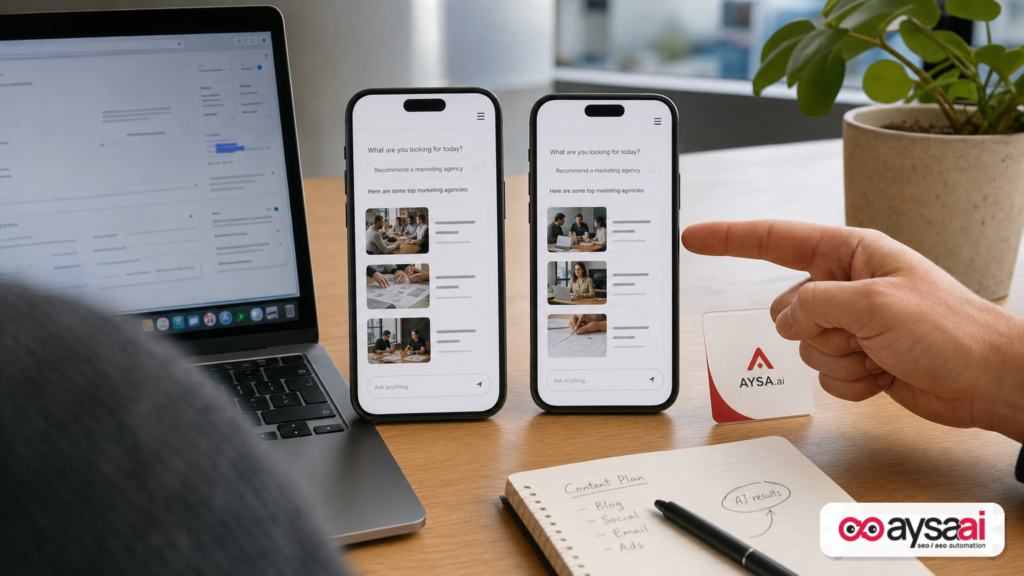
- Personalized AI search replaces universal rankings with individualized recommendations. Two people can ask the same question and get different answers.
- AI systems rely on entities, context, and multimodal signals (text + images + video + reviews + local data) to decide what to surface.
- Brand recognition and consistency matter more than “one perfect page.” Your website is necessary—but not sufficient.
- Measurement must evolve. Classic Rank tracking can’t fully represent personalized outcomes. You need visibility Monitoring across AI experiences and brand-centric signals.
- Execution becomes the moat. The winners will be the teams that can implement high-confidence improvements continuously, with governance.
Table of contents

- What changed: personalized answers over ranked links
- A short history: personalization didn’t start in 2026
- The big shift: from universal rankings to individualized recommendations
- How AI personalization works (in plain English): entities + context + multimodal signals
- The convergence of search and social: discovery happens everywhere now
- Multimodal search: every asset is searchable now
- What AI “trust” looks like: brand signals, consistency, and proof
- What can go wrong: new failure modes in AI-era discovery
- How to measure success when rankings are personalized
- The SME scenario: a local clinic (and an ecommerce store) in personalized AI search
- A practical action plan: what to do in the next 30/60/90 days
- Where AYSA fits: governed, approved execution for AI search readiness
- What to do next (checklist)
- Sources and further reading
What changed: personalized answers over ranked links

Search used to be mostly about documents. You typed a query, and a search engine ranked pages. If you improved your page, you improved your position.
AI-powered search experiences now behave differently. They try to deliver an answer (or a set of recommended options) that fits the individual. This is the core point emphasized in Search Engine Land’s guide to AI-driven personalized search: personalization now goes beyond location and language and moves toward understanding the person behind the query—using entities, context, and multimodal inputs across the web ecosystem (Search Engine Land).
That shift has two immediate consequences for businesses:
- Visibility is not uniform anymore. There isn’t one “true” SERP, one “true” AI Overview, or one “true” list of recommended businesses.
- Your competition is broader. You’re not only competing against similar pages; you’re competing against brands with stronger presence across reviews, video, community discussions, and credible third-party references.
If you’re still treating SEO like “pick a Keyword → write a page → rank → win,” you’ll keep feeling like something is wrong—even when you’re “doing the basics.” The basics are still required. They’re just no longer enough.
A short history: personalization didn’t start in 2026
We should be honest: search has been personalized for a long time. Location-based results, language preferences, device differences, and search history have influenced what people see for years. Even classic “coffee shop” queries were never truly universal.
What changed is the scope and depth of personalization. Modern AI systems can incorporate:
- Conversational history (follow-up questions that keep context)
- Multimodal inputs (images, voice, video)
- Preference signals (what you usually click, who you follow, what you save)
- Local context and reputation signals (especially reviews and consistent business facts)
Google, in particular, has been expanding AI-driven experiences like AI Overviews and AI Mode in ways that influence how results are discovered and summarized. Search Engine Land has reported on Google’s messaging that AI search features send large volumes of Clicks to websites (Search Engine Land coverage), but the bigger operational takeaway for teams is this: clicks may still exist, yet the path to being chosen is different—more contextual, more selective, and more brand-dependent.
The big shift: from universal rankings to individualized recommendations
Traditional SEO asked: “Which page best matches this query?”
Personalized AI search asks: “Which answer is best for this person right now?”
That’s a very different game.
When an AI system synthesizes an answer, it’s often blending multiple sources: your website, reviews, video transcripts, local listings, and third-party commentary. And because it’s trying to be helpful in context, it may present different options to different people—even if the underlying “topic” is the same.
For businesses, this reframes the goal:
- Less: “How do I rank #1 for one term?”
- More: “How do I become the most defensible, trusted recommendation across the contexts where my buyers search?”
Practically, it means you have to build for recommendability, not just indexability.
How AI personalization works (in plain English): entities + context + multimodal signals
If you’re not deep in SEO, terms like “entities” can sound academic. Here’s the simplest way to think about it:
Keywords are strings. Entities are things. A keyword is “best running shoes.” Entities are “Nike Pegasus 41,” “ASICS Gel-Kayano,” “overpronation,” “marathon training,” “foot pain,” “women’s size 8,” “return policy,” “a specific store in Austin,” and “a podiatrist explaining injury risk.”
AI systems increasingly try to understand the world as connected things and relationships:
- Who is the brand? (Organization entity)
- What products/services exist? (Product/Service entities)
- Where do you operate? (Place entities)
- Which experts speak for you? (Person entities, author signals)
- What proof exists? (Reviews, citations, consistent third-party references)
Then, personalization comes from context:
- Location or implied local intent
- Device (mobile “near me” behavior vs desktop research)
- Conversation history (“I told you I’m allergic to X”)
- Format (photo search, voice search, text query)
- Preference signals (what content you’ve engaged with, what you follow)
Finally, multimodal signals expand what “content” even is. Your product photo, your YouTube transcript, your podcast appearance, and your local reviews can all contribute to whether AI sees you as the best match for a person’s moment.
One of the most actionable pieces of the broader Search Engine Land ecosystem here is the focus on structured data and entity gaps. Their related piece on schema for AI search frames the practical job: identify and prioritize the missing entity connections that keep your brand from being understood confidently (Schema for AI search: entity gaps).
Entity gaps: the silent reason you’re “invisible” to AI
In my experience, most “AI visibility” problems are not magical. They’re missing connections. Examples of common entity gaps SMEs have:
- No clear organization identity: inconsistent business name variations, missing About page, unclear ownership, no editorial standards.
- Thin service definitions: services described only in vague marketing language, not as distinct offerings with scope, pricing ranges, FAQs, and outcomes.
- Weak people signals: anonymous posts, no author bios, no credentials, no consistent expert presence.
- Poor local facts: inconsistent NAP (name, address, phone), missing service areas, outdated hours.
- Unlinked assets: great videos with no transcript on-site, great PDFs that are image-only, great reviews that aren’t referenced as proof anywhere you control.
Fixing entity gaps is not glamorous, but it’s foundational. It’s also the type of work that benefits from continuous monitoring and safe execution—because details drift over time.
The convergence of search and social: discovery happens everywhere now
We need to retire the old mental model:
- Search = intent, answers
- Social = awareness, vibes
That separation is increasingly untrue. The same “discovery” moment might start on a social platform, continue in an AI assistant, and end in a map result—or the other way around.
Search Engine Land’s guide calls out the way AI systems learn from and reference content across YouTube, Reddit, LinkedIn, X, TikTok, Instagram, podcasts, and forums, while social platforms themselves increasingly function as search engines (Search Engine Land).
This matters because AI recommendations often lean on:
- Community validation (threads, discussions, Q&A)
- Creator demonstrations (short videos that prove outcomes)
- Review ecosystems (local and category-specific platforms)
Search marketers should pay attention to one more adjacent signal from the supplied research context: the ecosystem of data sources that LLMs can access is expanding. Search Engine Land has covered OpenAI/ChatGPT gaining access to Yelp reviews, ratings, and photos (Search Engine Land coverage). You don’t need to overreact, but you do need to accept the trajectory: more third-party reputation data will influence AI answers.
Operational takeaway: stop running search and social as separate teams
If your SEO team optimizes pages while your social team chases trends with no connection to the site, you’re leaking authority. AI doesn’t care about your org chart. It cares whether the brand signals align across the ecosystem.
At minimum, you need a shared “discovery plan” that covers:
- Core entities (brand, products, services, locations, experts)
- Proof assets (case studies, reviews, demos, research)
- Distribution surfaces (site + video + community + local + partners)
- Governance (who approves changes, who updates facts, who responds)
Multimodal search: every asset is searchable now
Multimodal search is a simple idea with massive consequences: AI can interpret more than text. That means more of your business outputs are “indexable” in a practical sense—even if they’re not traditional webpages.
Assets that now routinely influence discovery include:
- Images (including product photos and location photos)
- Short-form video (demonstrations, walkthroughs, before/after)
- Long-form video transcripts (YouTube content repurposed as knowledge)
- Podcasts and interviews (expert signals and quotable explanations)
- PDFs and presentations (if they contain searchable text)
- Local profiles and reviews
- Structured data that clarifies meaning
In other words: your business has a portfolio of discoverable assets, not a blog.
Search is becoming ambient (and that changes intent)
Search used to be a deliberate action. Now it’s embedded into moments:
- Voice queries while driving
- Image-based queries in a store aisle
- Conversational follow-ups without retyping context
So the right optimization question becomes: When someone needs us, can AI recognize us fast, trust us, and explain us correctly?
What AI “trust” looks like: brand signals, consistency, and proof
AI search personalization increases selectivity. When the system is choosing an answer “for you,” it can’t list 10 blue links and let you figure it out. It must decide what to highlight.
That forces a trust evaluation. In practice, AI systems lean on signals that look like:
- Consistency of facts across your site and third parties
- Depth and specificity (clear coverage, not generic summaries)
- Expert contribution (real people, credentials, accountability)
- Independent validation (reviews, mentions, citations, community references)
- Freshness where it matters (hours, availability, pricing ranges, current policies)
The Search Engine Land article connects this shift to broader reputation and credibility questions, echoing Google’s long-running emphasis on quality evaluation (commonly framed as E-E-A-T in industry conversation). Whether or not you use that acronym internally, the operational point is straightforward: AI needs reasons to trust you.
Your new goal: become a recognized entity AI can confidently recommend
In the AI era, “brand” is not just a logo. It’s the sum of connected signals that let a machine say, “I know what this company is, what they do, who it’s for, and whether it’s reliable.”
That requires:
- Clear identity (organization, leadership, contact, policies)
- Clear offerings (services/products with definitions, boundaries, FAQs)
- Clear proof (reviews, case studies, examples, third-party references)
- Clear presence (the places your customers actually look)
And yes—this still includes technical SEO. But it’s technical SEO in service of a bigger goal: machine-readable clarity.
What can go wrong: new failure modes in AI-era discovery
Personalized AI search introduces failure modes that classic SEO playbooks didn’t prepare most teams for.
1) “We ranked, but we’re not recommended”
You might still rank for a term in classic results and still not appear in AI answers. Why?
- Your page is relevant, but your brand isn’t trusted enough to be cited.
- Your content matches the keyword, but it lacks entity clarity (who/what/where).
- Your competitors have stronger proof signals (reviews, demos, credible mentions).
2) Fragmented brand reality across the web
If your hours differ across directories, your name varies across social profiles, or your product specs are inconsistent across pages, you force the AI system into guesswork. Guesswork leads to exclusion—or worse, incorrect summaries.
3) Technical debt that blocks understanding
Technical debt isn’t just about speed scores. It’s about whether your site is:
- Crawlable and indexable
- Structured with clear information hierarchy
- Accessible (alt text, transcripts, readable content)
- Consistent in canonicalization and duplicates
Search Engine Land has also discussed technical debt tradeoffs in SEO—what to fix vs. what to ignore (Search Engine Land: technical debt in SEO). In AI search, the cost of ignoring some “small” issues can rise, because AI needs clean inputs.
4) Waiting too long (“we’ll see how AI shakes out”)
“Wait and see” sounds safe, but it quietly compounds risk. If your competitors are building entity coverage, strengthening review ecosystems, and publishing credible expert content across platforms, they become the default recommendation.
Search Engine Land has highlighted the hidden cost of a wait-and-see SEO strategy (Search Engine Land: wait and see). My perspective is blunt: in personalized AI search, delay is not neutral. It’s letting the model learn the category without you.
How to measure success when rankings are personalized
If everyone can see different answers, measurement has to change. But that doesn’t mean “measurement is impossible.” It means you need a different scoreboard.
What to measure instead of (only) rankings
Here are the practical layers I recommend businesses track:
- AI visibility checks for category queries: Are you being recommended when people ask “best X for Y” in your space?
- Brand and entity coverage: Do your pages clearly define products/services, locations, people, policies, and proof?
- Content usefulness signals: Are pages solving the next question, not just the first one?
- Local and review health: Volume, recency, and consistency of reviews and business facts.
- Search Console patterns: Query mix changes, impression shifts, and page-level performance (not as “truth,” but as trend).
- Conversion quality: Leads and sales by landing page and by discovery surface, where possible.
In other words: measure recommendability, not just rank.
Why monitoring matters more than reporting
Most businesses have too many reports and not enough action. In AI-era discovery, the winning pattern is:
- Monitor signals continuously
- Generate specific improvements
- Approve the right ones
- Execute quickly and safely
- Repeat
This is exactly where a system like AYSA fits (more on that later): monitoring that leads directly to governed execution, not a backlog of “SEO tasks” that never ship.
The SME scenario: a local clinic (and an ecommerce store) in personalized AI search
Let’s make this real with two scenarios I see constantly.
Scenario A: a local clinic competing for “best dermatologist near me”
A dermatology clinic used to focus on:
- Ranking a “Dermatologist in [City]” page
- Adding some blog posts
- Collecting a few backlinks
In personalized AI search, the recommendation can depend on a broader and more human set of signals:
- Entity clarity: Do you clearly list services (acne, eczema, skin cancer screening), insurance info, and practitioner credentials?
- Local proof: Are reviews recent, detailed, and consistent with what you want to be known for?
- Multimodal helpfulness: Do you have short videos explaining procedures and aftercare? Do you provide plain-language FAQs?
- Consistency: Are your hours, phone, and address consistent across your website and profiles?
- Trust anchors: Do you show real authorship, medical review processes, and clear disclaimers where needed?
Even if the clinic “ranks,” an AI answer might recommend another clinic that has stronger proof and clearer entity coverage.
Scenario B: an ecommerce store fighting for “best carry-on for international flights”
An ecommerce brand used to focus on category pages and product pages, then chase rankings.
Now the winning assets often include:
- Product photos that AI can interpret (clear angles, context)
- Video demos (fit in overhead bin, weight test, durability test)
- Comparison pages that define the category (“international carry-on size limits”)
- Policies that remove friction (returns, warranty, shipping timelines)
- Third-party validation (press mentions, credible reviews)
And importantly: the AI answer may personalize based on user constraints (budget, airline, trip length, past preferences). If your content doesn’t map to those constraints, you’ll be skipped.
A practical action plan: what to do in the next 30/60/90 days
You don’t need to do everything at once. You need the right sequence.
First 30 days: establish clarity and fix obvious trust gaps
- Audit your brand/entity fundamentals.
- Do you have a strong About page?
- Do you clearly define what you sell and who it’s for?
- Do you have real authors/experts where appropriate?
- Fix consistency across critical surfaces.
- Business name, address, phone, hours, service areas
- Policies: shipping/returns, booking/cancellation, warranty
- Choose 10 “money queries” that represent your category.
- Not just keywords—real decision questions customers ask.
- Example: “best [service] for [situation]”, “how much does [service] cost”, “what’s the difference between X and Y”.
- Set up monitoring that leads to action.
- Use a system like AYSA to monitor and propose changes you can approve and deploy: AYSA Monitoring.
Next 60 days: close entity gaps and build proof assets
- Prioritize “entity gap” fixes.
- Add/strengthen structured information where it clarifies reality.
- Connect services/products to FAQs, pricing guidance, and examples.
- Use schema where appropriate (and validate carefully). For research direction on this topic, see: Search Engine Land: schema and entity gaps.
- Create 3–5 “proof-first” assets.
- A case study (even a small one)
- A comparison guide
- A short demo video with transcript
- A visual FAQ (images that answer questions)
- Upgrade your content for follow-up questions.
- AI search is conversational. Your pages should anticipate the next step.
- Add “Who this is for,” “When not to choose this,” and “What to do next.”
By 90 days: build a repeatable engine (and governance)
- Formalize your discovery operating model.
- One owner for entity data (facts)
- One owner for proof assets (reviews, case studies, demos)
- One owner for technical hygiene
- A clear approval workflow so changes ship weekly, not quarterly
- Expand to the channels that match your category.
- You don’t need to be everywhere. You need to be where customers seek validation.
- For many categories: video + reviews + one community surface outperform “more blog posts.”
- Track outcomes tied to business value.
- Leads, calls, bookings, revenue—mapped to content and surfaces
- AI visibility monitoring for your priority category questions
Where AYSA fits: governed, approved execution for AI search readiness
Most teams don’t fail because they don’t know what to do. They fail because:
- Recommendations pile up in a backlog.
- Engineering is busy.
- Changes feel risky.
- No one owns the approvals.
AI-era SEO/AEO/GEO is more iterative than classic SEO. You need to improve, validate, and ship continuously—without breaking your site or your brand voice.
That’s the gap AYSA is built to close.
AYSA’s model in this context
- Monitor what matters for AI discovery and site health: AYSA Monitoring
- Prepare recommended changes (content, technical, structured clarity) tied to visibility outcomes.
- Ask for approval so you retain governance—no “black box” changes.
- Execute accepted changes safely and consistently, so strategy becomes reality.
If you’re specifically trying to understand whether AI assistants recommend your brand in your category, start here: AYSA AI Search Visibility. If you need tools to support AI SEO work across the board: AYSA AI SEO Tools.
Why approval-based execution is the competitive advantage
AI search increases the pace of change. But most businesses—especially SMEs—cannot afford reckless edits. Compliance, brand accuracy, medical/legal nuance, pricing, and operational constraints are real.
Approval-based execution gives you the speed of automation with the safety of human governance. In practice, that means:
- Fewer “SEO experiments” that accidentally create liability
- Faster improvements to pages that drive revenue
- Consistency across teams and vendors
- A repeatable cadence that compounds over time
If you want to explore how this maps to your business size and needs, see: AYSA pricing. For more playbooks and editorial guidance, browse: AYSA blog.
What to do next (action list)
- Pick your category battles. Identify 10 decision queries that represent real buying intent.
- Run an entity clarity audit. Can a machine clearly understand who you are, what you sell, where you operate, and why you’re credible?
- Fix inconsistencies. Business facts, policies, product specs, service definitions—make them match everywhere.
- Build 3 proof assets. A demo video, a comparison guide, and a case study outperform another generic blog post.
- Make your content multimodal-ready. Add transcripts, alt text, and accessible, scannable structure.
- Set up monitoring + execution. Use AYSA Monitoring and tie it to an internal approval workflow.
- Track recommendation visibility, not just rank. Start with AI Search Visibility and build a quarterly improvement cadence.
Sources and further reading
- Search Engine Land: AI-driven personalized search: A practical guide
- Search Engine Land: Schema for AI search: How to identify and prioritize entity gaps
- Search Engine Land: Google says AI Search features send billions of clicks to websites each week
- Search Engine Land: ChatGPT gains access to Yelp reviews, ratings, and photos
- Search Engine Land: Technical debt in SEO: When to fix vs. when to ignore
- Search Engine Land: The hidden cost of a ‘wait and see’ SEO strategy
Note: This article uses the Search Engine Land guide as research input and builds an original AYSA.ai editorial perspective and playbook. Where broader claims would require primary documentation beyond the supplied research context, I’ve framed them as analysis rather than stating them as fact.
Continue the AI search topic inside AYSA.
Use these pages to connect the article with AI SEO tools, AI visibility monitoring, AI Overviews and approved website execution.
Turn this topic into a website action plan.
Use these AYSA hubs to move from reading to technical fixes, AI visibility monitoring, research, glossary context and approval-first SEO execution.