Google’s Enhanced Brand Lift Studies: What the “Pay More for Sensitivity” Shift Means for Your Marketing Measurement (and How to Act on It)
Google is expanding Enhanced Brand Lift Studies, offering more sensitive lift detection—if you can justify roughly 3x the budget. Here’s what changed, who should use it, where it can mislead, and how to turn brand lift into an execution plan across search, AI visibility, and on-site improvements with AYSA.

Google is expanding access to a more sensitive version of Brand Lift Studies in Google Ads. On paper, the change is simple: you can now choose Standard or Enhanced measurement, and enhanced can detect smaller lifts—but it costs significantly more budget to run.
In practice, this is a bigger story about where paid media is headed in 2026: platforms want you to spend more not only to reach people, but to prove you reached them in a way that moved brand perception. That proof can be valuable—especially as AI-driven search, recommendation engines, and “answer-first” experiences compress the path from awareness to decision. But it can also become a very expensive way to confirm what you can’t operationalize.
I’m Marius Dosinescu, and at AYSA.ai we focus on the part most teams struggle with: turning marketing signals into approved, high-confidence website changes that improve search visibility—across classic SEO and emerging AI Search (AEO/GEO). In this editorial, I’ll break down what changed, why it matters, where it can mislead, and how to build an execution loop that makes brand measurement worth paying for.
Concise summary
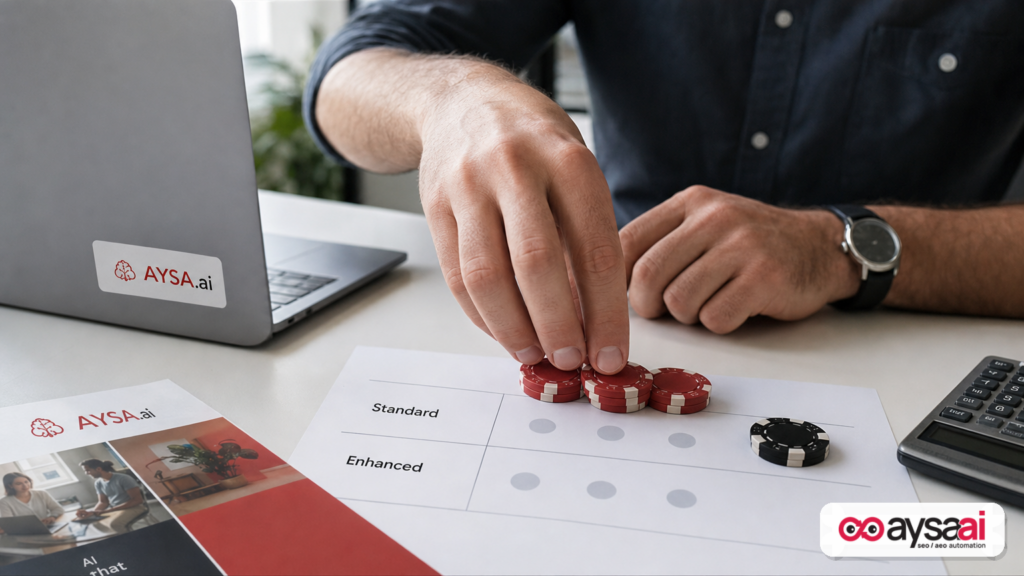
Google Ads now offers two Brand Lift Study options: Standard and Enhanced. Enhanced measurement is designed to detect smaller changes in brand metrics (awareness/consideration, depending on study design) but requires meaningfully higher spend. If you’re running sizeable upper-funnel campaigns, this can improve decision confidence. If you’re an SME with limited budget, you should treat it as a tool for specific moments (launches, creative pivots, expansion) rather than a default setting—and you should pair it with an Execution Plan that changes your creative, targeting, landing pages, and organic/AI Search Presence.
Table of contents
- Key takeaways (executive summary)
- What actually changed in Google Ads Brand Lift Studies
- Why Google is pushing harder on brand measurement now
- The measurement tradeoff: sensitivity vs. cost vs. decision value
- Who should pay for Enhanced Brand Lift (and who shouldn’t)
- What Brand Lift can tell you (and what it can’t)
- How Brand Lift Studies go wrong: common failure modes
- Triangulate: the minimum measurement stack to pair with Brand Lift
- A concrete SME scenario: local clinic scaling awareness without wasting budget
- What agencies should rethink: governance becomes a competitive advantage
- How AYSA fits: turning brand measurement into an execution loop
- What to do next (action list)
- Sources and further reading
Key takeaways (executive summary)
- Enhanced Brand Lift is about detecting smaller changes. Google’s new option is positioned as more sensitive than the standard study, which matters when your campaign effect is real but modest.
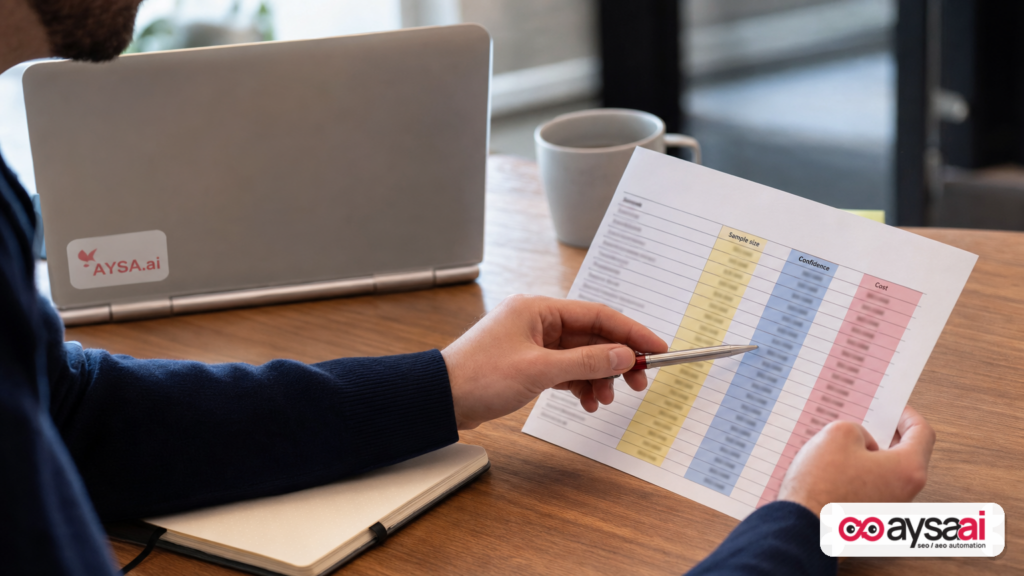
- You’re trading budget for statistical confidence. Google indicates enhanced studies require ~3x the budget, in exchange for a higher chance of detecting a lift.
- This is not “free accountability.” Better measurement doesn’t automatically mean better outcomes—only better visibility into whether your creative and media plan are moving perception.
- Brand lift is most useful when you’ve planned what you’ll change. Before you spend more for sensitivity, define the decisions you’ll make based on outcomes (creative, landing pages, audience, messaging, offers).
- SMEs can still win without enhanced studies. If you can’t justify the budget, you can approximate learning via a simpler triangulation stack (branded demand, direct/returning behavior, geo or time-based testing), then invest in execution.
- AYSA’s advantage is execution with governance. Use measurement insights to generate an approved backlog of site changes that improve both traditional SEO and AI search visibility. AYSA monitors, prepares recommendations, asks for approval, and executes accepted changes: AYSA Monitoring.
What actually changed in Google Ads Brand Lift Studies
According to Search Engine Land, Google is expanding Brand Lift Studies with a new Enhanced measurement option, giving advertisers a choice between:
- Standard Brand Lift: designed to measure larger lifts (the source reports 2%+).
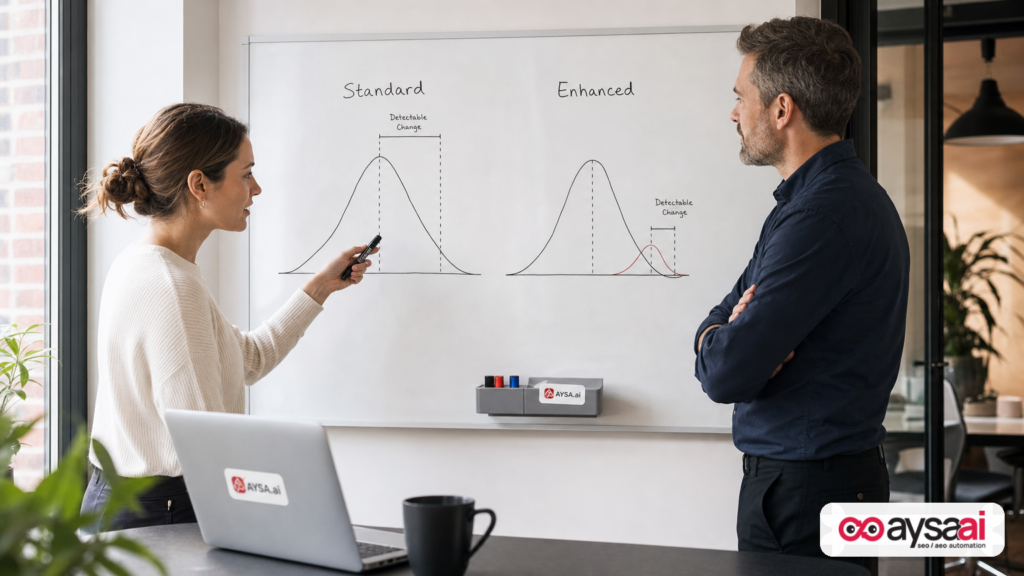
- Enhanced Brand Lift: designed to detect smaller lifts (the source reports as low as 1.2%).
The same Search Engine Land coverage notes that enhanced measurement requires approximately three times the budget, but increases the likelihood of detecting a positive lift (reported as a 60% improvement in detection likelihood). You can read the original report here: Search Engine Land – Google expands Brand Lift Studies with enhanced measurement option.
Those numbers are important, but don’t over-focus on them. The real business question is: what decisions become possible when you can reliably detect smaller lifts? If your organization can’t or won’t act on a 1–2% shift in a brand metric, the extra sensitivity might be academic.
Where this lives in your workflow
Brand Lift Studies are typically relevant for upper-funnel formats and outcomes—think YouTube campaigns, broader reach initiatives, and messaging tests where last-click conversions are an incomplete story. In many organizations, brand lift also becomes the bridge between the media team and the leadership team: it’s an attempt to quantify “Did people care more?” rather than “Did people click?”
Why Google is pushing harder on brand measurement now
This update is consistent with a broader trend: platforms are under pressure to prove incrementality and to justify spend that isn’t immediately conversion-oriented. Three forces are driving that pressure:
1) AI search compresses discovery and reshapes brand demand
As AI-driven experiences grow, users often jump from a vague need to a shortlist quickly. That changes how “brand” forms: less via repeated SERP Clicks, more via summaries, recommendations, and social proof. Even Google itself has been publicly emphasizing that AI search features still send clicks to the web at large scale (see: Search Engine Land coverage). Whether or not your traffic mix changes, what’s clear is that visibility and perception upstream matters—and marketers want ways to measure that.
2) Ads automation is increasing, so governance matters more
Campaign automation can accelerate outcomes, but it can also make it harder to answer basic questions like: “What caused the improvement?” or “Are we paying for demand we would have gotten anyway?” The practical response is governance and better measurement. Search Engine Land has been highlighting how Google Ads automation makes governance a competitive advantage: Google Ads automation makes governance a competitive advantage.
3) The industry is moving from reporting performance to proving impact
In many companies, marketing is being asked to defend budget with more than platform-reported conversions. Brand Lift is one of Google’s answers: it’s a way to quantify changes in awareness, consideration, and other brand outcomes that sit earlier than the purchase event.
My point of view: this is directionally good. But it’s also a reminder that measurement is becoming a paid feature. If you want more certainty, you’ll increasingly need either more spend (to get adequate sample size) or better experimentation discipline (to reduce noise). Usually, the right answer is a combination of both.
The measurement tradeoff: sensitivity vs. cost vs. decision value
Let’s translate “enhanced measurement” into business terms.
Sensitivity: what changes can you detect?
When Google positions Enhanced Brand Lift as detecting smaller lifts, they’re essentially saying: we can reduce the minimum detectable effect. In normal experimentation language, that means you’re increasing statistical power by increasing sample size (more spend → more reach/exposure → more survey responses → tighter confidence intervals).
That’s useful when you’re operating in markets where:
- Lift is inherently small (mature category, lots of competition).
- Your creative changes are subtle (message nuance, not a new product).
- You need confidence to make high-stakes budget shifts.
Cost: what else could that budget do?
The hidden cost isn’t only “3x budget.” It’s the opportunity cost of what you could do with that extra money:
- Run a stronger creative test (more variants, clearer winner).
- Improve landing pages (clarity, trust signals, pricing transparency, FAQs).
- Invest in organic search and AI search visibility so your brand shows up when people research you later.
- Fund a geo experiment or incrementality test alternative.
Decision value: will this change what you do on Monday?
Here’s the harsh truth: many organizations buy measurement they won’t act on. If you run Enhanced Brand Lift and it shows a small positive lift, what changes? If it shows no detectable lift, what changes? If you can’t articulate that, you’re buying reassurance, not learning.
I like to force a simple pre-commitment question:
- If Enhanced shows lift and Standard would not: what will we scale or repeat?
- If Enhanced shows no lift: what will we stop, change, or rebuild?
Who should pay for Enhanced Brand Lift (and who shouldn’t)
Enhanced Brand Lift is not “better” in the abstract. It’s better for specific situations.
Good candidates for Enhanced Brand Lift
- Large awareness flights with high fixed costs. If you’re already spending enough that the incremental 3x budget is still within a planned brand investment window, enhanced sensitivity can reduce ambiguity.
- New market expansion. When entering a new region or audience segment, small differences matter early—and you can’t lean on historical benchmarks.
- Creative repositioning. If you are changing messaging (e.g., “premium” vs “value,” “fast” vs “trusted”), small lift differences can predict downstream performance.
- Leadership demands proof. If brand budget is under scrutiny, a more confident read can be politically useful—provided you don’t oversell it.
When Enhanced Brand Lift is likely a bad deal
- SMEs with tight budgets and obvious execution gaps. If your website messaging is unclear, your reviews are weak, or your category pages are thin, put money into fixing that first.
- Short or fragmented campaigns. If you can’t sustain consistent creative and targeting long enough, you’ll buy noise.
- When your next decision is already made. If leadership is going to spend the same regardless of lift, measurement becomes ceremonial.
What Brand Lift can tell you (and what it can’t)
Brand Lift Studies are designed to measure changes in brand-related metrics (commonly awareness, ad recall, consideration, or intent) by comparing exposed vs. control groups. Conceptually, this is closer to experimentation than attribution—but it’s still not a perfect window into incrementality.
What it can tell you
- Directional impact of creative and messaging. Did people exposed to the ads report different perceptions than those not exposed?
- Whether upper-funnel is doing anything at all. In some categories, awareness campaigns are run on faith. Lift provides a reality check.
- Relative comparisons. Variant A vs. variant B, audience 1 vs. audience 2—when designed well, lift can help prioritize.
What it can’t tell you (without additional work)
- Profit impact. A lift in consideration doesn’t automatically mean incremental revenue.
- Long-term brand equity. Short-term perception shifts may fade quickly.
- Cross-channel causality. Lift is platform-specific unless you design a broader experiment.
So treat Brand Lift like a signal, not a verdict.
How Brand Lift Studies go wrong: common failure modes
If you’re going to pay more for sensitivity, you also need to pay more attention to rigor. Here are failure modes I see across the industry (and the ones most likely to waste your 3x budget):
1) Creative confounds (too many things changed)
If you change the offer, the landing page, the audience, and the creative at the same time, lift results become impossible to interpret. You might detect a difference, but you won’t know what caused it.
2) Audience overlap and frequency problems
If your targeting is too broad and your frequency is inconsistent, you can create a messy exposure pattern where some users get hammered and others barely see the ads. That can distort perceived lift and can also cause fatigue (which can reduce lift even if the creative is strong).
3) Seasonality and market noise
Running a lift study during a major holiday, a competitor’s big promotion, or a news cycle relevant to your category can create external shifts that drown out your effect. Enhanced sensitivity can’t fix bad timing—it can only detect smaller differences within the noise you allow.
4) Weak messaging (the “it’s fine” creative)
Many campaigns aren’t designed to create lift; they’re designed to look acceptable in a brand review. If your creative doesn’t clearly communicate differentiation, lift is likely to be small or inconsistent. Paying more to detect a tiny lift can become a trap: you’ll prove the campaign was “slightly positive” instead of confronting that it was unremarkable.
5) Measuring the wrong question
Sometimes you shouldn’t be measuring “awareness.” You should be measuring “trust,” “fit,” or “category association.” If the question is misaligned with the business problem, enhanced sensitivity just gives you a more precise answer to the wrong question.
Triangulate: the minimum measurement stack to pair with Brand Lift
Whether you use Standard or Enhanced Brand Lift, you’ll make better decisions if you triangulate across a few additional signals. The goal isn’t to create a data swamp. It’s to prevent one study from becoming your only “truth.”
1) Branded demand signals
Brand campaigns should often move some form of branded intent over time. That may show up as:
- Branded searches and brand+category queries in Google Search Console (if you have access).
- Direct traffic trends (carefully interpreted).
- Growth in returning visitors.
These signals are imperfect, but they help answer: “Did anything change outside the ad platform?”
2) On-site behavior quality
If awareness increases, the next question is: when people arrive, do they understand you? Monitor:
- Landing page engagement (scroll depth, time on page—interpreted cautiously).
- Path to key pages (pricing, reviews/testimonials, product/category pages).
- Lead quality or assisted conversion paths where possible.
3) AI search visibility (AEO/GEO readiness)
This is the part most teams still underestimate. If your brand campaign works, people will research you later—often through AI-assisted search experiences or “best X for Y” style queries. If AI systems can’t confidently describe your business, your paid awareness leaks value.
This is where AYSA fits naturally: use AYSA AI Search Visibility to monitor whether your brand is being surfaced for the questions customers actually ask, then turn gaps into approved website improvements.
4) Simple experiments you can afford
If enhanced lift is too expensive, consider designs that create clearer comparisons:
- Geo split (test region vs control region) where operationally feasible.
- Time split (on/off flights) with careful controls.
- Creative A/B with stable targeting and offers.
None of these are perfect, but they can be good enough to make decisions—especially if you pair them with on-site execution improvements.
A concrete SME scenario: local clinic scaling awareness without wasting budget
Let’s make this real with a scenario I see often.
Scenario
A local dermatology clinic has two growth goals:
- Fill appointment capacity for higher-margin services (cosmetic procedures).
- Build a stronger premium perception versus cheaper competitors.
They run YouTube and paid search campaigns. Conversions exist, but the founder is skeptical: “Are we just paying for people who would have found us anyway?”
Where Enhanced Brand Lift might help
If the clinic is already investing meaningfully in video and wants to test messaging like:
- “Board-certified, safety-first” vs.
- “Natural results, premium experience”
…a more sensitive lift study could help detect which message increases consideration, even if the difference is subtle.
Why it might still be the wrong first move
But here’s the catch: if the clinic’s site doesn’t clearly explain procedures, pricing ranges, outcomes, recovery expectations, and trust signals, then even a successful awareness campaign will leak value. People will research, fail to get clarity, and bounce—then choose a competitor that answers the questions better.
So the clinic’s best path often looks like this:
- Run Standard Brand Lift (or no lift study yet) while tightening creative basics.
- Fix the on-site decision journey (service pages, FAQs, proof, reviews, before/after galleries where appropriate and compliant).
- Monitor AI search visibility for “best dermatologist for acne scars,” “laser resurfacing recovery,” “Botox natural look,” and similar intent questions.
- Then upgrade measurement (Enhanced Brand Lift) once the site can convert the new demand you create.
This sequencing matters. Enhanced measurement is a multiplier on competence. If your fundamentals are weak, it mostly measures how consistently you underperform.
What agencies should rethink: governance becomes a competitive advantage
If you run paid media for clients, Enhanced Brand Lift pushes you into a new posture. Clients will increasingly ask:
- “Is this awareness spend actually working?”
- “If it is working, why aren’t we seeing it in revenue?”
- “If it’s not working, what exactly should we change?”
The agency that wins won’t be the one with the fanciest report. It’ll be the one with the clearest governance model—what gets tested, what gets changed, what gets paused, and how insights become execution.
This aligns with Search Engine Land’s broader theme that governance is becoming a competitive advantage in Google Ads automation (source). Enhanced Brand Lift makes that more true, because now you can spend more to measure more—but you can also spend more to learn nothing if your process is weak.
How I’d change agency reporting
- Stop presenting lift as a win/loss trophy. Present it as a decision input with next actions.
- Separate “platform learning” from “business learning.” Platform studies are useful, but you need corroboration.
- Create a measurement charter. Document the hypothesis, the primary metric, the expected effect size, and the decision rule.
The uncomfortable truth: inconclusive results happen
Even with enhanced sensitivity, you will sometimes get inconclusive outcomes. Your job is to build a system where inconclusive doesn’t mean “we wasted money.” It means “we reduced uncertainty and discovered what not to scale.” That’s a governance skill, not a platform feature.
How AYSA fits: turning brand measurement into an execution loop
Brand Lift tells you whether perception moved. It rarely tells you why it moved, and it almost never tells you how to turn that into compounding growth across channels.
That’s the gap AYSA is built to close.
From lift results to website actions
When you learn that a message increases consideration—say “fast installation” or “premium materials”—you need the site to reinforce it. Otherwise you create cognitive dissonance: the ad promises one thing, the site proves nothing.
AYSA helps operationalize that reinforcement by:
- Monitoring your site’s SEO/AEO signals and performance indicators: AYSA Monitoring
- Preparing improvements that align content, structure, and technical signals with what users (and AI systems) need to understand your brand.
- Requesting approval before making changes—so teams maintain governance and control.
- Executing accepted changes so work doesn’t die in a spreadsheet or backlog.
Brand measurement meets AI search visibility (AEO/GEO)
The future “brand funnel” often looks like this:
- User sees your ad (awareness).
- User asks an AI-assisted search question about your category (research).
- User receives a shortlist and comparison (evaluation).
- User visits your site or converts through a lead form (action).
If step 2–3 fails because AI systems can’t confidently represent your brand, your paid awareness underperforms. That’s why it’s rational to pair brand lift measurement with ongoing AI search visibility monitoring: AI Search Visibility.
An execution system, not another dashboard
Most SMEs don’t need more charts. They need a system that translates learning into action. If you want to explore how AYSA approaches this across SEO and AI visibility, start here: AI SEO Tools.
And if you need to sanity-check whether AYSA fits your scale and workflow, pricing is transparent: AYSA Pricing.
What to do next (action list)
If you’re an advertiser or agency deciding whether to use Enhanced Brand Lift, use this action plan to avoid paying for measurement that doesn’t change outcomes.
1) Write a one-page measurement brief (before you spend)
- Hypothesis (what do we believe will happen?)
- Primary metric (what lift question are we asking?)
- Minimum decision threshold (what change is “worth acting on”?)
- Decision rule (if lift is positive/neutral/negative, what do we do?)
2) Decide if you’re ready for Enhanced
- Do you have stable creative and targeting for the test window?
- Are you large enough that 3x budget won’t starve other critical work?
- Do you have at least two meaningful next actions you’re willing to take?
3) Fix the “leaky bucket” on your site first
Before you invest in detecting small lifts, ensure your site can capture the demand you create:
- Clear value proposition and differentiation
- Trust signals (reviews, credentials, policies)
- Fast mobile experience and clean information architecture
- FAQ content that matches real customer questions
If you want a structured system to monitor and execute improvements with approval, start with AYSA Monitoring: AYSA Monitoring.
4) Pair Brand Lift with triangulation metrics
- Branded demand trends (Search Console queries where available)
- Direct and returning traffic trends (careful interpretation)
- Landing page engagement and lead quality indicators
5) Connect learnings to AI search readiness
Monitor whether your brand appears when users ask category questions—because that’s often where brand campaigns cash out later. Track and improve with: AI Search Visibility.
6) Build an “Approved Execution” backlog
Every lift study should result in a small backlog of approved actions. Examples:
- Update above-the-fold messaging to match the creative that lifted consideration.
- Add comparison pages or FAQs that answer the objections implied by low lift.
- Strengthen category framing: the words you use to describe what you are and who you’re for.
- Improve internal linking so high-intent pages are easier to reach.
Then execute. If execution lags, measurement becomes performative.
7) Document what you learned and reuse it
Brand measurement is expensive. Your “learning asset” should compound:
- Turn winning messages into site copy, FAQs, and sales scripts.
- Use losing messages to define what not to say (and why).
- Keep a creative-and-messaging knowledge base so you don’t retest the same idea every quarter.
If you want more practical editorials like this, see the AYSA blog: AYSA Blog.
Sources and further reading
- Search Engine Land: Google expands Brand Lift Studies with enhanced measurement option
- Search Engine Land: Google Ads automation makes governance a competitive advantage
- Search Engine Land: Google says AI Search features send billions of clicks to websites each week
- Search Engine Land: How to prepare for Google’s DSA sunset and move to AI Max
- Search Engine Land: Google says AI Max unlocks billions of new monetizable searches
- Search Engine Land: AI-driven personalized search: A practical guide
Note: The Search Engine Land report references Google’s statements about budgets and sensitivity. For teams that require primary documentation, consider confirming the latest product details directly inside your Google Ads account help resources or through your Google representative. I’m not adding additional claims beyond the supplied research context.
Continue the AI search topic inside AYSA.
Use these pages to connect the article with AI SEO tools, AI visibility monitoring, AI Overviews and approved website execution.
Turn this topic into a website action plan.
Use these AYSA hubs to move from reading to technical fixes, AI visibility monitoring, research, glossary context and approval-first SEO execution.