
AI Search Isn’t Replacing SEO—It’s Requiring Better SEO: A Practical Playbook for Getting Cited, Chosen, and Found
AI answers are built on retrieval, structure, and trust—meaning technical SEO and information architecture are now your eligibility layer for AI visibility. Here’s what changed, why it matters, and a step-by-step execution plan (with AYSA) to earn citations and demand in AI-driven search.

By Marius Dosinescu, AYSA.ai
AI-driven search is forcing an uncomfortable truth into the open: most websites were never built to be retrieved, understood, and cited by machines at scale. They were built to look good, publish frequently, and hope Google figured it out.
That era is ending. Not because SEO is dead—but because SEO is becoming the entry ticket to visibility in AI answers.
When search engines and AI assistants produce an answer directly on the results screen, the “winner” isn’t just the page that ranks. It’s the page the system can reliably fetch, parse, trust, and quote. That’s a technical and information architecture problem first, a copywriting problem second.
This editorial is inspired by and builds on a clear thesis from Search Engine Journal: AI Search Is Nothing Without SEO & It Knows It. I’m going deeper than the headline and turning the idea into an execution-grade playbook for SMEs, ecommerce teams, and agencies—without hype, without “prompt tricks,” and without pretending we can measure what we can’t.
Concise Summary

AI answers are usually produced through a pipeline that looks like this: crawl/index → retrieve relevant documents → generate a response. If your content isn’t cleanly indexable, semantically structured, and unambiguous about what it means, you will struggle to appear in AI citations and AI-driven discovery—no matter how often you publish.
The biggest change is that Technical SEO is no longer “maintenance.” It’s now AI Search infrastructure. And infrastructure requires Monitoring, governance, and consistent execution—not occasional audits.
Key Takeaways (Read This If You Only Have 2 Minutes)
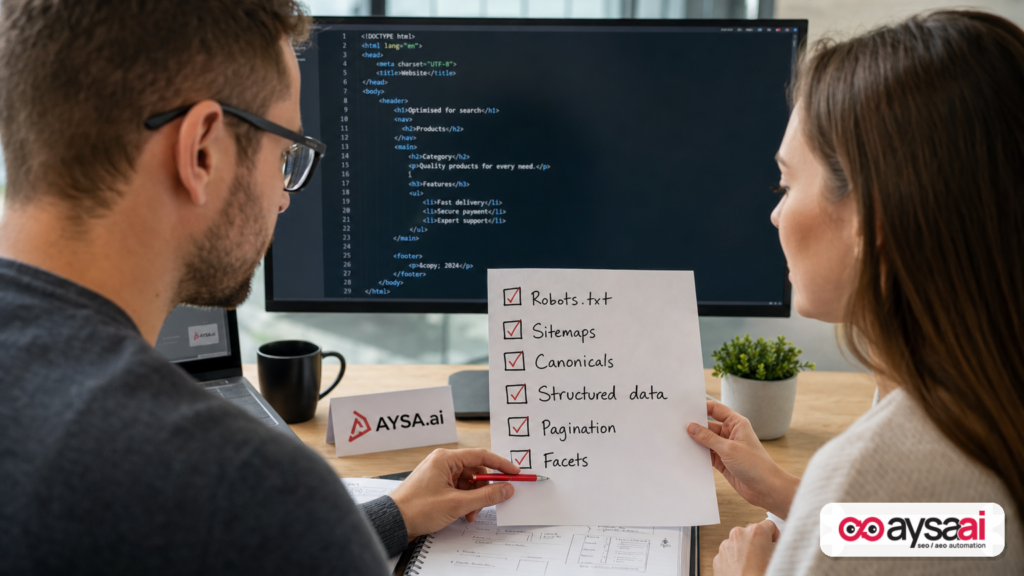
- AI search depends on retrieval. Large language models generate text, but AI search products ground answers using retrieved documents. If your site is difficult to crawl, messy to index, or confusing to parse, you’re not reliably “eligible.”
- GEO/AEO doesn’t replace SEO. It increases the value of SEO fundamentals: clean architecture, Entity Clarity, and structured content that can be extracted safely.
- Visibility is splitting into two goals: (1) being retrieved and cited in AI answers, and (2) being the chosen brand when the user decides to act.
- Traffic may drop while outcomes improve. AI summaries compress Clicks. Your job is to protect qualified demand and conversions, not nostalgia metrics.
- Execution speed matters. The best strategy is worthless if fixes wait months in a dev backlog. That’s where AYSA fits: monitor, propose, request approval, and execute accepted changes.
Table of Contents

- What Changed: From “Ten Blue Links” to Retrieval + Synthesis
- Why SEO Still Powers AI Search (Even If the Interface Changed)
- The New Eligibility Layer: Technical SEO as AI Search Infrastructure
- RAG, Grounding, and Why Machines Need Your HTML to Make Sense
- Entity Signals & Trust: How to Be the Brand AI Can Safely Recommend
- Why “AI Content” Stopped Working (And Why Structure Matters More Than Volume)
- AEO/GEO Playbook: How to Win Citations Without Chasing Hacks
- Local, Ecommerce, SaaS: What Changes by Business Model
- Measurement in the AI Era: What to Track When Clicks Get Compressed
- What Can Go Wrong (And How to Avoid Invisible Failures)
- Where AYSA Fits: Approved Execution for AI Search Readiness
- 90-Day Action Plan: From Technical Cleanup to AI-Ready Growth
- What to Do Next
- Sources and Further Reading
What Changed: From “Ten Blue Links” to Retrieval + Synthesis
Search used to be a referral engine. You searched, got a list of links, and clicked through. That model created a fairly clean incentive: rank higher, earn more clicks, convert.
Now, the interface increasingly behaves like a destination. AI answers summarize, compare, and recommend inside the search experience. Even when they cite sources, they can satisfy intent before a click happens.
The practical result for businesses isn’t philosophical. It’s operational:
- Visibility is no longer only about ranking. It’s about being selected as input to the answer.
- Content value is shifting toward extractability. If the system can’t cleanly extract the relevant passage, it won’t cite you.
- SEO work moves “down the stack.” The boring parts—indexing, structure, canonicalization, internal linking—suddenly become the high-leverage parts.
Search Engine Journal’s editorial makes the key point: as AI search products depend on structured, accessible information, SEO becomes foundational—not optional. Read the original perspective here: SEJ: AI Search Is Nothing Without SEO & It Knows It.
Why SEO Still Powers AI Search (Even If the Interface Changed)
A common misconception is that “LLMs replaced search.” In reality, most AI search experiences still need an information retrieval layer. The model can generate fluent language, but it needs current, credible documents to ground answers, reduce hallucinations, and cite sources.
So what does “SEO” mean in this world?
- SEO is how content becomes indexable. Crawlers need to access it, render it, and understand it.
- SEO is how content becomes interpretable. Semantic HTML and clean information architecture reduce ambiguity.
- SEO is how content becomes attributable. Clear entities, authorship, and source relationships support citation.
If AI summaries are the front end, SEO is still the back end.
And that means “GEO/AEO” isn’t a replacement discipline. It’s an additional set of outcomes we want from the same underlying system: a technically sound, well-structured website that machines can trust.
The New Eligibility Layer: Technical SEO as AI Search Infrastructure
In the classic SEO era, technical work was often treated like a periodic cleanup: fix the crawl issues, update the sitemap, resolve redirects, and move on.
In AI search, technical SEO becomes an eligibility layer—a set of conditions that determine whether your content can reliably participate in retrieval and citation.
Here are the technical foundations that matter more now, not less:
1) Crawlability and renderability
AI retrieval systems can’t cite what they can’t fetch. Practical implications:
- Make sure important content isn’t blocked by robots directives or hidden behind scripts that fail in headless rendering environments.
- Ensure consistent HTTP status codes and avoid “soft 404” patterns (pages that look like content but behave like errors).
Primary reference: Google’s own documentation remains the most reliable north star on how crawling works—start with Google Search Central: Crawling and indexing.
2) Index hygiene (canonicalization and duplicates)
AI retrieval loves clarity. Duplicate pages, parameterized URLs, and inconsistent canonicals create multiple near-identical “truths.” That introduces uncertainty:
- Which URL is the primary source?
- Which version is current?
- Which one should be cited?
If you run ecommerce, faceted navigation can generate thousands of thin combinations. If you run local SEO, location pages can become near duplicates. Both situations need governance.
3) Information architecture and internal linking
Think like a retrieval system: internal links are your site’s “map.” Logical hierarchies and consistent navigation help machines cluster topics, infer importance, and find related context.
For SMEs, the simplest win is usually this:
- Create a small set of authoritative hub pages (core services, core categories).
- Link to supportive pages that answer specific questions.
- Link back up to the hub using descriptive anchor text.
4) Structured data (schema) as a disambiguation tool
Schema markup isn’t magic, and it’s not a guarantee of AI citations. But it is a clean way to reduce ambiguity about what a page represents (a product, an organization, a local business, a medical clinic, a FAQ, etc.).
Use it to clarify—not to spam.
Primary reference: Schema.org and Google Search Central: Structured Data Introduction.
5) Site performance and stability
Performance isn’t just UX. It affects crawl efficiency, rendering success, and user outcomes when AI-driven discovery does send visitors your way.
Google’s practical performance framework is still Core Web Vitals. Reference: Google Search Central: Page Experience.
RAG, Grounding, and Why Machines Need Your HTML to Make Sense
SEJ highlights a critical point: large language models are probabilistic text generators. They produce language based on likelihood, not on a built-in database of verified facts. That’s why AI search products increasingly use retrieval and grounding: fetch relevant documents, then generate an answer based on those documents.
The takeaway for business owners is straightforward:
- Your HTML is your contract with machines. If your page doesn’t clearly say what it is, machines will guess.
- Your headings are not decoration. H2/H3 structures act like signposts for extraction.
- Your “answer” should be findable. If it takes 800 words to get to the point, you increase the chance the system pulls a competitor’s clearer sentence instead.
This is why technical SEO and content structure converge. A modern SEO program is also a retrieval-readiness program.
Entity Signals & Trust: How to Be the Brand AI Can Safely Recommend
In AI answers, recommendation risk is real. If an assistant recommends the wrong product or an unsafe service provider, the platform takes reputational damage. So these systems will prefer sources that look consistent, reputable, and easy to verify.
You don’t need to “game” this. You need to become legible.
What entity clarity looks like in practice
- Consistent brand naming across your site, your profiles, and your citations.
- Clear organization pages (About, contact, policies) that reduce ambiguity.
- Author or expert attribution where it matters, especially in sensitive verticals.
- Evidence and references when you make claims (standards, certifications, primary sources).
Even if we don’t claim specific AI system behavior without direct measurement, this is a safe principle: systems that cite sources will prefer sources that look reliable and consistent.
Why “AI Content” Stopped Working (And Why Structure Matters More Than Volume)
A lot of businesses tried the obvious move: publish more content faster using generative tools. Some saw short-term gains. Many saw diminishing returns. The problem isn’t that AI content is inherently “bad.” The problem is that most mass-generated content is:
- Generic (no unique information gain)
- Redundant (covers the same ground as 1,000 other pages)
- Unverifiable (no sources, no specifics, no first-hand details)
- Poorly structured for extraction (rambling intros, hidden answers)
AI search amplifies this because summaries compress the web. The system doesn’t need ten similar articles. It needs one clean source per subtopic, ideally with specific details.
What to do instead: “citable content design”
- Lead with the direct answer.
- Follow with context and constraints (when it applies, when it doesn’t).
- Add examples and decision criteria (help users choose).
- Include evidence, references, and clarifying definitions.
- Make the structure scannable (clear headings, bullets, tables when useful).
In other words: create pages that a machine can quote without misunderstanding you.
AEO/GEO Playbook: How to Win Citations Without Chasing Hacks
“Optimize for AI” attracts a lot of noise: prompt hacks, word-count myths, and rituals that don’t survive contact with production systems.
Here’s a durable playbook that aligns with SEO fundamentals and AI retrieval realities.
1) Build a topic map, not a blog calendar
Stop thinking in individual posts. Think in coverage:
- What are the 10–20 highest-intent questions customers ask before buying?
- What comparisons do they need?
- What objections block conversion?
- What “how it works” explanations reduce risk?
Then publish in clusters with internal links that make your expertise obvious.
2) Make every core page “retrieval-friendly”
Retrieval-friendly doesn’t mean “dumbed down.” It means:
- Precise definitions
- Clear H2/H3 hierarchy
- Short, quotable passages that contain the key point
- Tables or lists where comparisons matter
3) Consolidate and prune instead of endlessly adding
If you have five articles answering the same question, you likely have a canonicalization and internal competition problem. Consolidation often beats creation.
4) Strengthen attribution and “source signals”
Even without making unverifiable claims about specific AI models, we can say this: citations are easier when the page looks like a source. Practical steps:
- Add a clear “last updated” date when maintained.
- Provide author/expert info where appropriate.
- Link out to primary references when you cite standards or definitions.
5) Treat technical SEO as a continuous system
AI-era SEO isn’t a quarterly audit; it’s continuous monitoring. Pages change, templates change, dev releases break things, and indexation drifts.
This is exactly where execution systems matter.
Local, Ecommerce, SaaS: What Changes by Business Model
The AI search shift impacts everyone, but the “shape” of the work differs depending on how customers buy.
Local services (clinics, contractors, hotels, multi-location)
Local visibility is increasingly influenced by brand/entity consistency and location clarity:
- Each location page needs unique, verifiable details (services, staff, facilities, service area rules).
- Avoid mass-duplicated location templates with swapped city names.
- Make conversion paths obvious (call, book, directions).
If AI answers cite third-party forums and aggregators more than your brand, it’s often because those sources are clearer, more specific, and easier to extract. Your fix is not only “more content”—it’s better structure and differentiation.
Ecommerce
Ecommerce is where technical SEO meets scale. Common AI-era priorities:
- Clean product canonicalization (variants, parameters).
- Robust internal linking from categories to best sellers and key filters.
- Unique product and category information beyond manufacturer text.
- Structured data for products (price, availability where appropriate).
One practical mindset shift: your category pages are no longer just “navigation.” They are source documents that can be retrieved and cited.
SaaS and B2B
SaaS buyers ask comparison questions. AI answers compress this research stage. That means:
- Create clear “use case” pages that define who you’re for.
- Publish honest comparison and alternative pages (accurate, non-slanderous).
- Build documentation and implementation content that demonstrates real expertise.
Measurement in the AI Era: What to Track When Clicks Get Compressed
If AI summaries keep users on-platform longer, click-based KPIs alone will mislead you.
So what should SMEs and agencies track?
1) Conversion outcomes, not just sessions
- Leads (forms, calls, bookings)
- Revenue and qualified pipeline
- Store visits / direction requests (where measurable)
2) Share of “answer space” signals (qualitative but trackable)
You may not have perfect instrumentation for every AI surface. But you can still run a disciplined process:
- Define a set of priority prompts/queries
- Track whether you’re mentioned/cited over time
- Correlate changes with site releases (templates, content updates, schema changes)
For traditional performance measurement foundations, Google’s documentation on analytics setup is still a safe reference point. If you rely on Google Analytics, start with Google Analytics 4 documentation (implementation and concepts). For SEO diagnostics and indexing signals, use Google Search Console documentation.
3) Indexing and crawl health as leading indicators
In AI search, technical regressions can remove you from eligibility before you notice performance drops. Monitor:
- Index coverage changes
- Robots/noindex accidents
- Canonical drift
- Sudden internal link changes after redesigns
What Can Go Wrong (And How to Avoid Invisible Failures)
AI visibility failures often aren’t dramatic. They’re silent. Here are the common ones I see repeatedly—and what to do about them.
Failure #1: “We published great content but nothing happened”
Common causes:
- Pages aren’t being indexed consistently
- Internal links don’t lead crawlers to the content
- Duplicate intent across multiple pages confuses retrieval
Fix: technical audit + consolidation + internal link architecture.
Failure #2: “Our site looks great, but AI cites Reddit/aggregators”
Common causes:
- Your pages are too promotional and light on specifics
- No clear comparisons, constraints, or decision criteria
- Thin location/service pages
Fix: publish “decision support” content with specific, verifiable details and clear structure.
Failure #3: “We replatformed and lost visibility overnight”
Replatforming risk is higher than most SMEs realize. AI-era impact compounds it because retrieval systems may stop seeing stable canonical URLs and structured content.
Fix: migration governance—redirect mapping, canonical controls, sitemap validation, and post-launch monitoring.
Failure #4: “We tried schema and nothing changed”
Schema is a clarity tool, not a ranking hack. If the underlying content is weak or duplicated, schema won’t rescue it.
Fix: upgrade the content’s information gain and structure, then use schema to disambiguate.
Where AYSA Fits: Approved Execution for AI Search Readiness
Most businesses don’t fail because they don’t know what to do. They fail because execution is slow, fragmented, or stuck between “marketing wants it” and “engineering backlog says later.”
AYSA is built for that reality.
Our model is simple and intentionally operational:
- Monitor technical and content signals continuously, so regressions don’t become surprises.
- Prepare recommended fixes and improvements as concrete, reviewable changes.
- Ask for approval—you keep governance and control.
- Execute accepted changes so SEO and AI readiness don’t die in a backlog.
If you want the overview of how we approach AI-driven visibility, start here: AYSA AI Search Visibility.
If you want to see the toolset that supports the workflow, start here: AYSA AI SEO Tools.
What AYSA is especially good at in the AI-era SEO stack
- Continuous monitoring for indexing and technical drift: AYSA Monitoring
- Execution of repetitive, high-impact fixes (internal link improvements, metadata patterns, content structure updates, schema governance—when appropriate)
- Keeping SMEs moving without requiring a large in-house SEO team
For teams that need predictable cost structure, see AYSA Pricing.
And for ongoing guidance and playbooks, browse the AYSA blog.
90-Day Action Plan: From Technical Cleanup to AI-Ready Growth
Here’s a practical plan you can run in a quarter. It’s designed for SMEs and lean marketing teams, but agencies can productize it too.
Days 1–15: Establish your eligibility baseline
- Confirm crawl/index basics (robots, sitemaps, status codes)
- Identify duplicate clusters (parameters, printer pages, duplicate location/service variants)
- Map your top 20 pages that should be “retrieval-ready” (money pages + highest-intent informational pages)
Output: a prioritized list of technical blockers and a shortlist of pages to upgrade first.
Days 16–45: Fix the structural issues that block retrieval
- Canonicalize duplicates and reduce index noise
- Improve internal linking so key pages are reachable in a few clicks
- Standardize headings and page templates for clarity (especially categories and locations)
- Add/repair structured data where it clarifies meaning (not as spam)
Output: fewer “competing truths” and a cleaner map for retrieval systems.
Days 46–75: Upgrade content into citable source documents
- Rewrite or restructure the top pages to lead with answers and include decision criteria
- Consolidate overlapping pages into one authoritative version
- Add evidence, definitions, and constraints that reduce ambiguity
Output: content that is easier to quote accurately.
Days 76–90: Build the monitoring + iteration loop
- Create a recurring technical check cadence (weekly or biweekly)
- Track a set of priority queries/prompts and note citations/mentions
- Review conversions and lead quality (not just sessions)
Output: a system you can run continuously, not a one-time project.
What to Do Next
- Choose your goal: Do you need more leads now, stronger brand discovery, or better product/category visibility? AI-era SEO is easier when the goal is explicit.
- Audit for eligibility: Make sure your important pages can be crawled, indexed, and parsed cleanly.
- Fix duplication and ambiguity: One topic, one authoritative page, supported by a clear cluster.
- Rewrite key pages for citations: Answer-first structure, definitions, examples, and evidence.
- Install monitoring and execution: If you can’t keep the site clean, it will drift back into noise.
- Use AYSA to operationalize the loop: start with AI search visibility and add monitoring so you catch issues before rankings—and citations—disappear.
Sources and Further Reading
- Search Engine Journal: AI Search Is Nothing Without SEO & It Knows It
- Google Search Central: Crawling and indexing
- Google Search Central: Intro to Structured Data
- Schema.org (structured data vocabulary)
- Google Search Central: Page Experience
- Google Search Console Help
- Google Analytics 4 Help
Note: This editorial intentionally avoids claiming specific measurable behaviors of particular AI assistants beyond what is supported in the provided research context and generally accepted search documentation. Where measurement is uncertain, the recommendations focus on durable technical and content principles that improve retrieval, interpretability, and user outcomes regardless of interface changes.
Continue the AI search topic inside AYSA.
Use these pages to connect the article with AI SEO tools, AI visibility monitoring, AI Overviews and approved website execution.
Turn this topic into a website action plan.
Use these AYSA hubs to move from reading to technical fixes, AI visibility monitoring, research, glossary context and approval-first SEO execution.

