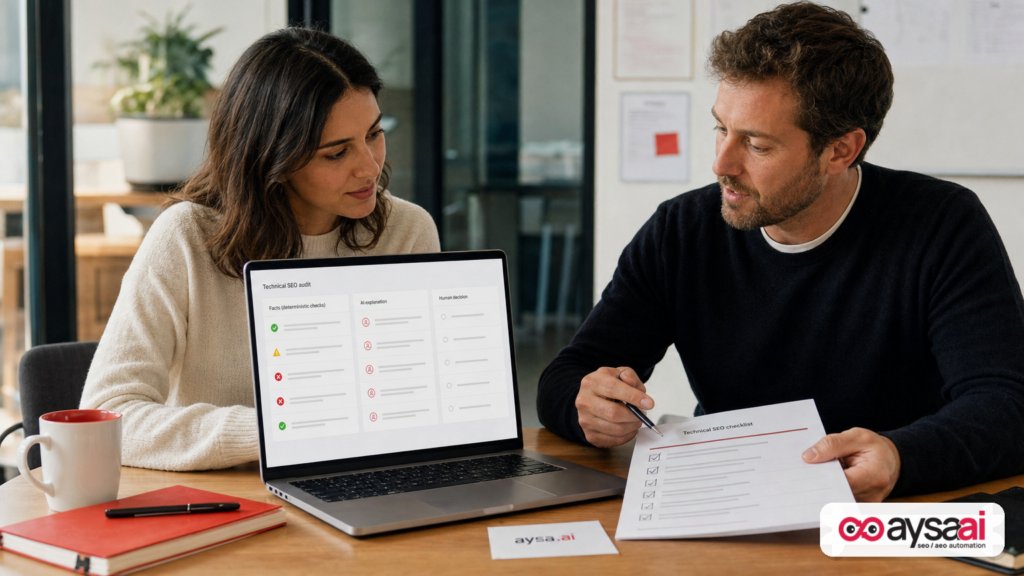
AI Search Visibility Isn’t a Score: The Practical Metrics That Actually Predict Growth
Most AI visibility dashboards count mentions and citations as if they were rankings. In AI search, that’s often a vanity metric. Here’s a practical measurement framework—brand accuracy, presence, recommendation share, and outcomes—plus an execution plan SMEs and agencies can run with AYSA.

AI Search visibility is becoming the new “rankings.” And just like rankings, it’s dangerously easy to measure in a way that looks scientific but doesn’t predict revenue.
Most AI visibility tools today count mentions and citations across ChatGPT-style assistants and Google’s AI-generated results. That’s not useless—but it’s also not a business KPI. In practice, the gap between what these tools report and what actually changes customer behavior keeps widening.
This editorial is my practical framework for measuring AI search visibility the right way—built from what the industry is learning, plus what we’re building toward at AYSA: Monitoring what matters, preparing high-impact changes, asking for approval, and executing accepted website improvements at scale.
Concise summary

If you only remember four things:
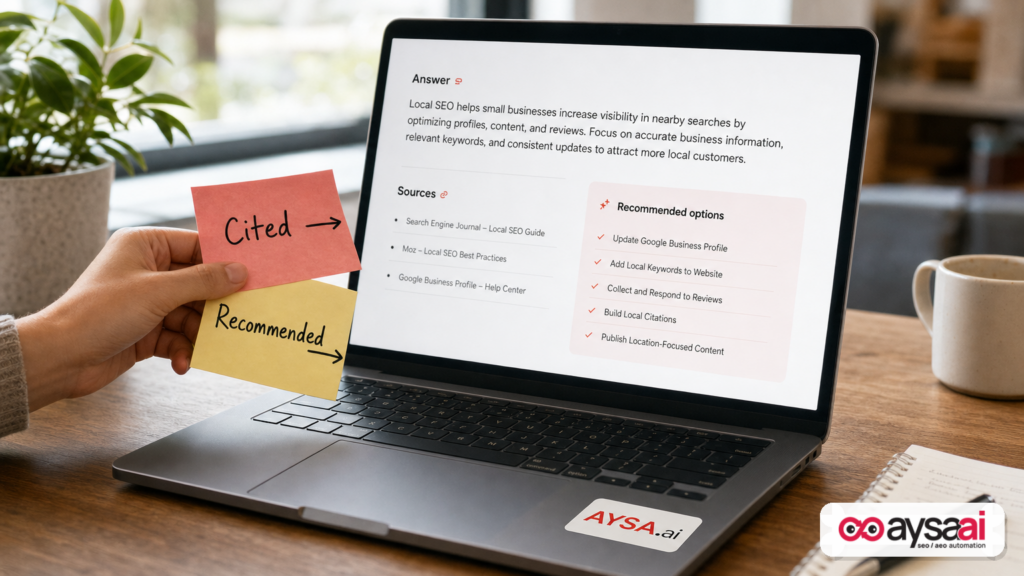
- A citation is not a recommendation. Models can cite your page and still tell the user to choose a competitor.
- AI answers vary. Measuring one prompt once is mostly noise; you need sampling and repeatability.
- Brand accuracy comes first. If the model is wrong about who you are, every “visibility” metric downstream is distorted.
- Outcomes are the scoreboard. The only visibility that matters is visibility that drives actions you can observe (leads, calls, bookings, signups, sales).
Key takeaways (for busy owners and operators)
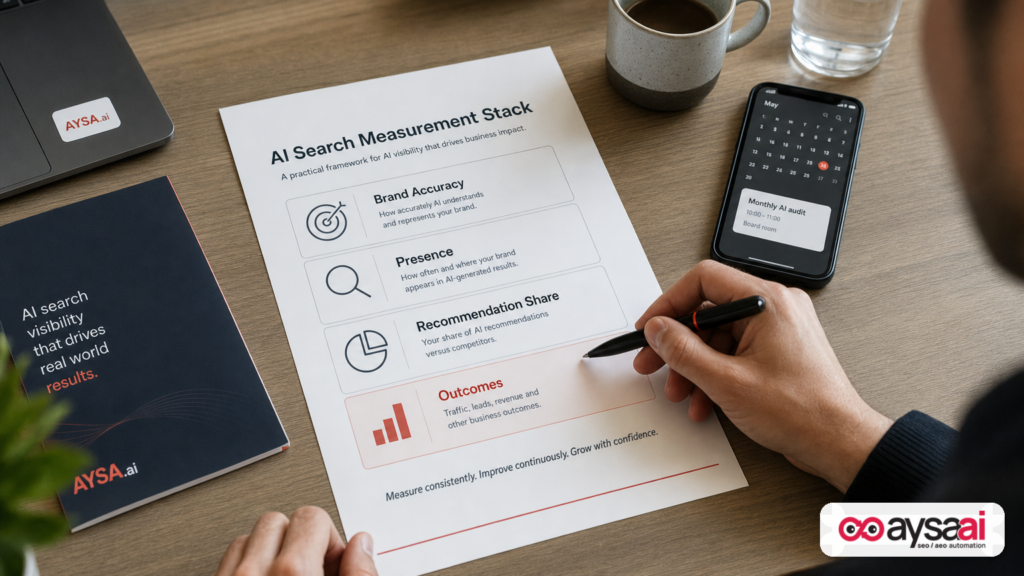
- Stop treating AI visibility as a single number. Replace it with a stack of metrics: brand accuracy → presence → recommendation share → outcomes.
- Ground measurement in reality. Use prompt sets tied to real demand (your services, products, locations, and customer questions), not “what we think people ask.”
- Track composition changes. If a model starts producing longer answers or listing more options, raw mentions can rise without any real competitive gain.
- Invest in execution. Measurement without a closed-loop workflow (identify → prepare fixes → approve → ship) becomes another dashboard no one acts on.
Table of contents
- What changed: from “rank” to “answer space”
- Why “AI visibility” is often the wrong number
- Citations aren’t recommendations (and why that distinction matters)
- Ask once, measure noise: variance is the rule
- The metrics that matter: a practical framework
- Metric #1: Brand accuracy (your AI truth baseline)
- Metric #2: Presence (share of answer space)
- Metric #3: Recommendation share (being the choice)
- Metric #4: Outcomes (actions you can measure)
- How to design a measurement program that isn’t self-deception
- SME scenario: a local clinic competing in AI answers
- What agencies must change (or they’ll sell the wrong work)
- Where AYSA fits: monitoring + approved execution for AI-era SEO
- What to do next (30/60/90-day plan)
- Sources and further reading
What changed: from “rank” to “answer space”
Traditional SEO measurement was built for a world where a search engine returned a relatively stable list of links. Yes, it changed constantly—but it still behaved like a “page” you could monitor: positions, Impressions, Clicks, conversions.
AI search breaks that mental model in two ways:
- The interface is an answer, not a list. Users may never see ten blue links, even if the engine used the web to generate the answer.
- The output is variable. Different users, contexts, prompts, and platforms can produce materially different brand sets and ordering.
That means the unit of competition isn’t a single “rank.” It’s the answer space: the set of possible outputs for a class of questions your customers ask.
Many teams are still measuring AI like it’s 2012 Rank tracking—because that’s familiar, easy to sell internally, and easy to visualize. But familiarity is not validity.
Why “AI visibility” is often the wrong number
The current wave of AI visibility tools tends to do something like this:
- Create (or import) a list of prompts.
- Run them through ChatGPT/Perplexity/Gemini/Google AI-generated experiences.
- Count how often your brand is mentioned or cited.
- Produce a single number or trend line.
It looks like a modern version of rank tracking. But that similarity is misleading.
Slobodan Manic’s analysis on Search Engine Journal makes the core critique clear: the dominant dashboards measure what’s easiest to count, not what’s closest to the decision. Mentions and citations are benchmarks, not outcomes—and treating them like outcomes creates false confidence and misallocated work.
Primary source: Search Engine Journal – How To Measure AI Search Visibility.
The “prompt list” problem: invented queries vs real demand
AI visibility measurement starts with the prompt set. If the prompt set is fantasy, the metric is fantasy.
In classic SEO, you could at least anchor your work in observed queries (via Google Search Console or other tools). In AI measurement, many teams brainstorm prompts in a conference room and call that “demand.”
That leads to two common failure modes:
- You optimize for prompts nobody uses. You win a dashboard, not a market.
- You miss high-intent prompts that are ugly, specific, and unglamorous. The prompts that drive revenue often look boring (e.g., “best insurance-covered PT near me for rotator cuff”).
The “impressions inflation” problem: machines search too
Even in traditional search measurement, we’ve lived through the pain of vanity numbers. Impressions can rise while clicks fall. Attention can drift while reporting looks “up and to the right.”
AI systems intensify that distortion because models can trigger multiple searches behind the scenes for a single user question (often described as grounding or query fan-out). That can generate activity that resembles demand—without being human demand.
Google’s tooling direction matters here. Google provides performance measurement through Search Console (official: Google Search Console), and it’s a foundational input for many teams. But when AI-generated experiences increase impressions without increasing clicks, it becomes harder to interpret what “visibility” means unless you connect it to outcomes and on-site behavior.
Citations aren’t recommendations (and why that distinction matters)
This is the most important mindset shift for business owners:
A citation is when the model uses your page as a source.
A recommendation is when the model tells the user to choose you.
Many AI visibility tools collapse those into one number. That’s like treating “we appeared in the footnotes” as the same as “we got the sale.”
The SEJ source includes multiple research examples showing the gap can be large, and it aligns with what we see in practice: models can ingest your content, cite it, and still recommend someone else—sometimes because your page mentions competitors or compares alternatives.
What businesses should take from this:
- Being cited can mean you informed the answer. That’s useful.
- Being recommended means you are the answer. That’s what changes customer behavior.
- You must measure them separately. Otherwise you’ll “improve visibility” while losing preference.
Practical example (non-SEO): the restaurant guide trap
Imagine you run a boutique hotel. You publish a page titled “Best Hotels in Charleston for Couples.” You include yourself and ten competitors.
An AI assistant might cite your guide as a source (because it’s comprehensive), then recommend three other hotels you listed (because they have stronger review sentiment, clearer amenities, or simply fit the model’s heuristics). Your “citation visibility” rises while your “recommendation share” falls.
That’s not an edge case. It’s a predictable failure mode when we measure footnotes instead of preference.
Ask once, measure noise: variance is the rule
In AI search, single measurements are often misleading because outputs can vary across time and context.
The SEJ source cites Rand Fishkin’s point that to get statistically meaningful insight, you need to measure like a poll: multiple samples, variability, and confidence intervals. Even if you don’t run thousands of prompts, the direction is right: repeatability matters.
What this means operationally:
- Stop screenshotting “one good answer” and calling it progress.
- Stop panicking over “one bad answer” and calling it a crisis.
- Start tracking presence/recommendation across repeated runs, prompt variants, and time windows.
Track answer composition, not just brand presence
Another point raised in the SEJ source is subtle but critical: if a model starts producing longer answers, listing more brands, or changing format, your raw mention count can rise even if your competitive standing is unchanged.
So you should track:
- How many brands are listed in answers (per prompt class and platform)
- Answer length (rough proxy for “inventory” available to be mentioned)
- Placement patterns (top list vs “also consider” vs narrative mention)
In other words: measure your visibility relative to the size of the answer space.
The metrics that matter: a practical framework
Here’s the measurement stack I recommend for SMEs and agencies that want something durable:
- Brand Accuracy – Is the model correct about who you are?
- Presence – How often do you appear across the answer space that matters?
- Recommendation Share – How often are you presented as the choice (not just a source)?
- Outcomes – Does any of that visibility drive measurable business actions?
These metrics ladder up. If you skip the bottom of the stack, the top becomes untrustworthy.
Metric #1: Brand accuracy (your AI truth baseline)
Before you chase “visibility,” confirm the model understands your entity correctly.
Brand accuracy sounds basic, but it’s where the biggest hidden losses happen. If AI systems are wrong about you, they can:
- Recommend you for the wrong use case
- Exclude you because they misclassify you
- Compare you to the wrong competitors
- Misstate policies, locations, offerings, pricing model, or target audience
The SEJ source describes brand accuracy audits as a disciplined way to evaluate what models get right and wrong using objective questions (founding year, HQ, services/products, geography, differentiators). That’s the right approach: audit facts, not flattery.
How to run a brand accuracy audit (SME-friendly)
Create a list of 15–30 “non-negotiable facts” and “non-negotiable distinctions.” Examples:
- What we sell (top 5 categories)
- Who we’re for (B2B vs B2C; industries; patient types; etc.)
- Where we operate (cities, service areas, shipping countries)
- What we don’t do (critical exclusions)
- Our official name and brand spelling
- Key policies (returns, shipping speed, insurance accepted)
Then ask each platform those questions on a schedule (monthly or quarterly) and score accuracy.
If you’re wrong in the model’s “mental profile,” it’s not an SEO problem. It’s a market perception problem that happens to be mediated by machines.
What typically improves brand accuracy
Without inventing platform-specific mechanisms, the practical levers are straightforward and “web fundamentals” oriented:
- Clear About/Company pages with consistent facts
- Consistent brand naming across the web (profiles, citations, directories)
- Structured data where appropriate (schema markup) and clean site architecture
- Unambiguous product/service taxonomy
- Authoritative third-party references (press, industry listings) when legitimately earned
And because this is an editorial for operators: none of this matters if you don’t ship changes. That’s why execution systems matter as much as measurement.
Metric #2: Presence (share of answer space)
Once brand accuracy is acceptable, measure presence: the percentage of relevant answers where your brand appears.
Presence is the honest replacement for “rankings.” Not because it’s perfect, but because it fits the reality of variable outputs.
Presence should be reported with context:
- Presence by platform (Google AI-generated experiences vs other assistants)
- Presence by intent class (informational, comparison, “best,” local, troubleshooting)
- Presence by geography (if you’re local or multi-location)
- Presence by device/context (where available)
Presence that matters vs presence that feels good
Two presence numbers can look similar and mean opposite things:
- High presence in top-funnel Q&A might build awareness but drive little revenue.
- Moderate presence in high-intent comparisons can drive disproportionate pipeline.
So the business move is not “maximize presence everywhere.” It’s “maximize presence where buying decisions are made.”
Metric #3: Recommendation share (being the choice)
Recommendation share answers the only question your CFO really cares about:
When customers ask AI who to choose, how often does it choose us?
This is distinct from being cited or mentioned. Recommendation can look like:
- Being listed as a top option in a short list
- Being explicitly described as “best for” a use case
- Being the only option recommended (rare, but powerful)
Recommendation share should be tied to a defined prompt universe. If you don’t know what customers ask, recommendation share can become another prompt-list fantasy metric.
How to make recommendation share measurable
For most SMEs, you don’t need perfection—you need repeatable directional insight. Do this:
- Define 20–50 high-intent prompts grouped by category (your money-makers).
- Create 3–5 variations per prompt (wording differences, “near me,” “for [use case]”).
- Sample repeatedly over time (weekly/monthly cadence).
- Score recommendations with a simple rubric (Top pick / In list / Mention only / Not present).
Then trend it over time alongside actual business outcomes.
Metric #4: Outcomes (actions you can measure)
Visibility that doesn’t lead to outcomes is not a growth metric. It might be brand building—but you still need a plan to validate that.
Depending on your business, outcomes can include:
- Lead form submissions
- Calls and booked appointments
- Ecommerce purchases
- Email signups
- Demo requests
- Store visits (where measurable)
What makes outcomes hard in AI search
Attribution was never perfect. AI makes it less perfect—because the “moment of influence” may occur in an assistant interface, and the user may arrive later via branded search, direct traffic, or no click at all.
So instead of pretending you can attribute every AI impression to revenue, use a mix:
- Direct response signals: referral traffic where it exists, assisted conversions, on-site behavior changes
- Brand lift signals: branded search trends, direct traffic trends, sales team inbound mentions (“I saw you in ChatGPT”)
- Controlled experiments: ship changes, measure deltas in presence/recommendation/outcomes
And keep your reporting honest: if you can’t verify a causal link, call it a hypothesis and test it.
How to design a measurement program that isn’t self-deception
Most measurement programs fail not because the tools are bad, but because the design is wrong. Here are the principles I’d enforce as a business operator:
1) Build a prompt universe from real business structure
If you’re an ecommerce brand, prompts should map to:
- Category + use case (e.g., “best running socks for blisters”)
- Product attributes (materials, size ranges, durability)
- Comparisons (“Brand A vs Brand B”)
- Problem-solving queries (“how to choose X”)
If you’re local, prompts should map to:
- Service + location + urgency (“emergency plumber in Austin tonight”)
- Service + trust qualifiers (“licensed,” “insured,” “same-day”)
- Cost/policy qualifiers (“accepts insurance,” “financing,” “warranty”)
2) Separate measurement layers: facts, presence, recommendation, outcomes
Don’t let one number stand in for four different realities.
3) Sample, don’t snapshot
Variance is normal. Your system should treat it as normal.
4) Track “inventory size” (answer composition) to avoid false wins
If answers get longer or list more brands, raw visibility can rise without competitive gain. Normalize your metrics.
5) Close the loop with execution
Measurement without execution becomes theater. The business advantage comes from teams that can ship improvements faster, more safely, and more consistently than competitors.
SME scenario: a local clinic competing in AI answers
Let’s make this concrete with a realistic scenario.
Business: A 3-location physical therapy clinic.
Goal: More booked evaluations.
Problem: The owner sees an “AI visibility score” from a tool showing improved mentions. But bookings are flat.
Step 1: Brand accuracy audit (the clinic’s AI profile)
We ask objective questions across platforms:
- Which insurance do you accept?
- Do you treat post-surgical rehab?
- What neighborhoods do you serve?
- What are your hours?
- Do you offer dry needling?
If the model answers “wrong,” it may never recommend the clinic for the right patients, no matter how many times it cites the website.
Step 2: Presence by high-intent prompt classes
We track presence across prompts that map to booked appointments:
- “physical therapist for rotator cuff pain in [city]”
- “PT clinic that accepts [insurer] near me”
- “dry needling near [neighborhood]”
Presence improves only where it matters.
Step 3: Recommendation share and “why” analysis
If the model recommends other clinics, we document the stated reasons (reviews, specialization, location clarity, scheduling convenience). Those reasons become the to-do list.
Step 4: Outcomes alignment
We watch booked evaluations, calls, and form submissions. If presence rises but outcomes don’t, we test whether:
- We’re present in informational prompts, not booking prompts
- Landing pages aren’t conversion-ready
- Scheduling friction is losing demand
- Brand accuracy issues still exist
This is how you prevent “AI visibility” from turning into another chart that doesn’t pay the bills.
What agencies must change (or they’ll sell the wrong work)
If you run an agency, AI search pressures your model in two ways:
- Clients will ask for AI visibility reporting. If you give them a single mention/citation score, you’ll look sophisticated while optimizing the wrong thing.
- Execution speed becomes a competitive advantage. Clients won’t wait months to “see if it worked” when answers change weekly.
The agency pivot: from rank reports to perception + outcomes
The SEJ source frames AI visibility as a new vanity metric, echoing the industry’s earlier evolution from rankings → traffic → conversions. Agencies should skip the painful middle and build reporting that starts with:
- Brand accuracy
- Presence (share, normalized)
- Recommendation share
- Outcome deltas
Then sell the work that improves those numbers: entity clarity, content architecture, technical foundations, and conversion readiness.
Don’t ignore the blind spots
The SEJ source highlights two measurement blind spots worth naming in client communication:
- Training cutoff / stale knowledge: parts of model “memory” may lag behind current reality.
- Platform data opacity: not every model provider will expose reliable analytics, so measurement must mix direct and indirect signals.
Good agencies set expectations: we can measure directionally and operationally, but not with perfect attribution.
Where AYSA fits: monitoring + approved execution for AI-era SEO
At AYSA, we treat AI search as an execution problem, not a dashboard problem.
Yes, you need measurement. But the businesses that win won’t be the ones with the prettiest “AI visibility” chart. They’ll be the ones that can:
- Detect what changed (and where it affects revenue)
- Prepare the right site updates quickly
- Ship safely with approvals and traceability
- Repeat this cycle continuously
AYSA’s role in the loop
- Monitor: Use AYSA Monitoring to keep an eye on the signals that matter, not just raw mentions.
- Make AI search visibility actionable: Start with AI Search Visibility as a practical layer, not a vanity score.
- Execute changes with governance: AYSA prepares website changes, asks for approval, and executes accepted updates—so insights don’t die in a spreadsheet.
- Operate across SEO/AEO/GEO: Align site structure, content clarity, and technical signals so machines and humans can both understand your brand.
Where to start inside AYSA
- Explore our approach to tooling and workflows: AI SEO Tools
- See plans and operational fit: Pricing
- Browse more implementation-driven editorials: AYSA Blog
What to do next (30/60/90-day plan)
If you want a plan that a small team can actually run, here’s a pragmatic rollout.
Next 30 days: establish truth and baseline
- Run a brand accuracy audit (15–30 objective questions) across the AI platforms your customers use.
- Define your “money prompts” by mapping prompts to your products/services, locations, and decision-stage questions.
- Set baseline presence and recommendation share using repeated sampling (not one-off screenshots).
- Confirm outcome tracking works (forms, calls, bookings, purchases). If tracking is broken, fix that first.
Next 60 days: ship the highest-leverage fixes
- Fix factual inconsistency across site pages (About, FAQs, location pages, product/service definitions).
- Improve category and service taxonomy so your offerings are unambiguous.
- Build/refresh comparison and “best for” content that reflects the decision stage (without accidentally handing competitors the win).
- Reduce conversion friction (scheduling, contact, checkout, trust elements).
Next 90 days: operationalize the loop
- Establish a monthly measurement cadence with the four-layer stack.
- Track composition changes (answer length/brand count) so your metrics don’t lie.
- Create an internal “AI issues backlog” (accuracy errors, missing categories, weak landing pages) and burn it down.
- Use an execution system so improvements ship consistently—this is where AYSA’s prepare → approve → execute model compounds.
Common mistakes to avoid
- Mistake: Celebrating citations as wins. Fix: Report citations separately from recommendations.
- Mistake: Measuring once. Fix: Sample repeatedly and normalize.
- Mistake: Optimizing generic prompts. Fix: Focus on high-intent prompt classes.
- Mistake: Treating AI visibility as a marketing KPI without tying it to outcomes. Fix: Build outcome alignment into reporting from day one.
- Mistake: Insights with no execution. Fix: Use a workflow that ships approved changes quickly and safely.
What to do next (action list)
- Write your 20 “non-negotiable facts” and run a brand accuracy audit this week.
- Build a prompt universe tied to your revenue drivers (not brainstormed vanity prompts).
- Measure presence and recommendation share with repeated sampling.
- Normalize for answer composition changes (answer length, number of brands listed).
- Connect those metrics to outcomes you can observe.
- Choose an execution workflow (or platform) that can ship changes continuously.
- If you want this operationalized, start with AYSA AI Search Visibility and Monitoring, then build your execution backlog.
Sources and further reading
- Search Engine Journal: How To Measure AI Search Visibility (primary research input for this editorial)
- Google Search Console (official product page)
- AYSA: AI Search Visibility
- AYSA: Monitoring
- AYSA: AI SEO Tools
- AYSA Blog
- AYSA Pricing
Continue the AI search topic inside AYSA.
Use these pages to connect the article with AI SEO tools, AI visibility monitoring, AI Overviews and approved website execution.
Turn this topic into a website action plan.
Use these AYSA hubs to move from reading to technical fixes, AI visibility monitoring, research, glossary context and approval-first SEO execution.