
AI Search Is Reshaping Visibility: The Q3 Playbook For Winning Citations, Not Just Rankings
Impressions are rising while clicks fall—even when rankings hold. Here’s what changed in AI-powered search, why classic SEO dashboards are lying by omission, and the practical Q3 plan to win visibility via citations, extractable answers, and multi-channel presence.

By Marius Dosinescu (AYSA.ai)
Concise summary: AI-powered search is changing what “visibility” means. Many businesses are seeing Impressions rise while Clicks fall—even when rankings stay stable—because AI answer layers (including AI Overviews) and other zero-click elements capture attention and intent before users ever reach your site. The Q3 priority is no longer “rank higher” alone. It’s (1) diagnose whether click loss is caused by AI answer layers vs competitors, (2) build extractable content that can be surfaced and cited, (3) expand presence on platforms AI systems trust, (4) plan paid and organic together, and (5) report citations alongside clicks so leadership understands the real visibility picture.
This editorial is inspired by and references Search Engine Journal’s overview of five AI search shifts marketers can’t ignore before Q3. I’m not rewriting that article; I’m building the broader operating system businesses actually need—especially SMEs who can’t afford to chase every new SERP feature without a plan.
Key takeaways (read this first)
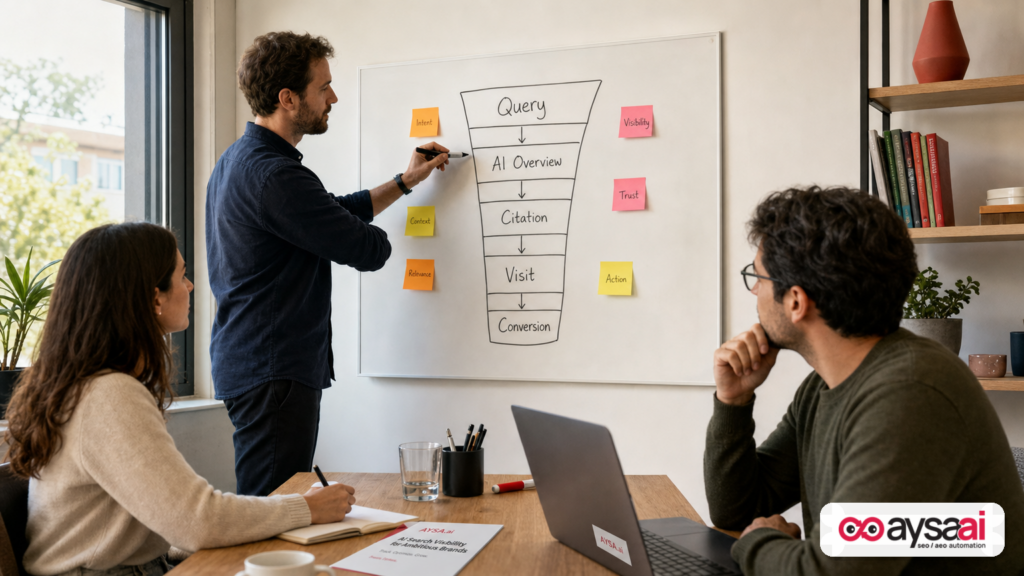
- CTR decline isn’t automatically “seasonal.” Segment queries to separate losses caused by AI answer layers from losses caused by competitors outranking you.
- Visibility has split into two layers: rankings and surfacing (being extracted/cited in AI answers). You need to optimize for both.
- Off-site presence matters more than before. Communities and professional platforms increasingly act as citation sources for AI answers—whether you like it or not.
- Paid and organic now collide in the same AI-driven interface. Treat them as a single “visibility budget,” not separate channels with separate goals.
- Reporting must evolve: clicks alone no longer represent the full value of search visibility. Add “citation visibility” to your executive dashboard.
- Execution speed is now a competitive advantage. But blind automation is risky. The winning model is: monitor → prepare changes → ask for approval → execute safely. That’s exactly how AYSA operates.
Table of contents

- Context: Why your Search Console exports suddenly feel wrong
- What changed: search is becoming an answer layer (and you’re being measured like it’s 2018)
- Shift #1 — Don’t treat organic CTR decline as a seasonal dip
- Shift #2 — Optimize for being surfaced, not just ranked
- Shift #3 — Build presence on the platforms feeding AI models
- Shift #4 — Plan paid and organic in the same room
- Shift #5 — Report citations alongside clicks (or you’ll underinvest in visibility)
- A concrete SME scenario: the local clinic with stable rankings and falling appointments
- What agencies must rethink before Q3
- What can go wrong (and how to avoid expensive mistakes)
- The Q3 action plan: a 30-60-90 day operating system for AI search visibility
- Where AYSA fits: monitoring + approval-based execution for AI search
- What to do next
- Sources and further reading
Context: Why your Search Console exports suddenly feel wrong
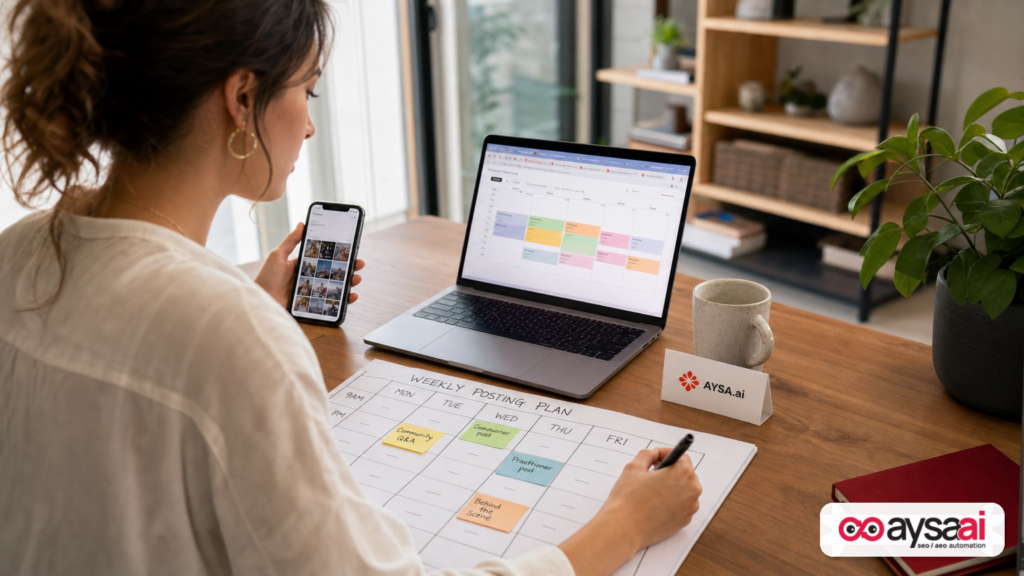
Many teams are staring at the same confusing pattern:
- Impressions are up.
- Average position hasn’t cratered.
- Clicks are down.
- Leads are down (or flat).
Historically, we’d blame: “seasonality,” “SERP layout changes,” or “Google testing a new feature.” But the difference now is structural. The SERP isn’t just a list of blue links competing for clicks. It’s increasingly an answer environment where the user can get what they need without visiting your site—and where the search engine chooses which sources to cite or reference.
The practical implication for business owners is simple: the old KPI stack is incomplete. If your reporting still assumes the main job of SEO is to produce a click, you will misread reality, make the wrong Q3 investments, and then wonder why “more content” didn’t fix it.
This is why I’m pushing a more operational concept: AI Search Visibility. It’s broader than SEO as we practiced it for the last decade. It includes rankings, yes—but also citations, extracted passages, local presence, and multi-channel authority signals.
If you’re new to this framing, start with AYSA’s overview of AI search visibility. It’s the direction search is moving, and it’s where your strategy must move too.
What changed: Search is becoming an answer layer (and you’re being measured like it’s 2018)
Search used to work like this:
- You rank.
- You earn a click.
- You convert the visit.
Now, for many query types, the experience looks more like this:
- User asks a question.
- Search returns an AI-generated summary/answer layer.
- Some sources are cited/linked (not always the top-ranked pages).
- User may never click—or may click later, differently, or on a different site.
That shift has two consequences that will define Q3 planning:
- Traditional SEO “wins” don’t always show up as traffic. You can rank well and still be invisible in the answer layer.
- Brands are being shaped by AI answers—even when those answers don’t send visits. If AI answers describe you incorrectly, omit you, or cite a competitor, that’s a marketing problem whether or not Search Console reports it as a click.
Search Engine Journal framed this clearly: CTR drops with stable rankings are often a symptom of AI Overviews and zero-click results absorbing clicks. That’s the new baseline problem for marketers heading into Q3, and it’s why the “fix” can’t be a generic SEO checklist.
Shift #1 — Don’t treat organic CTR decline as a seasonal dip
When clicks fall, most teams do one of two things:
- They panic and rewrite pages without understanding what changed.
- They dismiss it as seasonal and keep executing last quarter’s plan.
Both are expensive mistakes. Before you change content, you need to understand which problem you have:
- Competitor displacement: you’re losing because someone outranked you, outranked your snippet, or stole your brand narrative.
- Answer-layer displacement: you’re losing because the SERP itself is satisfying intent without a click (or rerouting clicks to citations you don’t control).
How to diagnose: AI answer displacement vs competitor displacement
You don’t need exotic tooling to start. Your existing Google Search Console exports can provide the clues—if you segment correctly.
Do this segmentation exercise:
- Pick a date range comparison where clicks dropped (e.g., last 28 days vs previous 28 days).
- Export queries and pages.
- Create two buckets of queries where CTR dropped:
- Bucket A: average position stayed roughly stable (visibility loss without ranking loss).
- Bucket B: average position declined meaningfully (ranking loss).
Interpretation:
- Bucket B is classic SEO work: content relevance, internal links, page quality, technical issues, competitive gap analysis.
- Bucket A is where your Q3 strategy likely breaks: the SERP changed around you. You may be “ranking,” but not earning attention.
What to do with Bucket A:
- Manually review the SERP for a sample of these queries and note what’s now above organic results (answer layers, local packs, forums, shopping modules, etc.).
- Ask: are citations pointing to you, to competitors, or to third parties?
- Decide whether the right move is to (a) become a cited source, (b) shift to queries with higher click potential, or (c) defend visibility with paid where it’s economically justified.
This is where an “SEO-only” mindset fails. You’re no longer optimizing for a list. You’re optimizing for an environment.
AYSA’s practical help starts here: monitoring to catch these changes early, then a workflow that prepares recommended changes and asks for approval before executing. Speed matters, but so does control.
Shift #2 — Optimize for being surfaced, not just ranked
Ranking is still valuable, but it’s no longer the whole game. AI systems don’t simply pick the #1 result and paraphrase it. They often:
- Extract smaller passages.
- Synthesize multiple sources.
- Prefer content that is clear, well-structured, and easy to quote.
This means your pages need to be extraction-ready—not only keyword-optimized.
What “extractable” content looks like in practice
Here are patterns that consistently make content easier to surface and cite (and also easier for humans):
1) Put the answer first (and then earn the right to elaborate)
If the query is “how long does shipping take,” the first screen of the page should contain a plain-English answer—then supporting details and exceptions.
Example structure (simple, not fancy):
- Direct answer: “Most orders ship in 1–2 business days and arrive in 3–5 business days.”
- Context: “Custom items may take longer.”
- Breakdown: a small table by shipping method.
- FAQ: “What about holidays?” “Do you ship internationally?”
2) Use headings that map to real questions
Replace vague headings (“Overview,” “More Information”) with headings that match user intent:
- “What is [service]?”
- “Who is [service] for?”
- “How much does [service] cost?”
- “What are the risks or downsides?”
- “How to choose a provider”
3) Create “citation blocks” inside your content
Not everyone needs to publish long-form encyclopedias. What you need are quotable units:
- A definition paragraph.
- A numbered step-by-step process.
- A checklist.
- A pros/cons list with short bullets.
- A short “when to use / when not to use” section.
4) Make authorship and credibility obvious
AI systems and humans both look for signals of real expertise. Make it easy to understand:
- Who wrote the content and why they’re qualified.
- When it was last updated.
- What sources you rely on (when appropriate).
Note: I’m not making claims about any one specific “AI ranking factor” here—we should be cautious. But from a business perspective, content with explicit expertise signals is simply more trustworthy and easier to cite.
Technical fundamentals that make surfacing easier
Most “AI optimization” fails because teams skip basics. If your site is hard to crawl, slow, inconsistent, or poorly structured, you’re asking AI systems (and search engines) to do extra work. That’s rarely rewarded.
Foundational checks to prioritize:
- Indexation hygiene: the right pages indexed; thin/duplicate pages handled.
- Clean internal linking: key pages are reachable and contextually connected.
- Consistent entity signals: business name, services, locations, and definitions used consistently.
- Structured markup where appropriate: use schema responsibly (not spammy) to clarify content types.
- Page experience basics: readable typography, stable layout, accessible navigation.
If your Q3 plan is “publish more” without fixing structure, you’ll create more pages that rank (maybe) but still don’t get surfaced.
If you want a starting point for this operationally, explore AYSA’s AI SEO tools—the emphasis is not on replacing humans, but on making the fundamentals easier to maintain and execute with review gates.
Shift #3 — Build presence on the platforms feeding AI models
The uncomfortable truth for many business owners: AI-driven answers don’t only rely on your website. They rely on the broader web—often including platforms you don’t control.
SEJ’s point is especially important: communities and professional networks (like discussion forums and practitioner content) can show up as trusted sources in AI outputs. If your brand is absent from those ecosystems, you may be absent from the citations too.
This doesn’t mean you should chase every platform. It means you should pick the right two or three places where:
- Real customers ask questions.
- Real practitioners discuss solutions.
- Category narratives are formed (“the best,” “the safest,” “the most reliable,” “the budget choice”).
Practical moves SMEs can do without a huge team:
- Create a “category truth” library: 10–20 short, clear answers your team can reuse (pricing philosophy, comparison points, safety notes, timelines, guarantees).
- Publish practitioner viewpoints: not fluff—real experience, tradeoffs, and what to watch out for.
- Earn mentions that reflect expertise: participate in discussions with helpful answers, not sales pitches.
Where AYSA fits: this is part of “AI search visibility” as a system, not a campaign. Your site content, your brand mentions, and your reporting need to align. Otherwise you’re optimizing one surface while the market is being shaped somewhere else.
Shift #4 — Plan paid and organic in the same room
Many organizations still treat paid and organic like separate departments with separate success metrics:
- SEO reports rankings, clicks, and traffic.
- PPC reports impression share, CPCs, and conversions.
In AI-shaped search experiences, that split becomes dangerous, because users encounter a blended environment where paid placements and organic citations compete for the same attention—and can even change what users consider “the answer.”
SEJ flagged this shift directly: AI-driven experiences are evolving, ads are appearing in new contexts, and if you only watch organic you may miss where paid is taking visibility you assumed rankings would secure.
A practical “same room” agenda for Q3:
- Query-by-query visibility review: For top revenue queries, list what appears: AI answer layer, citations, local modules, shopping, organic results, paid placements.
- Define ownership: Which queries should be defended with paid? Which should be won through surfacing/citations? Which should be deprioritized because the SERP is now mostly zero-click?
- Agree on measurement: If the SERP reduces clicks, you may need to measure “brand exposure” and downstream conversions differently (more on this below).
SME-friendly heuristic: Don’t use paid to “make up for” broken organic fundamentals. Use paid to defend revenue while you improve extractability and citation likelihood. Paid is a bridge—not the foundation.
Shift #5 — Report citations alongside clicks (or you’ll underinvest in visibility)
If your executive dashboard still has only these:
- Organic sessions
- Organic conversions
- Rankings
- CTR
…you’re missing a growing portion of “visibility value.”
SEJ’s point is the one that most leadership teams need to hear: Search Console clicks don’t measure your full search visibility anymore. If your brand is cited in AI answers, that exposure can influence perception and future demand—even if it doesn’t produce an immediate click you can attribute.
So what do you do without inventing metrics?
What to add to reporting (without pretending it’s perfect)
- Citation tracking (directional): Where and how often your brand/pages appear as cited sources in AI answer experiences for your target topics.
- Share of narrative: Are AI answers describing your category using your language, or your competitor’s language?
- Branded demand signals: Are branded searches and direct traffic stable while non-branded clicks fall? (This can indicate awareness without immediate click-through.)
Important: I’m not claiming any single tool provides perfect “AI citation analytics” today. The responsible approach is to treat it as directional intelligence—good enough to inform Q3 priorities, not a replacement for revenue attribution.
From an execution standpoint, this is where ongoing monitoring becomes non-negotiable. Without it, teams realize they’ve lost visibility months after the fact.
A concrete SME scenario: the local clinic with stable rankings and falling appointments
Let’s make this real with a scenario that I see over and over in different forms.
Business: A multi-location dental clinic.
What they see:
- They still rank in the top 3 for “teeth whitening cost,” “emergency dentist,” and “invisalign alternatives.”
- Search Console impressions are up.
- Clicks are down ~noticeably.
- Appointment requests from organic are down.
What changed in the market:
- More queries now trigger answer layers summarizing cost ranges, risks, and “what to expect.”
- Local results and other modules pull attention away from classic organic listings.
- Competitors that publish clear, quotable “cost and timeline” answers get cited—sometimes even if they rank below.
How the clinic should respond (Q3-ready plan):
- Diagnose which queries are answer-layer displaced. Focus on the ones where position is stable but CTR fell.
- Create extractable “care decision” content:
- Clear pricing philosophy (what drives cost up/down).
- Eligibility criteria and contraindications.
- Step-by-step procedure overview.
- Risks and aftercare FAQs.
- Upgrade location pages for clarity: services, hours, emergency process, insurance/payment options—presented in a way that’s easy to lift.
- Build practitioner presence: have dentists publish short educational posts where patients actually ask questions, and link back to the clinic’s definitive pages.
- Align paid and organic: defend appointment-driving queries with paid while organic work improves surfacing readiness.
- Report more than clicks: track citations and brand mentions tied to key services and locations, so leadership sees progress before clicks rebound.
That’s not “do more SEO.” That’s an operational response to AI search behavior.
What agencies must rethink before Q3
If you run an agency—or you hire one—Q3 is where the service model either modernizes or gets trapped in outdated deliverables.
1) Deliverables must shift from “content volume” to “visibility outcomes”
Publishing 10 blog posts a month is not a strategy. It’s a production schedule. In AI-driven SERPs, your job is to win specific visibility surfaces:
- Being cited for “what is,” “how to,” “cost,” “best,” “alternatives,” and “vs” queries.
- Owning local visibility where relevant.
- Owning the brand narrative in communities and professional ecosystems.
2) Your reporting has to evolve or clients will cut the wrong things
When clicks decline, clients often say: “SEO isn’t working.” If you can’t show citation visibility and narrative share, the budget will shift to channels that look measurable in the short term—whether or not they’re the best long-term move.
3) Execution speed and quality control are now the differentiator
The old model: audit → roadmap → backlog → wait.
The new model: monitor → prepare → approve → execute → measure, continuously.
This is where tooling and workflow matter. AYSA is built to help teams operate like this: it monitors, prepares recommended website changes, asks for approval, and executes accepted changes. That “approved execution” model is a serious advantage for agencies that need speed without risking client sites.
If you’re curious how that system approach works, start with AI Search Visibility and then explore the workflow on AI SEO tools.
What can go wrong (and how to avoid expensive mistakes)
Whenever the market shifts, bad advice spreads fast. Here are the mistakes I’m actively warning SMEs and agencies about.
Risk #1: Chasing “AI hacks” and forgetting fundamentals
If a site is structurally weak—thin pages, duplicate content, unclear information architecture—no amount of “AI optimization” will save it. Start with clarity, crawlability, and usefulness.
Risk #2: Rewriting everything without diagnosis
If your clicks fell because of answer-layer displacement, rewriting may not restore clicks. The right move might be:
- Becoming a cited source.
- Targeting different query types where clicks still exist.
- Building demand and brand preference so users seek you directly.
Risk #3: Measuring success only by last-click traffic
As search becomes more “discovery,” last-click attribution becomes a weaker proxy for influence. You need a blended view: clicks + citations + brand demand + conversions.
Risk #4: Letting automation publish changes without review
Automation is necessary. Unreviewed automation is dangerous. If you deploy templated changes at scale without oversight, you can break:
- Page intent alignment
- Compliance requirements (especially in health/finance)
- Brand voice and legal claims
- Internal linking logic
This is why I believe the future is approved execution: the system proposes changes, humans approve, and the system executes safely. AYSA is built around that principle.
The Q3 action plan: a 30-60-90 day operating system for AI search visibility
You don’t need a 40-page deck. You need a cadence your team can run every week.
Days 0–30: Diagnose and prioritize
- Segment CTR decline (stable position vs lost position).
- Inventory your “money queries” (the ones tied to revenue, not vanity traffic).
- Map SERP surfaces for those queries: answer layers, local modules, forums, shopping, etc.
- Identify your citation targets: the pages you want AI systems to lift from.
- Set reporting expectations: explain to leadership why clicks may not rebound immediately—and what you’ll measure instead.
Days 31–60: Build citation-ready assets
- Upgrade 5–15 priority pages for extractability: direct answers, headings, FAQs, checklists.
- Strengthen internal linking so those pages are clearly central.
- Clarify credibility signals: authorship, update timestamps, references where appropriate.
- Launch a light multi-channel presence plan on the 1–3 platforms that matter in your category.
Days 61–90: Align paid/organic and operationalize monitoring
- Run a shared visibility review with PPC/SEO stakeholders.
- Define defensive paid coverage for high-intent queries while organic surfacing improves.
- Implement ongoing monitoring for AI visibility shifts, CTR anomalies, and high-value page performance.
- Refine reporting to include citations and narrative signals alongside clicks and conversions.
If you want a system that supports this cadence, AYSA is designed to: monitor the site, prepare recommended changes, request your approval, and execute the accepted updates—without turning your website into an uncontrolled experiment. Start with Monitoring, then review the broader capability set on AI SEO tools.
Where AYSA fits: monitoring + approval-based execution for AI search
AI search changes faster than most teams can coordinate. Even when you know what to do, the bottleneck is usually execution:
- Getting a dev slot.
- Aligning stakeholders.
- Updating dozens or hundreds of pages consistently.
- Not breaking what already works.
AYSA is built around a model I consider essential now:
- Monitor visibility signals and site fundamentals continuously.
- Prepare prioritized recommendations (content, structure, technical hygiene).
- Ask for approval so your brand and compliance needs are protected.
- Execute accepted changes reliably and at scale.
This is how you keep up with AI-driven SERP shifts without gambling with blind automation.
To explore the product in context:
- AI Search Visibility (the strategy layer)
- AI SEO Tools (capabilities)
- Monitoring (always-on detection)
- Pricing (fit and packaging)
- AYSA Blog (ongoing education)
What to do next
- Today: Segment your CTR decline into “ranking loss” vs “answer-layer loss.” Don’t fix what you haven’t diagnosed.
- This week: Pick 5–10 revenue-driving pages and rewrite the first screen to be extractable: direct answer, clear headings, brief bullets.
- This month: Build a small “citation library” of your best definitions, checklists, and comparisons—then distribute them where your buyers learn.
- Before Q3 planning locks: Run one paid + organic visibility review and decide what you will defend with spend vs win with surfacing.
- Ongoing: Add citations to your reporting so leadership sees visibility even when clicks are compressed.
Sources and further reading
- Search Engine Journal: 5 AI Search Shifts Marketers Can’t Afford to Miss Before Q3
- Search Engine Journal: SEO section
- Search Engine Journal: Latest news
- Search Engine Journal: Webinars (useful for staying current on AI search changes)
AYSA internal resources:
Note on sourcing: The supplied research context primarily includes Search Engine Journal’s editorial framing and navigation links. Where this article provides analysis beyond that (e.g., operational playbooks, heuristics), it is presented as practical guidance and interpretation rather than as externally verified claims.
Continue the AI search topic inside AYSA.
Use these pages to connect the article with AI SEO tools, AI visibility monitoring, AI Overviews and approved website execution.
Turn this topic into a website action plan.
Use these AYSA hubs to move from reading to technical fixes, AI visibility monitoring, research, glossary context and approval-first SEO execution.

