Alexa Becomes the New Search Box: How Conversational Shopping Ads Will Reshape Ecommerce (and What SMEs Must Do Now)
Amazon is blending agentic shopping with advertising inside Alexa conversations. That shifts product discovery from keywords and category pages to intent-rich dialogue—and it changes how brands win visibility, measure performance, and protect margins. Here’s a practical playbook for SMEs and agencies, plus how AYSA helps you monitor, prepare, approve, and execute the site changes that AI shopping surfaces demand.

Amazon is pushing the shopping experience toward something that looks less like “search + results page” and more like “conversation + decision.” And it’s doing it in a place consumers already trust for household tasks: Alexa.
According to reporting by Search Engine Land, Amazon has combined its AI shopping assistant Rufus with Alexa+ to create “Alexa for Shopping,” a unified shopping flow that includes product research, comparisons, cart building, and purchase automation—while also weaving advertising directly into the conversation.
This is not just another ad placement. It’s a structural change in how intent is expressed, interpreted, and monetized. For SMEs, it raises a hard question: when shopping becomes a dialogue, are you discoverable in that dialogue—and is the dialogue steering customers toward you or away from you?
Concise summary
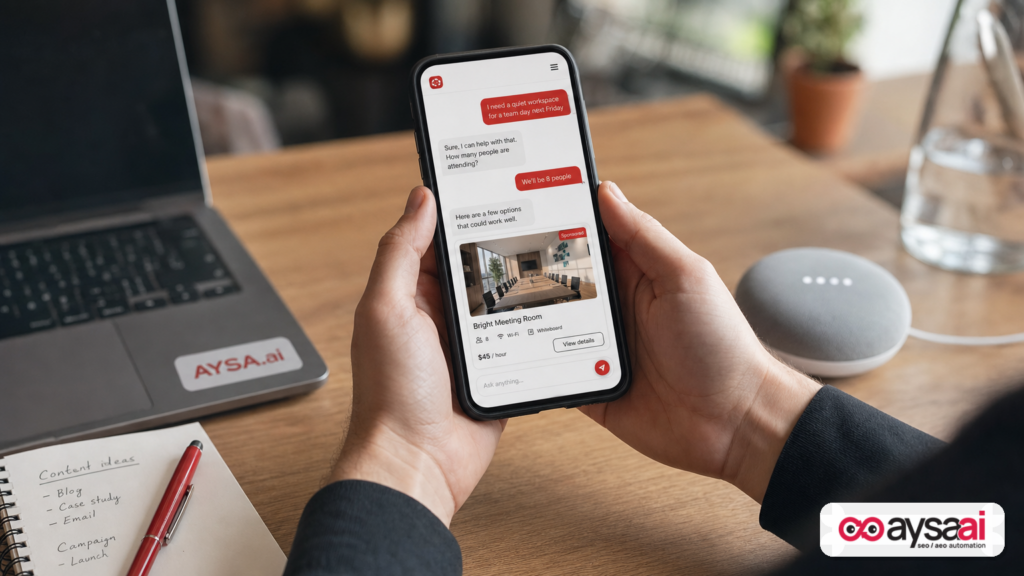
Amazon is turning Alexa into an agentic shopping destination and positioning ads inside AI-powered shopping conversations. That matters because:
- Discovery shifts from keywords to dialogue—people describe goals, constraints, and preferences in natural language.
- Ads become part of the assistant’s “recommendations”, compressing the path from consideration to purchase.
- Measurement becomes more closed-loop inside Amazon—but may become more opaque outside it.
- Ecommerce SEO and retail media converge: your product data, content, and merchandising choices increasingly determine whether you’re recommended.
Key takeaways (what to do if you only read one section)

- Treat AI assistants like a new shelf, not a new ad unit. You’re competing for recommendation position, not just Clicks.
- Fix “answerability” first: product page clarity (compatibility, sizing, materials, returns, shipping, warranty, comparisons) is now conversion-critical earlier in the journey.
- Assume fewer, higher-impact touchpoints. If the assistant offers 2–3 options, being #4 is the same as invisible.
- Separate growth from margin leakage. Conversational ads can drive volume fast; without guardrails, they can also drive discounting and cannibalization.
- Invest in Monitoring and execution speed. When the environment changes weekly, the brands that win are the ones that detect issues early and ship fixes continuously.
Table of contents
- What actually changed: Alexa is now a shopping agent with ads inside the conversation
- From search box to shopping agent: the bigger context behind this move
- Why this matters: the new funnel is a dialogue, not a keyword
- Who wins and who loses when assistants become the storefront
- The great merge: paid and organic visibility collide in AI shopping
- The measurement shift: from clicks to closed-loop outcomes (and new blind spots)
- What can go wrong: brand, trust, compliance, and UX risks
- A practical SME scenario: “Alexa, order more…” and the brand you lose without noticing
- A practical playbook for SMEs: how to get recommended (not just listed)
- What agencies should rethink: skills, deliverables, and operating cadence
- Where AYSA fits: monitoring, preparing changes, approval, and execution
- What to do next (action list)
- Sources and further reading
What actually changed: Alexa is now a shopping agent with ads inside the conversation
The reported change is simple to state and big in implication: Amazon is unifying its AI shopping assistant (Rufus) with Alexa+ to create “Alexa for Shopping.” The core capability is “agentic shopping”—not just answering questions, but helping customers compare, track prices, build carts, and automate purchases.
Amazon is also making advertising a built-in part of this flow. As described by Search Engine Land, existing Amazon Sponsored Ads formats (e.g., Sponsored Products, Sponsored Brands) can be eligible to appear within these shopping experiences, and Amazon is introducing conversational ad formats that can engage users throughout the buying journey.
Translation for business owners: the ad isn’t only on a search results page anymore. It can appear as part of the assistant’s interactive help—right where a customer is expressing intent in plain English.
That shift matters because conversation collects richer signals than clicks. People don’t just say “running shoes.” They say:
- “I need running shoes for flat feet under $120, preferably not white.”
- “Find me a stroller that fits in a small trunk and works for a newborn.”
- “What’s the difference between these two protein powders?”
Those details are gold—for customers and for advertisers. And Amazon is positioning itself to monetize that moment.
From search box to shopping agent: the bigger context behind this move
For two decades, ecommerce discovery largely meant:
- Google query → website visit → browse → buy (or bounce)
- Amazon search bar → marketplace listing → buy
- Social ad → landing page → buy
Now AI assistants are collapsing steps. The “research” layer (reading reviews, comparing options, interpreting specs, shortlisting) is being automated. The interface is changing from a page to a dialogue.
In the Search Engine Land coverage, Amazon frames conversational and agentic shopping as a current reality, not a distant concept. It also points to scale signals (for example, usage of Rufus) to argue that consumers are already interacting this way.
Whether you sell on Amazon, sell direct-to-consumer, or rely on leads, the same trend is coming for you: AI will increasingly decide which options are even seen.
In parallel, the broader search ecosystem is shifting toward AI answers and AI-native discovery. Search Engine Land has been covering adjacent moves across platforms—like Meta adding AI experiences in search and Microsoft/Bing evolving AI reporting and intents. Those changes aren’t identical to Amazon’s, but they’re directionally aligned: the interface is becoming an assistant, and the assistant is becoming the gatekeeper.
Why this matters: the new funnel is a dialogue, not a keyword
SMEs often think of “the funnel” as something you can map to channels:
- Top of funnel: content, social, YouTube, broad keywords
- Mid-funnel: comparison pages, reviews, email
- Bottom-funnel: brand search, retargeting, direct traffic
Conversational shopping disrupts that model because the assistant can do multiple funnel stages in one sitting.
A dialogue compresses the journey
A real customer conversation might go:
- “I need a gift for my dad who grills a lot.”
- “Under $80.”
- “He already has a thermometer.”
- “Okay, show me options.”
- “Add that to cart, but can it arrive by Friday?”
That’s discovery, qualification, objection handling, and conversion—all in one flow.
You’re not just competing with similar products
In a dialogue, alternatives can broaden. A user asking for “a gift for someone who grills” could be guided to:
- Grill tools
- Meat rubs
- Gift cards
- Cookbooks
- Subscription boxes
If your brand’s merchandising and content don’t clearly map to needs and use cases, you can lose visibility even if your product is “technically relevant.”
The assistant creates a new shelf with fewer slots
Classic search results might show ten blue links, a shopping carousel, and ads. In voice or conversational interfaces, the user may receive two or three “best” options. That’s a brutal concentration of attention.
So the question becomes: what makes an assistant recommend you? It’s rarely one factor. It’s the combined effect of:
- Product data quality and completeness
- Availability and shipping promises
- Price competitiveness (and consistency)
- Ratings and review narratives
- Brand recognition and trust signals
- Ad eligibility and bidding strategy
- Content that answers common objections
Who wins and who loses when assistants become the storefront
This shift doesn’t automatically favor the biggest brand—though scale helps. The real winners will be the businesses that treat assistant-driven shopping like a discipline, not a novelty.
Likely winners
- Brands with crisp positioning: If the assistant can summarize why you’re different in one sentence, you’ll surface more often.
- Operationally reliable sellers: Fast shipping, stable inventory, clear returns, fewer “surprises.”
- Merchants with excellent product information: Not fluffy copy—usable specifics that resolve ambiguity.
- Teams who test and iterate: Creative, offers, PDP changes, and feed improvements on a steady cadence.
Likely losers
- “Me too” products with no clear differentiation and inconsistent review quality.
- Brands that rely on one discovery channel (e.g., Google organic only, or a single marketplace listing).
- Businesses with outdated PDPs that don’t answer the questions assistants surface (compatibility, setup, care instructions, warranty, etc.).
- Teams who can’t ship changes because execution is bottlenecked by dev cycles, approvals, or agency handoffs.
The great merge: paid and organic visibility collide in AI shopping
Search Engine Land’s framing is important: Amazon is integrating sponsored ad formats directly into shopping conversations. In other words: ads are not separate from the shopping help—they’re embedded in it.
That accelerates a trend the search industry has been wrestling with across AI surfaces: paid and organic are no longer cleanly separated in the user’s mind—or in the interface.
What changes for ecommerce SEO
Traditional ecommerce SEO often focused on:
- Category page rankings
- Long-tail product queries
- Editorial content that captures research intent
Those still matter. But in a conversational environment, the assistant is effectively building a “dynamic SERP” per user. So SEO expands into:
- Answer Engine Optimization (AEO): Are your pages easily quotable and summarizable?
- Generative Engine Optimization (GEO): Are you present in the knowledge a model draws from when forming a recommendation?
- Merchandising clarity: Are product variants, bundles, and accessories structured in a way an assistant can reason about?
If you want a deep dive on AI-driven visibility concepts, start with AYSA’s overview of AI search visibility and how to monitor whether AI surfaces recommend you (or ignore you).
What changes for advertising
Retail media has been growing for years. The new change is the surface: conversational placements can influence the user earlier and more directly, while the user is still forming preferences and constraints.
That demands a shift in creative and targeting logic. Instead of only optimizing for a query like “best air fryer,” you may be optimizing for conversational contexts like:
- “I have a small apartment kitchen.”
- “I’m cooking for two.”
- “I need something easy to clean.”
Your messaging and your product content must align with those contexts—or you’ll win the impression and lose the sale.
The measurement shift: from clicks to closed-loop outcomes (and new blind spots)
One of Amazon’s strongest pitches, per Search Engine Land, is closed-loop measurement powered by first-party signals. In commerce, closed-loop is a big deal: it links exposure → engagement → purchase.
But every “closed loop” has an edge, and the edge is where businesses get hurt.
The good: clearer outcome attribution (inside the platform)
When the same ecosystem controls the ad impression, the shopping interaction, and the purchase, it can provide more direct measurement than many open-web flows. For advertisers, that can reduce guesswork.
The risk: optimizing the wrong outcome
Closed-loop measurement can still push you into bad decisions if:
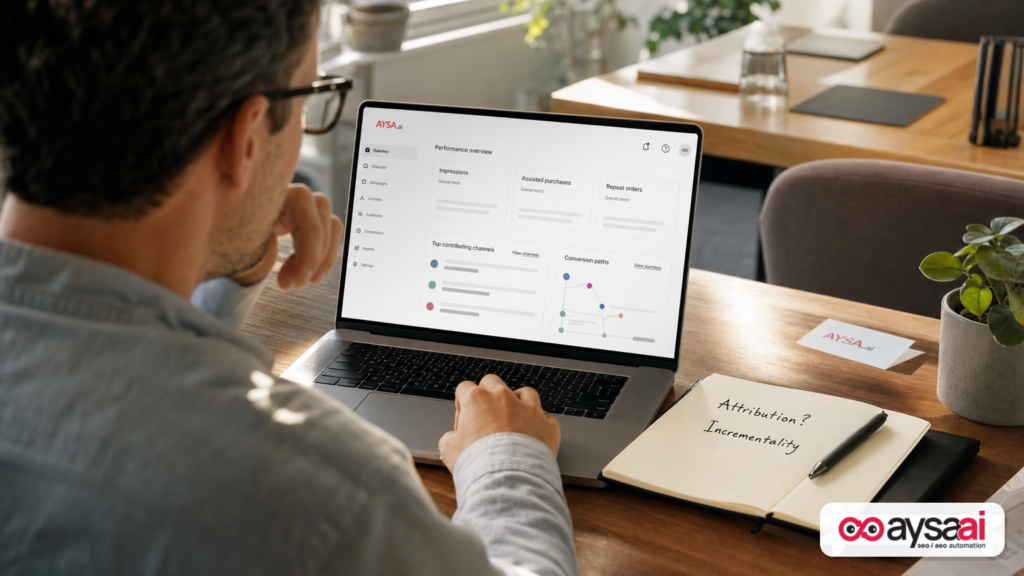
- You can’t see incrementality: was the sale truly influenced, or would it have happened anyway?
- You over-optimize for conversion rate: which can bias you toward discounting, brand bidding, or already-loyal customers.
- You ignore margin and returns: a “conversion” can be unprofitable after fees, shipping, or return rates.
SMEs should treat assistant-driven commerce metrics the way mature teams treat paid search: outcomes matter, but unit economics decides sustainability.
What to monitor (practically)
Even if you’re not an analytics-heavy business, you should be able to answer:
- Which products are gaining impressions but losing share?
- Are “assistive” placements increasing AOV or lowering it?
- Are returns rising on products being recommended more often?
- Is repeat purchase improving, or are you buying one-time buyers?
If you don’t have a monitoring cadence, you’re flying blind. AYSA’s Monitoring is designed for this reality: detect visibility and performance issues early, prepare the right fixes, and move them through approval to execution.
What can go wrong: brand, trust, compliance, and UX risks
When ads blend into conversational help, trust becomes fragile. If users feel “steered,” they push back. If regulators feel disclosures are unclear, platforms adjust fast—and advertisers pay the price in volatility.
We can’t verify future enforcement outcomes from the provided sources, but the direction is clear: AI experiences are being scrutinized for accuracy and accountability across markets. Search Engine Land has also covered legal exposure related to AI-generated claims in search contexts (see their reporting on AI answer liability: Google can be directly liable for false AI Overview claims: German court). The underlying takeaway for ecommerce is universal: if an AI surface makes a misleading claim about your product, you need processes to detect it and fix the source of confusion.
Brand safety isn’t just adjacency anymore
In conversational commerce, brand safety includes:
- Being recommended for the wrong use case
- Being framed with incorrect specs (dimensions, compatibility, ingredients)
- Being compared unfairly (or inaccurately) to a competitor
That’s a content and data quality problem as much as an ad problem.
UX risk: assistants expose your weak points instantly
Humans tolerate ambiguity on product pages longer than assistants do. A shopper might scroll. An assistant might simply choose a different product if it can’t confidently answer:
- “Will this fit my device?”
- “Is this safe for sensitive skin?”
- “How long does it take to assemble?”
If your product pages don’t answer these questions clearly, you won’t just lose SEO rankings—you’ll lose recommendation eligibility.
A practical SME scenario: “Alexa, order more…” and the brand you lose without noticing
Let’s make this real.
Scenario: You run a small but growing ecommerce brand that sells specialty coffee pods (or tea, vitamins, pet treats—any replenishable product). You’ve built a loyal base. People reorder monthly.
Historically, reorders happen via:
- Your email reminders
- Your subscription option
- Customers typing your brand name into Amazon or Google
Now imagine the reorder behavior becomes:
“Alexa, order more coffee pods.”
Here’s where things get dangerous:
- If the assistant defaults to “best value” or “fastest delivery,” you could lose the sale to a competitor—or a private-label alternative.
- If your pack sizes, names, or variants are confusing, the assistant might surface the wrong item, causing returns and churn.
- If a sponsored placement appears in the conversation at the wrong time, it can hijack your hard-earned repeat purchase behavior.
None of that requires your product to be bad. It only requires the assistant to have a “more confident” path elsewhere.
The SME lesson: assistant-driven shopping makes clarity and defaults the new battleground. You need to control the information the assistant uses and the user experience that follows the recommendation.
A practical playbook for SMEs: how to get recommended (not just listed)
This is the heart of the article. If you’re an SME, you don’t need a research lab. You need a system.
1) Make your product pages “conversation-ready”
Assistants thrive on clean, explicit, unambiguous information. Your goal is to remove uncertainty.
Checklist (high impact):
- Compatibility: device models, sizes, age ranges, ingredients, materials
- Constraints: who it’s not for (allergies, limitations, usage warnings)
- Shipping and returns: clear, prominent, plain language
- Proof: real FAQs, support snippets, usage instructions
- Comparison anchors: “What’s the difference between X and Y?” answered on-page
This is where AEO becomes practical: you’re not writing fluff for a crawler—you’re writing answers for customers and assistants.
2) Build content around “next-question intent”
In conversational discovery, each answer triggers a next question. Brands that anticipate the next question reduce drop-off and increase recommendation confidence.
Search Engine Land has discussed the importance of “next-question intent” for AI visibility in related coverage (Why next-question intent matters for AI search visibility). The idea translates directly to ecommerce: don’t just answer the initial question—answer what the shopper asks right after.
For example, if you sell standing desks, the sequence might be:
- “What’s the best standing desk for a small space?”
- “Will it fit a 27-inch monitor and a laptop?”
- “Is it stable at full height?”
- “How hard is assembly?”
Create FAQ sections, comparison pages, and support content that covers those chains. Then link them cleanly.
3) Treat your product data like revenue infrastructure
Whether you sell primarily on Amazon or DTC, your structured product information matters more as assistants mediate the selection process.
Even without asserting a specific schema strategy from the supplied sources, it’s worth noting the industry’s direction: structured markup and product metadata help machines interpret pages consistently. Search Engine Land recently noted Schema.org is surfacing adoption data by type (Schema.org now shows you how many sites are using each schema type). That’s a signal that structured information is an active area of practice and measurement.
Practical SME move: audit your top-selling product pages for completeness and consistency before you chase new channels.
4) Align your paid strategy to conversational moments (not only keywords)
If conversational placements expand, the winning advertisers will understand the intent states inside the dialogue:
- Exploration (“what should I buy?”)
- Constraint setting (“under $100,” “no fragrance”)
- Shortlisting (“compare these two”)
- Commitment (“add to cart”)
Your offers and messaging should match the state. Don’t throw a discount at someone who is still trying to figure out “which type” is right—they need clarity, not urgency.
Also watch the industry trend: AI-native ad formats are expanding beyond Amazon. Search Engine Land has reported on OpenAI launching product feed ads in a beta (OpenAI launches product feed ads in Ads Manager beta). You don’t need to jump into every beta, but you do need to accept the trajectory: product feeds and conversational ad units are becoming a new distribution layer.
5) Protect margin with guardrails
Assistant-driven shopping can increase conversion efficiency. That’s great until:
- You overbid to “win the recommendation” and destroy profitability.
- You discount to increase conversion rate and train customers to wait for deals.
- You cannibalize your existing branded demand.
Guardrails SMEs can implement:
- Set product-level ROAS/ACOS targets tied to margin, not revenue.
- Segment “new-to-brand” vs repeat where possible (at minimum conceptually in reporting).
- Protect hero SKUs: don’t let automation push spend into the wrong variants.
- Keep a human approval step for major bid/creative shifts—especially in volatile weeks.
6) Build a monitoring cadence for AI visibility
In the old world, you checked rankings. In the new world, you check whether AI surfaces are recommending you, how you’re described, and what competitors are being suggested instead.
This is exactly where an execution system matters. AYSA is built to:
- Monitor visibility and signals that impact AI discovery (Monitoring)
- Prepare changes (content updates, structured improvements, technical fixes)
- Ask for approval so SMEs stay in control
- Execute accepted changes so you don’t stall in endless backlogs
If you’re evaluating systems, start with AYSA’s AI SEO tools and how they map to AI search visibility workflows.
What agencies should rethink: skills, deliverables, and operating cadence
Agencies and consultants are going to feel this shift in two ways:
- Clients will ask, “Why am I not showing up in AI answers/recommendations?”
- Clients will demand faster execution—because the environment changes faster.
Deliverables need to evolve past “rankings + reports”
In assistant-driven commerce, the deliverable is not a PDF. It’s a shipped improvement:
- Updated PDP template that answers top objections
- Comparison content that resolves “X vs Y” queries
- Feed/data cleanup plan
- Testing roadmap for conversational ad messaging
Ops matters more than strategy decks
A strategy that takes 90 days to implement will lose to a competitor that ships weekly.
This is why we’ve been opinionated at AYSA: execution is the differentiator. Monitoring insights without implementation is just anxiety.
If your agency workflow is stuck in tickets and long dev queues, consider a model where you:
- Run continuous monitoring
- Prepare batches of fixes weekly
- Get client approval quickly
- Execute changes safely with rollback options
That “approved execution” approach is central to how AYSA is designed—and it’s why many SMEs prefer it over tools that only diagnose problems.
Where AYSA fits: monitoring, preparing changes, approval, and execution
Let me be direct about the business reality: AI shopping surfaces will increase volatility. The brands that win won’t just have better ideas—they’ll have better systems.
AYSA’s role in this shift is to help SMEs and lean teams do four things consistently:
1) Monitor what AI surfaces are doing to your visibility
When conversational shopping grows, you need to know when:
- Your product or brand stops getting recommended
- A competitor is suddenly appearing in “best for…” contexts you used to own
- Your own pages are missing the answers customers keep asking
Start here: AYSA Monitoring
2) Prepare changes that improve answerability and conversion
For ecommerce, the most common “AI visibility” improvements are not mystical. They’re operational:
- Better product descriptions and FAQs
- Cleaner internal linking between comparisons, FAQs, and PDPs
- Fewer technical errors that block discovery
AYSA helps you identify and prepare these updates in a structured way so they can actually ship.
3) Keep humans in control with approvals
SMEs cannot afford rogue changes to pricing pages, product claims, or regulated content. Approved execution is a safety feature, not a slowdown.
4) Execute accepted fixes (the part most teams can’t do reliably)
Execution is where most “AI optimization” plans die. AYSA is designed to move from insight to implementation with accountability.
If you want to understand how this fits your business size and cadence, see AYSA pricing and browse examples and thinking in the AYSA blog.
What to do next (action list)
Use this as a 30-day plan. Keep it simple.
- Audit your top 20 revenue-driving products: do the pages clearly answer compatibility, constraints, shipping/returns, and “X vs Y” comparisons?
- Write down the top 25 customer questions your support team sees—and make sure each is answered on the site in a way an assistant can extract.
- Create 5 comparison pages (or sections) for the most common “vs” and “best for” scenarios in your category.
- Align paid messaging to intent stages: test one message for exploration, one for shortlisting, one for commitment.
- Add margin guardrails to your ad optimization so conversational placements don’t quietly erode profitability.
- Set a monitoring cadence (weekly): track AI visibility, product content gaps, and sudden competitive displacement.
- Adopt an execution system: use AYSA to monitor, prepare changes, get approvals, and ship updates continuously.
Sources and further reading
- Search Engine Land: Amazon turns Alexa into a shopping agent — and an advertising platform
- Search Engine Land: OpenAI launches product feed ads in Ads Manager beta
- Search Engine Land: Schema.org now shows you how many sites are using each schema type
- Search Engine Land: Why next-question intent matters for AI search visibility
- Search Engine Land: Google can be directly liable for false AI Overview claims: German court
- Search Engine Land: Bing Webmaster Tools updates AI reporting with Intents, Topics, Citation Share and Compare
Related AYSA resources:
Author: Marius Dosinescu / AYSA.ai
Continue the AI search topic inside AYSA.
Use these pages to connect the article with AI SEO tools, AI visibility monitoring, AI Overviews and approved website execution.
Turn this topic into a website action plan.
Use these AYSA hubs to move from reading to technical fixes, AI visibility monitoring, research, glossary context and approval-first SEO execution.