OpenAI Product Feed Ads in ChatGPT: What It Means for Retailers, Agencies, and the New “Conversation Shelf”
OpenAI is testing product feed ads in Ads Manager—bringing the dynamic catalog model into ChatGPT conversations. Here’s what changed, why it matters, the risks, and a practical playbook for retailers and agencies (plus how AYSA helps you execute the site and feed work that actually makes these ads perform).

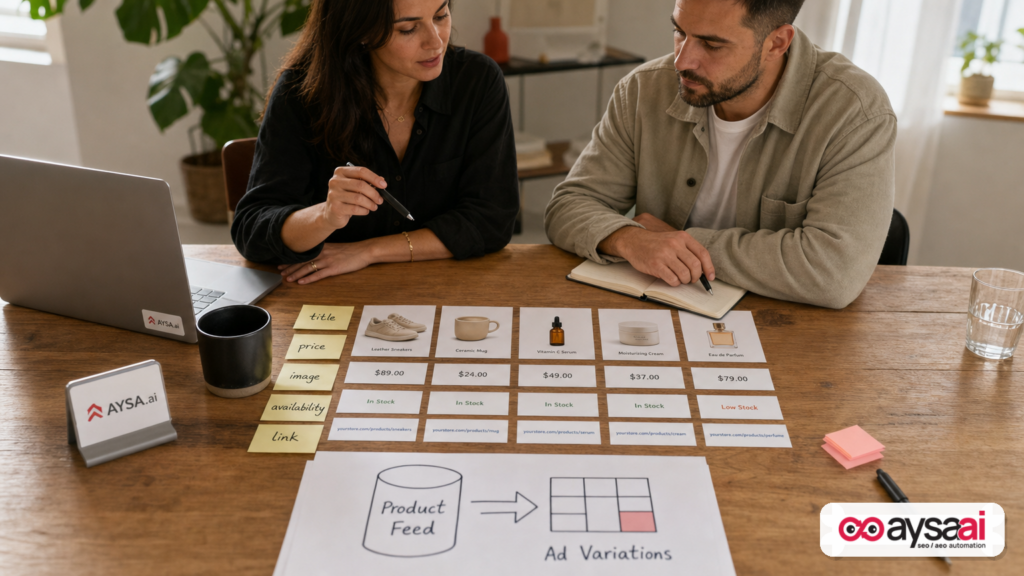
OpenAI is testing a familiar performance marketing mechanic in a new place: product feed ads inside its Ads Manager, designed to help retailers match catalog items to purchase-focused conversations in ChatGPT—without manually building an ad for every SKU.
This sounds like a simple feature release. It’s not. It’s a sign that the battle for “the digital shelf” is moving from search results pages and social feeds into AI conversations. And that shift forces retailers, agencies, and marketers to rethink what “ads,” “SEO,” and even “merchandising” mean when a user asks: “What’s the best option for me?”
I’m Marius Dosinescu, and from the AYSA.ai perspective, the headline isn’t “OpenAI has ads now.” The headline is: your product data and your website are about to do more of the selling—because AI-driven ad delivery is only as good as the catalog, landing pages, and structured signals behind it.
Concise summary

- What changed: OpenAI introduced product feed ads in Ads Manager (beta), letting retailers upload a catalog and generate ads from individual items.
- Why it matters: Product feeds scale performance ads, but in ChatGPT they may also influence what users perceive as “recommended” in a conversation—blurring ads and discovery.
- What to do: Treat your catalog as a high-stakes data asset: fix titles, attributes, prices, availability, canonical URLs, and landing pages; improve Structured data; tighten merchandising logic; build measurement discipline.
- Where AYSA fits: AYSA monitors your site, prepares the specific technical and content changes that improve product/collection landing pages and discoverability, asks for approval, and executes accepted updates—so catalog-based advertising and AI discovery have clean surfaces to land on.
Table of contents
- What OpenAI launched (and what we can safely infer)
- The shift: from “search results pages” to “conversation shelves”
- Why product feeds became the default in performance marketing
- The hidden prerequisite: your product data has to be “AI-ready”
- Landing pages matter more than ever (and most stores underinvest)
- Measurement: what gets harder in conversational ads
- Risks and failure modes: brand safety, bad matches, and catalog chaos
- What agencies should rethink: from “campaign builders” to “inventory operators”
- A practical SME scenario: the 5,000-SKU home goods store
- A 30–60 day action plan for retailers testing ChatGPT feed ads
- How AYSA helps: approved execution for AI-era visibility
- What to do next (checklist)
- Sources and further reading
What OpenAI launched (and what we can safely infer)
According to Search Engine Land, OpenAI introduced a new Ads Manager beta capability that lets retail advertisers upload product feeds and automatically create ads from catalog items. The stated goal: connect shoppers with relevant products in purchase-focused conversations without manually building ads for each item.
The article also notes that OpenAI says feed-based ads have been among the strongest-performing formats in its Ads Beta so far, and that this mirrors the dynamic feed strategy long used by other major ad platforms.
Here’s what we can infer—carefully—without inventing details:
- Catalog-based ad assembly: Feed fields (title, price, image, availability, URL, etc.) can be used to generate ad objects at scale.
- Relevance matching: Ads can be selected based on the conversation context and user intent.
- Retail focus: This is purpose-built for ecommerce and product catalogs, not generic lead gen.
What we cannot responsibly claim from the provided context: the exact placement format in ChatGPT, UI screenshots, specific targeting options, auction dynamics, or performance benchmarks. Those may exist in beta documentation or product emails, but they’re not in our research context—so we treat them as unknowns.
The shift: from “search results pages” to “conversation shelves”
Traditional digital retail discovery is built around a few familiar shelves:
- Search shelves (Google, Bing): Keyword → results → click → compare
- Social shelves (Meta, TikTok): scroll → interest → impulse → click
- Marketplace shelves (Amazon, Walmart): filter → reviews → buy
ChatGPT introduces a different shelf: the conversation shelf.
In a conversation, the user isn’t just typing a query. They’re explaining constraints:
- “I need a carry-on suitcase that fits international airlines.”
- “I want a moisturizer that won’t irritate sensitive skin.”
- “Show me a gift under $50 that ships in two days.”
That means the ad opportunity becomes less about “rank for a keyword” and more about “be the best match for the constraint set.” Product feeds are the only scalable way to compete in that environment—because you can’t handcraft creative for every possible constraint combination. The data has to do the work.
This also aligns with a broader industry pattern: AI is increasingly merging paid and organic visibility. Search Engine Land has been tracking the convergence, including pieces like How AI is merging paid and organic visibility. The practical takeaway is simple: your paid strategy can’t be separated from your website quality anymore.
Why product feeds became the default in performance marketing
Product feeds didn’t win because they’re trendy. They won because they solve three hard problems that every retailer runs into the moment they scale:
1) Scale: humans can’t build ads at SKU volume
If you have 200 SKUs, you can still brute-force a lot. If you have 5,000, 50,000, or 500,000 SKUs, brute-force becomes organizational debt. Feeds turn your catalog into an advertising substrate.
2) Freshness: inventory changes faster than campaigns
Prices update. Products go out of stock. Shipping windows change. Promotions rotate. In feed-based systems, the ad platform can reflect those changes without a marketer re-uploading creative every day.
3) Relevance: the best item depends on the user
Even inside the same product line, the “best” recommendation depends on size, color, budget, intent, and urgency. If the platform can match user intent to item attributes, you get more relevant Impressions and fewer wasted Clicks.
In other words: feed-based ads are automation-friendly performance marketing. That’s why this feature coming to OpenAI’s Ads Manager matters. It signals that OpenAI is building the same scalability primitives that made Google Shopping and dynamic ads on social so powerful—now pointed at conversational intent.
The hidden prerequisite: your product data has to be “AI-ready”
Most teams think feed ads are “just a channel” problem—upload feed, set budget, done.
In reality, feed ads are a data governance problem. If your feed is sloppy, the platform will still scale—just in the wrong direction.
Here’s what “AI-ready” usually means in practice:
Titles that describe the product the way a human shops
Retailers often generate titles for internal use (“SKU 18371 / Model XZ / Variant 04”). That’s useless in discovery.
High-performing titles typically include:
- brand (if it matters to shoppers)
- product type
- key differentiator (material, size, compatibility, etc.)
- variant (only if it changes purchase intent)
Attributes that match real constraints
Conversational shopping is constraint-heavy. If your feed doesn’t include the attributes people ask about, the platform can’t match you.
Examples:
- For apparel: fit, fabric, seasonality, care instructions
- For electronics: compatibility, warranty, power specs
- For home goods: dimensions, materials, room type
Price integrity and availability hygiene
Nothing burns trust faster than a conversation that suggests a product at one price, then lands the user on a page with a different price or out-of-stock status.
If you want to play in AI conversations, you need to treat “price + availability” as a reliability system, not a marketing detail.
Canonical URLs and variant logic that don’t leak value
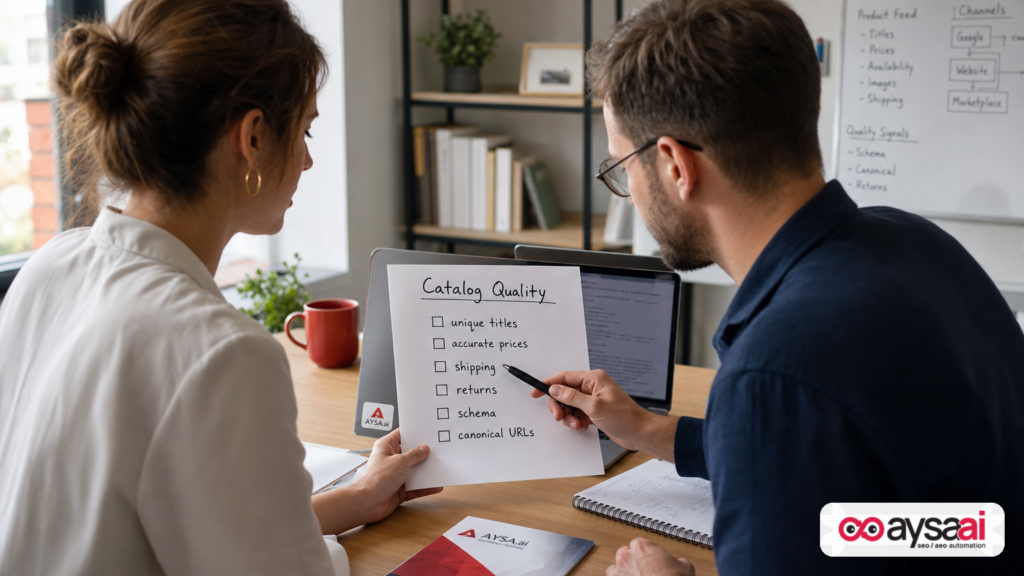
Ecommerce sites are famous for URL sprawl—variants, filters, UTM parameters, session IDs, sort orders, and duplicates. Even if the ad platform can ingest your product URLs, your site still needs to:
- resolve to a stable canonical page
- load fast on mobile
- show the exact item referenced (variant correctness)
This is where many catalog-based ad programs silently fail: the ad gets the click, but the landing page doesn’t close the sale—or worse, it confuses the shopper.
Landing pages matter more than ever (and most stores underinvest)
When ads are selected from feed data, marketers tend to obsess over the feed and forget the destination.
But AI-driven discovery increases the importance of landing pages for one reason: the user arrives with higher expectations.
If the conversation implied “this matches your constraints,” the shopper expects the product page to confirm those constraints immediately. That means:
- clear above-the-fold confirmation of the key attribute(s)
- credible shipping/returns info (not buried)
- real photos that match the variant
- reviews or proof points that address common objections
- fast Page speed and stable UX
Structured data is not “SEO busywork” anymore
In an AI-driven environment, structured data (like product markup) becomes a shared language between your store and machines. Even though the Search Engine Land piece is about paid ads, the adjacent reality is that AI systems rely on structured signals. If your pages are ambiguous, machines guess.
We can’t cite a specific OpenAI requirement from the provided context, but the strategic lesson remains: improve the machine-readability of your product and category pages. If you’re already doing this for SEO, you’re also reducing friction for any AI discovery system that touches your site.
If you want to systematize this, AYSA’s approach is to monitor the site, identify issues that affect visibility and conversion, prepare the recommended fixes, and only execute after your approval. Start here:
- AYSA Monitoring (ongoing detection of issues and opportunities)
- AI Search Visibility (how your brand shows up in AI-driven discovery)
Measurement: what gets harder in conversational ads
Retailers love feed ads because they’re measurable—impressions, clicks, ROAS, conversion value. In conversational environments, measurement can get fuzzier, because:
- Users may get answers without clicking immediately.
- They may click later via a different channel (organic search, direct, email).
- They may compare multiple options within the conversation before acting.
So what should SMEs and agencies do? Without inventing platform-specific measurement capabilities, you can still build a practical measurement discipline:
1) Don’t skip the basics: clean URLs and attribution hygiene
Ensure landing pages don’t break when tagged. Keep canonical logic correct. Avoid parameter chaos that creates duplicate URLs or breaks caching.
2) Treat early tests as incrementality experiments
When a new channel emerges, last-click numbers can be misleading. Use holdouts where possible, or at least compare performance against a baseline period while controlling for promo calendars.
3) Watch assisted behavior, not just last-click
If conversational ads influence consideration, you may see lifts in Branded Search, direct traffic, and repeat sessions. Don’t overclaim causality—but do monitor patterns.
AYSA can help here by making sure the site changes you need for clean measurement (like consistent canonicalization, internal linking, and page quality) are identified and executed in a controlled way. Tools and workflows live here: AI SEO Tools.
Risks and failure modes: brand safety, bad matches, and catalog chaos
Whenever automation increases, new risks show up. Product feed ads in ChatGPT are no different. Here are the failure modes I’d expect retailers to face—based on how feed systems behave across platforms.
Risk 1: The “wrong product for the right question” problem
If your feed attributes are incomplete, the system can’t match properly. You might show a “water-resistant” jacket to someone asking for “waterproof,” or a product in the wrong size range. In a conversation, that mismatch feels more personal—because the user asked a nuanced question.
Risk 2: Context and brand voice drift
Catalog ads assembled from data can feel transactional. In a conversational interface, brands may want more control over tone and claims. If the platform’s ad rendering is minimal (or standardized), your differentiation has to come from:
- strong product photography
- clear titles and descriptions
- landing page persuasion
Risk 3: Compliance and policy surprises
Retail categories like health, supplements, finance-adjacent products, or sensitive personal products can trigger policy constraints. We don’t have OpenAI’s full policy context in the provided material, so the safe advice is: build a compliance checklist early and expect iteration.
Risk 4: Catalog ops becomes marketing ops
Feed advertising forces a new relationship between teams:
- Merchandising controls inventory and pricing.
- Marketing controls budget and performance goals.
- Engineering controls site templates and data plumbing.
If those teams don’t share a single source of truth, you get whiplash: ads promoting items that the warehouse can’t fulfill, or landing pages that don’t align with the feed.
What agencies should rethink: from “campaign builders” to “inventory operators”
Agencies grew up in a world where the job was:
- build campaigns
- write ads
- manage bids
- report results
Feed advertising already changed that. But conversational inventory makes the shift unavoidable: you’re managing an always-on product recommendation layer, not just ads.
That means the best agencies will:
Own feed quality as a billable competency
Not “we uploaded it.” Instead: governance, QA, attribute completeness, taxonomy decisions, and change control.
Tie creative performance to landing page performance
If you’re buying traffic into a conversation shelf, the landing page must close the loop quickly. Agencies that refuse to touch the site will increasingly look obsolete.
Blend paid + organic visibility thinking
If AI is merging paid and organic visibility, then ad teams need to understand technical SEO and content quality—and SEO teams need to understand intent-based merchandising. (Search Engine Land’s coverage of this convergence is a useful starting point: AI is merging paid and organic visibility.)
This is also where the “ultimate guide” era of SEO content is fading, replaced by more intent- and journey-based assets. Search Engine Land discusses this shift in What replaces the ultimate guide in AI search. Even for paid, this matters: your landing pages and supporting content need to answer follow-up questions, not just rank for a head term.
A practical SME scenario: the 5,000-SKU home goods store
Let’s make this real.
You run a 5,000-SKU home goods ecommerce store—think kitchen tools, small appliances, storage, and décor. You’ve done okay with Google Ads, some social, and email. You’re invited into OpenAI’s Ads beta, and now product feed ads are available.
Here’s what happens if you approach it the “old” way:
- You export your catalog.
- You upload it.
- You set a budget.
- You wait for ROAS.
And here’s what happens next:
- Some items look great; others show weird titles like “Storage Bin – Default Variant.”
- High-intent conversations trigger low-margin items because they’re cheapest, not because they’re best.
- Click-through is fine, but conversion is weak because the product page doesn’t immediately confirm size/material constraints.
- You blame the channel, pause it, and miss the opportunity.
Now the “new” approach—what I’d recommend:
Step 1: Pick one category with predictable intent
For example: “airtight food storage containers.” The intent is strong, the attributes are clear (size, material, dishwasher safe, BPA-free), and the landing pages can be improved quickly.
Step 2: Fix feed fields for that category first
- normalize titles (brand + container type + size + key feature)
- ensure images show the variant accurately
- confirm availability logic is correct
Step 3: Upgrade landing pages to close the conversation
Above the fold, show:
- the exact size and capacity
- materials and safety claims (only if true and substantiated)
- shipping timeline
- returns clarity
Step 4: Treat this as an operations loop
Every week:
- identify mismatches (queries/intents → wrong products)
- adjust attributes and taxonomy
- improve category-level content to answer follow-up questions
- fix site issues that slow or confuse the buyer
AYSA is designed for that weekly operational loop: monitoring surfaces issues; recommendations are prepared; you approve; execution happens. That’s how you keep momentum without turning every change into a multi-team fire drill.
A 30–60 day action plan for retailers testing ChatGPT feed ads
If you’re a retailer or agency preparing for this, here’s a realistic plan that doesn’t assume enterprise resources.
Days 1–10: Catalog and site readiness audit (fast, pragmatic)
- Pick 1–3 categories to pilot (not your whole store).
- Audit product titles for human readability and uniqueness.
- Audit variant handling (size/color) and make sure URLs resolve cleanly.
- Spot-check price and availability consistency between feed and landing pages.
- Review top landing pages for speed and mobile usability.
Where AYSA helps: Monitoring catches technical and content issues that impact visibility and conversion, and reduces the chance you scale broken pages with paid traffic.
Days 11–30: Pilot build and “data-first” optimization
- Clean attributes for pilot categories (dimensions, materials, compatibility).
- Standardize naming conventions across variants.
- Improve collection/category pages so they answer comparison questions.
- Ensure internal linking supports discovery (category → subcategory → product).
This is also a good time to align on what success means. If the channel is new and attribution is uncertain, define a short list of metrics you will trust for the pilot period.
Days 31–60: Expand cautiously and systematize governance
- Add more categories only after you can explain what worked.
- Create a weekly catalog QA routine (prices, stock, titles, images).
- Set a change log for feed updates and landing page changes.
- Document common mismatch patterns and fix root causes in the feed.
The goal is to turn “testing a beta” into a repeatable operating model.
How AYSA helps: approved execution for AI-era visibility
Most platforms can help you spend money. Very few can help you earn performance by improving the underlying asset: your website and product content.
AYSA is built for the execution gap that kills most growth programs:
- Monitoring: detect technical, content, and visibility issues continuously (Monitoring).
- Preparation: generate prioritized fixes and improvements for pages that matter (product pages, category pages, informational support pages).
- Approval: you control what gets changed—nothing ships without review.
- Execution: accepted changes get implemented so teams don’t stall.
In the context of OpenAI product feed ads, AYSA’s value is not “run your ads.” It’s helping you build the clean, consistent, high-converting surfaces those ads depend on:
- better product and category content that matches real intent
- technical hygiene that prevents duplicate URLs and canonical confusion
- site improvements that make attribution and measurement more reliable
- ongoing visibility tracking as AI discovery evolves (AI Search Visibility)
If you’re evaluating whether this model fits your team, start with:
- Pricing (to see how AYSA maps to team size and scope)
- Blog (ongoing guidance on AI-era SEO/AEO/GEO execution)
What to do next (checklist)
Use this as your practical next-step list—whether you’re in the beta now or planning for when access broadens.
For retailers
- Choose a pilot category with clear attributes and steady demand.
- Clean your feed titles and attributes for that category (human-first, constraint-ready).
- Fix landing pages to confirm constraints above the fold (size, material, compatibility, shipping).
- Reduce URL chaos (canonical correctness, variant consistency).
- Document a weekly catalog QA routine so performance doesn’t decay over time.
For agencies
- Add feed governance to your service menu (not as an afterthought).
- Build a site + feed joint roadmap with the client (marketing + merchandising + dev).
- Update reporting to reflect assist and incrementality, not only last-click ROAS.
- Partner with execution systems (like AYSA) so recommendations actually ship.
If you want AYSA to support the site execution side—so your ads aren’t landing on messy, ambiguous pages—start with our toolset and visibility workflows: AI SEO Tools and AI Search Visibility.
Sources and further reading
- Search Engine Land — OpenAI launches product feed ads in Ads Manager beta
- Search Engine Land — How AI is merging paid and organic visibility
- Search Engine Land — What replaces the ultimate guide in AI search
- Search Engine Land — Meta launches AI Mode in Facebook search to answer questions
- Search Engine Land — Bing Webmaster Tools updates AI reporting with Intents, Topics, Citation Share and Compare
Continue the AI search topic inside AYSA.
Use these pages to connect the article with AI SEO tools, AI visibility monitoring, AI Overviews and approved website execution.
Turn this topic into a website action plan.
Use these AYSA hubs to move from reading to technical fixes, AI visibility monitoring, research, glossary context and approval-first SEO execution.