From “Chaos Gardens” to AI Search: What Google’s New Gardening Tips Reveal About the Future of Local & Ecommerce SEO
Google’s gardening-focused Search features (AI Mode, Canvas, Search Live, and Shopping “nearby”) aren’t just for hobbyists—they’re a preview of how customers will research, decide, and buy. Here’s what changed, why it matters for SMEs, and how to operationalize AI Search visibility with AYSA’s approved execution model.

Google recently published a consumer-friendly piece on “5 gardening tips you can try right in Search,” showcasing features like AI Mode, Canvas, Search Live (via Lens) and Shopping filters for finding items “nearby.” On the surface, it’s about healthier plants. In practice, it’s a clear signal of where Google Search behavior is headed: more visual input, more AI-assisted planning, and more purchase-ready Local intent—all inside the search experience.
This matters for small and mid-sized businesses because these workflows compress the customer journey. People won’t just search, click, and browse. Increasingly, they’ll ask Search to assemble the plan, diagnose the problem from a camera, and find what’s in stock near them—often before they ever reach your website. That’s not a reason to give up on SEO; it’s a reason to modernize it toward AI Search visibility (AEO/GEO), data quality, and fast execution.
I’m Marius Dosinescu, and at AYSA.ai we focus on a practical reality: strategy doesn’t win on its own. Execution does—especially when search experiences change faster than most teams can ship updates. So let’s use Google’s gardening example as a blueprint for what’s changing in AI Search, why it matters for revenue, and what you should do next.
Concise summary

- Google is normalizing AI-assisted “do it for me” search: planning (Canvas), visualizing (AI Mode image prompts), diagnosing (Search Live), and shopping locally (“nearby” filters).
- These experiences reduce website Clicks but increase the value of being referenced as the trusted source, product, or local provider.
- SMEs should shift from “rank for keywords” to “be the chosen answer” by structuring content, tightening product/location data, and publishing problem-solving pages that work for visual + Conversational search.
- The bottleneck is execution: approvals, technical debt, stale inventory/location info, and slow content updates.
- AYSA fits as an execution system: monitor what changes, prepare the right site updates, ask for approval, then implement accepted changes quickly.
Table of contents
- What Google’s “gardening tips in Search” is really telling us
- What changed in Search (and why it’s bigger than gardening)
- AI Mode + Canvas: why “planning” queries are the new battleground
- Visualization queries: when Search becomes the first design draft
- Search Live + Lens behaviors: the rise of “diagnosis” search
- Shopping “nearby” and inventory checking: local intent is becoming frictionless
- From SEO to AEO/GEO: how AI results change what ‘ranking’ means
- What can go wrong (and how to reduce risk)
- Concrete SME scenario: the local nursery that loses sales in AI Search
- What agencies should rethink right now
- A practical action plan (30/60/90 days)
- Where AYSA fits: monitoring + approved execution for AI Search visibility
- What to do next
- Sources and further reading
What Google’s “gardening tips in Search” is really telling us
When Google highlights consumer features in a mainstream blog post, it’s not just a how-to guide—it’s product positioning. The gardening article frames Search as a “digital tool shed” and demonstrates a set of behaviors that are increasingly common across industries:
- Upload an image → get a tailored recommendation (not just search results).
- Ask for a plan → get a structured schedule (not just a list of articles).
- Point a camera at a problem → get real-time troubleshooting (not just a forum thread).
- Find what’s in stock nearby → reduce the time between intent and purchase.
Swap “mini greenhouse for herbs” with “best standing desk for my home office,” “why is my HVAC making this noise,” “what moisturizer matches this skin condition,” or “what brake pads fit my car.” The pattern holds: Search is evolving into an AI-assisted decision and action layer.
The implication for businesses is uncomfortable but empowering: you are no longer optimizing only for a blue-link click. You’re optimizing to be eligible and chosen inside an AI-assembled answer, a shopping module, or a live diagnostic flow. That’s AEO/GEO in plain terms.
Primary source context: Google’s post is here: Google Search Blog — “5 gardening tips you can try right in Search”.
What changed in Search (and why it’s bigger than gardening)
Let’s translate Google’s five tips into business implications.
1) AI Mode: Search is moving from retrieval to synthesis
In the gardening post, AI Mode is used to visualize a space and recommend a placement (e.g., a mini greenhouse on a patio). The key shift: Search isn’t just retrieving pages; it’s synthesizing a recommendation based on context (sun exposure, space constraints, user preferences).
Business impact: If your product/service is part of that recommendation set, the user may never open 10 tabs. They may choose from the AI’s shortlist.
2) Canvas: Search is expanding into “project management”
Canvas is positioned as a way to build an annual management plan and customize it. That’s not “search” as we’ve known it; it’s closer to a planning assistant.
Business impact: Your content needs to be machine-usable: tasks, timelines, checklists, comparisons, and decision criteria—structured so it can be assembled responsibly.
3) “Chaos garden” prompts: trend-driven discovery becomes conversational
Google highlights “chaos gardens” and the idea of asking AI Mode for a seed mix and success strategy. Trend terms come and go, but the mechanics matter: people will ask for “the recipe,” not “the category.”
Business impact: Your pages should answer “recipe queries” (what to buy + how to do it + what to avoid) with clear structure and product mapping.
4) Shopping nearby: local inventory becomes a ranking advantage
The post encourages using Shopping to find items in stock nearby, and even suggests letting Google help check inventory by contacting businesses (as described in the post).
Business impact: Local data accuracy isn’t a hygiene task; it’s a growth lever. If your “in stock” reality doesn’t match what platforms believe, you lose the moment of intent.
5) Search Live: visual, real-time Q&A changes support and conversion
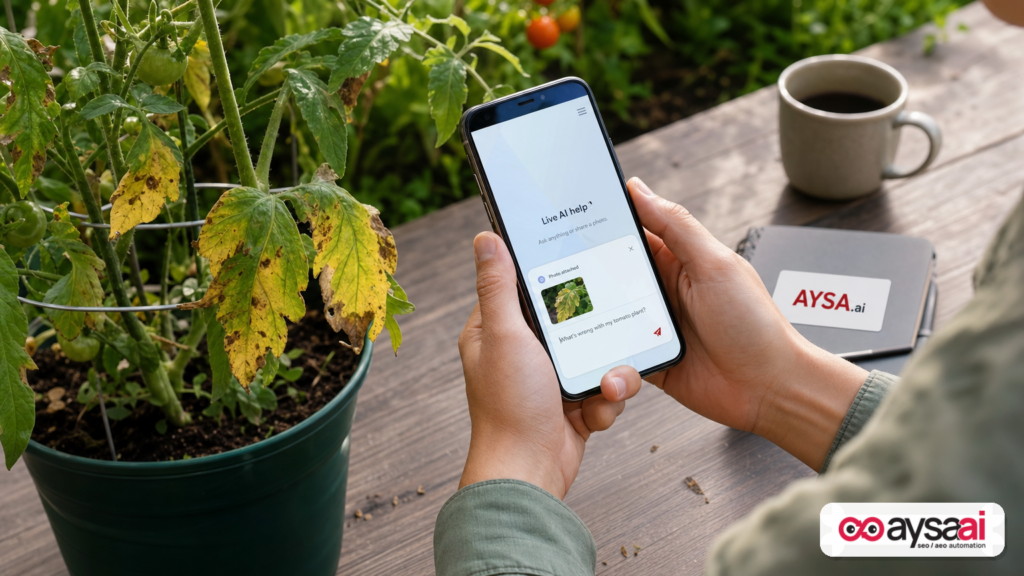
Diagnosing tomato leaves through Lens and asking follow-up questions is a preview of how customers will seek help across products and services.
Business impact: Support content becomes pre-purchase content. If you help people diagnose and solve, you earn trust—and a sale.
AI Mode + Canvas: why “planning” queries are the new battleground
In classic SEO, “how to” content was mostly about ranking a blog post. In AI Search, “how to” evolves into “build me a plan,” and that plan is assembled from multiple sources—sometimes with minimal Attribution depending on the interface and user flow.
If you’re an SME, you should care about planning queries because they sit right before purchase:
- “What do I need to start X?”
- “Create a monthly checklist for Y.”
- “What’s the best sequence to do Z?”
- “Compare options and recommend one for my constraints.”
What to publish (so you’re eligible to be used in plans)
Think in terms of components an AI system can safely use:
- Checklists with clear prerequisites and “if/then” branches.
- Timelines (monthly/weekly) that specify conditions (climate, skill level, budget).
- Decision tables (e.g., “If you have partial shade, choose A/B/C; if full sun, choose D/E/F”).
- Maintenance guides (what success looks like, common failure modes, troubleshooting steps).
How to structure it (for humans and machines)
You don’t need to “write for robots.” You need to write clearly enough that both humans and AI can extract reliable steps:
- Use descriptive H2/H3 headings and avoid clever/ambiguous titles.
- Provide short definitions before deep dives.
- Separate “tools/materials” from “steps.”
- Use scannable bullets for constraints and warnings.
- Maintain consistent terminology (don’t call the same item three different names).
This is where many brands fail: they write inspirational content, not operational content. AI planning experiences reward operational clarity.
AYSA angle: A lot of this is repeatable: identify planning queries, generate a structured outline, draft content, add internal links, then publish. The hard part is shipping consistently. That’s why we treat visibility as an execution pipeline, not a one-off “content sprint.” Learn more about the tooling approach at AYSA AI Search Visibility and AYSA AI SEO Tools.
Visualization queries: when Search becomes the first design draft
Google’s example—uploading a patio photo and asking AI Mode to suggest the best spot for a mini greenhouse—points to a broader shift: visualization is becoming a first-step query.
That matters because “design” is where brands can get inserted early:
- Home services: “Where should I place a mini-split?”
- Retail: “What size rug fits this living room?”
- Healthcare/wellness: “How do I set up a home exercise corner safely?”
- Hospitality: “Which room type is best for a family with a stroller?”
What businesses should do to win visualization moments
- Create “fit and placement” pages: sizing, spacing, installation constraints, and photos that show context (not just studio shots).
- Publish clear specs: dimensions, compatibility, requirements, limitations.
- Answer “where should I put it” questions in FAQs and guides (not buried in support PDFs).
- Build internal linking paths from inspiration → selection → purchase → support.
Visualization queries are high intent, but they’re also high risk: if the recommendation is wrong, customers blame the product and churn. Your job is to reduce ambiguity and provide constraints.
Search Live + Lens behaviors: the rise of “diagnosis” search
The gardening post’s tomato-leaf example is an everyday “diagnosis” workflow: show symptoms, ask what it is, then ask what to do next. This pattern is already common in many industries:
- Automotive: strange sounds, warning lights, worn parts.
- Appliances: error codes, leaks, temperature issues.
- Skincare: irritation, dryness, product reactions.
- IT/SaaS: confusing UI states, integration failures.
Why this matters for SEO and revenue
Diagnosis queries are often the first time a customer realizes they need a product, part, appointment, or professional help. If your brand shows up with clear, safe, step-by-step guidance, you become the obvious next click—or the obvious next purchase.
How to build “diagnosis-ready” content
- Symptom-first pages: “Yellow leaves,” “curling leaves,” “brown spots,” “wilting”—or your equivalent symptoms.
- Disambiguation steps: “If you see A plus B, likely X; if A without B, likely Y.”
- Immediate actions: what to stop doing, what to check, what’s safe.
- Escalation rules: when to call a pro, when to replace a part, when to seek care.
- Product mapping: recommended tools/solutions with constraints (compatible models, sizes, or conditions).
Be careful: “diagnosis” can drift into regulated territory (medical/legal). If you operate in those spaces, you need strong disclaimers, conservative advice, and a clear path to professional consultation. Don’t let AI-era content pressure push you into risky claims.
Shopping “nearby” and inventory checking: local intent is becoming frictionless
Google’s gardening article explicitly emphasizes Shopping features for sourcing supplies locally, including filtering for items “in stock nearby” and using “near me” queries to find local options. For SMEs, this is the most directly monetizable part of the shift.
What’s new in the customer journey
Historically, local shopping looked like this: search → open multiple sites → call stores → drive around. The direction is now: search → shortlist → confirm availability → purchase/pickup. The less friction, the fewer chances you get to recover from bad data.
What SMEs should tighten immediately
- Location basics: correct address, hours, phone, categories.
- Product availability signals: your site should clearly state what’s available, what’s seasonal, and what’s special order.
- Landing pages that match “near me” intent: local pages that answer “can I get this today?”
- Fast mobile UX: if customers do click, don’t waste it with slow pages and popups.
I’m intentionally not listing specific Google Merchant Center configurations here because they’re not included in the supplied source context, and I won’t pretend I reviewed additional documentation in this research set. The strategic point stands: local availability and accuracy are becoming central to conversion.
From SEO to AEO/GEO: how AI results change what ‘ranking’ means
Traditional SEO focused on rankings and traffic. AI Search shifts the conversation toward:
- Eligibility: can your content be used safely as a source?
- Selection: will the system choose your explanation, product, or business?
- Attribution: do you get a link/mention, and is it compelling?
- Actionability: does it lead to a visit, call, route request, or purchase?
This is why the market is using terms like AEO (Answer Engine Optimization) and GEO (Generative Engine Optimization). Whatever label you prefer, the work is similar:
- Write content that answers real user jobs-to-be-done.
- Publish structured, constraint-aware guidance.
- Maintain clean entity signals: who you are, what you sell, where you operate.
- Ship updates continuously as queries, features, and competitors change.
AYSA resources: If you want the operational playbook rather than theory, start with AI Search Visibility and our ongoing learnings on the AYSA blog.
What can go wrong (and how to reduce risk)
AI-assisted search experiences create new failure modes. Here are the big ones I see SMEs walking into.
1) You publish “AI content” that’s pretty, but not trustworthy
Verbose guides without constraints, sources, or practical steps don’t help users—and they don’t help AI systems pick you as a reliable reference.
Fix: Build content around decisions, checks, and steps. Add “what not to do,” and be clear about limits.
2) Your local data is wrong at the exact moment demand spikes
Seasonal businesses (gardening, HVAC, holidays, back-to-school) often suffer from outdated hours, wrong phone routing, or inaccurate availability messaging.
Fix: Create a simple data governance rhythm: weekly checks in peak season, monthly otherwise.
3) Your website can’t support fast iteration
AI Search changes quickly; SMEs often rely on one developer, one agency retainer, or a “we’ll get to it next month” cycle.
Fix: Adopt a monitored backlog with approvals and rapid execution—exactly the gap AYSA Monitoring is built to support.
4) You optimize for the wrong KPI
If you measure only organic clicks, you’ll miss visibility in AI answers and shopping modules. But if you measure only “impressions,” you may celebrate noise.
Fix: Tie metrics to outcomes: qualified leads, calls, bookings, purchases, and assisted conversions.
5) Over-automation without approvals creates brand risk
In regulated or reputation-sensitive categories, pushing unreviewed changes can be dangerous.
Fix: Use an approved execution model: prepare changes, get stakeholder sign-off, then deploy.
Concrete SME scenario: the local nursery that loses sales in AI Search
Let’s make this real with a plausible scenario you can map to your business—even if you don’t sell gardening supplies.
The business
A two-location nursery sells seasonal plants, soil, fertilizer, raised beds, and basic tools. They also run weekend workshops.
The new customer journey (inspired by Google’s gardening workflows)
- A customer searches: “chaos garden partial shade seed mix.”
- They ask AI Mode for a “recipe” and get a list of suggested seed types plus what to buy.
- They immediately switch to Shopping and filter for “nearby” to buy seeds and soil today.
- They visit one store—because it shows “in stock”—and discover the seed mix is out of stock.
- They buy from a big-box competitor down the road (or online).
Where the nursery actually lost
Not on “content,” and not on “rankings.” They lost on operational truth meeting search-driven convenience.
What they should do
- Publish a “chaos garden for partial shade” guide with:
- recommended seed categories and why
- what to avoid in partial shade
- a simple “shopping list”
- links to product pages and workshop signups
- Create location-specific pages that emphasize same-day pickup and seasonal availability.
- Add “substitute products” logic: if a specific mix is out, promote alternatives.
- Implement a weekly “peak season accuracy review” for hours, top products, and promo landing pages.
This is exactly the kind of scenario where execution speed beats strategy decks. The winning nursery is the one that updates pages, clarifies availability, and publishes the troubleshooting content before the next trend spike.
What agencies should rethink right now
If you run an agency (or rely on one), the gardening post is a reminder that your deliverables must evolve. AI Search compresses timelines, and clients will care about outcomes faster.
1) Move from “monthly deliverables” to “continuous improvements”
When Search introduces new behaviors like Search Live Q&A or AI planning canvases, the opportunity window can be weeks, not quarters.
2) Technical + content + local are now inseparable
AI experiences blend discovery, decision, and purchase. The siloed model (content team vs. technical team vs. local listings) breaks down.
3) Clients need governance, not just tasks
AI-era SEO fails because of approvals and bottlenecks. Agencies that can implement an approval workflow (and prove it) will outperform those who simply recommend.
4) Reporting must show “AI visibility,” not only sessions
Again: I’m not going to invent new Google reporting fields not present in the source context. But the strategic direction is clear: agencies must capture evidence that the brand is being surfaced in AI-driven experiences, and connect that to conversions where possible.
A practical action plan (30/60/90 days)
Below is a pragmatic plan for an SME that wants to be visible in AI-assisted search behaviors like the ones Google showcased—without boiling the ocean.
Days 1–30: get your foundation “AI-eligible”
- Inventory your highest-intent pages: top product pages, top service pages, location pages, and your top 10 support questions.
- Rewrite for clarity:
- Add short definitions at the top.
- Add “who this is for” and “when not to use this.”
- Add scannable steps and checklists.
- Build 3 “diagnosis” pages based on the most common customer problems.
- Refresh local basics: hours, contact routing, “same-day” expectations, and seasonal notes on your location pages.
Days 31–60: publish planning content that converts
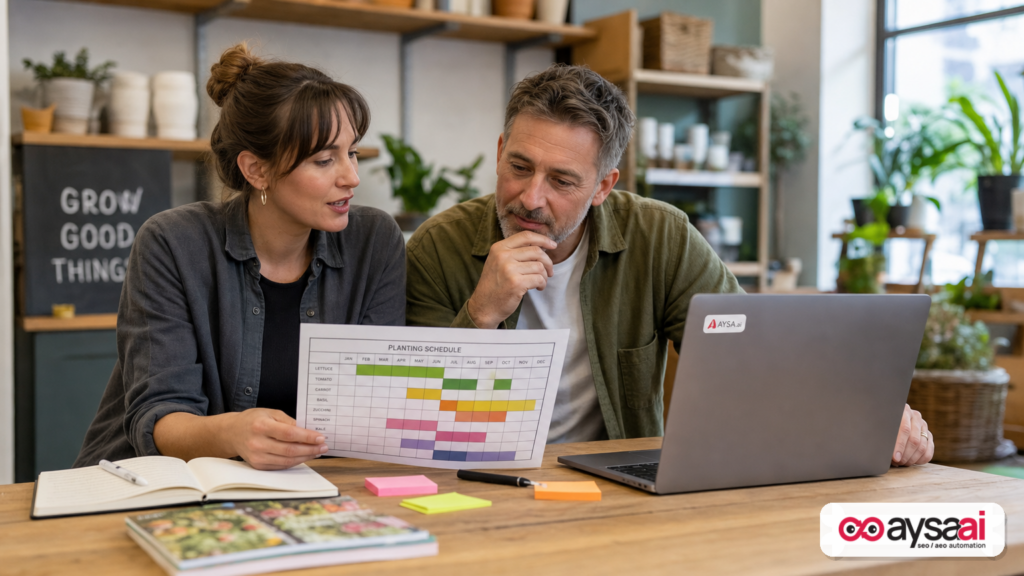
- Create 2–3 “project plans” (the Canvas idea) your customers would ask for:
- “30-day starter plan”
- “90-day maintenance plan”
- “annual checklist”
- Add decision tools: comparison tables, sizing guides, “choose X if…” blocks.
- Connect content to commerce: every guide should link to the right category/product/service pages and explain what to buy next.
Days 61–90: operationalize monitoring and execution
- Establish a monitoring rhythm: what changed in rankings/visibility, what pages decayed, what products are trending.
- Implement an approval workflow so improvements ship weekly, not quarterly.
- Run a “seasonal intent” refresh for your top categories and locations (e.g., spring, summer, holidays).
Where AYSA helps: This is the difference between knowing what to do and actually doing it. AYSA is built to monitor, prepare changes, route them for approval, and execute the accepted updates on your website. See Monitoring and Pricing for operational fit.
Where AYSA fits: monitoring + approved execution for AI Search visibility
Most AI Search conversations stop at “create better content” or “add schema.” That’s necessary, but insufficient, because teams don’t fail on ideas—they fail on throughput.
AYSA’s model is intentionally execution-first:
- Monitor the signals that matter (visibility changes, content decay patterns, and priority pages).
- Prepare specific, page-level improvements (content structure, internal links, clarity upgrades).
- Ask for approval so stakeholders stay in control (especially in regulated or brand-sensitive categories).
- Execute accepted changes consistently, so your site stays current as AI Search behaviors evolve.
If you’re serious about being the business that shows up when a customer asks Search “what should I do next?” you need a system—not sporadic projects. Start here:
What to do next
- Pick one high-intent category (a product line, service line, or location) and map the “plan → buy → troubleshoot” journey.
- Publish one planning asset (a checklist, schedule, or step-by-step guide) that directly leads to a purchase or booking.
- Create two symptom/diagnosis pages that answer what customers show on camera.
- Refresh local availability messaging (what’s in stock today, what’s seasonal, what’s special order).
- Set a weekly shipping cadence for updates—small, approved improvements beat quarterly rewrites.
- Use an execution system so monitoring turns into changes on your site, not just reports.
Sources and further reading
- Google Search Blog — “5 gardening tips you can try right in Search”
- The Keyword (Google Blog) (publisher context)
- Google DeepMind blog (Google AI context link surfaced on the source page)
- Google Research blog (Google AI context link surfaced on the source page)
- Google Developers blog (platform context link surfaced on the source page)
- Google Cloud blog (infrastructure context link surfaced on the source page)
Note on sourcing: This editorial intentionally relies on the supplied Google Search Blog source and the reputable Google ecosystem links surfaced within that page. Where additional official documentation would normally be cited (e.g., detailed commerce/inventory integrations), it is not included in the provided research context, so I’ve kept claims conservative and framed recommendations at the strategy/process level.
Continue the AI search topic inside AYSA.
Use these pages to connect the article with AI SEO tools, AI visibility monitoring, AI Overviews and approved website execution.
Turn this topic into a website action plan.
Use these AYSA hubs to move from reading to technical fixes, AI visibility monitoring, research, glossary context and approval-first SEO execution.