
Client, You Are Fired: SEO, PPC and the New Reality of AI Search
A founder story about losing old clients when Google, Meta and AI search changed faster than manual marketing models could adapt.
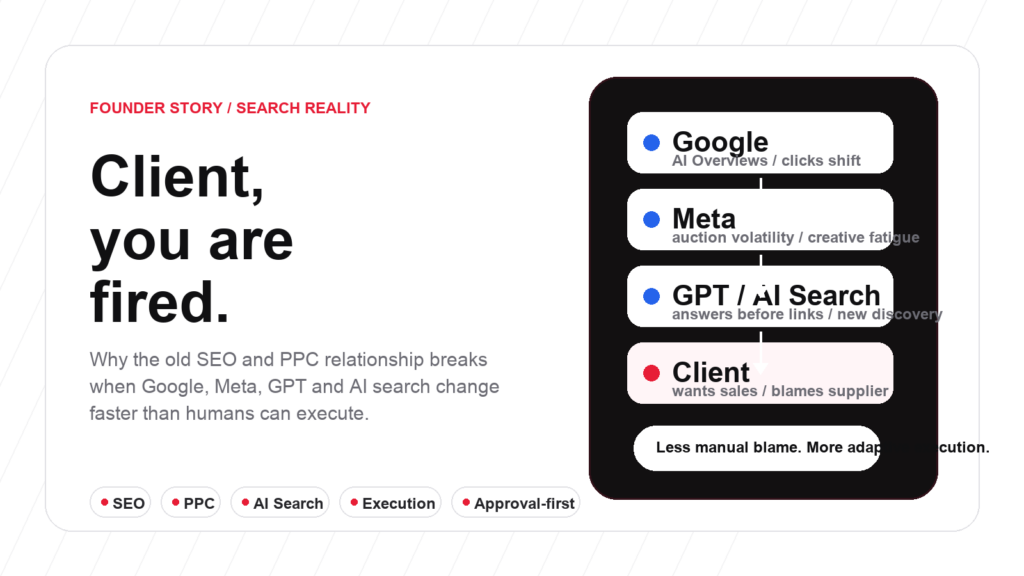
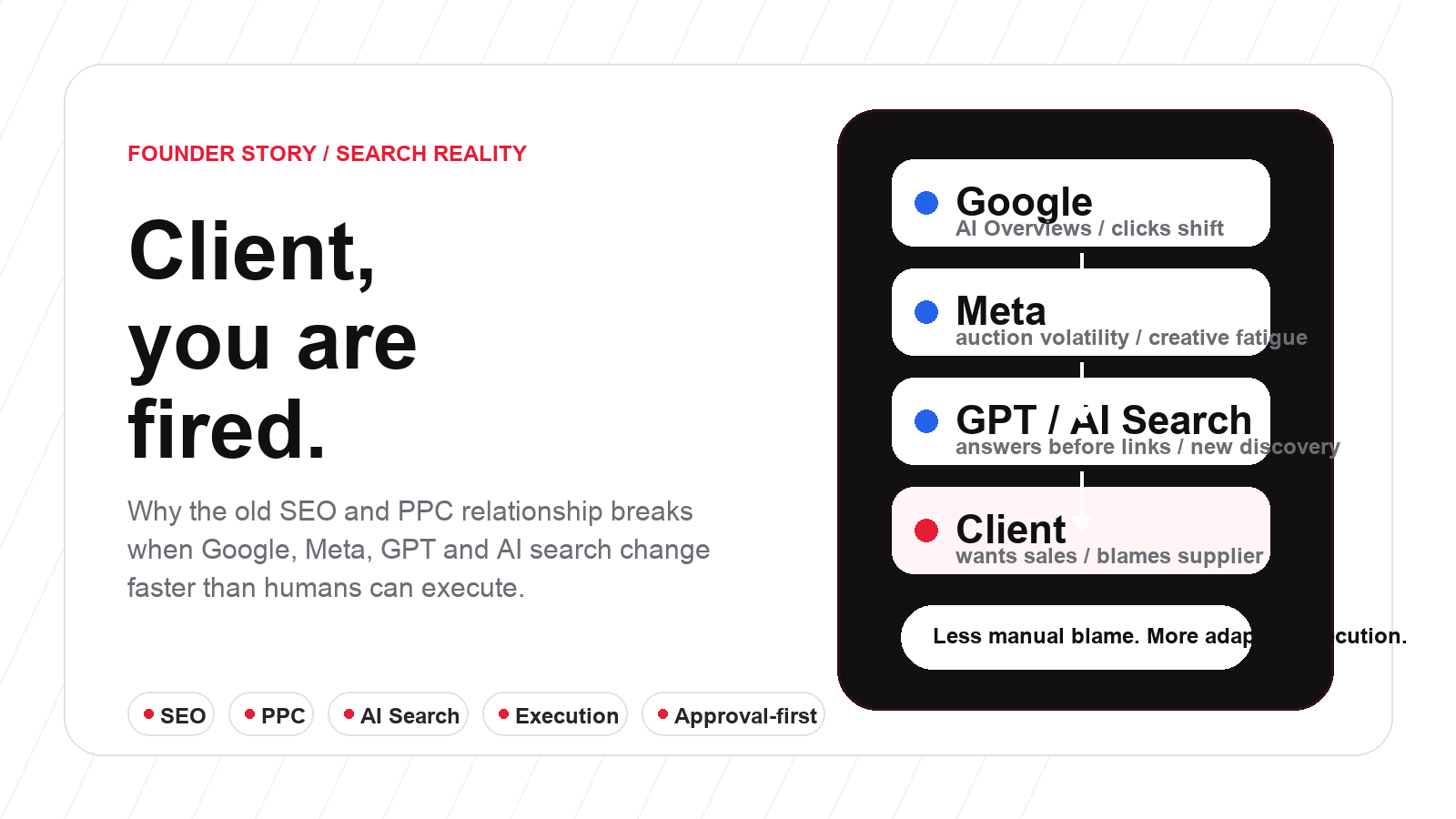
Executive summary: This is not a story about a bad client. It is not a story about a lazy agency. It is a story about a broken marketing contract between clients, suppliers and platforms. For many years, clients paid agencies or consultants for SEO, Google Ads, Meta Ads and reporting. If leads came in, everyone was happy. If leads slowed down, the supplier was blamed. That model worked while the digital environment was relatively stable. It breaks when Google, Meta, GPT, AI Overviews, AI Mode, Zero-click search, privacy changes and auction volatility change faster than humans can manually react.
I recently had to end a long-standing client relationship. The collaboration had been good financially and humanly. We started strong. We produced results. Then the landscape changed. SEO became slower to convert. Paid search became more expensive. Social ads became less predictable. AI Search started changing how people discover information. The client still needed sales, and we were still the supplier standing in front of the problem. At some point, the honest answer was not another report, another meeting or another promise. The honest answer was: this model no longer works the way both sides expect it to work.
Why this story matters
There is a sentence nobody wants to say in business: “Client, you are fired.” It sounds arrogant. It sounds emotional. It sounds like the supplier is running away from responsibility. But sometimes it is the most honest sentence in the room.
I am writing this because I believe many founders, agency owners, consultants and marketing teams are living the same situation quietly. They do not talk about it publicly because it sounds dangerous. Who wants to admit that an old client left, that results became harder, that Google Ads no longer printed leads like before, that SEO traffic no longer converted with the same predictability, or that the client started seeing the supplier as the cause of a much larger market problem?
The story is simple. We had a client relationship that was good on paper and good between people. The collaboration was not toxic at the beginning. There was trust. There was history. There were results. We started with energy, obtained visible progress and had a normal business relationship. But the digital marketing landscape did not stay still. Search changed. Paid media changed. User behavior changed. AI search entered the discovery journey. Google increasingly answered more questions directly. Ads became more expensive and less forgiving. Social platforms became harder to read. And the old expectation remained: the supplier should make sales happen.
That expectation is understandable. A business owner does not buy marketing to admire dashboards. A business owner buys marketing to sell more, receive more calls, book more appointments, move more products, generate more revenue and sleep better at night. When that does not happen, the supplier becomes the visible target.
But this is exactly why the story matters. The problem is no longer only campaign management. It is not only SEO. It is not only PPC. It is not only content. It is the operating system of digital growth. The old model assumes that humans can analyze, decide, execute and adapt fast enough through meetings, emails, spreadsheets and manual work. The new reality requires continuous Monitoring, rapid preparation, approval workflows, automated execution, faster feedback loops and a system that can keep adapting while platforms keep changing.
The old marketing contract was simple: we do the work, you get results
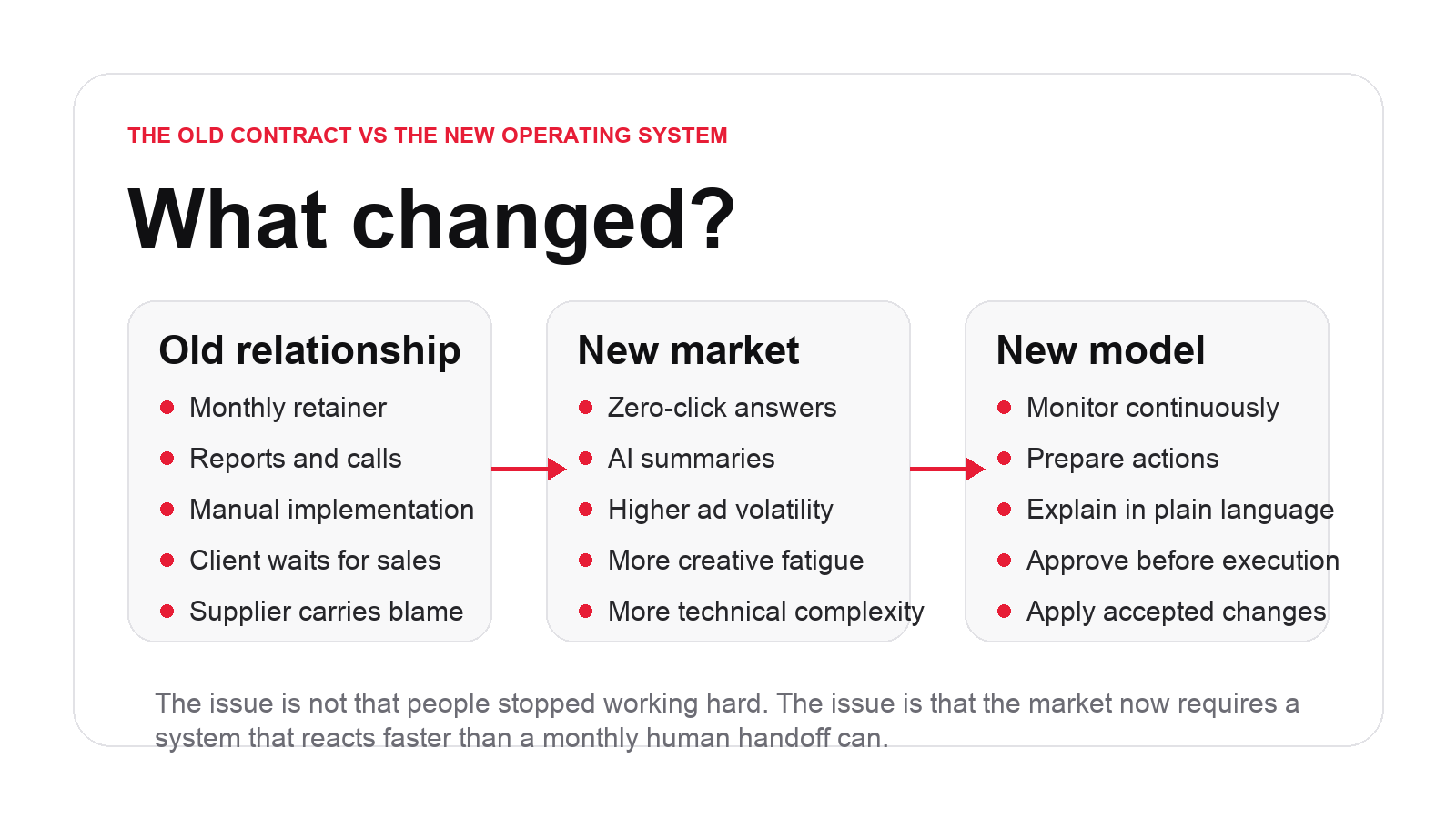
For a long time, the commercial relationship between a client and a digital marketing supplier was built on a relatively simple contract, even when the written contract was more complicated. The client paid a retainer. The supplier did SEO, PPC, Meta Ads, content, reporting and optimization. If sales grew, the supplier was considered good. If sales dropped, the supplier was considered weak.
That contract worked because the environment had enough stability. Google Search was still mostly a list of links. Search ads had strong intent and often converted. Facebook and Instagram could find audiences at a cost that made sense. Attribution was never perfect, but it was more believable. SEO recommendations had time to compound. Content could rank, bring Clicks and create leads. Agencies could plan quarterly roadmaps and still look reasonably modern.
Inside that model, suppliers were expected to be a mix of strategist, technician, copywriter, media buyer, analyst and psychologist. The client expected growth. The supplier tried to deliver. When things worked, both sides continued. When things stopped working, the relationship became emotional. “What are we paying for?” “Why are leads down?” “Why is Google more expensive?” “Why are competitors visible?” “Why is SEO slow?” “Why did the last campaign not convert?”
These are fair questions. The problem is that the answers are no longer simple. A campaign can be well managed and still become more expensive because auction pressure increased. A website can improve SEO and still receive fewer clicks because the search interface answers more directly. A content strategy can be correct and still take longer because AI summaries, stronger competitors and lower click-through rates reduce the speed of visible impact. A supplier can work hard and still lose the narrative because the client sees only revenue pressure.
This is the hidden danger of the old contract. It sells control in a market where no single supplier controls the platforms. It sells predictability in an environment that is becoming less predictable. It sells human effort in a world that increasingly rewards systems.
What changed underneath us
The first major change is the search experience itself. Google is no longer only a gateway to websites. It is also an answer layer, a product comparison layer, a local discovery layer, a shopping layer, a video layer and now an AI-assisted interface. AI Overviews and AI Mode change how users move from query to decision. Some searches still produce classic clicks. Others produce summaries, comparisons and answers before the user reaches a website.
The second change is paid media economics. Google Ads remains powerful, but power does not mean cheap. In competitive industries, cost per click and cost per lead can rise while conversion quality becomes more uneven. WordStream’s 2025 Google Ads benchmarks reported that the average cost per lead across industries increased from $66.69 in 2024 to $70.11 in 2025, a 5.13% increase. Their related analysis notes that this followed a much larger increase from 2023 to 2024. That does not mean every account is doomed. It means the old assumption that “we can always buy more leads” is less safe.
The third change is social advertising fatigue. Meta platforms can still perform very well, especially for brands with strong creative, clear offers and good tracking. But social ads require constant testing. Creative burns out. Audiences shift. Tracking is imperfect. The cost of producing and testing enough creative has become part of the real cost of paid social. Many SMEs underestimate this. They see the ad budget, but not the system needed to keep the ads effective.
The fourth change is measurement. Privacy changes, consent management, attribution gaps, AI-assisted discovery, dark social, Branded Search and offline decisions make it harder to prove exactly which channel created a sale. Clients want certainty. Platforms offer modeled data. Suppliers explain nuance. Revenue pressure does not care about nuance.
The fifth change is AI itself. ChatGPT, Gemini, Perplexity, Claude and AI search experiences are not just content tools. They are changing how users ask questions, compare options and make decisions. Users can now ask for a pediatric clinic, a parking service, a florist, a hotel, a SaaS product, a consultant or a comparison without using the old keyword pattern. They may receive a synthesized answer, a shortlist, a map, citations, reviews and criteria before they ever click a traditional result.
In this world, SEO is no longer only “rank this page.” It becomes: make the business understandable, retrievable, comparable, credible and easy to cite. PPC is no longer only “buy traffic.” It becomes: pay for attention in a more crowded, more expensive, more automated auction while organic discovery becomes less linear. The supplier who still works with last decade’s workflow is trapped.
The numbers behind the frustration
We should not build strategy on feelings alone. The data supports the feeling that the market has changed.
SparkToro and Datos’ 2024 zero-click study found that for every 1,000 Google searches in the European Union, only 374 clicks went to the open web; in the United States, the number was 360. The same study reported that 59.7% of EU Google searches and 58.5% of U.S. Google searches resulted in zero clicks. This does not mean SEO is dead. It means the click is no longer guaranteed even when the user finds information.
WordStream’s 2025 Google Ads benchmarks show pressure on paid search efficiency. Their report says the average cost per lead across all industries rose 5.13% year over year, from $66.69 to $70.11. In many industries, small increases are manageable. But for SMEs with thin margins, inconsistent sales teams or weak conversion funnels, a higher cost per lead can make a campaign feel broken even when the account is technically managed well.
IAB and PwC reported that U.S. internet advertising revenue reached $258.6 billion in 2024, the highest level since 2021, with growth fueled by digital video, retail media, search and social. In plain language: more money keeps entering the digital advertising system. That creates opportunity, but it also increases competition. If more advertisers fight for the same attention, weaker offers and slower optimization lose.
McKinsey’s 2025 State of AI survey adds another layer. It reports that 88% of respondents say their organizations use AI regularly in at least one business function, up from 78% a year earlier. It also reports that 23% of respondents are scaling agentic AI systems somewhere in the enterprise, while another 39% are experimenting with AI agents. This matters because enterprise marketing systems are moving toward AI-assisted workflows. SMEs cannot compete with manual processes forever.
Taken together, these numbers explain why old client relationships are breaking. Organic clicks are harder to win. Paid leads are more expensive. Digital advertising competition is larger. AI adoption is accelerating. Search interfaces are changing. Yet many clients still expect the same commercial output from the same manual monthly workflow.
Why I had to fire the client
When I say I had to fire the client, I do not mean it as a victory sentence. It was not pleasant. It was not a moment of ego. It was a sad business decision.
The relationship had history. There had been trust. There had been results. But the situation became impossible because the client’s expectation remained fixed while the market reality changed. SEO and PPC were no longer producing the same visible business impact. The channels were not dead, but their mechanics had changed. The client still needed sales. We were still the supplier. The pressure naturally landed on us.
At that point, the conversation becomes dangerous. The supplier can overpromise to keep the contract. The supplier can blame Google, Meta, the economy, competitors, AI or the client’s website. The client can blame the supplier. Both sides can continue for a few more months while trust decays. Or one side can say the truth: the current model is no longer aligned with the outcome both sides want.
I chose the truth. I did not want to continue billing a client inside a relationship where the supplier was expected to compensate manually for structural changes in the market. If the business needs a new growth operating system, selling the old service shape is not fair. If the client believes the supplier alone is the reason results slowed down, the relationship becomes unproductive. In that case, ending the relationship is healthier than pretending another campaign report will fix the underlying problem.
The painful part is that the client was not entirely wrong to be frustrated. They were paying for growth. They wanted results. They had business pressure. The uncomfortable part is that we were also not wrong. We had not suddenly forgotten marketing. The ground moved.
Why suppliers get blamed when platforms change
Suppliers get blamed because they are the visible interface between the business and the platforms. A client cannot call Google and ask why AI Overviews changed behavior. They cannot negotiate with Meta’s auction. They cannot force users to click. They cannot ask ChatGPT to send more referral traffic. They can call the agency, consultant or marketing provider.
This creates a psychological problem. The supplier becomes responsible not only for their own work, but also for market volatility, platform decisions, competitor pressure, tracking uncertainty, sales process weaknesses, offer quality, website conversion issues and sometimes the client’s business model. That is too much responsibility for a monthly service relationship that does not control all variables.
In the old world, this blame was tolerable because results were often easier to stabilize. In the new world, blame becomes more frequent because changes are faster. AI search can change visibility. Google updates can shift organic traffic. Ads can become more expensive. Competitors can automate content and creative faster. A platform can introduce a new interface that changes user behavior. The supplier still has to explain the month.
This is why I believe the classic agency-client relationship needs to be redesigned. The future relationship cannot be “pay us and trust us.” It must become “here is what the system detected, here is what we prepared, here is what needs approval, here is what was executed, here is what changed, here is what we learned.” The client needs transparency, but more importantly, the client needs execution speed.
The new system we need
The future is not a world where nobody needs humans. That is an immature reading of AI. The future is a world where humans stop doing repetitive execution work that software can prepare, track and execute more consistently.
A modern SEO and AI visibility system should monitor the website continuously. It should read Search Console signals, detect pages with impressions but weak click-through rates, find content gaps, identify technical issues, notice broken links, watch indexation drift, monitor AI visibility, prepare schema opportunities, suggest internal links, detect authority gaps, propose content improvements and track what was approved and applied.
The system should not publish blindly. That is important. Blind automation creates risk. The business owner, marketer or agency should approve important changes. But after approval, execution should not require a long chain of emails, copy-paste, spreadsheets and developer tickets. Approved work should move into the website workflow.
This is the key shift. The old model is report-first. The new model is execution-first. The old model asks humans to interpret dashboards. The new model asks the system to prepare actions. The old model makes the client wait for people to manually implement. The new model makes the client approve what matters and lets the system handle the repetitive work.
That is why I believe the next generation of SEO tools will not be dashboards. Dashboards are useful, but they do not solve the execution problem. The next generation will be operating systems: connected agents that understand the website, explain the work, request approval and execute accepted actions.
Old model
Client pays a retainer, supplier sends reports, platforms change, results slow down, trust drops, blame increases.
New model
Why AYSA exists
AYSA was created from exactly this frustration. Not because agencies are bad. Not because clients are wrong to demand results. Not because AI magically fixes everything. AYSA exists because the old workflow between SEO knowledge and website execution is too slow for the new market.
When Google changes, the website must adapt. When AI search changes how people ask questions, the content must become clearer, more useful and more retrievable. When pages receive impressions but do not convert, titles, content and internal links must be reviewed. When technical issues reduce crawlability or indexability, they must be detected and prioritized. When authority is missing, opportunities must be found, explained and approved. When a business owner does not understand SEO language, the system must explain the work in plain terms.
AYSA is designed to replace a large amount of repetitive human SEO labor: the manual checking, mapping, drafting, rewriting, linking, monitoring, prioritizing and follow-up that usually gets lost between reports and implementation. It does not remove business responsibility. It does not guarantee rankings. It does not promise that Google, Meta or AI platforms will behave predictably. But it creates a better operating model for a world where waiting one month for the next report is too slow.
The reason I believe this is the future is simple: the market is moving from campaign management to continuous adaptation. SEO, PPC, AEO and GEO are no longer separate boxes. They are signals inside the same discovery environment. A user may see an ad, ask an AI assistant, compare a Google result, check reviews, visit a website, return through branded search and buy later. No human team can manually monitor every signal, prepare every action and implement every improvement at the speed required by thousands of SMEs.
The future belongs to systems that make the business more adaptive. Human judgment remains important. But the repetitive work must be automated or semi-automated. The client should approve the direction. The system should do the heavy lifting.
What I learned from losing the client
Losing a client is painful, especially when the relationship was once good. But it can also be useful. It forces a founder to ask whether the service being sold still matches the market being served.
My conclusion is that the old digital marketing relationship is no longer enough. Businesses cannot depend only on monthly human effort. Suppliers cannot keep absorbing platform volatility as if it were their personal fault. Clients cannot expect old channel economics to return just because they need them to. Everyone needs a more honest model.
That model is not “do nothing and blame Google.” It is not “fire every agency and use AI blindly.” It is not “write more content with ChatGPT.” It is a disciplined operating system: monitor, prepare, explain, approve, execute, learn, repeat.
In the old world, a client hired people to do marketing. In the new world, a client needs a system that can keep the business visible while the search and advertising landscape keeps changing. That is the real lesson.
So yes, sometimes you have to fire the client. Not because the client is bad. Because the old agreement is no longer true. And if the agreement is no longer true, continuing the relationship is not loyalty. It is theatre.
Less SEO work. More organic growth.
Stop buying reports when the market demands execution.
AYSA monitors your website, prepares SEO, AEO and AI visibility work, asks for approval and executes accepted changes inside your website workflow.
Sources and further reading
This article cites and interprets data from SparkToro and Datos’ 2024 zero-click search study, Search Engine Land: 2025 Google Ads cost benchmarks, Search Engine Land: 2025 Google Ads cost benchmarks, IAB/PwC reporting on 2024 digital advertising revenue, and McKinsey’s 2025 State of AI survey. The client story is anonymized and intentionally avoids identifying details. The AYSA sections are our product perspective and do not claim guaranteed rankings, guaranteed sales, guaranteed AI Overview inclusion or guaranteed paid media performance.
Continue the AI search topic inside AYSA.
Use these pages to connect the article with AI SEO tools, AI visibility monitoring, AI Overviews and approved website execution.
Turn this topic into a website action plan.
Use these AYSA hubs to move from reading to technical fixes, AI visibility monitoring, research, glossary context and approval-first SEO execution.

