
CPC Inflation Isn’t an Auction Problem Anymore: The New Pre‑Click Economics of Paid Search (and How SMEs Can Win)
Rising CPCs are increasingly driven by what happens before the bid: AI answers reduce click supply, brands concentrate demand, and post‑click experience determines whether expensive traffic pays back. Here’s the new playbook for SMEs and agencies—plus how AYSA helps you monitor, prepare, approve, and execute the fixes that protect margins.
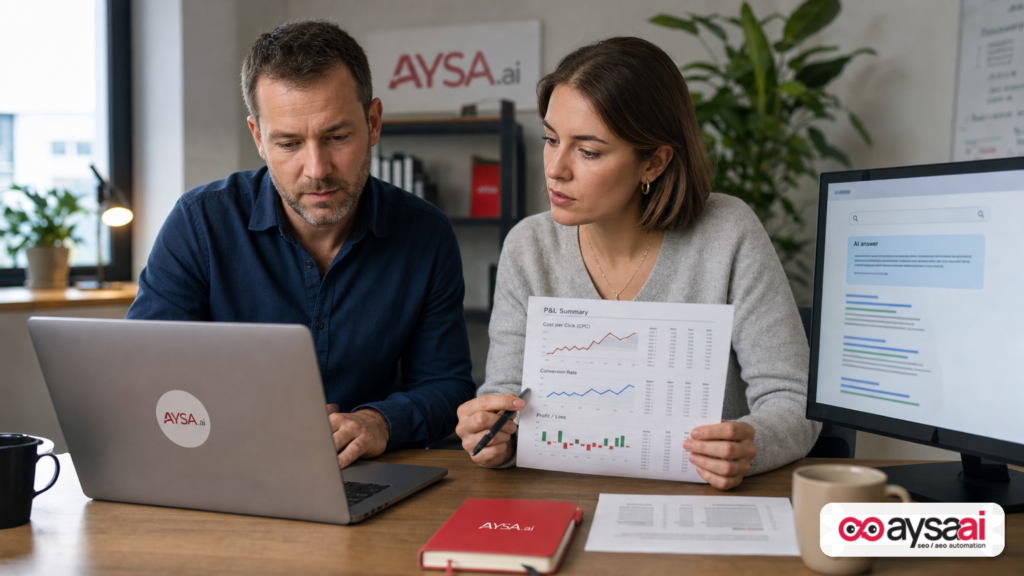
Paid search is getting more expensive, but the uncomfortable truth is this: the auction is no longer the main reason your CPCs are rising. The economics of search have shifted upstream (before a bid is even placed) and downstream (after the click, where profit is actually made). If you keep treating CPC inflation like an “optimize bids and ad copy” problem, you’ll keep paying more for less.
This editorial breaks down what changed, why it matters to real businesses (especially SMEs), and what to do next. It also explains how AYSA monitoring and AYSA’s AI SEO tools fit into a new operating model: monitor what’s happening across AI and classic search, prepare the fixes, ask for approval, then execute accepted website changes—fast.
Table of contents
- The short version (concise summary)
- Key takeaways
- What actually changed: clicks got scarcer, not just more expensive
- Why CPC inflation starts before the auction
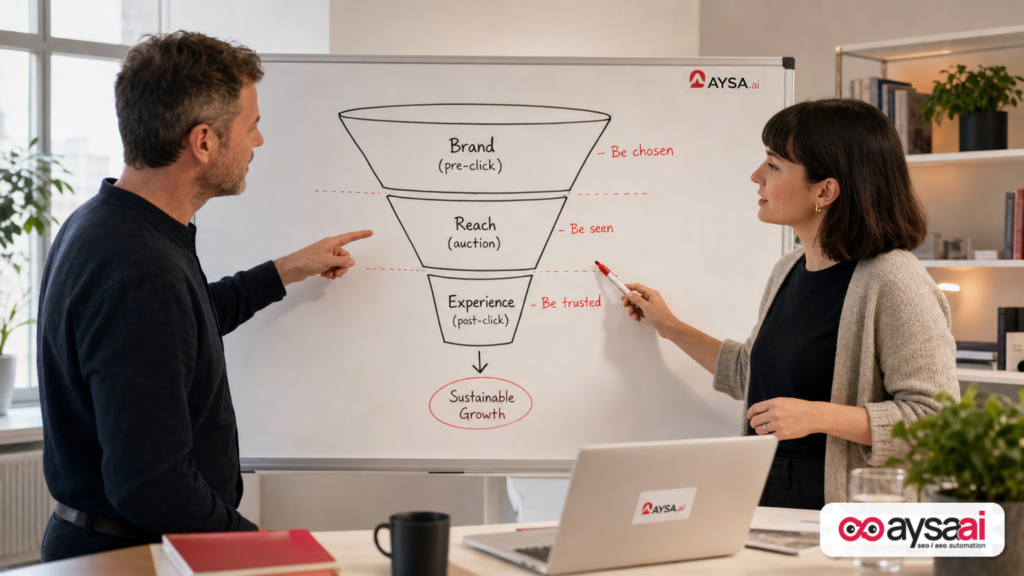
- The three levers that now decide paid search performance
- Lever 1: Brand (pre-click): the new cost center you can’t ignore
- Lever 2: Reach (the auction): still important, but less powerful
- Lever 3: Experience (post-click): your best defense against rising costs
- The new unit economics: how to stop CPC inflation from destroying margins
- An SME scenario: the local clinic that suddenly can’t afford its own patients
- What SMEs should monitor weekly (not quarterly)
- What agencies should rethink: new deliverables, new accountability
- Where AYSA fits: monitor → prepare → approve → execute
- A practical 30/60/90-day action plan
- What to do next
- Sources and further reading
The short version (concise summary)
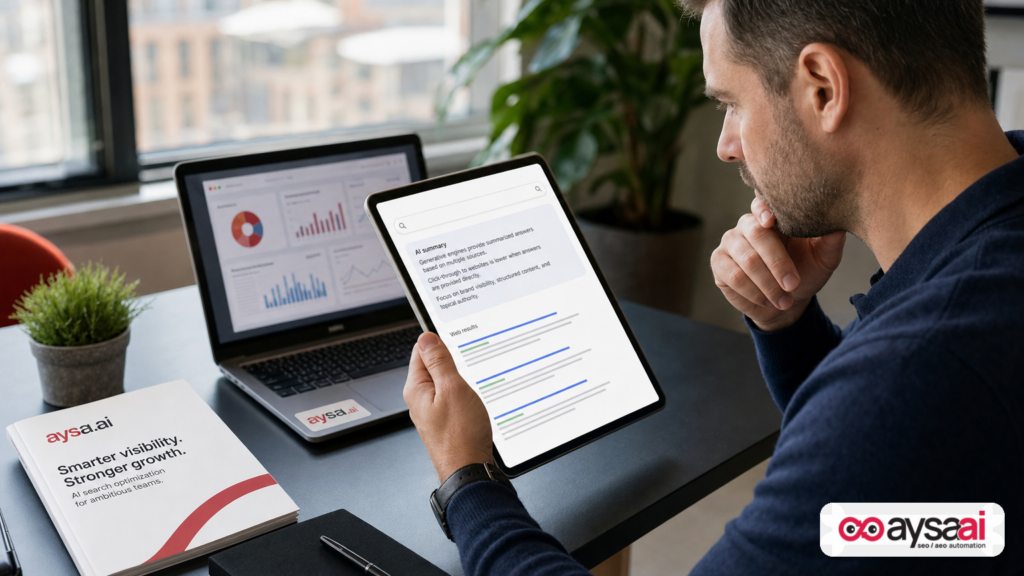
Search auctions are tightening because the supply of valuable Clicks is shrinking. AI answer surfaces (like AI Overviews) reduce organic click volume and concentrate commercial demand into fewer remaining “exit clicks.” More advertisers—helped by easier creative tooling—pile into those same queries. The result looks like simple CPC inflation, but it’s really a broader market shift.
Winning now requires managing three layers together:
- Brand (pre-click): how visible and trusted you are across the web (including the places AI systems learn from and cite).
- Reach (auction): your Keyword coverage, match strategy, bidding, assets, and automation guardrails.
- Experience (post-click): the landing page and funnel that turns expensive traffic into revenue or captured leads.
The biggest gains are often outside the auction: build authority so fewer purchases require paid search, and upgrade post-click experience so each paid click is worth more.
Key takeaways

- CPC inflation is increasingly a “click scarcity” problem. If fewer users click, the remaining clicks become more contested and therefore more expensive.
- Brand strength has become a performance variable. Strong brands earn cheaper conversions because users seek them out and trust them faster.
- Post-click conversion is your controllable lever. You can’t control market inflation, but you can control your landing page clarity, speed, trust, and lead capture.
- SEO, AEO/GEO, CRO, and PPC now share one P&L. Treat them as separate teams and you’ll pay “coordination tax” in higher CAC.
- Monitoring is strategy. In 2026, waiting for a quarterly review means you discover the problem after the budget is already gone.
What actually changed: clicks got scarcer, not just more expensive
For years, teams could explain higher CPCs with a familiar story: “More competition, therefore more bids, therefore higher costs.” That story still exists, but it’s incomplete.
What changed is the shape of the search results page and the user’s incentive to click. When results pages answer more questions directly, users leave without clicking. That creates a market where:
- Informational queries become less reliable traffic sources.
- Commercial queries carry more “make or break” revenue pressure.
- Brands fight harder for the smaller set of remaining clicks.
The Search Engine Land analysis that inspired this piece frames it clearly: CPC inflation starts before the auction because the upstream environment determines how many clicks even make it into the auction pool. Read the original here: Why CPC inflation starts before the auction.
It’s also consistent with the broader discussion around “zero-click” behavior and declining organic click volume referenced in that piece (including SparkToro’s work, as cited there). Even if you don’t rely heavily on informational traffic today, the knock-on effect matters: when organic clicks decline, companies shift budget into paid search to make up the shortfall—raising auction pressure for everyone.
Why CPC inflation starts before the auction
Think of paid search as a marketplace with two variables:
- Demand: how many advertisers want the click.
- Supply: how many valuable clicks exist.
Historically, marketers obsessed over demand: competitor count, bid strategy, Quality Score. Today, supply is the hidden driver. If AI answer experiences reduce click-through, you now have less supply of the clicks that convert—especially the “I’m ready to buy/book” clicks that still escape the results page.
That means CPC inflation can happen even if:
- your bids don’t change,
- your competitors don’t dramatically change their bids, and
- your ads look “fine.”
Because the underlying market changed.
The three levers that now decide paid search performance
I like the three-layer model because it forces a business conversation, not just a channel conversation.
1) Brand (pre-click)
This is everything that shapes whether a user chooses you before they ever click an ad: recognition, trust, reputation, authority signals, and visibility across the places people research. It includes AI-era discoverability: whether your business shows up in AI summaries, community conversations, and the broader content ecosystem.
2) Reach (at the click / in the auction)
This is classic paid search craft: coverage, match types, negatives, structure, bidding, creative, and automation guardrails. It still matters, but it’s constrained by the upstream click supply.
3) Experience (post-click)
This is your landing page and funnel: speed, clarity, offer, proof, friction, tracking, and nurture. It determines what each click is worth—and it’s the lever you can improve even when the market gets worse.
In the Search Engine Land framing, these levers show why the auction is now the smallest part of the opportunity. That’s not a knock on PPC teams; it’s a reality check that the “easy gains” moved.
Lever 1: Brand (pre-click): the new cost center you can’t ignore
In 2026, brand isn’t just “marketing fluff.” It’s a measurable input into CAC.
Here’s the practical mechanism:
- Strong brands get more navigational demand. Users search the brand name or go directly—reducing reliance on non-brand CPCs.
- Strong brands get higher conversion rates. Users arrive with pre-existing trust, lowering the number of clicks needed per sale.
- Strong brands get cheaper clicks (sometimes). Better engagement signals can help ad performance, and higher click-through can support efficiency.
But “brand” here isn’t just a logo. It’s the sum of signals across the web: reviews, consistent business info, topical authority, mentions, and useful content that gets referenced in communities and publications.
If you’re a small business owner reading this, you might be thinking: “I can’t outspend the big players.” Exactly—and that’s why brand work is your leverage. You can’t always win the auction, but you can win the decision before the auction by being the obvious choice.
Brand in the AI era: AEO/GEO is not optional anymore
AI-driven answer experiences change the nature of visibility. The goal is no longer only “rank #1.” It’s also “be referenced and recommended” in AI summaries and assistants.
At AYSA, we treat that as AI search visibility work: monitoring where you appear, what entities you’re associated with, and whether your site communicates clear, verifiable information. If you want the framework, start here: AI Search Visibility.
Even if your revenue is still mostly Google Ads-driven, AEO/GEO work is now a paid-search cost reducer. When you show up upstream, fewer people need the expensive click to find you.
The non-obvious brand asset: clarity content that reduces sales friction
Many SMEs publish content to “get traffic.” In the AI era, publish content to:
- clarify your offer (pricing ranges, process, timelines),
- answer objections (warranties, compliance, refund policies),
- prove expertise (case studies, methodology, credentials), and
- make the next step easy (book, call, quote).
This content won’t always show up as a neat organic traffic spike, but it will show up as higher conversion rates on paid traffic and better sales efficiency.
Lever 2: Reach (the auction): still important, but less powerful
Let’s be clear: you still need competent PPC execution. If you’re leaking budget due to sloppy match types, poor negatives, weak assets, or broken tracking, fix that first.
But reach optimizations are increasingly incremental compared to pre-click brand improvements and post-click conversion work. Why? Because you’re optimizing within a constrained pool of clicks. If the pool shrinks, everyone’s optimizations compete in the same small arena.
Automation needs guardrails, not blind faith
As platforms push more automation and broader matching, many SMEs experience a familiar pattern:
- Performance looks okay early, then CPCs rise and lead quality drops.
- Search term visibility becomes less actionable.
- Budgets drift toward “close enough” queries that don’t convert.
The fix is rarely “turn off automation.” The fix is governance: define what counts as a qualified lead, ensure conversion tracking reflects that definition, and add guardrails so the system doesn’t optimize toward vanity conversions.
This is where cross-team alignment matters: PPC teams can’t do it alone if the website can’t capture qualified intent, and sales can’t follow up.
Red ocean vs. blue ocean tests (without betting the company)
The Search Engine Land source highlights a helpful concept: saturated “red ocean” auctions vs. emerging “blue ocean” placements where intent exists but competition is lower (e.g., Microsoft Ads/Bing, Reddit, newsletters, or early AI ad inventory). That doesn’t mean every SME should jump channels immediately. It means you should design controlled experiments.
Rule of thumb: don’t “diversify” because it sounds smart. Diversify because it creates bargaining power against the most expensive auctions and because it builds demand outside Google’s tightest bottlenecks.
If you want one place to coordinate monitoring across organic, AI, and paid performance signals, start with AYSA Monitoring. The practical value is not a pretty dashboard—it’s fewer surprises.
Lever 3: Experience (post-click): your best defense against rising costs
Here’s the hard business truth: you can’t control CPC inflation, but you can control whether expensive traffic turns into profit.
The post-click experience is where most SMEs still lose. Not because they’re lazy—because ownership is fragmented. PPC lives in one tool. The website lives somewhere else. Analytics are “kinda set up.” Sales follow-up is a different system. Nobody owns the full conversion path, so nobody owns the economics.
Quality Score and landing page experience still matter
Even in an AI-shaped SERP world, platforms still evaluate ad experiences. Landing page relevance, clarity, and usability can impact performance and efficiency. The Search Engine Land piece calls out landing page experience as a component of Quality Score, reminding us that post-click improvements can reduce the need to “buy” position purely through bids.
But don’t stop at Quality Score. Most expensive clicks don’t convert instantly—especially in considered purchases (B2B, high-ticket services, elective healthcare, home improvement). Your landing page must do two jobs:
- Convert now when the user is ready.
- Capture intent when they’re not (email, callback request, estimate builder, account creation, brochure download, etc.).
If the user doesn’t buy today, you still need to keep the value
When CPCs rise, “bounce” becomes expensive. A high-performing post-click system has at least one secondary capture mechanism that doesn’t feel like a desperate popup.
Examples that work for SMEs:
- A clinic: “Check availability” (captures preferred date/time + contact).
- A local service: “Get a price range in 60 seconds” (captures job type + ZIP + contact).
- An ecommerce store: “Back in stock alerts” and “subscribe for care guide + warranty registration.”
- A SaaS company: “Interactive demo” and “ROI calculator.”
These captures turn a $7 click into a relationship instead of a dead end.
The new unit economics: how to stop CPC inflation from destroying margins
CPC is not the metric that kills your business. Unmanaged unit economics do.
To keep this practical, focus on four numbers:
- CPC (cost per click): what you pay for a visit.
- CVR (conversion rate): how many visits become a lead/sale.
- AOV / LTV (average order value / lifetime value): what a customer is worth.
- CAC (customer acquisition cost): what it costs to acquire a customer (not just a lead).
If CPC goes up 20% and your CVR goes up 20%, your CAC can stay roughly stable. That’s why post-click experience is a defense mechanism.
This is also why brand is upstream leverage: stronger brand often increases CVR and increases the share of cheaper navigational demand.
Stop reporting “channel metrics” and start reporting P&L metrics
SMEs and agencies often argue about whether the problem is SEO, PPC, or “the website.” That debate is a symptom of reporting that’s too fragmented.
Instead, create a shared scorecard:
- New customers (or booked appointments)
- CAC (blended, not just PPC)
- Conversion rate by landing page
- Lead-to-customer rate (sales-qualified, not form fills)
- % of demand that is brand-led (navigational, direct, returning)
AYSA’s philosophy is aligned with that: monitor signals, propose website changes tied to outcomes, and execute only what you approve—so optimization becomes operational, not theoretical. See AI SEO Tools.
An SME scenario: the local clinic that suddenly can’t afford its own patients
Let’s make this real with a scenario I see constantly.
Business: a local clinic (dental, dermatology, physical therapy—take your pick). Historically, they grew through a mix of SEO articles (“how to treat X”), local listings, and Google Ads for “near me” and service keywords.
What changes:
- Informational traffic declines because users get answers directly on the results page.
- Competitors—some backed by larger groups—move budget into paid search to replace lost organic.
- The clinic’s non-brand CPC rises, but bookings don’t rise with it.
What’s actually happening across the three layers:
- Brand (pre-click): The clinic is not the “named option” people recognize. Reviews might be good, but the brand isn’t top-of-mind. If AI summaries surface “best clinics” style answers, the clinic isn’t consistently referenced.
- Reach (auction): The clinic competes on the same few keywords as everyone else. Match types broaden, budgets drift, and the team starts bidding defensively.
- Experience (post-click): The landing page is slow, the offer is unclear (no pricing range, no insurance clarity), and booking requires a phone call during business hours. Many clicks die.
The fix is not “raise bids.” The fix is a coordinated set of changes:
- Brand: strengthen local authority signals and clarity pages (services, insurance, credentials), and build consistent presence across the web.
- Reach: tighten query focus around high-intent services, add strong negatives, and ensure conversion tracking reflects booked appointments (not just button clicks).
- Experience: implement online booking or a call-back flow, add trust proof near the CTA, and clarify service fit.
That’s “CPC inflation starts before the auction” in practice: the clinic is paying more because it didn’t own enough demand upstream and didn’t monetize enough demand downstream.
What SMEs should monitor weekly (not quarterly)
When the environment is changing fast, the businesses that win aren’t the ones with the smartest theories. They’re the ones who notice shifts early and execute.
Here’s a weekly monitoring checklist that’s realistic for SMEs:
1) Search demand mix: brand vs. non-brand
If brand demand is flat while non-brand CPC rises, your unit economics are in danger. Treat brand demand as an asset you build.
2) Landing page conversion rate by intent level
Don’t average everything. Compare CVR for high-intent pages (pricing, booking, product pages) vs. generic pages.
3) Lead quality (sales-qualified), not just form fills
If automation optimizes toward low-quality leads, you’ll “win” cheap conversions that don’t create revenue.
4) Visibility in AI search experiences (AEO/GEO)
You don’t need perfection—you need trend awareness. Are you being referenced? Are competitors being referenced? Are your key entities (products, locations, services) clearly communicated?
AYSA’s value here is operational: AI search visibility plus monitoring to spot when your presence shifts, then actions to fix what’s fixable.
What agencies should rethink: new deliverables, new accountability
If you run an agency, CPC inflation is also a business model stress test. Clients don’t care whether inflation is “normal.” They care whether the channel still produces customers profitably.
Three changes agencies should make:
1) Bundle PPC with post-click ownership (or partner tightly)
“We drive traffic, the website is your problem” is not viable when post-click experience is the main defense against inflation. Agencies need CRO capability or deep collaboration with whoever owns UX and development.
2) Add AI visibility / AEO/GEO as a performance input
It’s not a separate shiny service—it’s upstream demand protection. Clients need to understand that AI answer experiences can siphon informational clicks and shift the economics of paid search.
3) Reframe reporting around profit, not CPC
A lower CPC can still be unprofitable. A higher CPC can be fine if conversion rate and LTV justify it. Agencies should lead with blended CAC, lead-to-customer rate, and landing page performance by intent.
If you need an operating system to scale this across clients without drowning in manual audits, AYSA is built for the “monitor, propose, approve, execute” loop. Start with the overview at AYSA Blog and explore pricing for operational fit.
Where AYSA fits: monitor → prepare → approve → execute
Most teams know what they should do. They just can’t ship it consistently.
That’s the gap AYSA is designed to close—especially in a world where pre-click and post-click changes matter as much as (or more than) the auction.
1) Monitor what’s changing
- Track visibility shifts that indicate demand moving away from your site.
- Watch for page-level performance changes that hurt conversion.
- Identify technical and content issues that reduce trust and clarity.
Start here: AYSA Monitoring.
2) Prepare the fixes (with context)
Fixes should be packaged as business actions, not SEO chores. Example:
- “Add service pricing ranges + financing info to increase booking rate” (not “update content”).
- “Improve entity clarity with structured data where appropriate” (not “add schema because schema”).
Explore the toolset: AI SEO Tools.
3) Ask for approval (so teams move faster, safely)
SMEs need control. Agencies need governance. AYSA’s model makes changes reviewable before anything ships.
4) Execute accepted website changes
This is the compounding advantage. The best strategy in the world doesn’t matter if it sits in a slide deck. Execution is where you protect margins when CPCs rise.
A practical 30/60/90-day action plan
This is a realistic plan for an SME or lean marketing team. The aim is to improve resilience against CPC inflation without needing a massive replatform.
Days 1–30: Stop the bleeding (measurement + high-intent focus)
- Audit conversion tracking to ensure it reflects qualified outcomes (booked calls, purchases, confirmed appointments).
- Identify top 5–10 highest-intent landing pages and improve clarity: offer, proof, and CTA above the fold.
- Segment reporting into brand vs. non-brand and by landing page intent level.
- Set up monitoring so you detect swings quickly (AYSA Monitoring).
Days 31–60: Build demand insulation (brand + AI visibility)
- Create or upgrade your “decision pages”: pricing, comparisons, process, FAQs, guarantees, and service fit.
- Strengthen trust signals: reviews, credentials, policies, clear contact paths.
- Assess AI search visibility and entity clarity (start at AI search visibility).
- Launch 1–2 controlled “blue ocean” experiments with a capped budget and a clear success metric.
Days 61–90: Optimize for compounding returns (experience + retention)
- Add a secondary capture mechanism on high-cost pages (callback, estimate builder, email capture with real value).
- Improve lead nurture: fast follow-up, clear qualification, and remarketing aligned to real intent.
- Reduce paid dependency by building a repeatable content/authority workflow.
- Operationalize: adopt a consistent loop of monitoring → preparing changes → approvals → execution.
What to do next
- Step 1: Reframe the problem: stop asking “How do we lower CPC?” and start asking “How do we improve profit per click?”
- Step 2: Map your work to the three layers: brand (pre-click), reach (auction), experience (post-click).
- Step 3: Pick one measurable improvement per layer and ship it in the next 30 days.
- Step 4: Put monitoring in place so you catch market shifts early: AYSA Monitoring.
- Step 5: Explore how AYSA can turn strategy into approved execution: AI SEO Tools and AYSA Pricing.
Sources and further reading
- Search Engine Land: Why CPC inflation starts before the auction (primary source for the framing and context)
- Search Engine Land: Google says AI Max unlocks billions of new monetizable searches (context on expanding query space and shifting competition)
- Search Engine Land: SEO and PPC alignment starts with your org chart (organizational angle referenced in the broader SEL context)
- Search Engine Land: ChatGPT Ads adds conversion bidding, geo exclusions and bulk campaign tools (signals about emerging AI ad surfaces)
- AYSA: AI Search Visibility
- AYSA: AI SEO Tools
- AYSA: Monitoring
- AYSA Blog
- AYSA Pricing
Note: The Search Engine Land source references additional third-party research (e.g., benchmarks and click studies). Where those primary links weren’t provided in the supplied research context, this editorial treats them as directional context rather than independently verified claims.
Continue the AI search topic inside AYSA.
Use these pages to connect the article with AI SEO tools, AI visibility monitoring, AI Overviews and approved website execution.
Turn this topic into a website action plan.
Use these AYSA hubs to move from reading to technical fixes, AI visibility monitoring, research, glossary context and approval-first SEO execution.

