
SEO vs. PPC Is Over. The Real Fight Is for AI Influence (and Execution)
AI shifted search from clicks to influence. In 2026, SEO and PPC aren’t competing channels—they’re complementary inputs to the same AI-shaped buying journey. Here’s how SMEs and agencies should rebuild strategy, measurement, and execution.

For nearly two decades, the “SEO vs. PPC” debate has been a comfortable argument because it fit a comfortable world: a search engine results page that looked like a list, a funnel that started with a click, and two levers—organic and paid—competing for the same scarce resource.
That world is gone.
In 2026, search is increasingly a synthesis layer. AI answers, summaries, and “assistant-style” interfaces shape decisions before anyone Clicks. And when people do click, they’re often clicking after trust has already been assigned—by the AI summary, by brand recognition, by local proof, by review signals, or by the consistency of your business facts across the web.
So the real question isn’t “SEO or PPC?” It’s: How do we win influence and outcomes across AI surfaces, ads, and organic—without multiplying effort or wasting budget?
This editorial is my perspective as Marius Dosinescu at AYSA.ai: what changed, why it matters, what breaks in most teams, and what to do next if you’re an SME, an in-house marketer, or an agency trying to build durable search growth in an AI-first world.
Concise summary
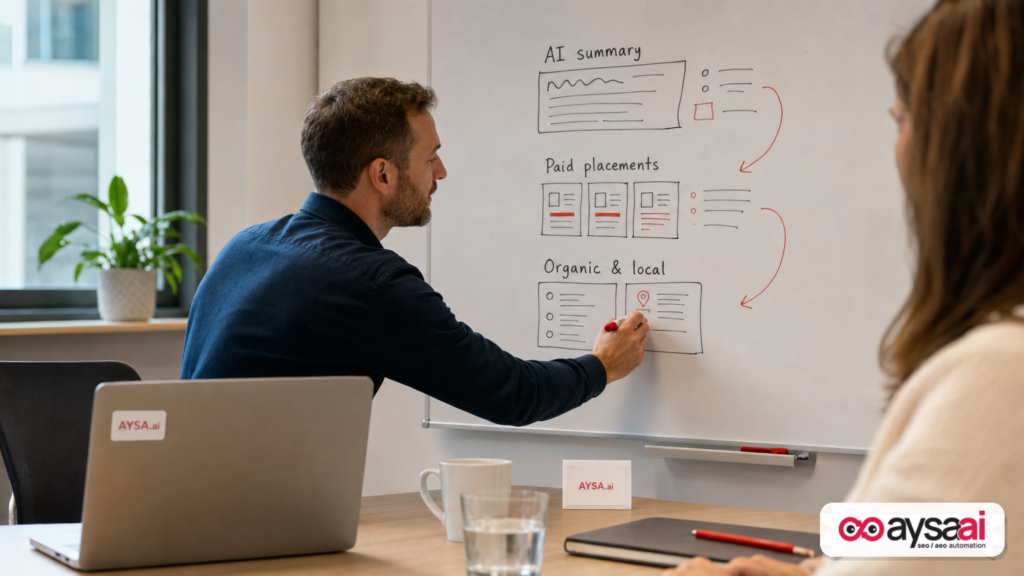
- AI changed the buying journey: decisions often happen before the click, which changes how you measure success and how you allocate budget.
- SEO and PPC are no longer substitutes: they’re complementary inputs into the same search ecosystem, especially as AI citations can prime later clicks to ads or organic listings.
- Your website became targeting infrastructure: modern paid formats increasingly depend on landing page clarity and structured content—traditional “SEO work” now improves paid performance too.
- Execution is the bottleneck: most businesses don’t lose because they lack ideas; they lose because fixes don’t ship consistently. That’s where an approval-based execution system like AYSA matters.
Table of contents

- What changed: Search became a synthesis layer (not a list of links)
- The new unit of value: from clicks to influence
- Why the SEO vs. PPC debate is finally over
- The hidden truth: SEO assets increasingly power paid performance
- Measurement reset: what to track when clicks disappear
- A concrete SME scenario: “Why am I ranking #1 but getting no leads?”
- Local businesses: AI can’t recommend what it can’t verify
- Content in 2026: clarity, structure, and proof beat volume
- Your AI entity footprint: what it is and how to audit it
- How to build a unified plan (SEO + PPC + AI) without doubling your workload
- Org charts, incentives, and why agencies struggle here
- Where AYSA.ai fits: monitoring + approval + execution
- What to do next
- Sources and further reading
What changed: Search became a synthesis layer (not a list of links)

Traditional SEO and PPC were built on a mental model: the SERP is a stable list of ranked “slots.” You win by occupying the highest slot you can afford (PPC) or earn (SEO). Then you optimize for clicks.
But AI-driven experiences changed what the “results page” is. Instead of a list, it’s increasingly a dynamic assembly of components: AI summaries, maps/local packs, shopping modules, “People Also Ask,” video carousels, paid placements, and organic results that can be pushed far below the fold depending on query type.
Search Engine Land’s analysis argues that this shift breaks the foundation of the old debate and frames AI as the force squeezing both paid and organic on the same page—moving value upstream, from click capture to decision influence. See: Why the SEO vs. PPC debate is finally over (Search Engine Land).
Even if you still get clicks, the context of those clicks has changed. A click today may come after the user has already:
- read an AI summary,
- seen a brand cited as a reference,
- scanned reviews in the Local pack,
- compared pricing in shopping,
- formed an opinion about who is “legitimate.”
That means the goal is no longer just rank or CPC. The goal is presence + credibility + conversion-ready experiences across surfaces.
The new unit of value: from clicks to influence
For years, marketers treated the click as the unit of value. Your dashboards were built around it. Your budget arguments were built around it. Your agency retainers were built around it.
But when AI answers reduce the need to click, the click becomes a smaller and smaller slice of total search activity. The real currency becomes:
- Being the brand that shows up as the recommended solution (in AI summaries, local results, and recognizable organic/paid placements).
- Being the brand that is verified and consistent (name, address, phone, services, policies, expertise, proof).
- Being the brand with the clearest “machine-readable” value proposition (so ad systems and AI systems can match you correctly).
Search Engine Land cites research indicating that when brands are cited inside AI Overviews, they can see better performance in both organic and paid listings beneath the overview—suggesting the citation functions less like a link and more like an endorsement that primes the later click. That’s the core behavior change: influence happens above your listing, and then the click (if it happens) follows the path of trust.
Practically, this is why I’m pushing teams to stop asking “Which channel wins?” and start asking “What evidence does the AI and the SERP use to assign trust?”
Why the SEO vs. PPC debate is finally over
The SEO vs. PPC debate assumed a zero-sum fight for the same visitor. One person. One click. Two ways to get it.
In an AI-shaped journey, that model collapses because:
- Both channels can be suppressed simultaneously when the answer is provided directly on the results surface.
- Visibility in one channel can lift performance in the other (e.g., brand familiarity and AI citations increasing the chance that a user clicks your ad or your organic listing).
- Search is happening “everywhere,” not only on classic search engines—people use marketplaces, social platforms, and AI tools as search behaviors.
So the debate is “over” not because SEO or PPC stopped working, but because they’re no longer opposing strategies. They’re now complementary layers of the same go-to-market motion.
When someone asks me “Should we do SEO or PPC?” my answer is: “Neither—start with outcomes, then design a plan that wins trust and captures demand across surfaces.”
The hidden truth: SEO assets increasingly power paid performance
Here’s the part many teams still miss: the boundary between SEO work and paid work is getting thinner.
Search Engine Land points to Google’s move toward AI-driven ad experiences (for example, AI Max as an evolution of dynamic targeting) where the system relies more heavily on your website and landing pages to understand what you sell and which queries you match. That means your “SEO inputs” are increasingly “PPC inputs.”
Whether you call it AI Max, dynamic matching, or automated creative, the direction is consistent: machines read your site to decide where your ads show and how they perform.
What this implies for SMEs and agencies:
- Landing page clarity is now a targeting lever. If your page is vague, you don’t just rank poorly—you may match poorly in paid systems too.
- Structured information is no longer optional. Clean headings, consistent service/product definitions, and schema (where appropriate) can support eligibility and comprehension across multiple surfaces.
- “SEO content” that never converts is wasted. The same page must educate humans and provide clean signals to machines while still driving leads or sales.
This is exactly why “channel teams” often produce channel failures. The SEO team publishes content that reads like it was written for Google; the paid team builds ads that promise things the landing page doesn’t clearly support; the AI system summarizes a confusing page; and then everyone blames the channel.
The fix is not more content. The fix is one narrative across SEO, paid, and AI surfaces—backed by proof.
Measurement reset: what to track when clicks disappear
If you keep measuring 2026 search with 2016 scoreboards, you’ll make 2016 decisions. That’s the trap.
In an influence-first search environment, you still track clicks and conversions—but you also need indicators that you’re earning trust placement and decision visibility.
For SMEs, here’s a pragmatic measurement stack (without pretending any single metric is perfect):
1) Business outcomes (the only scoreboard that matters)
- Qualified leads (not just form fills)
- Booked appointments / calls / demos
- Revenue (where trackable)
- Margin-aware CAC or cost per lead
2) Search capture (what you still control)
- Branded search demand trend (are more people looking for you by name?)
- Non-branded demand capture (queries that indicate category intent)
- Local visibility signals (maps impressions, calls, direction requests where available)
3) AI visibility (the new layer)
- Are you being referenced/cited in AI summaries for your category?
- Are competitors being referenced instead?
- Are the facts about your business consistent and verifiable?
If you want a practical way to start here, AYSA provides monitoring and reporting designed for AI-era visibility, including AI search visibility and ongoing monitoring that helps you catch drift before it becomes a quarter-long revenue problem.
4) Operational throughput (the hidden driver of compounding)
- How many high-impact fixes ship per month?
- How long does it take to move from “we should” to “it’s live”?
- How often do pages decay and never get refreshed?
Most teams don’t lose because they lack strategy. They lose because execution is slow, approvals are messy, and the site never gets updated in a disciplined loop.
A concrete SME scenario: “Why am I ranking #1 but getting no leads?”
Let’s make this real.
Imagine a local service business—say an architectural studio, a high-end landscaping firm, or a boutique legal practice. You Google a few keywords and see yourself ranking #1 organically. The agency celebrates. The owner is still asking: “Where are the leads?”
This is not mysterious in 2026. It’s structural.
Here’s what can happen on a high-commercial-intent query:
- Paid placements dominate the top of the page.
- A local pack appears (sometimes with promoted options).
- AI summaries answer “what to do” without a click.
- Directory sites take a big share of attention.
- Organic listings—even the #1 organic listing—sit far below the decision zone.
So yes, you may “rank #1.” But you’re functionally invisible at the moment the user decides who to contact.
What should an SME do in this scenario?
Step A: Confirm the reality with data (not vibes)
- Compare impressions vs. clicks in Google Search Console.
- Look at query intent: are you ranking for research queries that don’t convert?
- Check where leads actually come from (phone calls, forms, directions, bookings).
If the click-through rate is collapsing while impressions hold, you’re seeing the influence shift in action.
Step B: Improve “decision visibility,” not just rankings
- Strengthen local presence: Google Business Profile completeness and consistency.
- Build category proof: portfolios, case studies, before/after, credentials, FAQs.
- Add structured clarity: unambiguous service definitions, coverage areas, pricing approach.
Step C: Use paid tactically when the SERP is pay-to-play
- Bid on high-intent, high-margin queries where you can convert.
- Send clicks to pages that clearly match the query promise.
- Measure cost per qualified inquiry, not cost per click.
This is where the old SEO vs. PPC mindset hurts you. The best answer is often: tighten SEO for credibility and local proof, and use PPC to guarantee presence in the decision zone—while AI changes how both are consumed.
Local businesses: AI can’t recommend what it can’t verify
Local SEO has always been about trust: accurate business information, consistent citations, legitimate reviews, real-world proof.
In AI search, that becomes even more literal: AI systems are less likely to “recommend” a business they can’t confidently verify. If your identity is inconsistent—different phone numbers, mismatched names, outdated addresses, unclear categories—you create uncertainty. Uncertainty is the enemy of recommendations.
Search Engine Land’s broader coverage includes local-specific pitfalls such as Google Business Profile changes potentially disrupting rankings. If local is your lifeline, treat operational accuracy (addresses, categories, hours, services) as a growth lever—not admin work. See: Why Google Business Profile address changes can disrupt local rankings (Search Engine Land).
For SMEs, the practical playbook is boring—but it works:
- Make sure your core business facts are consistent everywhere they appear.
- Build pages that clearly state what you do, where you do it, and who you help.
- Collect reviews ethically and respond like a real business.
- Keep photos and offers current.
AI didn’t replace local SEO; it raised the penalty for sloppiness.
Content in 2026: clarity, structure, and proof beat volume
AI made content cheap. That’s not a moral statement; it’s a market reality. When everyone can generate 50 blog posts a week, the advantage shifts from volume to:
- Clarity: can a human (and a machine) quickly understand your offer?
- Specificity: do you define services, constraints, and outcomes precisely?
- Proof: do you demonstrate legitimacy with real examples, policies, credentials, and transparent details?
- Maintenance: do you refresh what matters instead of publishing endlessly?
Search Engine Land points to this “clarity” principle explicitly in its coverage of modern blogging and AI search behavior. See: The new SEO rules for bloggers in 2026: Why clarity matters in AI search (Search Engine Land).
Here’s a content approach that works for most SMEs and many mid-market teams:
1) Convert your homepage and core landing pages into “explainers”
Not marketing fluff. Explainers. In plain English:
- Who this is for
- What problem it solves
- What’s included / not included
- How pricing works (even ranges or “what drives price”)
- What proof you have (case studies, results, credentials)
2) Build a small set of category authority pages
If you’re a clinic: conditions you treat and how you treat them. If you’re ecommerce: buying guides and product comparisons tied to your inventory. If you’re SaaS: use cases and integrations that map to real buyer intent.
3) Add FAQs that answer real objections
Not the generic “What is X?” FAQs. The ones that reduce sales friction: timelines, guarantees, policies, compatibility, insurance, shipping, returns, onboarding, security.
4) Maintain instead of endlessly publishing
AI search rewards current truth. If you have old pages that are outdated, ambiguous, or contradictory, they become liabilities—because AI systems can pick up and summarize those contradictions.
Your AI entity footprint: what it is and how to audit it
“Entity” can sound technical, but the concept is simple: AI systems and search engines need a stable understanding of who you are, what you do, and how to distinguish you from similar businesses.
Your “AI entity footprint” is the collection of signals that support that understanding: your website facts, structured data, business listings, consistent naming, and the broader web context that corroborates your claims.
Search Engine Land offers a tactical starting point for auditing this footprint. See: How to audit your AI entity footprint (Search Engine Land).
Entity gaps: where teams unknowingly sabotage themselves
Common issues that create “AI confusion” (especially for SMEs):
- Name drift: your business name appears differently across platforms.
- Service ambiguity: you use marketing terms that customers don’t search, and machines can’t map.
- Location ambiguity: you serve an area but don’t define it clearly on-site.
- Proof gaps: you claim expertise but don’t show credentials, associations, case studies, or policies.
- Outdated pages: old pages contradict current offerings or pricing.
Schema and structured clarity (without overengineering)
Structured data isn’t a magic trick, but it can reduce ambiguity. Search Engine Land has specific guidance on schema and entity gaps: Schema for AI search: How to identify and prioritize entity gaps (Search Engine Land).
What I recommend for most SMEs:
- Start with the basics (organization, local business, products/services where appropriate).
- Only mark up what you can defend publicly.
- Focus on consistency and correctness over cleverness.
And remember: schema supports understanding; it doesn’t replace having clear content and proof on the page.
How to build a unified plan (SEO + PPC + AI) without doubling your workload
The biggest fear I hear from founders and marketing leads is: “Are you telling me we need to do SEO, paid, and AI optimization now? That sounds like three jobs.”
It’s not three jobs if you build the plan around shared assets and one execution loop.
The “one asset, many surfaces” principle
Build (or rebuild) a small number of pages that are so clear and credible they can feed:
- Organic rankings (traditional SEO)
- Local visibility (Maps/local)
- Paid landing page relevance (improving paid efficiency)
- AI summaries and citations (AI visibility)
Examples of high-leverage assets:
- A “Service + Location” page that genuinely explains the service, who it’s for, pricing drivers, and proof.
- A category page for ecommerce that clarifies differences between product types, includes selection guidance, and answers returns/shipping questions.
- A “Use case” page for SaaS that ties a specific problem to features, implementation, security, and expected outcomes.
A workflow that doesn’t collapse under approvals
Most businesses fail here because strategy becomes a backlog of “shoulds.” The bottleneck is approvals, dev cycles, and content production that never finishes.
This is why AYSA is built as an execution system: we monitor, prepare changes, ask for approval, and then execute accepted website changes. That makes continuous optimization possible without turning your site into a forever project.
Relevant starting points if you want to see how AYSA approaches this:
Org charts, incentives, and why agencies struggle here
Search Engine Land’s surrounding coverage highlights something many operators feel but rarely name: alignment between SEO and PPC starts with the org chart and incentives (who owns what, what gets credited, and what gets funded). See: SEO and PPC alignment starts with your org chart (Search Engine Land).
Here’s the uncomfortable truth:
- SEO teams are often rewarded for rankings and traffic (even if it doesn’t convert).
- Paid teams are often rewarded for ROAS or CPA (even if they’re cannibalizing brand demand or leaning on weak landing pages).
- Content teams are often rewarded for publishing volume (even if the content is redundant or decays).
AI makes this misalignment more expensive because the surface is more compressed. If you don’t coordinate, you end up with:
- paid ads promising something the AI summary contradicts,
- SEO pages that don’t match commercial intent,
- local listings that confuse your service area,
- and ultimately: competitors becoming the “recommended” brand.
Agency reset: from deliverables to outcomes
Agencies that sell “SEO deliverables” (X blogs/month, Y backlinks, Z audits) will struggle. Not because those activities are always wrong, but because the buyer is now paying for influence and outcomes, not output.
If you run an agency, the AI era forces a new promise:
- We will improve your decision visibility (AI + local + organic + paid alignment).
- We will ship changes continuously (not quarterly audits that die in a doc).
- We will measure what matters (leads, bookings, revenue, qualified pipeline).
AYSA can support this shift by turning optimization into a system rather than a project—especially where “approved execution” reduces the friction between recommendation and implementation.
Where AYSA.ai fits: monitoring + approval + execution
If you accept the premise that the click is no longer the only unit of value, you need a system that does three things reliably:
- Detect change: rankings, AI visibility, content decay, technical issues, and SERP shifts.
- Translate into actions: clear recommended website changes tied to outcomes.
- Ship consistently: because compounding comes from execution, not intention.
That’s the operating model we’re building at AYSA:
- Monitors the site and visibility signals (so you’re not flying blind).
- Prepares specific changes (content updates, structural fixes, clarity improvements).
- Requests approval so businesses keep control and governance.
- Executes accepted changes so improvements actually go live.
You can explore the product areas most relevant to this article here:
To be clear, AYSA is not a replacement for strategy. It’s the system that ensures strategy becomes shipped work—especially when AI-era search demands continuous updates and cross-channel alignment.
What to do next
If you’re a business owner, marketing lead, or agency operator, here’s a practical action list you can start this week.
1) Stop funding channels; fund outcomes
- Define what a qualified lead is.
- Define your target CPL/CAC range based on margins.
- Map your top 5 revenue-driving services/products to pages and campaigns.
2) Audit “decision visibility” for your money queries
- For the queries that matter, list what appears above organic: AI summaries, ads, local packs, directories.
- Write down what a user learns about you before they ever see your site.
- Identify which competitors are being presented as default choices.
3) Rebuild one high-leverage page for clarity and proof
- Make the offer explicit (who it’s for, what’s included, what it costs/depends on).
- Add proof (case study, credentials, reviews, policies, photos, outcomes).
- Add FAQs that address objections.
4) Use PPC to buy presence where the SERP is crowded
- Bid narrowly on the highest-intent terms.
- Send traffic to the clearest matching page.
- Measure qualified outcomes, not clicks.
5) Put monitoring and execution on a schedule
- Set a cadence (weekly checks, monthly refreshes, quarterly consolidation).
- Decide who approves website changes and how fast.
- Adopt a system that turns findings into shipped improvements.
If you want this to run as an ongoing system rather than a one-time initiative, start with AYSA’s monitoring and AI search visibility, then align that with the website changes you can approve and deploy.
Sources and further reading
- Search Engine Land: Why the SEO vs. PPC debate is finally over
- Search Engine Land: The new SEO rules for bloggers in 2026: Why clarity matters in AI search
- Search Engine Land: Schema for AI search: How to identify and prioritize entity gaps
- Search Engine Land: How semantics and topical authority improve local SEO
- Search Engine Land: Why Google Business Profile address changes can disrupt local rankings
- Search Engine Land: How to audit your AI entity footprint
- Search Engine Land: 7 feedback loops for self-improving AI content workflows
- Search Engine Land: SEO and PPC alignment starts with your org chart
- Search Engine Land: Google says AI Max unlocks billions of new monetizable searches
- Search Engine Land: ChatGPT Ads adds conversion bidding, geo exclusions and bulk campaign tools
Note on claims and numbers: This editorial references ideas and directional findings discussed in the Search Engine Land source. Where specific statistics or third-party studies are mentioned in that article (e.g., CTR shifts, zero-click trends), treat them as reported by Search Engine Land unless you independently validate them with the original study authors.
Continue the AI search topic inside AYSA.
Use these pages to connect the article with AI SEO tools, AI visibility monitoring, AI Overviews and approved website execution.
Turn this topic into a website action plan.
Use these AYSA hubs to move from reading to technical fixes, AI visibility monitoring, research, glossary context and approval-first SEO execution.

