Google AI Mode connects to Instacart, Canva, and YouTube Music: why “search → action” is the new battleground for visibility
Google is rolling out connected app integrations inside AI Mode, letting U.S. users jump from an AI answer to checkout, design, or listening in fewer steps. That’s not just a UX upgrade—it’s a structural shift in how demand flows, how brands get credited, and how SEO, product feeds, and conversion tracking must evolve.
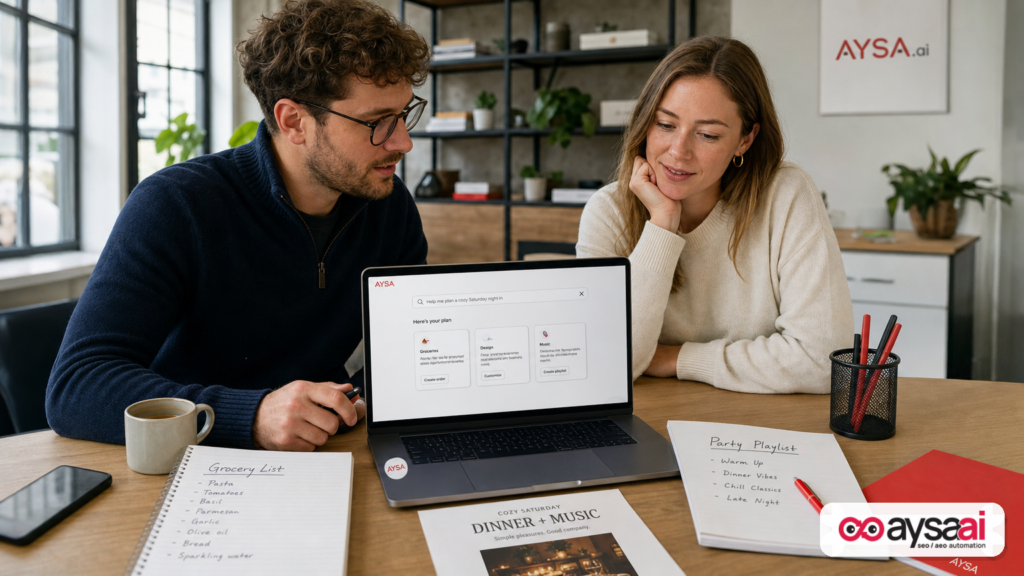
Google just made a quiet but consequential move: AI Mode in Search is starting to connect directly to third-party services so users can complete tasks—shopping, designing, and listening—without bouncing through the traditional “ten blue links” journey.
According to Search Engine Land, Google is rolling out connected app integrations in AI Mode for U.S. users, beginning with Instacart, Canva, and YouTube Music. The headline sounds like a UX feature. The reality is bigger: this is Google turning AI answers into transactional pathways.
As Marius Dosinescu at AYSA.ai, my point of view is simple: when Google compresses the path from “question” to “action,” the winners won’t be the brands with the best blog post—they’ll be the brands with the best data, eligibility, and execution velocity. This is AEO/GEO in practice: being present, understood, and selectable by AI systems that increasingly act as the user’s interface to the internet.
Concise summary
Google AI Mode’s new app integrations signal a shift from informational search to connected, intent-completing search. For businesses, this changes what “visibility” means: not just ranking or even being cited, but being actionable inside AI experiences. Brands need to tighten product/service data, strengthen Entity Coverage, instrument conversion paths, and adopt faster SEO/AEO execution loops. AYSA fits here as an Approved Execution system: we monitor, prepare changes, ask for approval, and execute accepted website updates—continuously.
Key takeaways
- AI Mode is moving from answers to actions. The next phase of AI Search is about completing tasks in connected services, not just summarizing the web.
- Fewer Clicks doesn’t automatically mean fewer customers—but it changes Attribution. Your brand may still benefit, but with less direct traffic and less obvious reporting.
- Eligibility beats eloquence. Clean product/service data, structured markup, inventory/availability signals, and strong entity alignment increasingly matter as much as (or more than) page-level content.
- SEO vs. CRO vs. partnerships is converging. If AI Mode can send users straight into carts, templates, and playlists, your “search strategy” now includes partner ecosystems and post-click experience design.
- Execution speed is the moat. The teams that can monitor AI visibility changes and ship fixes weekly—safely—will outpace slower competitors.
Table of contents
- What changed: AI Mode is becoming a connector, not just an answer box
- Why this matters: the conversion path is moving upstream into Google
- Who wins and who loses when Search becomes a “remote control” for apps
- What it means for SEO in 2026: from rankings to actions (AEO/GEO)
- Instacart integration: product visibility becomes cart eligibility
- Canva integration: content marketing meets “creative completion”
- YouTube Music integration: discovery → consumption loops get tighter
- Measurement and attribution: what you may stop seeing (and what to track instead)
- What can go wrong: brand control, pricing, compliance, and dependency
- A concrete SME scenario: the local catering company competing in a “zero-click, full-action” world
- The new playbook: optimize for “being chosen” in AI Mode (AEO/GEO), not just ranking
- Where AYSA.ai fits: approved execution for AI-first search
- What to do next (action list)
- Sources and further reading
What changed: AI Mode is becoming a connector, not just an answer box
Google AI Mode has been positioned as a way to search with an AI assistant inside Google Search. The important change in this rollout isn’t the phrasing quality or the number of citations—it’s the introduction of connected actions.
Per Search Engine Land’s reporting, U.S. users can securely connect supported services (starting with Instacart, Canva, and YouTube Music) and then take action from within AI Mode. The examples Google highlighted are telling:
- Plan a barbecue → add ingredients to an Instacart cart → checkout in Instacart.
- Create a flyer → ask for Canva templates → move into design work.
- Plan a party → generate a playlist → save to YouTube Music → listen.
This is a shift from “Search answers your question” to “Search orchestrates the next step.” In product terms, Google is moving up the stack: not just being the place demand starts, but the place intent gets completed.
Google also said more partners are coming. That’s the other key detail. Once this pattern exists, it can expand into travel booking, restaurant reservations, appointment scheduling, ticketing, learning platforms, CRM actions, and B2B workflows.
If you run a business, you should interpret this as: Google is building a new distribution layer where AI responses can directly trigger commerce and creation—and your ability to participate will depend on your data, integrations, and brand signals.
Why this matters: the conversion path is moving upstream into Google
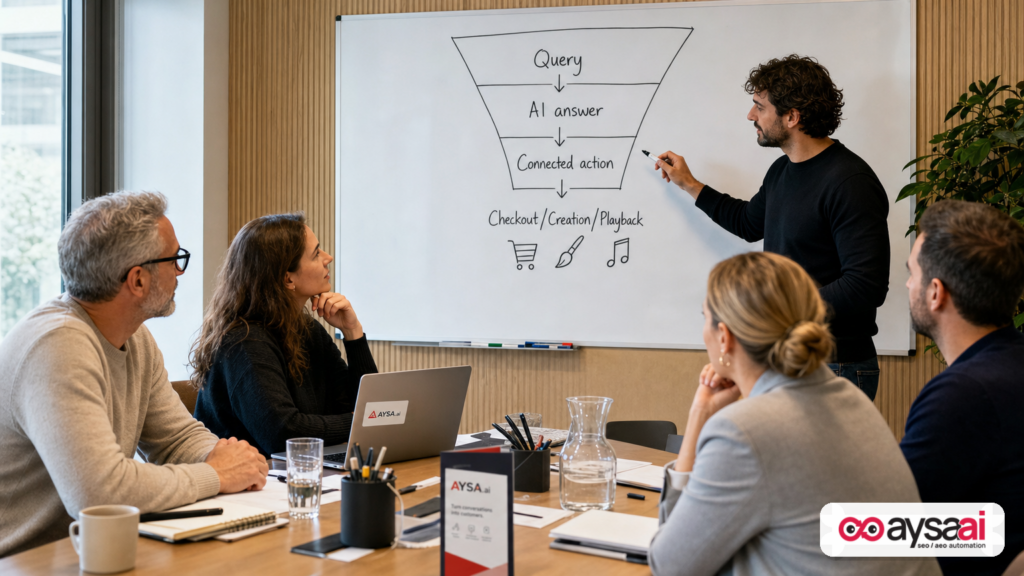
Historically, the search journey looked like this:
- User searches
- User clicks a result
- User lands on your site or a partner site
- User converts (purchase, lead, subscription)
AI Mode integrations compress that to:
- User searches
- AI assembles a plan + recommended items + next actions
- User pushes an action (add to cart, open template, save playlist)
- Conversion completes in a connected ecosystem
Two big consequences follow:
Consequence #1: “Visibility” becomes contextual and transactional
You can be “visible” in three different ways now:
- Referenced: your brand is mentioned/cited in an AI answer.
- Visited: the user clicks through to your site.
- Activated: the user takes an action involving your product/service, possibly without visiting your site first.
Most businesses are still measuring only the second one. That’s why this shift feels like “traffic is disappearing” even when demand isn’t necessarily gone—it’s being rerouted.
Consequence #2: AI-first experiences reduce friction—then reallocate power
Reducing steps can be genuinely good for users and can increase conversion rates. But it also means the interface that decides “what action to offer” becomes the new gatekeeper. Your website content is no longer the only (or primary) interface for decision-making.
In other words: search is becoming a control plane for the internet’s apps. If you’re not selectable by that control plane, you’re not in the most efficient path to purchase.
Who wins and who loses when Search becomes a “remote control” for apps
This isn’t purely an SEO story. It’s a distribution story, an ecosystem story, and—most uncomfortably—an incentive story.
Likely winners
- Brands with clean, structured product/service data that partners and Google can understand and activate.
- Businesses already integrated into major platforms (marketplaces, delivery networks, booking engines, design ecosystems).
- Teams with operational SEO: monitoring, fast iteration, and safe deployment.
- Companies that can compete on availability and convenience, not just storytelling.
Likely losers
- Businesses relying on informational content alone to capture top-of-funnel traffic without a clear action layer.
- Brands with messy catalogs, inconsistent naming, missing attributes, weak schema, and thin entity signals.
- Publishers (in many verticals) whose content gets summarized and turned into actions that happen elsewhere.
- SMEs who “set and forget” SEO and only react after a quarterly report shows decline.
One important nuance: the “losers” list doesn’t imply these businesses can’t win. It means the playbook changes from content volume to content + data + distribution readiness.
What it means for SEO in 2026: from rankings to actions (AEO/GEO)
We need to name the shift clearly:
- SEO traditionally optimized for rankings and clicks.
- AEO (Answer Engine Optimization) optimizes to be correctly represented in AI answers.
- GEO (Generative Engine Optimization) broadens that to influence how generative systems select, summarize, and recommend—across contexts.
AI Mode app integrations push us into a fourth layer: Action Optimization. It’s not an industry-standard label yet, but it’s the practical reality: being the product/service that AI can confidently help the user do something with.
This doesn’t kill SEO. It changes where SEO ends and where product ops, analytics, and partnerships begin.
It also reinforces a point Search Engine Land has been covering across AI Search updates: Google’s AI-driven search features are evolving quickly, and marketers have to adapt their measurement and tactics. For broader context, see their related coverage:
- Google says AI Search features send billions of clicks to websites each week (useful for understanding Google’s narrative about continued click flow)
- Top Stories roll out in Google AI Overviews (signals how SERP modules keep evolving around AI)
- AI-driven personalized search: A practical guide (context on personalization and its impact on visibility)
Those pieces aren’t “proof” of outcomes for your specific business, but they are helpful research leads for the direction of travel: AI is becoming more embedded in discovery, presentation, and now action.
Instacart integration: product visibility becomes cart eligibility
Let’s start with the most commercially direct example: grocery and consumables via Instacart.
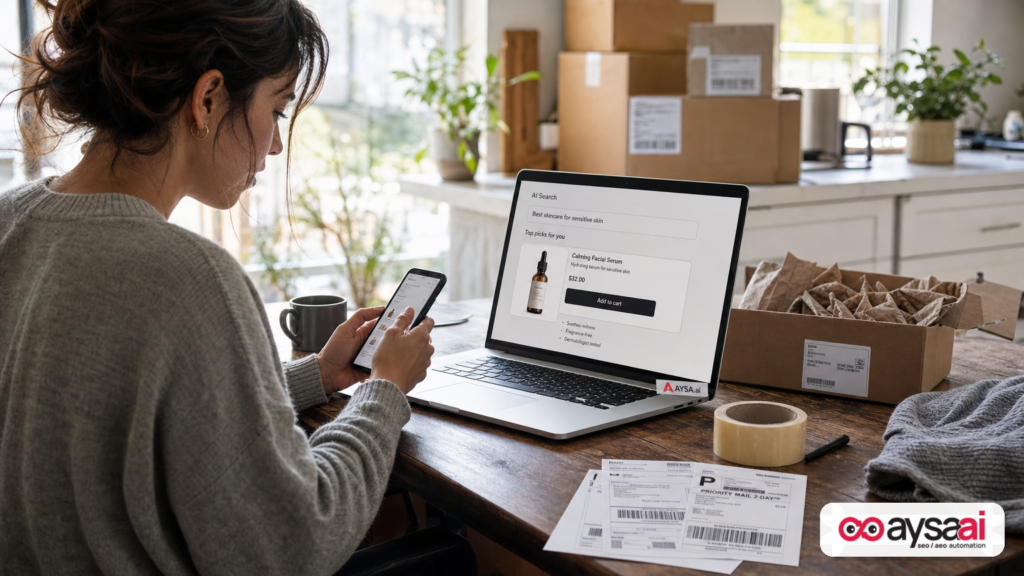
Google’s example (as reported by Search Engine Land) is a user planning a barbecue, then adding ingredients to an Instacart cart from AI Mode and checking out in Instacart.
Why Instacart is different from a “normal” click
In classic SEO, your content could rank for “best burgers for grilling” and then you’d capture traffic and (maybe) affiliate revenue, ad revenue, or email signups. In the connected-action world, the user may never need your article if AI Mode can assemble the shopping list and pipe it into a cart.
That creates a new competitive question: Are your products the ones AI Mode chooses to add?
What merchants should focus on
I’m not going to pretend we have Google’s internal selection rules. But we can reason about what makes a product “add-to-cart ready” in an AI-driven environment:
- Catalog hygiene: consistent titles, variants, units, and attributes (size, dietary tags, allergens, etc.).
- Availability realism: out-of-stocks and substitutions destroy trust fast, especially when AI made the plan.
- Entity clarity: brand + product names that map cleanly to what users ask for.
- Differentiation: if products are interchangeable commodities, AI will tend to choose defaults (often based on convenience).
If you’re a CPG brand, this is where SEO meets retail operations. If your data is inconsistent across partners, AI Mode integrations will amplify the mess.
Questions to ask your team this week
- Do our product names and attributes match how customers describe the product in natural language?
- Are we eligible and properly represented in the partner ecosystem(s) where customers actually buy?
- Do we have a way to monitor brand presence in AI-driven results beyond website clicks?
At AYSA, this maps to our AI search visibility and monitoring approach: you can’t manage what you can’t observe, and clicks alone are no longer the full story.
Canva integration: content marketing meets “creative completion”
Canva is a different kind of integration: it’s not checkout, it’s creation. But the business implication is similar: search results can become a bridge into a tool where work gets completed.
Google’s example (via Search Engine Land) is a user working on a flyer, asking Canva to show template options from AI Mode.
Why this should matter even if you don’t “do design”
Many SMEs rely on lightweight creative work:
- restaurants making weekly specials
- clinics promoting seasonal services
- local gyms posting class schedules
- ecommerce brands producing simple ads and landing visuals
Historically, search might have driven these users to blog posts like “flyer ideas” or “best Instagram post size,” where publishers and agencies captured traffic. In a connected AI flow, the user might get a recommendation and a template immediately.
The new visibility question
If AI Mode becomes a creative concierge, the question becomes:
When a user asks for a “summer sale flyer for a boutique,” whose products, offers, and brand elements does the AI suggest?
This is where brand assets, structured info, and consistent messaging become inputs. Not necessarily public “SEO content,” but the underlying clarity of what you offer, how you describe it, and how easily it can be turned into an on-brand creative.
Practical move
Create a single source of truth page (or a small set of pages) that clearly defines:
- your primary offers
- your differentiators
- your service areas (if local)
- your brand promise in plain language
- your FAQs that reflect real customer phrasing
Then use an execution system (like AYSA) to keep those pages updated and consistent as products and pricing change. This is exactly the kind of work that’s easy to postpone until it’s “wrong enough” to hurt performance. AI makes that tolerance smaller.
To explore operational SEO tooling, start with AYSA’s AI SEO tools and the tactical resources on our blog.
YouTube Music integration: discovery → consumption loops get tighter
YouTube Music is the third integration named in the rollout, and it highlights how AI Mode can connect planning with immediate consumption. The example: plan a party, generate a playlist in AI Mode, save it to YouTube Music, and start listening.
This matters beyond music because it shows Google’s model: AI Mode can create an object in another service (a playlist) and then hand off seamlessly.
Implication for content discovery businesses
If your business model depends on being the destination where discovery happens—publishers, bloggers, review sites, affiliate sites—connected actions are a warning sign. AI doesn’t have to “steal” your content to reduce your leverage; it just has to reduce the number of steps where a user needs you.
That means the defensible strategy becomes:
- Unique value AI can’t easily compress (original research, community, tools, proprietary data).
- Strong brand demand so users seek you out rather than accept defaults.
- Presence in AI answers where appropriate—but with realistic expectations about click-through.
Search Engine Land has also reported on adjacent YouTube AI search experiences (useful context): Ask YouTube AI search experience expands to U.S. desktop users. The throughline is clear: AI is becoming the interaction layer in multiple Google surfaces.
Measurement and attribution: what you may stop seeing (and what to track instead)
Most SMEs and many agencies still operate with a reporting stack built for the classic click path:
- Google Search Console for impressions/clicks
- GA4 for sessions and conversions
- ad platforms for paid attribution
Connected AI actions complicate that, because “the moment of influence” may happen in AI Mode while the conversion happens in a connected app or partner environment.
What gets harder
- Click-based ROI narratives: you may see fewer sessions even if orders hold steady via partners.
- Creative credit: AI-generated plans may include your brand without a direct trackable click.
- Funnel clarity: the “first touch” can be an AI response, not a landing page session.
What to track instead (practical, non-hallucinated)
Without inventing new metrics Google hasn’t confirmed, here are practical shifts you can implement now:
- Broaden KPI sets: include brand search trends, partner channel sales, and assisted conversions where available.
- Instrument partner flows: if you sell through intermediaries (delivery, marketplaces), set up routine reporting cadence and reconcile it with on-site data.
- Monitor AI visibility qualitatively and systematically: track whether you appear in AI answers for your core intents, and whether recommendations match your positioning.
- Audit message consistency: if AI is summarizing you, ensure the “summarizable truth” on your site is accurate.
This is one reason we built AYSA as a monitoring + approved execution loop. When visibility becomes more dynamic and less click-dependent, teams need a system to detect changes early and ship corrections safely.
What can go wrong: brand control, pricing, compliance, and dependency
Connected actions are powerful, but they introduce real business risks. Ignoring them doesn’t avoid the risk—it just makes it more likely you’ll discover it late.
Risk 1: Loss of brand control in the “decision moment”
If the AI interface becomes the place where the user decides, your carefully designed landing pages matter less at the top of the funnel. The user might never see your comparison table, your video, or your founder story.
Mitigation: strengthen brand-level signals and keep your core positioning consistent everywhere (site, feeds, partner listings).
Risk 2: Pricing and offer confusion
If AI Mode suggests products or bundles, any mismatch between what you claim and what partners fulfill becomes a trust killer. This is especially sensitive for regulated or high-stakes categories (health, finance) where inaccuracies have real consequences.
Mitigation: keep “source of truth” pages current and reduce duplication. Use a controlled workflow to approve changes before deploying.
Risk 3: Platform dependency grows
Every integration that shortens the funnel can make businesses more dependent on the platforms that control the interface. That’s not inherently bad—but it changes bargaining power and margin pressure over time.
Mitigation: maintain a dual strategy: win in partner ecosystems while protecting owned channels (email, direct traffic, repeat purchase).
Risk 4: SEO whiplash and reactive thrash
When teams see traffic drops, they often overcorrect: ripping out content, changing site structure, or blindly chasing “AI optimization hacks.”
Mitigation: adopt a measured, monitored approach. Search Engine Land’s coverage of AI search changes can be a useful signal feed, but you still need your own instrumentation and controlled execution.
A concrete SME scenario: the local catering company competing in a “zero-click, full-action” world
Let’s make this real with a scenario that’s easy to visualize.
Business: a local catering company in a mid-sized U.S. city. They do corporate lunches, small weddings, and private parties. Their site has menus, galleries, and an inquiry form. Historically, they’ve grown through local SEO + referrals.
The old journey
- User searches “catering for 30 people backyard party”
- User clicks 2–4 sites, scans menus, fills an inquiry form
- Caterer responds, sends quote, converts later
The new journey (AI-first)
- User asks AI Mode: “Plan a backyard party menu for 30, including vegetarian options, under $25 per person”
- AI provides a menu plan, shopping list, and potentially suggests options to complete tasks (delivery ingredients, create invitations, create a playlist)
- User may only contact a caterer if the AI experience nudges them—otherwise they might self-serve
Even without a direct “book catering” integration, the AI experience can reduce the need for multiple vendor site visits. The caterer’s new competition isn’t just other caterers—it’s “AI-assisted self-service.”
How the caterer wins anyway
- Own the “why hire us” use case: emphasize outcomes AI can’t deliver (setup, staffing, dietary safety, reliability, cleanup).
- Build clear service packages that map to AI questions (e.g., “Backyard Party Package for 30–50,” “Vegetarian-Friendly Corporate Lunch”).
- Make information extractable: FAQs, structured service descriptions, transparent minimums, service areas, and lead times.
- Be the best answer for “When should I hire a caterer vs DIY?”
This is AEO/GEO: optimizing for the prompts people ask, and ensuring AI can accurately and confidently represent your offer.
The new playbook: optimize for “being chosen” in AI Mode (AEO/GEO), not just ranking
Here’s the practical editorial take: if AI Mode is becoming an action layer, your job is to become the most reliable, selectable option for the intents that matter.
1) Map your “action intents,” not just keywords
Instead of only tracking “best X” queries, identify intents tied to completion:
- buy / order / deliver
- book / schedule
- design / create / generate
- compare / choose
- troubleshoot / fix
Then ask: what would a connected action look like in our category? Even if Google hasn’t integrated your vertical yet, planning for that shape is smart.
2) Tighten your entity signals and core pages
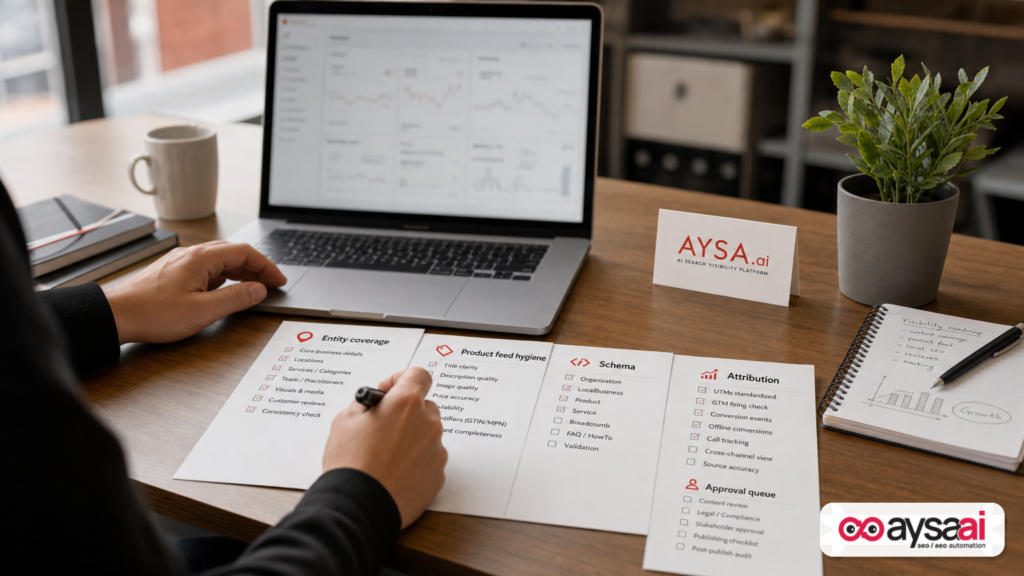
AI systems need clarity. That means:
- clear “About” and “What we do” language
- consistent naming (brand, products, services)
- strong internal linking between core pages and supporting content
- FAQs that match customer phrasing
This is also where topics like topical authority and semantics matter. As a research lead, Search Engine Land’s piece Visual semantics: The missing piece of topical authority is useful context: AI understanding is multimodal and semantic, not just keyword-based.
3) Treat product/service data as SEO inventory
If you sell products, your SEO asset isn’t only your blog. It’s your product catalog quality. If you sell services, it’s your service definitions, packages, and eligibility rules.
Audit for:
- duplicate or conflicting pages
- missing attributes
- unclear pricing/minimums
- outdated availability info
4) Build a monitoring loop for AI visibility changes
Whether you call it AI Mode, AI Overviews, or something new next quarter, the requirement is the same: you need a consistent way to track what AI says about you and whether you’re present for core intents.
This is exactly the use case behind AYSA AI Search Visibility and monitoring: observe first, then act.
5) Speed up execution—without creating risk
AI-era search changes can tempt teams into “cowboy SEO.” That’s how you end up with broken templates, accidental noindex tags, thin AI-generated pages, and brand voice chaos.
The operational answer is a system that:
- detects opportunities/issues
- prepares recommended changes
- requests approval
- executes safely
That’s the model we built at AYSA: approved execution that lets you move fast without gambling with your site.
Where AYSA.ai fits: approved execution for AI-first search
AI Mode integrations increase the cost of being slow. If the search interface is becoming a place where users complete tasks, then your “search presence” is a living system: products change, offers change, competitors change, SERPs change.
AYSA is designed for that reality:
- Monitor the site and search landscape continuously (Monitoring).
- Prepare recommended improvements (technical, content, internal links, structured clarity).
- Ask for approval so humans keep control and brand risk stays managed.
- Execute accepted changes so work doesn’t die in a backlog.
If you’re evaluating what this looks like in practice, start with:
One more editorial point: this isn’t about “chasing every Google update.” It’s about building a durable capability: closed-loop SEO/AEO operations.
What to do next (action list)
- Identify your top 10 “action intents.” The queries that lead to purchase, booking, or creation—not just reading.
- Audit your core pages for extractable clarity. Can AI summarize what you do, for whom, where, and why you’re different—correctly?
- Clean up product/service definitions. Reduce duplication, align naming, fill missing attributes, and remove contradictions.
- Review partner ecosystem readiness. If your customers buy through intermediaries, ensure your representation there is accurate and consistent.
- Set expectations with stakeholders. Explain that “fewer clicks” may not equal “less revenue,” but it will change reporting.
- Implement AI visibility monitoring. Track presence and correctness for priority intents. Don’t wait for quarterly surprises.
- Adopt an approved execution workflow. Fast iteration is required, but brand and technical risk must stay controlled.
Sources and further reading
- Search Engine Land: Google AI Mode adds Instacart, Canva and YouTube Music integrations
- Search Engine Land: Google says AI Search features send billions of clicks to websites each week
- Search Engine Land: AI-driven personalized search: A practical guide
- Search Engine Land: Top Stories roll out in Google AI Overviews
- Search Engine Land: Visual semantics: The missing piece of topical authority
- Search Engine Land: Ask YouTube AI search experience expands to U.S. desktop users
Note: This editorial uses the Search Engine Land report as the research starting point. Where Google’s detailed selection logic, metrics, or implementation specifics are not publicly documented in the supplied source context, I’ve treated them as analysis rather than fact.
Continue the AI search topic inside AYSA.
Use these pages to connect the article with AI SEO tools, AI visibility monitoring, AI Overviews and approved website execution.
Turn this topic into a website action plan.
Use these AYSA hubs to move from reading to technical fixes, AI visibility monitoring, research, glossary context and approval-first SEO execution.