Google’s June 2026 Spam Update: What It Really Means (And How To Protect Your Revenue Without Guesswork)
Google’s June 2026 spam update rolled out globally in days—fast, quiet, and policy-neutral. That doesn’t mean it’s harmless. Here’s how spam updates actually work, what patterns tend to get hit, what to monitor in Search Console, and a practical, execution-first playbook for SMEs and agencies—built for an era where AI-generated scale can turn into spam signals overnight.

Google’s June 2026 spam update rolled out globally, across all languages, and it was over fast. That combination—global + quiet + quick—is exactly what makes spam updates easy to underestimate and easy to mis-handle.
When most business owners hear “Google update,” they think of a sweeping core update that reorders the whole market. Spam updates are different. They’re not a public referendum on your brand. They’re improvements to Google’s ability to detect patterns it classifies as manipulation or low-value scale. And in 2026, “low-value scale” often looks like the side-effects of AI-driven publishing, templated expansion, and shortcut link tactics—sometimes created by well-meaning teams trying to grow.
This editorial is my practical guide for SMEs and agencies: what changed, why it matters, how to monitor the impact without panic, and what you should do next. Most importantly, it’s an Execution Plan—because strategy without implementation is just stress with better vocabulary.
Concise summary

- What happened: Google rolled out the June 2026 spam update globally and across all languages (June 24–26, 2026) per Google’s Search Status Dashboard, as reported by Search Engine Journal.
- What didn’t happen: Google did not announce new spam policies alongside this rollout (so the existing spam policy framework still applies).
- What it means: If you see ranking or traffic shifts, treat this as a spam-detection issue first—especially if you rely on templates, scaled pages, affiliate-heavy layouts, or AI-produced content at volume.
- What to do: Segment your data by page type, identify patterns that resemble spam signals, and implement controlled fixes. Recovery can take time; aim for durable changes, not “quick tricks.”
- Where AYSA fits: AYSA helps you monitor, prepare prioritized recommendations, request approval, and execute accepted changes—without turning your site into a testing lab during a volatile week.
Key takeaways (for busy operators)
- Spam updates punish patterns, not personalities. Don’t argue with the update; identify what pattern your site might be signaling.
- Speed of rollout doesn’t equal small impact. A two-day rollout can still cause a lasting demotion if your site trips newly improved detection.
- Most “AI content penalties” aren’t about AI. They’re about footprint: duplication, thinness, doorway behavior, and intent mismatch at scale.
- Monitor before you modify. The fastest way to make an update worse is to push dozens of untracked changes in response to a drop you haven’t segmented.
- Execution discipline is the moat. Teams that can ship measured fixes (and roll them back) outperform teams that theorize for weeks.
Table of contents

- What changed with the June 2026 spam update (and what we actually know)
- How spam updates differ from core updates (and why that changes your response)
- Why this matters for SMEs in 2026: AI scale, templates, and fragile trust
- What usually gets hit: patterns Google’s systems often interpret as spam
- The first 72 hours: what to monitor (and what not to overreact to)
- Triage framework: isolate the problem before you “fix SEO”
- Concrete SME scenario: an ecommerce brand hit by a spam update
- Remediation playbook: what to change on-site (content, templates, internal linking, index control)
- Links, reputation, and off-site signals: what to stop doing immediately
- What agencies should rethink: reporting, client comms, and change control
- Where AYSA fits: approved execution, not autopilot chaos
- What to do next (action list)
- Sources and further reading
What changed with the June 2026 spam update (and what we actually know)
Let’s separate facts from forum noise.
According to Google’s Search Status Dashboard update (as referenced in the Search Engine Journal report), Google rolled out the June 2026 spam update from June 24 to June 26, 2026. It applied globally and across all languages. Importantly, there was no companion policy announcement tied to this update—no new spam categories, no new documentation updates called out in the public note.
That absence matters. When Google pairs an algorithm update with new policy language, you can align remediation with clearly updated rules. When it doesn’t, you’re dealing with a detection improvement against existing policy concepts.
If you’re running a business, the useful takeaway is simple:
- This was not framed as a redefinition of “spam.”
- It was framed as improved ability to find spam (or spam-like patterns).
- Impact can show up as rankings drops, indexation quirks, or traffic declines concentrated in certain page groups.
And yes, it was the second spam update of 2026 (after March), which signals an ongoing cadence: Google’s spam detection systems are iterating frequently, not annually.
How spam updates differ from core updates (and why that changes your response)
Most bad SEO decisions happen because teams respond to the wrong kind of update.
Core updates: broad recalibration
A core update is Google changing how its overall ranking systems weigh many signals across the web. It can lift some sites while dropping others without anyone doing anything “wrong.” You respond by improving overall usefulness, differentiation, and brand signals—usually a multi-month approach.
Spam updates: enforcement and detection improvements
A spam update is closer to an anti-abuse system upgrade. Google has documented that spam updates involve improvements to automated systems that detect spam—often associated publicly with SpamBrain, Google’s AI-based spam prevention system (as described in Google’s spam update documentation, which SEJ references conceptually in its coverage).
Practically, that means spam updates tend to behave like this:
- Pattern-sensitive: Page templates, repeated blocks, and scaled publishing can create a detectable footprint.
- Less “debate,” more “classification”: If the system classifies a section of your site as spam-like, you can be suppressed until the site is re-evaluated.
- Recovery can lag: Even after fixes, Google may take time to reassess—so you need durable remediation, not frantic toggling.
So the response differs:
- Core update response: improve content strategy, Entity Authority, experience, and UX; measure over weeks/months.
- Spam update response: audit for manipulative or low-value patterns; reduce spam signals; fix indexation controls; clean templates; improve intent match; measure by page group.
If you treat a spam update like a core update, you’ll waste time polishing the wrong things while the problematic footprint remains.
Why this matters for SMEs in 2026: AI scale, templates, and fragile trust
In 2026, the biggest operational shift in SEO isn’t “Google is changing.” Google always changes. The shift is that your ability to create content and pages has become nearly unlimited—and your ability to maintain quality and uniqueness at the same pace has not.
That asymmetry is where spam updates land.
Spam is no longer just “obvious scams”
To a small business owner, “spam” sounds like hacked pages or fake pharma keywords. Those still exist, but spam detection systems also target subtler issues:
- scaled pages that add little unique value,
- doorway-like location expansions,
- thin affiliate pages that funnel traffic,
- manipulative Internal linking patterns,
- expired domain repurposing (when abused),
- mass-produced content that doesn’t satisfy the query intent.
Templates are a growth lever—and a risk multiplier
SMEs grow with repeatable systems: product category templates, service page templates, “near me” landing pages, programmatic SEO pages, and AI-assisted blog workflows.
Templates are not inherently bad. But a template that produces 2,000 pages with:
- the same intro paragraph,
- the same FAQ block,
- the same “trust signals,”
- the same internal links,
- and only a swapped city or product adjective…
…can look less like “helpful coverage” and more like a scaled attempt to capture long-tail traffic without earning it.
AI makes it easy to ship; Google makes it hard to rank
AI can help you draft, research, and operationalize content. But if AI is used as a volume strategy (instead of a quality strategy), spam updates become your volatility tax.
My view: Google’s spam cadence is a forcing function. It’s pushing the market toward fewer low-value pages and more differentiated resources—especially for businesses whose sites are primarily lead-gen or commerce.
What usually gets hit: patterns Google’s systems often interpret as spam
Google did not publish specific targets for this June 2026 spam update. So we can’t “confirm” exact triggers for this rollout. But we can talk about common patterns that repeatedly correlate with spam update impact—patterns that map to Google’s existing spam policy concepts and long-standing SEO enforcement trends.
Use this as an audit checklist, not an accusation list.
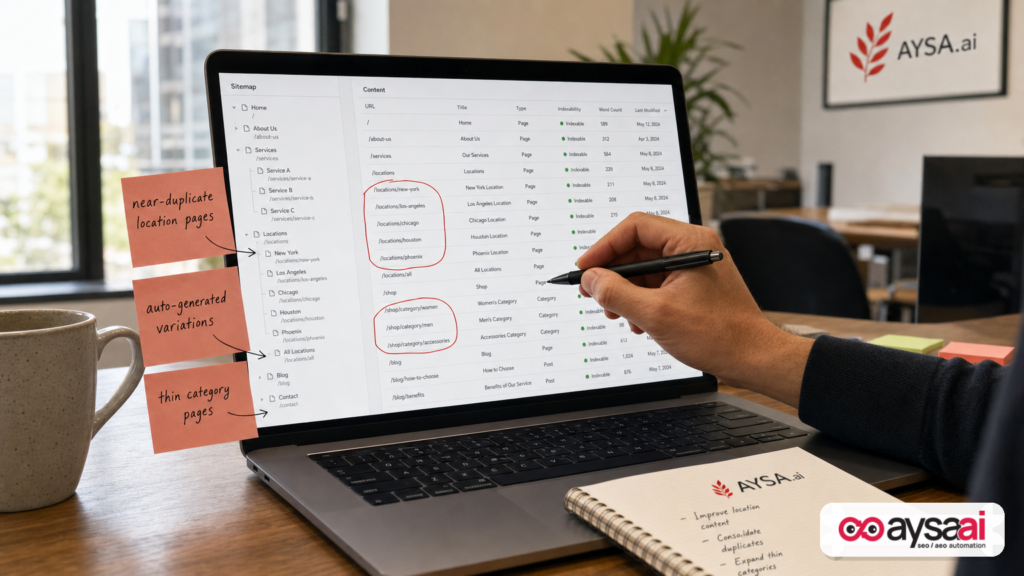
1) Doorway page patterns (especially location pages)
Multi-location brands and service-area businesses love location pages. They work—when they’re real.
They become a risk when you publish hundreds of “City + Service” pages that:
- describe the same service the same way,
- have no proof of presence,
- offer no city-specific details (pricing, constraints, examples, regulations, availability),
- all funnel to the same phone number or form with identical CTAs.
That looks like a doorway set: pages created primarily to rank for variations, rather than serve distinct needs.
2) Scaled content with thin differentiation
Programmatic SEO and AI-generated publishing can be legitimate—if the underlying dataset is meaningful and the page satisfies intent. But thin variants (same structure, minor token swaps) create a footprint.
High-risk examples:
- “Best [product] for [use case]” pages that repeat the same list with minor rewording
- “[tool] vs [tool]” pages that are just templated headings
- glossary pages that define terms without adding context, examples, or application
3) Thin affiliate or lead arbitrage structures
If your page exists mainly to push a click to another site (affiliate) or capture a lead to resell, you need to work harder to prove value. Pages that look like “SEO wrappers” around affiliate links tend to be fragile during spam-focused enforcement cycles.
4) Site reputation abuse and parasitic placements (when applicable)
Some businesses publish third-party content on high-authority domains to borrow rankings. This is a complicated area and enforcement has evolved over time. The operational advice is stable: if content exists on a domain primarily because of the domain’s ranking power rather than the publisher’s editorial purpose, it’s risky.
5) Spammy internal linking footprints
Internal links are good. But patterns can become manipulative:
- sitewide Keyword-stuffed Footer Links,
- auto-generated “related pages” blocks that create unnatural link graphs,
- every page linking to the same handful of money pages with identical anchors,
- mass-injected internal links from old posts to new pages without editorial logic.
6) Low-effort “FAQ everywhere” and schema abuse vibes
Structured data is valuable, but at scale it can become a footprint: identical FAQs injected across thousands of pages, or content that feels written for rich results rather than users.
7) Hacked or injected spam (still a thing)
Don’t ignore basics. Some spam update volatility is simply hacked content being detected or suppressed. SMEs often miss this because it’s buried in obscure URLs.
The first 72 hours: what to monitor (and what not to overreact to)
When an update hits, teams usually do one of two things:
- Panic-change: Push a dozen site changes in 48 hours and lose the ability to attribute cause and effect.
- Freeze: Wait weeks, hoping it “comes back.”
You want a third path: structured monitoring + controlled execution.
What to monitor (practical list)
Use Google Search Console as your primary early signal source. Track:
- Clicks & impressions by page group (not just sitewide).
- Query mix shifts: did you lose long-tail queries, location modifiers, product modifiers?
- Page-type segments: blog posts vs collections/categories vs product pages vs service pages vs location pages.
- Indexing anomalies: spikes in “Crawled – currently not indexed” or sudden deindexation of a page cluster.
- Manual actions / security issues reports (rare, but check).
Also track in GA4 (or your analytics) if you have clean organic landing page reporting, but prioritize Search Console for ranking-related volatility.
What not to overreact to
- One-day drops. Look for a sustained trend over several days and confirm it aligns with the rollout window.
- Average position noise. Average position can be misleading if your query set changes.
- “My competitor also dropped.” That doesn’t automatically mean “core update.” Spam updates can reshape a niche quickly.
Mark the window in your reporting
Because the rollout window is known (June 24–26), annotate it in your internal SEO timeline so later changes aren’t incorrectly blamed on it.
If you need a clean operational workflow, this is exactly what AYSA Monitoring is built for: track changes, watch anomalies, and keep a clear execution log of what changed and when.
Triage framework: isolate the problem before you “fix SEO”
“We got hit by the spam update” is not a diagnosis. It’s an alarm bell. Your job is to isolate where the impact is concentrated and what pattern those pages share.
Step 1: Segment by page template
Create buckets like:
- Product pages
- Category/collection pages
- Blog / editorial articles
- Location pages
- Help center / docs
- Comparison / “best” pages
If the drop is concentrated (e.g., 80% of loss from location pages), you have a template-level problem, not a brand-level problem.
Step 2: Identify the “footprint” variables
Within the affected bucket, check for:
- high duplication of intros/outros
- identical FAQs
- identical internal links and anchors
- thin content length (not because “short is bad,” but because the page doesn’t complete the user task)
- lack of unique proof (photos, team, inventory, pricing ranges, process)
Step 3: Confirm intent match
Spam systems don’t “read” like humans, but they do model satisfaction proxies. If the query implies a need (local availability, pricing, comparison, in-stock), and your page is generic, the mismatch is a signal.
Step 4: Audit index control
Sometimes the fix is not “rewrite 1,000 pages.” Sometimes the fix is:
- noindexing low-value variants,
- canonical consolidation,
- removing auto-generated parameter URLs from indexation paths,
- improving crawl paths so Google finds the pages that actually matter.
This is where many SMEs waste months: they try to “improve everything” instead of controlling what the site is asking Google to evaluate.
Concrete SME scenario: an ecommerce brand hit by a spam update
Let’s make this real.
Business: a 12-person ecommerce brand selling specialty home fitness accessories.
Growth tactic: they built 1,500 AI-assisted “best for” and “vs” pages targeting long-tail queries (“best resistance bands for runners,” “resistance bands vs kettlebells,” etc.). Pages share a template, a repeated intro, and a mostly repeated product list with minor reordering.
What happens during the spam update window:
- Sitewide traffic dips ~10% (not catastrophic), but the “Best for” folder drops 50%.
- Product pages remain stable.
- Category pages are slightly up.
Bad reaction: They rewrite every product page, change titles sitewide, and add more internal links—creating more noise, not clarity.
Good reaction: They do a 72-hour triage:
- Confirm the drop is isolated to “Best for” and “vs” templates.
- Identify duplication patterns: same headings, same FAQs, repeated product blurbs, thin differentiation by use case.
- Decide to consolidate: noindex the weakest 60%, merge overlapping topics into fewer, stronger guides, and upgrade the remaining pages with real testing notes, use-case photos, and clearer selection frameworks.
- Update internal linking to point to the consolidated guides, not the thin variants.
Outcome expectation: Recovery is not instant. But the site becomes structurally safer: fewer pages competing internally, fewer thin footprints, and more pages that genuinely satisfy intent. Over time, the brand’s content becomes a moat instead of a liability.
This is the 2026 reality: you can’t “out-volume” spam detection. You can only out-execute it with better value and tighter control.
Remediation playbook: what to change on-site (content, templates, internal linking, index control)
Assuming you’ve identified a page cluster likely impacted, here’s a practical remediation playbook. You won’t do all of this at once. The goal is to reduce spam-like signals while increasing user value—without breaking your site.
1) Consolidate duplicates instead of “light rewriting”
If you have 40 pages that differ only by one keyword token, you don’t have 40 assets. You have one asset split into 40 weak signals.
Actions:
- Merge overlapping topics into one definitive resource.
- Redirect or canonicalize the merged URLs (choose the approach carefully).
- Preserve any unique backlinks or references by consolidating to a stable URL.
2) Upgrade templates with true differentiation variables
If templates are core to your business (they are for most SMEs), make sure the template forces uniqueness rather than allowing token swaps.
Examples of differentiation variables that actually help:
- Local pages: service radius constraints, appointment lead times, local case examples, team members, local compliance notes, neighborhood-specific FAQs.
- Ecommerce categories: curated “how to choose” guidance, compatibility notes, shipping constraints, returns nuance, comparison tables that reflect real inventory differences.
- Service pages: process steps, pricing ranges, before/after examples, clear “who this is for / not for” sections.
3) Reduce boilerplate blocks that create a footprint
Boilerplate is not evil. But repeated blocks at massive scale can be a detectable signature.
Audit and consider trimming:
- identical intros and conclusions
- identical FAQ lists
- identical “Why choose us” paragraphs
- overused “definition” paragraphs that add no context
4) Rebuild internal linking to reflect editorial logic, not automation
Internal links should help users navigate and help search engines understand your structure. If your internal links look like a growth hack, they can become a liability.
Fixes:
- Remove sitewide keyword-stuffed link blocks.
- Use varied, natural anchors.
- Ensure hubs link to spokes and spokes link back (clean topical architecture).
- Stop auto-linking every mention of a keyword to the same URL.
5) Control indexation: fewer, better URLs in the index
This is the most underused lever for SMEs.
Ask: Which URLs do we actually want Google to evaluate as representative of our business?
Actions may include:
- noindex thin variants (filters, tag pages, internal search pages)
- canonicalize duplicates created by parameters
- prune expired promo pages that remain indexed
- improve sitemap hygiene to list only index-worthy pages
6) Add evidence of experience and operational reality
In spam-adjacent situations, “realness” helps. Add signals that the page is produced for customers, not for bots:
- original photography (even simple, honest photos)
- named authors or accountable business info
- clear contact/support pathways
- policies that match the offer (shipping, returns, booking, cancellations)
This isn’t about cosmetic “E-E-A-T checklists.” It’s about aligning your site with real business operations.
7) Improve page performance and UX where it blocks completion
Spam updates aren’t primarily speed updates. But if your pages are ad-heavy, hard to use, or designed to push a click rather than satisfy intent, you’re increasing risk.
Practical UX fixes:
- reduce intrusive interstitials
- make the primary action obvious (buy, book, call, compare)
- ensure content is readable and not buried under repeated modules
If you want an execution system that helps ship these changes without chaos, explore AYSA’s AI SEO tools and AI search visibility workflows. The key is not “more automation.” It’s approved execution: proposed changes, your sign-off, and controlled deployment.
Links, reputation, and off-site signals: what to stop doing immediately
When a spam update rolls out, some teams respond by buying links or ramping up “easy authority.” That’s usually the worst timing possible.
Stop: scaled low-quality link building
Any tactic that creates unnatural link patterns at volume can compound spam risk. If you’re already being evaluated through a spam-detection lens, adding questionable links is like arguing with a cop while speeding.
Stop: parasite SEO “renting authority” shortcuts
If your strategy depends on publishing on someone else’s domain purely because it ranks, you’re building on sand. Even if it works short-term, it can create brand whiplash when enforcement tightens.
Start: real authority building
Authority building that lasts typically looks like:
- unique data, original testing, or unique inventory insights
- partnerships with industry organizations
- PR that’s tied to actual news (not “guest post swaps”)
- customer stories and community proof
Not flashy. But stable.
What agencies should rethink: reporting, client comms, and change control
If you run an agency, spam updates test your operating maturity more than your keyword research.
1) Stop sending “algorithm update” panic emails
Clients don’t pay you to forward headlines. They pay you for diagnosis and action.
Better client message framework:
- What happened (timeline, known facts)
- What we see in your data (segmented)
- What we believe is impacted (hypotheses)
- What we’re doing this week (actions + approvals needed)
- What success looks like (leading indicators, not promises)
2) Implement change control during rollout windows
During a rollout, pushing unrelated changes can destroy attribution. Agencies should have a policy:
- Pause major site migrations or URL structure changes unless urgent.
- Continue low-risk improvements (bug fixes, clear technical errors).
- Log every change with date/time and scope.
3) Report by page type and intent, not “overall SEO”
Spam update impact is often localized. Your reporting should be localized too.
Examples:
- “Location pages (template A) are down; service pages are stable.”
- “Comparison pages lost impressions; product pages gained.”
- “Blog traffic dropped but branded queries are stable.”
4) Build a remediation backlog that can be executed
The biggest agency failure mode is producing a 60-slide audit and then not shipping the fixes.
In 2026, execution is the differentiator. If your delivery model can’t deploy changes (or coordinate with dev teams), you’re exposed—especially during spam and quality enforcement cycles.
Where AYSA fits: approved execution, not autopilot chaos
At AYSA.ai, we built around a simple observation: most businesses don’t lose to competitors because they lack ideas. They lose because they can’t consistently execute the right changes with enough speed and control.
Spam updates make that gap obvious.
The common SME loop (that we break)
- Traffic dips → someone notices late
- Someone guesses the cause → proposes random fixes
- Changes ship without tracking → results are ambiguous
- Team loses confidence → execution slows → the site stagnates
What “approved execution” looks like in practice
AYSA is designed to:
- Monitor organic visibility and site signals so you see issues early (Monitoring).
- Prepare prioritized recommendations aligned to business impact (not vanity SEO tasks).
- Ask for approval before implementing changes—so humans stay accountable.
- Execute accepted changes cleanly, with traceability, so you can learn and iterate.
This matters during spam updates because the worst move is uncontrolled experimentation. You want fast iteration—but with guardrails.
If you’re evaluating whether a system like AYSA fits your team size and workflow, start with Pricing and browse our latest thinking in the AYSA blog.
What to do next (action list)
Here’s the operational checklist I’d run this week if you’re concerned about the June 2026 spam update or you see unusual volatility.
Today (60–120 minutes)
- Annotate June 24–26, 2026 in your SEO timeline.
- In Search Console, compare the last 7–14 days to the prior period; identify whether changes are sitewide or page-type-specific.
- Check Search Console for manual actions and security issues.
This week (half-day to two days)
- Build a simple page-type segmentation (folders, templates, or URL patterns).
- For the most affected segment, audit the top 20 URLs for duplication footprints and intent mismatch.
- Create a remediation plan with three tiers: prune/consolidate, upgrade, leave alone.
- Pause risky off-site tactics (low-quality link building, scaled guest posting) until stability returns.
This month (durable moves)
- Consolidate overlapping pages into fewer, stronger assets.
- Improve templates so uniqueness is required (not optional).
- Clean indexation (noindex thin variants, fix canonicals, improve sitemaps).
- Establish change control: log changes, measure by page group, iterate.
If you want help operationalizing this without overloading your team, consider setting up a monitoring and execution cadence with AYSA: start at Monitoring, then align recommendations with your growth priorities via AI SEO tools and AI search visibility.
Sources and further reading
- Search Engine Journal: Google Begins Rolling Out The June 2026 Spam Update (primary source for this editorial’s timeline and rollout framing)
- Search Engine Journal: Google Algorithm Updates history (context and update tracking)
- Search Engine Journal: SEO News (ongoing coverage and context)
- Search Engine Journal: SEO category (broader SEO guidance)
Note: The Search Engine Journal article references Google’s spam updates documentation conceptually (including SpamBrain) but the official Google documentation links were not included in the provided research context. Where this editorial discusses spam policy categories and detection patterns, it does so as practical analysis aligned with long-standing industry understanding rather than quoting unpublished specifics of the June 2026 update.
Continue the AI search topic inside AYSA.
Use these pages to connect the article with AI SEO tools, AI visibility monitoring, AI Overviews and approved website execution.
Turn this topic into a website action plan.
Use these AYSA hubs to move from reading to technical fixes, AI visibility monitoring, research, glossary context and approval-first SEO execution.