
Google’s Universal Commerce Protocol and the New SEO Job: From Clicks to “Buy-Through” Readiness
Google’s Universal Commerce Protocol (UCP) points toward AI-driven shopping that can evaluate and purchase without a website visit. Here’s what changed, why it matters, what can break, and a practical playbook for SMEs and agencies—plus how AYSA helps you monitor, prepare, and execute the fixes that make your products eligible when AI becomes the checkout.

Search used to be simple: someone typed a query, clicked a result, and bought on your site.
Google’s Universal Commerce Protocol (UCP) is a signal that this “query → click → checkout” model is being rewritten. In the world Google is building, AI can discover products, compare options, and complete purchases inside AI-driven experiences—without a traditional website visit. That doesn’t mean your website stops mattering. It means your product data, policies, identifiers, and checkout capabilities become the new “rank factors” for revenue.
I’m writing this as Marius Dosinescu, building AYSA.ai—an execution system that monitors your site, prepares recommended changes, asks for approval, and then implements accepted updates safely. In the UCP direction of travel, that loop (monitor → prepare → approve → execute → verify) stops being nice-to-have. It becomes the core operating system for Ecommerce SEO.
Concise summary

UCP is positioned as an open, vendor-agnostic standard intended to let AI agents interact with merchants across the commerce lifecycle—from discovery to checkout and post-purchase flows. The SEO implication is major: optimization shifts from “earning Clicks” to “earning selection” and “being eligible to transact.” For SMEs and agencies, the practical work is less about writing more product copy and more about making your product and policy data consistent across your site and Merchant Center, improving Structured data quality, and ensuring inventory, price, shipping, and returns can be understood and trusted by machines.
Key takeaways

- SEO is moving from click-through to buy-through readiness. Your content still matters, but eligibility and reliability of data increasingly determine whether AI can recommend and purchase your items.
- Merchant Center becomes strategic infrastructure. Not just an ads feed—more like your product “truth layer” for AI discovery.
- Structured data consistency becomes a revenue control. Drift between Product/Offer schema and feed data can create trust/validation problems that remove you from AI-driven experiences.
- Long-tail prompts will be attribute-driven. AI shopping queries are situational (“arrives by Friday,” “fits Model X,” “returnable,” “machine washable”), and you win by exposing those attributes cleanly.
- Execution speed becomes a moat. Teams that can ship small data and technical fixes weekly will outperform teams that only run quarterly audits.
Table of contents
- What changed: Google is building a transaction layer, not just a search engine
- What UCP is (in plain English) and why it exists
- The new funnel: from click-through rate to buy-through readiness
- How shopper behavior changes when AI can buy
- Data is the product: what AI needs to confidently choose your item
- Merchant Center: the ecommerce SEO control plane most SMEs underinvest in
- Structured data: the consistency problem that will quietly cost you
- Conversational commerce: optimizing for prompts, not keywords
- What can go wrong (and how it shows up in the real world)
- SME scenario: a realistic “agentic purchase” journey and what breaks it
- Agency reset: deliverables that matter when clicks shrink
- Where AYSA fits: monitoring + approved execution for commerce SEO
- A practical 90-day action plan
- What to do next
- Sources and further reading
What changed: Google is building a transaction layer, not just a search engine
Historically, the web’s commercial loop required a click. Search results pointed to websites. Websites hosted product pages. Checkout happened in the merchant’s cart. Success was measurable with Impressions, CTR, sessions, and Conversion rate.
The direction described in Search Engine Land’s coverage of Google’s Universal Commerce Protocol is different: AI experiences can handle product discovery, evaluation, cart-building, checkout, and post-purchase steps. In that model, the “webpage” becomes optional. The transaction can be native to the AI layer.
This isn’t just a UX change. It’s a platform shift—similar in magnitude to mobile’s impact on desktop-era SEO. When the platform changes, what you optimize changes with it.
In click-based SEO, you can win with better content and better links. In transaction-layer SEO, you also need machine-readable commerce readiness: product identifiers that map cleanly to your backend, policy completeness, accurate shipping and returns data, inventory reliability, and structured data that doesn’t contradict your feeds.
What UCP is (in plain English) and why it exists
Based on the Search Engine Land reporting, UCP is positioned as an open-source, vendor-agnostic standard designed to let AI agents communicate with merchant systems across the commerce lifecycle—discovery, cart, checkout, and post-purchase tracking. It’s framed as a “universal translator” between AI shopping agents and ecommerce backends.
Here’s the plain-English version:
- AI wants to shop like a power user. It needs to search inventory, verify price, check shipping, apply discounts, and pay—without breaking or guessing.
- Merchants don’t want a thousand custom integrations. If every AI product needs a bespoke API integration per platform, only enterprise merchants benefit.
- A shared protocol reduces friction. If merchants publish capabilities in a standardized way, AI agents can transact reliably at scale.
Search Engine Land likens the concept to HTTPS—standardized communication that makes the web function at scale. Whether that analogy holds perfectly over time is less important than the strategic signal: Google is investing in standardization that enables AI-native commerce. SEO leaders should treat that as a “prepare now” moment, not a “wait for the full rollout” moment.
Primary implication: the “surface area” of SEO expands. Your feed governance, schema governance, and backend mapping become part of SEO because they become part of how AI decides and how AI buys.
The new funnel: from click-through rate to buy-through readiness
When I talk to founders and operators, the KPI list is usually: rankings → traffic → conversion rate → revenue. That chain assumes you control the purchase environment and that customers arrive on your site.
In agentic commerce, the chain becomes something closer to:
- Eligibility: can the AI understand your products, inventory, price, shipping, and policies well enough to include you?
- Selection: does the AI pick your item as the best match for the user’s constraints (budget, delivery date, compatibility, preferences)?
- Completion: can checkout happen smoothly with minimal friction?
- Retention: can you support returns, warranty, reorders, and customer service reliably?
Traffic may still matter, but it won’t be the only—or even the main—mechanism of value capture for commodity products and repeat purchases.
This is why I use the phrase buy-through readiness. Your job is no longer solely to get clicked. Your job is to be the merchant that AI can confidently transact with.
What SEOs (and business owners) need to accept early
- Some “lost clicks” are not lost revenue. If the purchase completes without a visit, your analytics may show a decline in sessions while revenue holds—or even increases.
- Some “lost revenue” is really data debt. If AI can’t validate your price, inventory, or returns, you may not even be considered.
- Attribution will get messier before it gets cleaner. As the transaction layer develops, measurement won’t map 1:1 to today’s channel definitions.
How shopper behavior changes when AI can buy
The biggest behavioral shift isn’t that people stop searching. It’s that people stop doing the “shopping labor.”
In classic ecommerce, the shopper compares options: reading reviews, checking shipping costs, verifying compatibility, and re-entering addresses and payment details. In AI commerce, the user can delegate that labor to an agent.
When delegation becomes normal, query structure changes too. Users stop typing “running shoes” and start asking:
- “Best trail running shoes for wide feet under $160 that arrive by Friday.”
- “A refill filter compatible with my fridge model, ideally the OEM part, quick shipping.”
- “A hypoallergenic moisturizer with no fragrance, returnable, and not tested on animals.”
Those prompts are rich with constraints. And constraints are solved with attributes, not adjectives.
If your site relies on marketing copy while your feed and schema omit important attributes (compatibility, dimensions, materials, shipping speed, return windows), the AI has less to work with. The best product doesn’t win. The best-described product wins.
Data is the product: what AI needs to confidently choose your item
In the next phase of ecommerce SEO, your product data is not a support artifact. It’s a competitive asset.
From the Search Engine Land summary, the recommended preparation spans three areas: product data, Merchant Center, and structured data. That’s exactly right—because AI needs a consistent “truth layer” across all three.
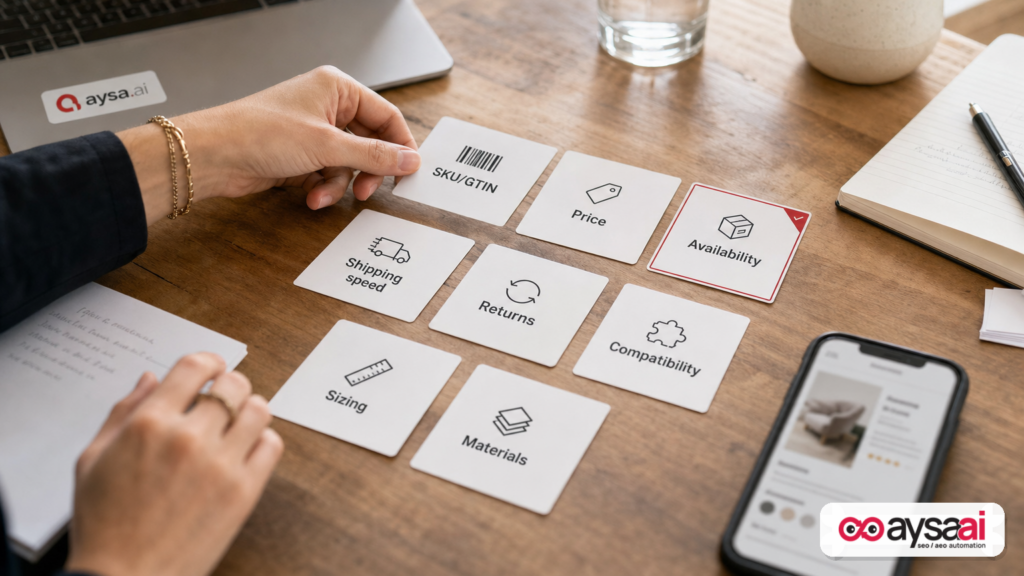
Here’s a practical breakdown of the data AI typically needs to transact without human babysitting:
1) Product identity (the “what exactly is this?” layer)
- Stable product IDs that map to your internal systems
- Global identifiers when relevant (e.g., GTINs)
- Variant clarity (size, color, pack count, model year)
If AI can’t uniquely identify an item, it can’t reliably compare it—or buy it.
2) Commercial truth (the “can I trust the offer?” layer)
- Accurate pricing and currency
- Availability that matches reality
- Shipping cost and speed (especially “arrives by” constraints)
- Returns policy and customer support contacts
Humans tolerate uncertainty and “we’ll see at checkout.” AI agents are the opposite: they need determinism to complete a workflow.
3) Fit, compatibility, and constraints (the “will this work for me?” layer)
- Compatibility data (devices, models, sizes)
- Dimensions, ingredients/materials, certifications (where relevant)
- FAQs that answer operational questions (“machine washable?” “works with Model X?”)
This is where conversational commerce lives. Most SMEs are under-structured here because their websites answer these questions in prose, not in queryable attributes.
Merchant Center: the ecommerce SEO control plane most SMEs underinvest in
For many businesses, Google Merchant Center (GMC) is treated as “the Shopping ads setup.” That’s a costly mental model. In the UCP direction of travel described by Search Engine Land, GMC becomes a central product data source for AI discovery and commerce features.
Even if you never run Shopping ads, your feed quality can increasingly affect whether Google understands your catalog and can represent it cleanly.
Merchant Center hygiene: what “good” looks like
- Feed completeness: Required and recommended attributes filled, consistently.
- Policy accuracy: Shipping, returns, and support kept current.
- Identifier mapping: Item IDs that don’t drift between your store, feed, and schema.
- Variant integrity: Clear differentiation between variants (avoiding duplicate/ambiguous listings).
Search Engine Land’s piece highlights feed attributes such as native_commerce and ID alignment via attributes like merchant_item_id in the context of enabling AI-driven checkouts. Treat those as a wake-up call: your feed is not “set it and forget it.” It’s operational infrastructure.
Note: I’m intentionally not presenting a definitive technical specification here beyond what’s in the provided research context. If your team is implementing UCP-related attributes, validate details directly in Google’s official documentation once available to you in your Merchant Center environment.
A practical reframe: GMC is now part of SEO
If SEO is “being chosen at the moment of intent,” and intent increasingly resolves inside AI, then the data systems feeding AI are SEO systems.
That’s why ecommerce teams should put GMC ownership closer to SEO/product operations than to “ads-only.” At minimum, SEO should co-own:
- Feed audits and change control
- Attribute completion standards
- Ongoing monitoring of disapprovals and policy mismatches
Structured data: the consistency problem that will quietly cost you
Structured data (schema) is one of those topics that gets treated as “technical SEO nice-to-have.” In an AI commerce environment, it becomes a trust layer.
Search Engine Land’s guidance is straightforward: keep your Product, Offer, and Review schema synchronized with your product feed. That advice aligns with how Google has long encouraged structured data implementation through Schema.org vocabulary and Google’s own rich result frameworks.
The key risk is schema drift:
- Your page says: “In stock,” but your feed says: “Out of stock.”
- Your schema price differs from your Merchant Center price due to a sale or currency formatting.
- Your product identifiers changed in your backend but not in markup.
Humans might still buy. Machines might exclude you.
Schema governance beats schema implementation
Most teams can implement Product schema once. Fewer teams can maintain it across:
- Theme updates
- App/plugin changes
- Variant logic changes
- Sale pricing and promo engines
- Internationalization
In practice, “schema governance” means:
- Automated checks that key properties exist (price, availability, identifiers)
- Regular validation
- Change control so releases don’t break markup silently
AYSA’s philosophy here is simple: monitoring has to lead to execution. A weekly report of broken schema is not a strategy. It’s a to-do list that never gets done unless your system can implement fixes.
Conversational commerce: optimizing for prompts, not keywords
Keyword research isn’t dead. But it’s no longer sufficient.
In conversational shopping, prompts bundle multiple criteria: price, delivery date, compatibility, materials, returnability, and even preferences like “minimal packaging.” To serve those prompts, AI needs structured attributes and reliable policies.
How to translate prompts into ecommerce requirements
Here’s a way to map human prompts to data fields your business can control:
- “Arrive by Friday” → shipping speed, cutoff times, carrier options, accurate fulfillment SLAs
- “Under $150” → accurate price, variants priced correctly, sale logic consistent
- “Fits my model” → compatibility tables, model numbers, replacement part mapping
- “Easy returns” → clearly defined return policy, return window, fees, condition requirements
- “No fragrance / hypoallergenic” → ingredient attributes, certifications, FAQ answers
This is the hidden work of UCP-style readiness: turning customer questions into structured truth.
Yes, content still matters—but it must become “answerable”
Many ecommerce sites have great content that is not machine-friendly:
- Compatibility buried in a PDF
- Sizing guidance in an image
- Shipping promises written vaguely on a policy page
In the new environment, you want the best of both worlds:
- Human-friendly explanations on-page
- Machine-friendly representations via structured data, feeds, and consistent attributes
What can go wrong (and how it shows up in the real world)
When a platform shifts, most businesses don’t lose because they’re “bad at SEO.” They lose because operations create unreliability. Here are common failure modes that become more damaging in AI-native commerce:
1) Pricing inconsistency across systems
A sale engine updates on-site price, but Merchant Center or schema lags. AI sees mismatches and reduces trust. The fix is not “more content.” It’s data alignment and update frequency.
2) Availability lies (even accidental ones)
If you oversell and then cancel orders, or if your inventory availability is stale, AI agents will learn that your store is unreliable. In click SEO, you might get a second chance. In agentic commerce, AI will route around you.
3) Shipping surprises and policy ambiguity
Hidden shipping costs and unclear return terms are already conversion killers. In AI commerce they may prevent selection entirely because the agent can’t confidently satisfy the user’s constraints.
4) Identifier chaos
Variant IDs that change, duplicate SKUs, missing global identifiers—these issues make it hard for machines to compare and transact. They also create feed errors and downstream reporting confusion.
5) Theme/plugin updates that break schema
Ecommerce platforms are constantly changing. If you don’t monitor schema, you won’t notice breakage until visibility declines. This is one place where automation is not optional.
SME scenario: a realistic “agentic purchase” journey and what breaks it
Let’s make this concrete with a realistic small business example.
Business: a 12-person ecommerce brand selling water filtration products and replacement filters across multiple fridge and pitcher models.
Customer prompt (AI Mode style): “Order a replacement filter compatible with my fridge model, under $60, that arrives by Saturday. Prefer OEM if available. Easy returns.”
What the AI needs to complete this order
- Compatibility mapping: filter part number ↔ fridge model
- Variant clarity: single vs multi-pack; genuine vs compatible
- Real-time-ish availability: can it actually ship today?
- Shipping options: delivery estimate logic the agent can trust
- Return policy: time window and conditions clearly stated
- Checkout readiness: a secure payment method the workflow supports
What breaks most often in SMEs
- Compatibility exists in a blog post or PDF, not in structured data.
- Merchant Center feed lists “generic filter,” but the page says “OEM filter.”
- Shipping policy page is vague (“ships in 1–3 business days”) with no cutoff times.
- Inventory is accurate in the warehouse system but not reflected in the feed quickly.
Result: the AI chooses a competitor—not necessarily because they have a better filter, but because their data is more complete, consistent, and transactable.
How this SME wins
- Expose compatibility in a structured way (and keep it maintained).
- Ensure one-to-one mapping between feed item IDs and backend checkout items.
- Keep schema price/availability aligned with the feed and on-page reality.
- Make shipping/returns explicit and current.
Notice the theme: it’s operational excellence presented in machine language.
Agency reset: deliverables that matter when clicks shrink
Agencies grew up on a deliverable economy: audits, keyword lists, content plans, backlink campaigns, monthly reports. Many of these still matter. But the center of gravity shifts.
If AI transactions reduce the number of website visits for certain purchase journeys, agencies must prove value in outcomes that don’t look like classic traffic growth.
New deliverables agencies should productize
- Feed + schema consistency audits (with implementation, not just findings)
- Attribute expansion programs (compatibility, materials, sizing, FAQs as structured fields)
- Merchant Center governance (error monitoring, disapprovals, policy completeness)
- Operational SEO: shipping/returns clarity, inventory reliability, ID hygiene
- AI visibility monitoring (where and how the brand appears in AI experiences)
Search Engine Land has also covered broader AI search shifts and the “AI decision layer” concept (see their related links list, including “Winning the AI decision layer: From AI discovery to agentic commerce”). That editorial direction is consistent with what agencies must do: move from optimizing for clicks to optimizing for decisions.
Measurement reset: what to report to clients and CFOs
When the funnel changes, your reporting must change too. Agencies and in-house teams should build reporting that includes:
- Merchant Center feed health and disapproval trends
- Structured data validity and drift checks
- Policy completeness and changes over time
- Coverage of critical attributes (shipping speed, returns, compatibility)
- AI search visibility snapshots (where feasible and responsibly measured)
This is also where budget conversations evolve. If you need a framework for defending investment, Search Engine Land’s related article “How to win SEO budget conversations with your CFO” is a useful lead to explore as mindset—even though the tactical details should be tailored to your business realities.
Where AYSA fits: monitoring + approved execution for commerce SEO
UCP-style commerce readiness creates a problem that most teams already have: they know what to fix, but they don’t ship fixes consistently.
That’s the execution gap—and it’s why we built AYSA the way we did.
AYSA’s operating loop (and why it matters here)
AYSA is designed to:
- Monitor your site for SEO and AI-search readiness signals (technical issues, content decay, structured data problems) via Monitoring.
- Prepare specific recommended changes (e.g., structured data fixes, page improvements, internal linking opportunities).
- Ask for approval so humans stay in control of what ships.
- Execute the accepted changes safely—so work doesn’t stall in tickets and spreadsheets.
As AI commerce grows, this model becomes directly relevant because the work becomes more technical, more ongoing, and more sensitive. You can’t “set up” product data once and call it done.
AI visibility is a business KPI now
Whether you call it AEO, GEO, or simply “being recommended,” the concept is the same: you need to know if AI systems can find you, understand you, and choose you.
That’s why we emphasize tools and workflows around AI discovery and recommendation visibility, including:
- AI Search Visibility to track and improve how your brand appears in AI-driven discovery contexts.
- AI SEO Tools to operationalize the technical and content work.
For SMEs: the goal is not “do everything”—it’s “do the right few things weekly”
Small teams don’t need a massive replatform. They need a reliable cadence:
- Monitor feed/schema health
- Fix top-impact mismatches
- Expand the few attributes customers always ask about
- Keep policies and shipping promises consistent
AYSA is built to make that cadence real—without turning every improvement into a quarter-long project.
A practical 90-day action plan
You don’t need to wait for UCP to be “fully mainstream” to benefit. These steps improve ecommerce performance today and position you for AI-native purchase flows tomorrow.
Days 0–15: establish your “commerce truth” baseline
- Inventory your systems of truth: ecommerce platform, ERP/inventory tool, Merchant Center feed, on-page structured data.
- Pick 20 top SKUs (by revenue and by strategic importance) and verify consistency across: title, price, availability, identifiers, variant attributes.
- Validate structured data for those products and record what’s missing or inconsistent.
- Audit policy pages: shipping, returns, customer support—ensure they are explicit and current.
If you want a systemized way to keep this from becoming a one-time spreadsheet, start with AYSA’s Monitoring foundation.
Days 16–45: fix the highest-impact mismatches
- Identifier alignment: ensure product IDs in feeds map cleanly to internal checkout items.
- Price and availability alignment: ensure schema, feed, and site render match under sales/promotions.
- Variant cleanup: reduce ambiguity (pack counts, sizes, colors) and ensure each variant is uniquely represented.
- Shipping clarity: make delivery promises precise enough to support “arrives by” constraints.
This is where execution matters most. Tools that only “report” problems are not enough. You need to actually ship fixes.
Days 46–90: build attribute depth for conversational queries
- Collect customer questions from support tickets, reviews, and on-site search logs.
- Turn the top questions into structured attributes where possible (compatibility, materials, care instructions, sizing guidance).
- Update product pages so the answers are clear for humans and consistent for machines.
- Set a monthly governance process: feed health review, schema validation review, policy review.
For teams building this as a repeatable program, AYSA can help coordinate work through approved execution—monitoring issues, preparing changes, requesting approval, and implementing what you accept.
What to do next
- Start with visibility: establish a baseline of how your brand appears in AI-driven discovery and recommendations via AI Search Visibility.
- Operationalize monitoring: set up ongoing checks for schema health and technical issues with AYSA Monitoring.
- Adopt an execution workflow: treat commerce SEO improvements as weekly releases, not quarterly audits.
- Align stakeholders: ecommerce ops + marketing + dev (or your agency) should share ownership of feed/schema/policy consistency.
- Invest in the right toolkit: explore AYSA’s toolset at AI SEO Tools and review plans at AYSA Pricing.
- Keep learning: we’ll continue publishing practical playbooks and execution patterns at AYSA Blog.
Sources and further reading
- Search Engine Land: Google’s Universal Commerce Protocol: The SEO implications (primary research input for this editorial)
- Search Engine Land: Winning the AI decision layer: From AI discovery to agentic commerce (context lead referenced in the provided source links)
- Schema.org (structured data vocabulary reference)
- Search Engine Land: Gemini Intelligence signals a new era for search and commerce (additional context lead from the provided source links)
- Search Engine Land: ChatGPT commands 92% of AI referral traffic. Here’s what 6.77 million sessions reveal. (broader AI traffic context lead from the provided source links)
- Search Engine Land: Google Search Console gains reporting on social and video platforms (measurement context lead from the provided source links)
Disclosure note: This editorial is based on the supplied research context and does not assume access to unpublished Google documentation. Where implementation details depend on official specs, verify within your Merchant Center environment and Google documentation available to you.
Continue the AI search topic inside AYSA.
Use these pages to connect the article with AI SEO tools, AI visibility monitoring, AI Overviews and approved website execution.
Turn this topic into a website action plan.
Use these AYSA hubs to move from reading to technical fixes, AI visibility monitoring, research, glossary context and approval-first SEO execution.

