If Users “Won’t Click” AI Links, SEO Isn’t Dead—But Your Strategy Must Change
A court filing quotes an OpenAI engineer saying users “won’t click” links—paired with Microsoft data suggesting far lower CTR in chat than search. Whether or not the numbers generalize, the direction is clear: visibility is shifting from clicks to outcomes. Here’s how SMEs and agencies should adapt content, tracking, and execution for AI search without guessing.

In a court filing, publishers suing OpenAI and Microsoft quote an OpenAI engineer saying, “no matter how prominently we show the links, users won’t click.” The same filing cites Microsoft data suggesting click-through rates (CTR) to certain publisher sites were far lower in Bing Chat than in traditional Bing Web Search. You can read the originating reporting from Search Engine Journal here: Court Filing Quotes OpenAI Engineer: Users “Won’t Click” Links.
Whether those specific numbers generalize across all queries, verticals, and AI interfaces is still an open question. The direction of travel is not. AI answers are designed to reduce effort—and for many intents, that means fewer Clicks.
This is not an obituary for SEO. It’s a strategy reset for how businesses earn demand in a world where the “visit” is no longer the default step between question and decision.
Concise summary
AI Search is separating being cited from being clicked. If your plan is still “rank → get click → monetize,” you’re exposed. The new playbook is: win the answer, earn the visit when it matters, and capture value even when no click happens—with measurement and Approved Execution that can keep up with interface changes.
Key takeaways
- Lower CTR from chat is plausible because the interface answers questions directly; it doesn’t mean traffic goes to zero, but it does change funnel shape.
- Citations aren’t traffic. Treat “AI visibility” as a top-of-funnel signal, not a KPI you can bank revenue on.
- Intent segmentation matters. Some queries will become near-zero-click; others (complex, high-risk, local, regulated) still generate visits.
- Measurement must evolve. You’ll need better Attribution hygiene and new ways to infer “assist value” when clicks disappear.
- Execution speed + governance is the competitive advantage: monitor changes, propose fixes, get approval, deploy quickly, and keep an audit trail.
- AYSA fits here as an AEO/GEO/SEO execution system that monitors, prepares improvements, asks for approval, and executes accepted website changes.
Table of contents

- The “Won’t Click Links” Moment: What Actually Changed
- What the Court Filing Does (and Doesn’t) Prove
- Why AI Interfaces Naturally Reduce Clicks
- Citations, Impressions, Clicks, and Conversions: Stop Mixing These Up
- Who Gets Hit Hardest: Intent and Industry Segmentation
- Publishers vs SMEs: Different Risks, Same Reality
- A Practical SME Scenario: The Clinic That “Won” AI Visibility but Lost New Patients
- Content That Works When Users Don’t Click
- Make the Click Worth It: Reasons to Visit in an AI-Answer World
- Measurement in the AI Era: What to Track Without Fooling Yourself
- What Can Go Wrong (and How to De-Risk It)
- The New Playbook: Win the Answer, Earn the Visit, Capture the Lead Anyway
- Where AYSA Fits: Monitoring + Approved Execution for AEO/GEO
- What to do next
- Sources and further reading
The “Won’t Click Links” Moment: What Actually Changed
For two decades, most digital growth strategies shared a simple assumption: if you show up in search, a meaningful percentage of people will click through to your website. That assumption shaped everything—how we wrote content, how we built links, how we measured ROI, and how we justified budgets.
AI search changes the interface contract:
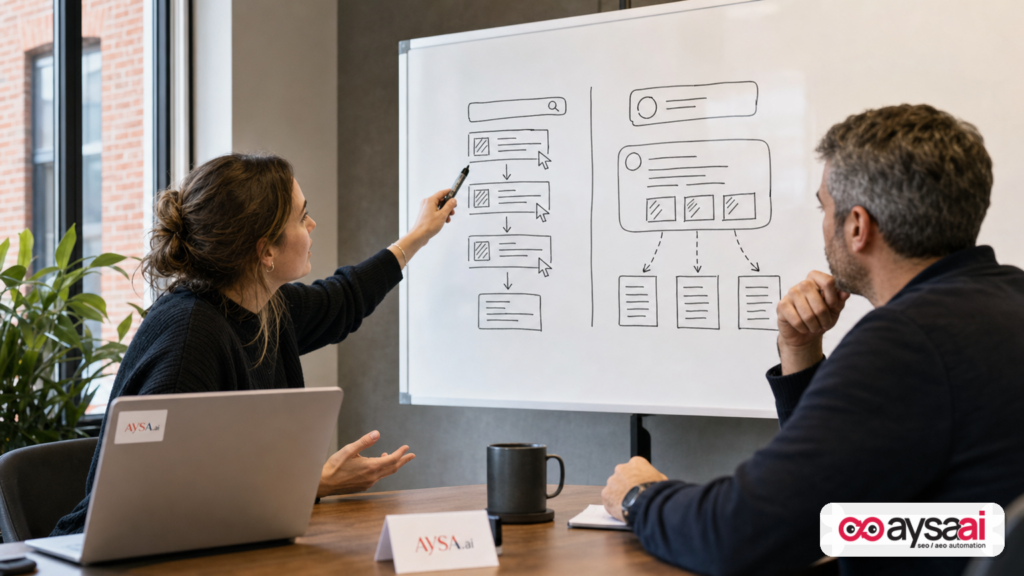
- Traditional search returns options (links). Users do the synthesis by clicking and comparing.
- AI answers return synthesis (a composed response). Links become citations—supporting material, not the main event.
That’s the heart of why a statement like “users won’t click” rings true as a product insight: if the system is designed to remove friction, it will remove friction from clicking too.
This doesn’t mean links disappear. It means links move down the hierarchy of attention. And when attention shifts, economics follow.
What the Court Filing Does (and Doesn’t) Prove
The Search Engine Journal report describes two things that matter to every business, not just publishers:
- A quote attributed to an OpenAI engineer: “no matter how prominently we show the links, users won’t click.”
- Microsoft data cited in the publishers’ brief indicating materially lower CTRs in Bing Chat versus Bing Web Search for certain publisher domains.
Important limitations (based on what’s described in the reporting):
- It’s litigation context. A summary judgment brief is argument, not a neutral research paper.
- We don’t have methodology. The reporting notes the brief doesn’t specify time range, query counts, impression definitions across surfaces, selection criteria, or how ranges were computed.
- Product names and behavior change fast. “Bing Chat” became “Copilot,” and interfaces evolve quickly; results can drift with UI and ranking tweaks.
Still, businesses shouldn’t wait for a perfect study before acting. We’ve already seen the structural trend: more answers in the SERP, more summarized results, and less necessity to click for basic questions.
The practical takeaway is not “CTR is down X%.” The takeaway is: your growth model can’t depend on CTR staying stable when the interface is explicitly designed to reduce the need to click.
Why AI Interfaces Naturally Reduce Clicks
Even without any “anti-publisher” intent, AI answers reduce clicks for three simple reasons:
1) The user’s job (comparison and synthesis) is outsourced
In classic search, users click multiple pages to triangulate. In AI chat, users ask follow-up questions inside the same thread. The thread becomes the destination.
2) The user’s risk threshold is lower for many queries
For low-stakes queries—“What’s the difference between X and Y?” or “How do I reset my router?”—a decent answer is good enough. A citation is reassurance, not a prompt to leave.
3) The interface rewards staying put
Chat UIs encourage continuation: “Ask a follow-up,” “Refine your question,” “Summarize,” “Compare,” and so on. Clicking out is a context switch.
So yes: fewer clicks is the default expectation. Your job is to make sure your business still wins when that happens.
Citations, Impressions, Clicks, and Conversions: Stop Mixing These Up
One of the most damaging patterns I see is businesses blending metrics as if they’re interchangeable.
Search Engine Journal’s reporting highlights a critical point: being cited and being clicked are different measurements, and even platform dashboards differentiate them.
Here’s a clean way to think about it:
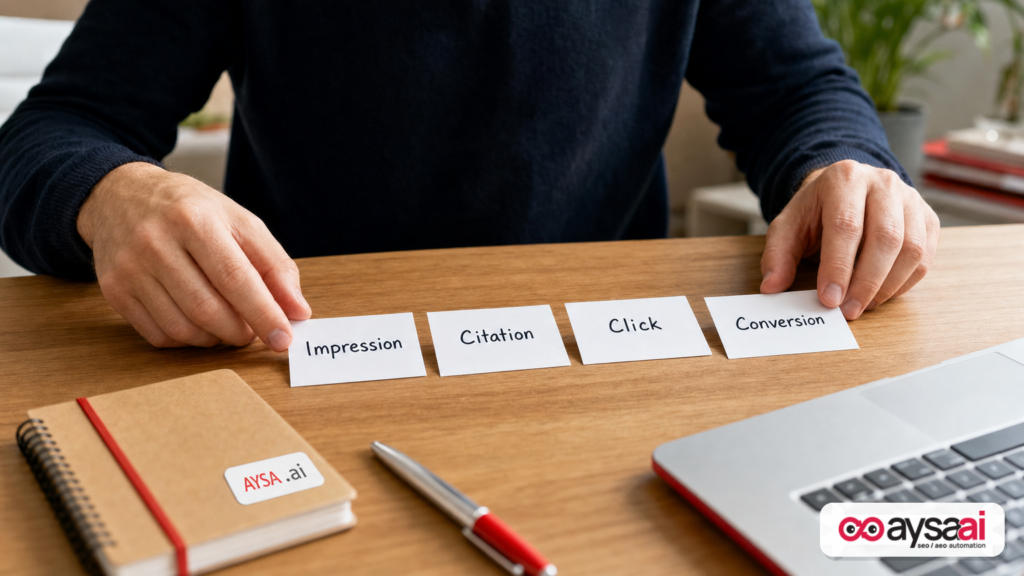
- Impression: your brand/page appears in an interface (search results or AI answer).
- Citation: the AI system references you as a source (a specialized type of impression).
- Click: someone actually visits your property.
- Conversion: the visit leads to value (lead, call, booking, purchase).
In AI search, you can see more citations without seeing more clicks. And you can see fewer clicks while still influencing the buyer’s decision.
That forces a new question: what is your website for?
- If it’s primarily an “information container,” AI will increasingly compete with it.
- If it’s a “trust and conversion engine,” AI can become a feeder—if you design for that.
Google’s own ecosystem is also trending toward visibility reporting that doesn’t always map neatly to clicks, especially for generative surfaces. That’s not a conspiracy; it’s a reflection of UI reality: the interaction sometimes completes without a click.
Who Gets Hit Hardest: Intent and Industry Segmentation
Not all queries are equally “clickable” in an AI interface. The impact depends on intent.
Intent types likely to see the biggest click compression
- Definitions & basic explainers: “What is…”, “How does… work?”
- Simple comparisons: “X vs Y” when the differences are standard and well-known.
- Quick troubleshooting: if steps are generic and risk is low.
- Top-of-funnel research: early-stage browsing where users want a summary first.
Intent types where clicks still matter (and can even increase in quality)
- High-consideration purchases: B2B, expensive consumer products, complex bundles.
- Local service selection: dentist, roofer, clinic, lawyer—users want proof, availability, and trust.
- Anything requiring a transaction: booking, checkout, quote, application.
- Regulated / high-risk topics: users may seek primary sources and second opinions.
The businesses that suffer most are those with a content model built around “answer the basic question and monetize with ads” (publisher economics) or “get the informational click and hope it converts later” (some SMEs).
The businesses that adapt best are the ones that treat content as a funnel asset: educate in AI, then pull the user into the site only when the site offers unique value.
Publishers vs SMEs: Different Risks, Same Reality
Publishers and SMEs are not the same—but they share a common dependency: distribution.
For publishers
The click is often the product. Fewer clicks can directly mean fewer ad impressions, fewer subscriptions, and weaker leverage for sponsorships. If CTR drops in AI chat compared to classic search, the economic hit can be immediate.
For SMEs
The click is a means to an end. If AI reduces low-intent traffic but still sends high-intent traffic (or pre-qualified leads), the business may be fine—or even better off.
But only if two things are true:
- You can measure where leads are really coming from.
- You can execute changes fast enough to keep the site aligned with how AI systems represent you.
This is where a modern stack matters: monitoring, analytics hygiene, and a workflow that turns findings into deployed improvements.
A Practical SME Scenario: The Clinic That “Won” AI Visibility but Lost New Patients
Let’s make this real.
Scenario: A multi-location dental clinic invests in SEO content: “Invisalign vs braces,” “How much does teeth whitening cost,” “What to do for tooth pain.” They start seeing their brand mentioned more often in AI answers. Everyone celebrates. But booked consults don’t increase—and in some weeks, they fall.
What happened?
Problem 1: The AI answered the question completely
If a user asks “Is Invisalign cheaper than braces?” and gets a good, generic answer, the clinic’s citation may reassure them—but not compel a click.
Problem 2: The clinic didn’t give users a reason to visit
The website content repeated what AI already summarized. No unique value:
- No local price ranges or financing examples
- No before/after gallery organized by case type
- No provider credentials tied to outcomes
- No “what happens at your first visit” walkthrough
Problem 3: Tracking hid the real story
AI referrals and “dark” attribution can land in buckets like direct/other, especially when users move between devices or copy/paste URLs. If you only look at last-click GA4 source/medium, you may miss assist behavior.
The fix isn’t to fight AI. The fix is to redesign content and conversion paths for a world where AI does the summarizing and your site does the proof, personalization, and transaction.
Content That Works When Users Don’t Click
If AI answers reduce clicks for generic content, your content must do at least one of these jobs:
1) Be the best source to cite
If the click doesn’t happen, the citation still shapes perception. So you want your pages to be easy to reference accurately:
- Clear definitions and structured sections
- Explicit claims with supporting context
- Up-to-date timestamps and ownership (author/editor where relevant)
- Consistent brand/entity signals (name, locations, specialties)
2) Contain unique, experience-based information
AI can summarize what’s common. It struggles more with what’s specific, operational, and locally true. Examples SMEs can publish:
- Pricing explainers with real examples (ranges, what affects price)
- Process pages (“What happens when you book with us”)
- Comparison pages tied to your offerings
- Data you own: turnaround times, service areas, inventory policies (without making unverifiable claims)
3) Enable a decision, not just education
Build pages that help the user take the next step:
- Checklists
- Selection guides
- Interactive tools (simple calculators, questionnaires)
- Clear CTAs aligned with intent (call, book, quote, demo)
In other words: stop publishing pages that are easy for AI to replace. Publish pages that AI can’t fully compress into a paragraph without losing the point.
Make the Click Worth It: Reasons to Visit in an AI-Answer World
If the AI already gave the answer, why should someone click?
Your site needs to offer value that the AI interface can’t deliver as well:
Trust and proof
- Real photos of your team, location, and work (where appropriate)
- Clear guarantees, policies, and service boundaries
- Credentials, experience, and compliance info
Local and personal relevance
- Availability, service areas, delivery windows
- Location-specific pages that explain what differs by branch
Transaction and convenience
- Instant booking
- Quote requests with clear expectations
- Checkout and financing
Depth the AI won’t show by default
- Full comparison tables
- Detailed specs, compatibility lists, ingredient disclosures
- Long-form case studies
Put simply: AI can be your top-of-funnel concierge, but your website must be your closer.
Measurement in the AI Era: What to Track Without Fooling Yourself
When clicks go down, measurement gets emotional. Teams panic, budgets get slashed, and good channels get blamed because attribution isn’t keeping up.
Here’s a pragmatic measurement approach that doesn’t require inventing new metrics out of thin air.
1) Track what you control: conversions and qualified leads
Start from outcomes:
- Form submissions
- Calls (with proper call tracking)
- Bookings
- Purchases
Then work backward to understand which surfaces assist those outcomes.
2) Separate brand vs non-brand demand
AI answers can increase brand familiarity without sending immediate clicks. Over time, that may show up as brand searches, direct visits, or “I heard about you” calls. If you don’t segment brand demand, you’ll miss this effect.
3) Treat AI visibility as an early indicator, not a KPI
Visibility signals (impressions/citations) can tell you whether you’re in the conversation. They do not, by themselves, prove growth.
The SEJ reporting notes Microsoft’s ecosystem distinguishes AI citation metrics from traditional click metrics. This is exactly the mindset shift: visibility ≠ traffic.
4) Instrument your site to catch “assist” behavior
Even without claiming specific platform behaviors, you can reduce attribution loss by tightening basics:
- UTM discipline on campaigns you control
- Consistent canonical URLs and redirects to prevent fractured reporting
- Server-side tagging where appropriate
- Call tracking that doesn’t collapse into “direct/other” buckets
If you’re not sure where to start, focus on: “Can we reliably answer: which pages and offers produce revenue?” That’s the bedrock.
What Can Go Wrong (and How to De-Risk It)
AI search creates new failure modes that classic SEO teams weren’t organized to handle.
Risk 1: You optimize for being cited, but your brand is misrepresented
If AI summarizes you incorrectly (wrong pricing, wrong service area, outdated features), you can lose trust without ever getting the chance to correct it on-site.
De-risk: keep key pages current, remove contradictions, and make “ground truth” pages unambiguous (pricing, policies, locations, eligibility).
Risk 2: Your best content becomes “answer bait” that never converts
Traffic drops and leads don’t rise because the content never had a conversion path.
De-risk: add decision-support elements (tools, comparisons, next steps) and map content to funnel stages.
Risk 3: You can’t execute fast enough
The slowest teams lose, not because they don’t know what to do, but because they can’t ship. By the time a change request clears stakeholders, the interface has changed again.
De-risk: implement an approved execution loop: monitor → propose → approve → deploy → measure → repeat. This is exactly the operational gap AYSA is designed to close.
Risk 4: You chase AI “hacks” and accumulate technical debt
When teams panic, they implement half-baked markup, duplicate pages, or thin content that bloats the site and confuses both users and systems.
De-risk: prioritize clarity, consolidation, and quality. One authoritative page beats five conflicting ones.
The New Playbook: Win the Answer, Earn the Visit, Capture the Lead Anyway
Here’s the operating model I recommend for SMEs and agencies navigating AI search.
Step 1: Identify where clicks are being compressed
Make a list of your top queries/pages and label them:
- Answerable in one paragraph? (high click compression risk)
- Requires personalization, proof, or transaction? (lower risk; higher value clicks)
This helps you decide where to invest in conversion experience versus where to invest in citation-friendly clarity.
Step 2: Build “proof pages” AI can cite but users still want to visit
Examples that work across verticals:
- Pricing & cost drivers (with real-world scenarios)
- Process pages (what happens next)
- Comparison hubs (your approach vs alternatives)
- Case studies and portfolios (evidence)
Step 3: Make conversion possible without a long session
If AI sends fewer clicks, each click must have higher odds of converting. Reduce friction:
- Short, clear forms
- Click-to-call and click-to-book
- Strong service-area and availability clarity
- Fast pages, clean UX, obvious next steps
Step 4: Protect the “entity layer” of your business
AI systems summarize entities (brands, people, products), not just pages. Ensure consistency across:
- Brand name, address, phone, hours
- Service lists and category language
- About pages, author bios, team pages where relevant
Step 5: Operationalize execution
The teams that win won’t be the ones who publish the most think pieces about AI. They’ll be the ones who can ship improvements weekly with quality control.
This is why I’m bullish on systems, not just strategy decks.
Where AYSA Fits: Monitoring + Approved Execution for AEO/GEO
AI-era search is not just an SEO problem. It’s an execution problem.
AYSA is built to help businesses operate an AI search program like a discipline, not a scramble:
- Monitor your site and search presence for changes and opportunities (AYSA Monitoring).
- Prepare concrete website improvements that align with AEO/GEO/SEO outcomes (see AI SEO tools).
- Ask for approval before anything goes live—so owners, marketers, and agencies keep control.
- Execute accepted changes to keep the site current, consistent, and conversion-ready.
If you’re trying to adapt to AI search with a monthly content calendar and a quarterly dev sprint, you’ll feel permanently behind. The interface changes faster than that. A monitoring + approved execution loop is how you keep up without breaking governance.
If you want the strategic framing, start here: AI Search Visibility. If you want to understand how we approach ongoing improvement, explore the AYSA blog. And if you’re evaluating budget reality, see pricing.
What to do next
- Audit your top 20 pages and label each as “AI-replaceable” vs “decision/transaction.”
- Upgrade 5 pages into proof-driven assets: pricing/process/comparisons/case studies—whatever fits your business.
- Tighten conversion paths: booking, quote, call, demo—make it frictionless.
- Fix measurement hygiene: ensure lead sources don’t collapse into direct/other; validate call and form tracking.
- Set an execution cadence: weekly changes with approvals, rather than ad-hoc “big projects.”
- Deploy monitoring so you can catch representation drift and content rot early (AYSA Monitoring).
Sources and further reading
- Search Engine Journal: Court Filing Quotes OpenAI Engineer: Users “Won’t Click” Links
- Search Engine Journal: AI Search coverage (research lead)
- Search Engine Journal: SEO coverage (research lead)
- Search Engine Journal: SEO News (research lead)
- Search Engine Journal: Technical SEO (research lead)
Note: The court filing details and CTR ranges referenced above are based on the Search Engine Journal reporting linked in this article. Where methodology and time ranges are not specified in the reporting, I’ve treated conclusions as directional rather than definitive.
Continue the AI search topic inside AYSA.
Use these pages to connect the article with AI SEO tools, AI visibility monitoring, AI Overviews and approved website execution.
Turn this topic into a website action plan.
Use these AYSA hubs to move from reading to technical fixes, AI visibility monitoring, research, glossary context and approval-first SEO execution.