Negative Search Results in 2026: The Practical Playbook for Removal, Deindexing, Suppression—and AI Answers
Your branded search results are a revenue asset—and in 2026, they include AI Overviews and assistant answers, not just Google’s blue links. Here’s a durable, business-first playbook for removing, deindexing, and suppressing negative content, plus how to manage what AI says about your brand.

In 2026, “reputation management” isn’t a side project—it’s core go-to-market. Your Branded Search results are a living sales page you don’t fully control. And now they’re not just ten blue links. They’re AI Overviews, assistant answers, knowledge panels, review snippets, and citations that travel across platforms.
This editorial is a practical, business-first playbook for dealing with negative search results: how to remove what you can, deindex what qualifies, suppress what won’t move, and manage the new frontier—what AI systems say about your brand. I’m writing from the perspective of building operational SEO systems at AYSA.ai: Monitoring, preparing fixes, asking for approval, and executing changes that stick.
Primary research lead: Search Engine Land’s sponsored piece on removal strategies is a useful starting point for the core levers and why AI Search changes the game. We’ll cite it, but this article is intentionally broader, more operational, and built for SMEs and agencies running this work as a repeatable program—not a one-off panic response. See: Search Engine Land: “5 strategies to remove negative search results in 2026”.
Concise summary
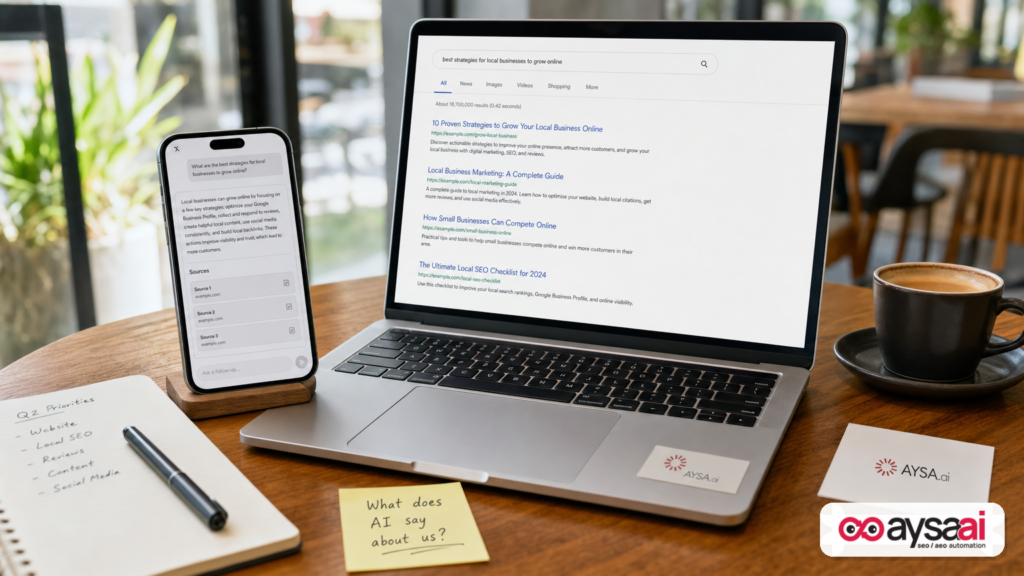
- Removal at the source is the only truly permanent option, and it matters more now because AI systems may still retrieve content even if it’s deindexed in one place.
- Deindexing is about search visibility (not deletion). Use it when you qualify—especially for personal data exposure.
- Suppression is SEO: build a strong entity footprint and publish/circulate authoritative assets that outrank the negative.
- AI answers change the workflow: you must monitor prompts, citations, and summaries—not just rankings.
- Execution velocity is the differentiator. Monitoring without shipping fixes is just anxiety with dashboards.
Key takeaways (read this if you only have 2 minutes)

- Triage fast: Can it be removed at the source? If yes, start there. If no, determine if it’s eligible for platform or Google removal, then decide between legal pathways and suppression.
- Assume your “brand SERP” is now multi-surface: classic results + AI Overviews + assistants. A clean Page 1 doesn’t guarantee a clean AI answer.
- Suppression is not “post more”: it’s about building a coherent, authoritative entity footprint and making it easy for search and AI systems to cite accurate, current information.
- Build operational muscle: make reputation work monthly and measurable: monitoring → decisions → approved fixes → publishing → re-check AI citations.
- Use automation for what it’s good at: technical and content execution. Use humans for Outreach, negotiations, and legal strategy.
Table of contents

- The 2026 shift: your reputation is no longer just Page 1—it’s the answer
- Why negative results rank (and why most businesses misdiagnose it)
- The five levers (and when each one wins)
- Lever 1: Remove the content at the source (the only permanent play)
- Lever 2: Deindexing and removal tools (what they can and can’t do)
- Lever 3: Legal pathways (and the operational risks)
- Lever 4: Suppress what you can’t remove (the SEO work)
- Suppression that actually works: build a defendable entity footprint
- Lever 5: Manage your presence in AI search (AEO/GEO for reputation)
- Monitoring: the missing layer (SERPs, AI citations, and alerts)
- An SME scenario: the clinic with a single damaging result
- Agency and in-house ops: turning chaos into a repeatable system
- Where AYSA fits: approved execution for reputation-driven SEO
- What to do next (action list)
- Sources and further reading
The 2026 shift: your reputation is no longer just Page 1—it’s the answer
For years, reputation work meant “clean up Page 1.” That’s still important. But in 2026, brand perception is increasingly formed before a user Clicks anything. They see an AI-generated summary, a “quick answer” from an assistant, or a compiled view that cites multiple sources.
That creates two new realities:
- You can win rankings and still lose the narrative. A negative story can be summarized into an AI answer even if it’s not the #1 blue link.
- Visibility is distributed. Users ask “Is this company legit?” in assistants, social platforms, and new search interfaces. They don’t always reach your website.
Search Engine Land’s piece frames this shift clearly: AI Overviews and assistants synthesize across the web, which changes what “removal” means and why source removal becomes even more valuable than deindexing alone (source).
My take: this turns reputation from a PR-only function into a hybrid discipline—SEO + content operations + compliance + customer experience. If your operational hygiene is weak (refund policies, support response, public documentation, leadership bios, third-party profiles), AI systems will fill gaps with whatever they can retrieve.
Why negative results rank (and why most businesses misdiagnose it)
When something ugly ranks for your brand name, it feels personal. It’s not. It’s math and incentives.
1) Authority beats intent
High-authority domains—news outlets, court-record aggregators, review platforms, complaint boards—are crawled frequently and trusted by algorithms. If they publish your name in a headline, they’re immediately competitive for your branded query.
2) Relevance is often “perfect” for branded search
Negative pages often include your exact brand or personal name in:
- Title tag / headline
- URL slug
- First paragraph and anchor links
Even without strong backlinks, that’s a relevance bullseye.
3) Engagement loops are real
People click drama. They read longer. They share it. Search systems notice behavior signals. The result can become “sticky.”
4) The most common cause: your footprint is thin
This is the part most SMEs miss, and it’s the part the Search Engine Land piece calls out: the negative result isn’t always unusually strong—your positive ecosystem is unusually weak (source).
If your only strong assets are a homepage and a neglected social profile, you’re not competing with a publisher. The fix is rarely “one blog post.” It’s a set of assets that clarify who you are, what you do, and why you’re credible.
The five levers (and when each one wins)
There are only a handful of levers that reliably move reputation outcomes in search. Everything else is a variation or a distraction. Here’s the practical map, ordered by durability.
Lever A: Source removal
Best when: the content is outdated, wrong, violates a site policy, reveals sensitive info, or the publisher will cooperate.
Why it wins: If it’s gone at the source, there’s nothing to rank, cite, or summarize.
Lever B: Deindexing/removal tools
Best when: the page includes specific categories of personal information or qualifies for a platform’s removal criteria.
Why it wins: Faster than lawsuits and often self-service, but it’s not deletion.
Lever C: Legal pathways
Best when: there’s defamation, IP theft, privacy violations, non-consensual imagery, or relevant regional rights (e.g., delisting frameworks).
Why it wins: It can create enforceable outcomes—but can be slow, expensive, and risky.
Lever D: Suppression (SEO)
Best when: the content is legal/accurate, hosted on strong domains, and won’t be removed.
Why it wins: You can often push damaging results down by building stronger assets that deserve to rank.
Lever E: AI answer management (AEO/GEO)
Best when: AI summaries misrepresent you, cite outdated sources, or pull from weak/biased pages.
Why it wins: It addresses the new “surface area” of reputation—the narrative, not just the ranking.
Lever 1: Remove the content at the source (the only permanent play)
Source removal is the gold standard. If you can get the publisher to delete, unpublish, or materially change a page, it tends to disappear from major search indexes after recrawling. You’re not playing whack-a-mole; you’re removing the mole.
Search Engine Land’s article lays out a workable outreach flow: find the right decision-maker, build a documented case, ask for updates/anonymization/noindex if deletion is denied, and then speed up recrawling using tools designed for outdated snippets (source).
Here’s how to turn that into an operator-grade process.
Step 1: Classify the content type (because the play differs)
- News article / blog post: likely needs editorial standards/policy angle, or proof the facts materially changed.
- Review platform listing: focus on policy violations, fraud, impersonation, or non-customer reviews; or respond and improve rating distribution (suppression).
- Forum thread / social post: moderation rules and account-level reporting often matter more than “PR language.”
- Court record / aggregator: requires legal documentation and sometimes expungement context; removal is inconsistent.
Step 2: Contact the right person, not the nearest email
Reporters don’t always control updates. Editors, standards desks, and site owners do. This is a business negotiation: present facts and documentation, not outrage.
If there’s a clear contact path, use it. If there isn’t, you may need to identify the entity behind the site using domain records (WHOIS is referenced as a tactic in the source context, and it’s a common starting point for identifying site ownership; see the Search Engine Land article for that workflow: source).
Step 3: Make a “documented case,” not a plea
In practice, the strongest requests include:
- What is factually wrong or outdated
- What changed (settlement, dismissal, corrected information, updated ownership, resolved dispute)
- What policy is implicated (accuracy, privacy, harassment, data exposure)
- What you want: delete, anonymize, update, or add
noindex
If you can’t prove a clear issue, be careful. Aggressive takedown demands for accurate reporting can backfire and create more coverage.
Step 4: Ask for the “second-best win” if deletion is unlikely
Many publishers won’t delete. But they might:
- Update the headline and lede to reflect new facts
- Add an editor’s note with verified corrections
- Anonymize an individual name in edge cases
- Add
noindex(page stays live but disappears from search)
In reputation work, noindex is often functionally equivalent to deletion for search visibility—but not for AI systems that might have other retrieval paths. That’s why you should still prefer true source removal when possible.
Step 5: Accelerate recrawling (where appropriate)
If a page is removed or updated, you can often reduce the “limbo period” by triggering recrawls/refresh. Search Engine Land references Google’s outdated content tool in this context (source). If you’re operating at scale, your checklist should include:
- Confirm HTTP status (404/410) or changed content is live
- Request refresh/removal where eligible
- Monitor cached versions/snippets for updates
Lever 2: Deindexing and removal tools (what they can and can’t do)
Deindexing is not deletion. It’s visibility control in a search product. For many business cases, that’s enough—because the business impact (leads, hiring outcomes, partnership confidence) happens at discovery time.
The Search Engine Land article points to Google’s evolving set of self-service and request-based tools, especially for personal data and non-consensual explicit imagery, and emphasizes their limitations: the content can remain accessible at the URL even if it stops appearing in results (source).
What deindexing is good for
- Doxxing and sensitive personal info exposure (addresses, phone numbers, IDs, etc.)
- Stale snippets and cached pages after a source update
- Non-consensual imagery scenarios where platforms and search engines provide reporting pathways
What deindexing is not good for
- Accurate negative news coverage you simply dislike
- Legitimate critical reviews
- “Remove this because it’s bad for business” requests
Operational note: don’t confuse removal tools with reputation strategy
Teams often spend weeks arguing about whether a URL can be removed, then do nothing else. That’s a mistake.
Even if you file removal requests, you should still run a parallel track that strengthens your entity footprint and improves the underlying customer experience that caused the negative content (if it’s a review/story rooted in reality). Removal without improvement is a temporary patch.
Lever 3: Legal pathways (and the operational risks)
Legal tactics can work—but they have failure modes that non-experts underestimate.
Search Engine Land’s piece lists common legal routes (DMCA, defamation claims, court orders, and European delisting frameworks often referred to as “Right to be Forgotten”) and warns about the Streisand effect: legal escalation can amplify attention (source).
DMCA takedowns (copyright)
If someone used your copyrighted photo, video, or text without permission, copyright frameworks can be a clean lever. But be careful: you need to actually own the rights and understand licensing history.
Defamation (false statements of fact)
Defamation is often misunderstood. “Negative” isn’t “false.” Opinions are generally treated differently than factual assertions. If you can document that a statement of fact is false, that can provide leverage with publishers and platforms. If you can’t, legal threats can make you look guilty or vindictive.
Court orders and escalations
Sometimes this is the right move, particularly for harassment, impersonation, or severe privacy violations. But litigation can be slow, expensive, and public. Your PR strategy must anticipate that.
Regional delisting frameworks
In Europe/UK contexts, delisting requests can be relevant for name-based queries in certain circumstances. Outcomes vary and are not universal. If you operate across regions, your strategy must reflect where your customers actually search—and where the delisting applies.
My business-first stance
If there’s real legal exposure or personal safety risk, escalate. Otherwise, treat legal as a precision tool, not a default. For most SMEs, the ROI is often higher in operational fixes + suppression + authoritative content—because those assets keep paying dividends after the crisis fades.
Lever 4: Suppress what you can’t remove (the SEO work)
This is where most “reputation management” becomes actual SEO strategy.
Suppression means outranking negative results with better results—assets that are accurate, helpful, and clearly associated with your entity. Search Engine Land’s article recommends building an entity footprint, claiming high-authority properties, publishing consistently, targeting branded modifiers, and doing legitimate digital PR because third-party coverage can rank on its own and lift everything else (source).
I’ll take that further and make it operational.
Suppression is a portfolio strategy
You don’t outrank a strong negative URL with one new page. You outrank it with a portfolio:
- Owned assets (your site pages you control)
- High-authority profiles (platform pages you can edit)
- Earned media (press/interviews/guest pieces)
- Community proof (credible directories, associations, podcasts, videos)
Suppression also requires intent matching
People rarely search only your brand name. They search:
- “Brand + reviews”
- “Brand + lawsuit”
- “Brand + scam”
- “Brand + complaints”
- “CEO name + controversy”
You don’t need to create spammy pages for every modifier. But you do need credible pages that address the real questions: policies, guarantees, leadership, pricing transparency, support channels, and proof of legitimacy.
What “good suppression” looks like in 2026
- Strong About and Trust pages: clear leadership, address/verification, policies, and references.
- Structured data: Organization/Person schema where appropriate; consistent naming.
- Freshness and maintenance: staleness loses; updated pages keep positions.
- Internal linking: your trusted pages should reinforce each other.
- Selective publishing: don’t flood your site; publish what supports brand queries and customer questions.
Suppression that actually works: build a defendable entity footprint
“Entity footprint” is one of those phrases that can sound abstract. Here’s what it means in plain English:
If a search engine or AI system tries to understand who you are, can it find consistent, corroborated information across the web?
If the answer is “not really,” then the negative page becomes the most coherent story about you. That’s the failure mode.
The entity footprint checklist (SME-friendly)
For a typical small business or founder brand, the minimum viable footprint includes:
- Your domain (ideally a clear brand match) with an updated About page and contact details
- Leadership bios with consistent names, titles, and history
- Key profiles claimed and updated (industry-relevant and reputable)
- One or more third-party validations: memberships, certifications, partner directories, awards (only if true)
- Content that answers trust questions: refund policy, shipping policy, security, guarantees, service standards
Why this works for both SEO and AI answers
Search engines rank pages. AI systems generate answers based on retrievable text and perceived authority. A coherent entity footprint helps both: it gives ranking systems something to rank and gives answer systems something to cite.
Search Engine Land’s broader context includes guidance on “auditing your AI entity footprint,” which reinforces the idea that entity consistency is now an AI visibility problem too (related context).
A note on “borrowed authority”
One of the most practical suppression concepts is borrowed authority: strong platforms already have trust and crawl frequency. When your profiles on those platforms are complete and consistent, they can rank for your name and brand queries.
This is not about gaming; it’s about representation. If you’re a real business, you should be findable on the platforms your customers and partners already use.
Lever 5: Manage your presence in AI search (AEO/GEO for reputation)
This lever barely existed for most teams a few years ago. Now it’s core.
Search Engine Land’s removal-strategy piece highlights a critical point: deindexed content may still be retrievable by AI systems crawling the open web, while source removal removes the underlying material entirely (source).
That leads to a practical strategy shift:
- Optimize for what AI can retrieve and cite.
- Reduce what AI can retrieve when it’s harmful and removable.
What “AI reputation” looks like day-to-day
In a classic SERP world, you watched rankings. In an AI answer world, you also watch:
- What the AI answer says about your brand
- Which sources it cites (if shown)
- Whether it presents allegations as facts
- Whether it merges you with a similarly named business/person
- Whether it uses outdated info about leadership, locations, products, or pricing
Practical AEO/GEO actions for reputation (without hype)
These actions help AI systems retrieve accurate, current information:
- Strengthen your About and policy pages (clear language, up-to-date details).
- Add or improve structured data so entities and relationships are clearer.
- Maintain consistent naming across profiles (brand spelling, leadership names, addresses, phone numbers).
- Create a “facts page” (company overview, timeline, key claims with references). Keep it honest and verifiable.
- Publish clarifications when needed (e.g., “We are not affiliated with X” if there’s name confusion).
For additional context on AI search surfaces, Search Engine Land has ongoing coverage of AI Overviews and AI visibility topics (see their related “AI Overviews vs. featured snippets” and AI visibility discussions in the site’s guide ecosystem; the page context we received links to broader AI search strategy content, though individual claims should be validated per use case).
What can go wrong (and often does)
- Over-correction: publishing defensive pages that look like SEO spin can hurt trust.
- Thin content spam: dozens of low-quality posts can dilute your site and confuse entity signals.
- Ignoring citations: teams focus on “what AI says” but not “why it says it.” Citations are the roadmap.
- Not fixing the root cause: if the underlying customer experience is bad, more negative content will appear.
Monitoring: the missing layer (SERPs, AI citations, and alerts)
Reputation work fails most often because it’s treated as a one-time project. But search and AI surfaces are dynamic. New pages rank. Old pages resurface. AI summaries update when sources change.
So the real question isn’t “How do we remove this one result?” It’s: How do we prevent the next one from becoming the main story?
What to monitor monthly (minimum viable)
- Branded queries: brand name, founder name, product names, and “brand + review/complaint/scam” modifiers.
- Page 1 composition: how many results are owned vs earned vs unclaimed.
- AI Overviews/AI answers: the narrative and any visible citations.
- New indexation events: new pages that mention your brand starting to rank.
- Review velocity and sentiment: spikes are often the earliest warning sign.
Monitoring without execution is a trap
Most tools stop at “here’s the problem.” In practice, teams need a system that turns monitoring into shipped improvements: pages updated, schema applied, internal links added, content published, technical issues fixed.
This is exactly the gap AYSA is designed to close: monitor, prepare recommended fixes, ask for approval, then execute accepted changes on your site. Learn more about the system layers here:
An SME scenario: the clinic with a single damaging result
Let’s make this real with a scenario that mirrors what I see constantly across local services and regulated industries.
The situation
A mid-sized clinic is doing fine operationally, but a single negative article and a handful of one-star reviews are now ranking for:
- “Clinic Name”
- “Clinic Name reviews”
- “Clinic Name lawsuit” (even though the story is outdated and the case was dismissed)
On top of that, an AI summary for the brand query mentions “legal disputes,” even though current leadership and policies have changed.
Triage using the five levers
- Source removal: The article is outdated and omits the dismissal. Outreach asks for an update or editor’s note with documentation.
- Deindexing tools: Not applicable unless sensitive personal info is exposed. Don’t waste time filing generic requests that won’t qualify.
- Legal: If the article contains provably false statements of fact, consult counsel. Otherwise, prioritize correction over escalation.
- Suppression: Build/refresh assets that should rank: updated About, leadership credentials, patient policies, quality standards, FAQ, and relevant directory profiles.
- AI answer management: Ensure the site has clear, up-to-date pages that AI systems can cite. Monitor prompts and citations monthly.
What the clinic publishes (and what it avoids)
- Publishes: a clear “Our standards of care” page, updated leadership bios, transparent billing/help page, and an evergreen FAQ.
- Avoids: a defensive “We are not bad!” blog post. That kind of content often reads like damage control and can become a new ranking result itself.
What success looks like
Success isn’t “the negative URL vanished.” Sometimes it won’t. Success is:
- The outdated story is updated or pushed below the fold
- High-intent queries surface trustworthy pages first
- AI summaries cite the clinic’s current policies and authoritative profiles
- Review sentiment improves because the operational issues were fixed
Agency and in-house ops: turning chaos into a repeatable system
If you’re an agency, reputation work can become a margin killer: lots of manual tasks, uncertain outcomes, and emotionally charged clients. If you’re in-house, it becomes “someone’s side job” until it becomes a fire.
To make this sustainable, you need a process, not heroics.
Step 1: Create a reputation inventory
Track every URL that matters:
- Negative: news, forum posts, review listings, aggregator pages
- Neutral: directory pages, old profiles, outdated partner pages
- Positive: owned pages, key profiles, earned media
Add fields for: query it ranks for, approximate position (manual snapshot is fine), removability (high/medium/low), and strategy assigned (remove/deindex/legal/suppress/AI).
Step 2: Build a “trust asset backlog”
Most brands don’t need endless blog content. They need a handful of pages that answer the questions prospects actually have when trust is uncertain.
If you’re unsure what those questions are, look at your support tickets, sales calls, and review patterns. Your customers will tell you exactly what AI should be citing—if you listen.
Step 3: Make execution approval-based
Reputation touches legal, HR, and brand. Uncontrolled changes create risk. The best workflow is:
- Monitor and detect issues
- Prepare recommended changes and content
- Get approval from stakeholders
- Execute quickly and consistently
This is the model we push at AYSA because it matches how real businesses operate. It’s also how you avoid the two classic failures: (1) nothing ships, or (2) things ship that shouldn’t.
Step 4: Maintain instead of “declare victory”
Suppression assets can slide if you stop updating them. Review platforms can change layouts. New content can rank. Make maintenance part of the plan.
Where AYSA fits: approved execution for reputation-driven SEO
AYSA isn’t a law firm and it doesn’t do publisher negotiations for you. But a lot of the work that determines whether suppression and AI answer management succeed happens on your site—and that work is repetitive, cross-functional, and easy to delay.
AYSA is built to make that work happen:
- Monitors brand and search visibility signals (including AI search visibility as a category of concern): AYSA Monitoring
- Prepares fixes (technical, content, internal linking, schema-oriented improvements) so you’re not starting from a blank doc
- Asks for approval before applying changes, which matters in reputational and compliance-sensitive contexts
- Executes accepted changes so your backlog doesn’t become a graveyard
If you’re trying to build a durable reputation moat, the best approach is to treat trust assets and entity clarity as part of SEO strategy—not a panic project. Start with:
- AI Search Visibility (what AI is likely to retrieve/summarize)
- AI SEO Tools (execution support)
- Pricing (for scoping ongoing monitoring + execution)
- Blog (ongoing editorial on AI search + SEO operations)
What to do next (action list)
If you’re dealing with negative results right now—or you want to prevent them—run this checklist.
Within 48 hours: triage and containment
- List the exact queries that matter (brand, founder, “brand + reviews”, etc.).
- Capture a snapshot of Page 1 for each query (date-stamped).
- Identify the top 3 negative URLs and classify them (news, review platform, forum, aggregator).
- Decide: source removal attempt? eligibility for deindex/removal? legal review? suppression track?
Within 2 weeks: build the foundation that should have existed
- Update your About page, leadership bios, and contact details.
- Ensure your policies are clear (refunds, shipping, guarantees, service standards).
- Claim and update key third-party profiles that represent your brand accurately.
- Publish 1–3 trust assets that answer real questions (not defensive fluff).
Within 60–90 days: execute suppression and AI answer shaping
- Build a content and PR plan focused on assets that can rank (earned media and authoritative profiles).
- Improve internal linking so trust assets are prominent and reinforced.
- Review AI summaries/assistant answers monthly and track citations (where visible) to prioritize what to fix next.
- Keep outreach and update requests active on removable content.
Ongoing: operationalize reputation as a business KPI
- Measure “owned vs unowned” Page 1 composition for key queries.
- Monitor review velocity and recurring complaint themes.
- Treat trust assets like product documentation: always current, always maintained.
Sources and further reading
- Search Engine Land — 5 strategies to remove negative search results in 2026
- Search Engine Land — How to audit your AI entity footprint
- Search Engine Land — How prompt injection puts your brand and AI workflows at risk
- Search Engine Land — Why creator content belongs in your AI search strategy
- Search Engine Land — How semantics and topical authority improve local SEO
Note: For official Google policy and tool documentation (e.g., specific removal eligibility), consult Google’s own help resources directly. This editorial references the tool categories and strategic implications discussed in the Search Engine Land source; eligibility varies by case and region.
Final word: reputation is now a search operations problem
The big change in 2026 isn’t that negative content exists. It’s that the web’s “summary layer” is getting thicker. AI systems synthesize. They compress nuance. And they often amplify the most crawled, most linkable, most emotionally charged content.
The businesses that win are not the ones with the best excuse—they’re the ones with the best operational response: remove what’s removable, suppress what isn’t, build real trust assets, and monitor the surfaces where customers form opinions.
If you want help turning that into a monthly system, that’s where AYSA fits: track AI search visibility, monitor issues continuously, and execute approved changes so improvements actually ship.
Continue the AI search topic inside AYSA.
Use these pages to connect the article with AI SEO tools, AI visibility monitoring, AI Overviews and approved website execution.
Turn this topic into a website action plan.
Use these AYSA hubs to move from reading to technical fixes, AI visibility monitoring, research, glossary context and approval-first SEO execution.