Amazon Quit Google Shopping (US) and Didn’t Come Back: What That Teaches Every Retailer About Paid Search, Incrementality, and the New “Visibility Stack”
Amazon’s U.S. Google Shopping presence dropped to zero and stayed there for a year. The real story isn’t “cheaper clicks”—it’s how fast auctions re-price, why incrementality beats platform ROAS, and how SMEs should redesign feeds, measurement, and SEO/AEO to stay visible even when paid landscapes shift overnight.

Amazon’s U.S. Google Shopping presence dropped to zero in July 2025 and—based on industry benchmark reporting and auction tracking—stayed there for at least a year. The shock value is obvious: one of the biggest retail advertisers in the world goes dark in a channel that has historically moved prices for everyone.
But the useful lesson for most businesses isn’t “maybe CPCs will drop.” The useful lesson is what this episode reveals about (1) how quickly auctions refill, (2) why incrementality is the only measurement that survives executive scrutiny, and (3) why your real defense is a diversified “visibility stack” that combines paid Shopping, organic search, and AI-era discoverability (AEO/GEO).
I’m writing this from the perspective of an operator: if your growth plan depends on one platform’s auction staying predictable, you don’t have a plan—you have a bet. And in 2026, you need fewer bets and more systems.
Concise summary
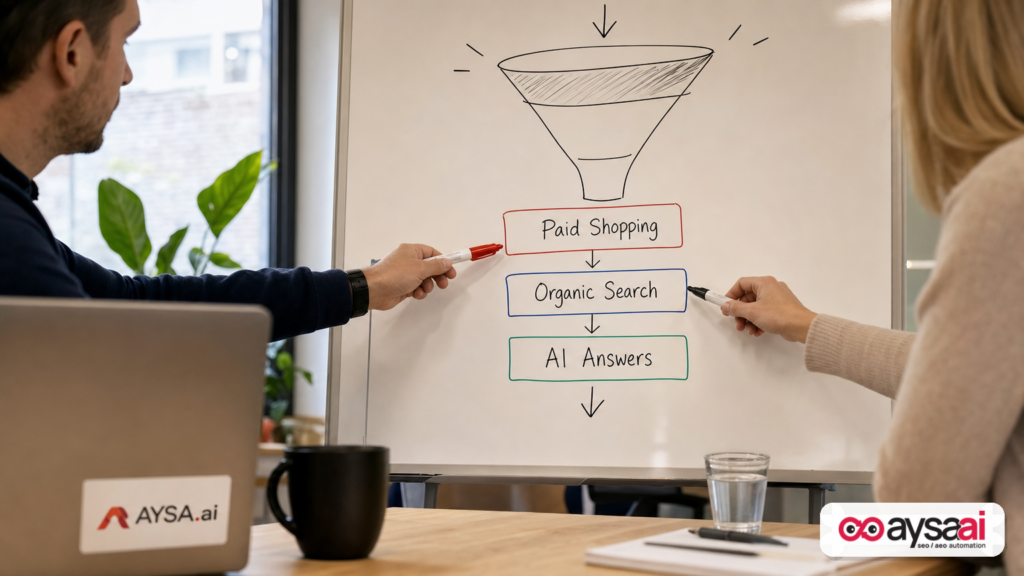
- Amazon’s U.S. Shopping ads going to 0% impression share didn’t create a lasting “cheap Clicks” era. Data discussed in industry benchmarks showed CPC changes were modest and other large advertisers filled the gap quickly.
- The bigger story is incrementality. Amazon is one of the few retailers capable of turning off a massive channel and surviving long enough to learn whether those sales were truly incremental.
- SMEs should treat Shopping as one layer of a broader visibility system. Improve product data, measurement, and organic + AI visibility so you’re not hostage to any single auction shift.
- Execution speed matters. The winners aren’t the teams with the best opinions—they’re the teams with Monitoring, clear guardrails, and a change process that actually ships improvements.
Key takeaways (print this for your next planning meeting)
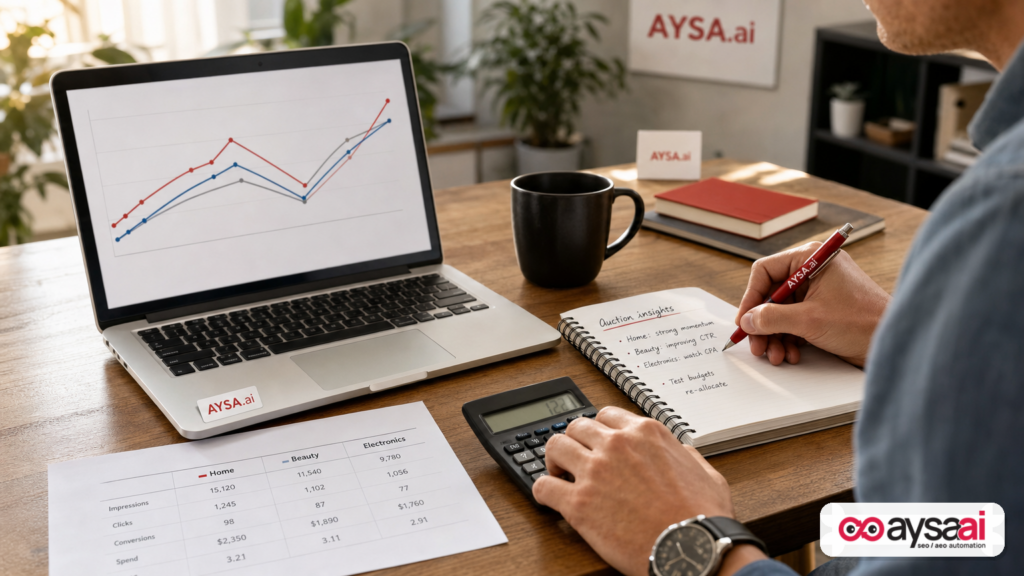
- Auctions don’t stay empty. If a giant exits, expect competitors to refill Impressions within weeks—not months.
- Lower CPC doesn’t mean better business outcomes. Cheaper traffic can dilute conversion value if it’s lower intent, poorly matched, or poorly merchandised.
- Incrementality is a leadership-level question. If finance can’t trust the answer, your budget will eventually get cut.
- Feed quality is strategy. Your product data determines which auctions you enter, how relevant you look, and whether you deserve the click.
- SEO/AEO is not “nice to have” anymore. It’s the hedge against paid volatility—and the connector between human search and AI answers.
Table of contents
- The short version: what changed, and what didn’t
- Why Amazon leaving mattered (even if you never compete with Amazon)
- What a year without Amazon in U.S. Shopping likely did to the auction
- Who filled the gap: marketplaces, big-box, and fast-fashion challengers
- Incrementality is the real headline (and most teams still measure it poorly)
- What can go wrong when you chase “new impressions”
- A concrete SME scenario: the home goods brand that thought CPC was the win
- The feed is your real storefront on Google (and it’s becoming “feed + meaning”)
- New KPIs for Shopping in 2026: stop grading yourself on ROAS alone
- What agencies should rethink: reporting, testing, and governance
- Where AYSA fits: monitoring + approved execution so you can move fast (without breaking the site)
- What to do next: a practical action plan
- Sources and further reading
The short version: what changed, and what didn’t
Here’s the reality behind the headline. When Amazon’s U.S. Google Shopping impression share fell to effectively zero and stayed there (as described in reporting and benchmark commentary), it created a momentary sense of opportunity: fewer bidders should mean lower costs and more impression availability.
In practice, large digital auctions don’t behave like abandoned real estate for long. If demand exists, other bidders step in. That’s exactly what the industry analysis cited in the source coverage described: spending and clicks kept growing across Shopping formats even without Amazon’s U.S. presence, while CPC shifts were relatively modest at a market-wide level.
So what changed? The composition of competition and the distribution of impressions. What didn’t change? The fundamental economics: product-category margins, consumer demand, and the fact that Shopping is still a performance channel where relevance and price competitiveness win.
Why Amazon leaving mattered (even if you never compete with Amazon)
If you sell handmade skincare, custom furniture, or specialized B2B supplies, you might assume Amazon’s ad decisions don’t affect you. But Amazon’s scale matters because:
- It influences price floors in many auctions. When a bidder with huge coverage changes behavior, it affects clearing prices, impression distribution, and what “good CPC” even means.
- It changes how shoppers navigate. Some shoppers who would have clicked an Amazon Shopping ad may click a retailer, a marketplace, or an entirely different discovery surface.
- It forces competitors to adapt. Big players don’t just “enjoy cheaper clicks.” They reallocate budgets, expand coverage, and test new categories—often crowding the same auctions smaller retailers hoped to inherit.
- It reveals a strategic truth: at a certain scale, the question is no longer “can this channel perform?” but “is this channel incremental versus what we already get for free?”
This is why I view Amazon’s continued absence (if it remains the case) less like a PPC anecdote and more like a measurement case study playing out in public.
What a year without Amazon in U.S. Shopping likely did to the auction
The source coverage points to benchmark reporting (including Tinuiti’s digital ads benchmarks) that observed continued year-over-year growth in Shopping spend and clicks after Amazon’s exit, alongside only slight average CPC movement. That pattern aligns with what experienced operators see over and over: when a large bidder leaves, auctions do not “stay cheaper.” They re-price.
Here’s the mechanism in plain English:
- Short term: Some auctions clear at lower prices because a major bidder is missing. This can produce a brief CPC dip and a brief surge in available impressions.
- Medium term: Competitors notice performance shifts (or simply notice more impression availability) and expand coverage. Automated bidding systems adapt. Budgets move. The market finds a new equilibrium.
- Long term: Category dynamics dominate. In categories where demand is intense and margins allow, CPCs climb back. In categories with weak demand, CPCs may stay softer—but the “softness” can correlate with lower conversion value.
That last point is where many teams get misled. Cheaper clicks are often cheaper for a reason: lower intent, weaker product-market fit, less competitive pricing, or lower trust at the point of conversion.
Why CPC alone won’t tell you if you’re winning
If you’re the owner of a seven-figure ecommerce brand, you don’t deposit CPC savings in the bank. You deposit profit. And profit is downstream of:
- Conversion rate and average order value
- Return rate, cancellations, and fraud
- Shipping and fulfillment costs
- New customer mix vs repeat customer mix
- Contribution margin by SKU and category
The source article referenced short-window analysis that suggested clicks rose when Amazon left, while conversion value could decline in the same window. Whether or not that pattern held in every category, it’s a useful warning: auction “wins” can be business “losses” if you don’t measure the full funnel.
Who filled the gap: marketplaces, big-box, and fast-fashion challengers
One reason broad CPC movement may stay muted is that large advertisers don’t leave a vacuum unchallenged. The source coverage discussed that other retailers and marketplaces increased presence and captured share—naming companies like Walmart and highlighting activity from Temu and Shein during parts of that period.
You don’t need to take a position on any specific competitor to learn the operational lesson:
- When one giant steps back, multiple large players step forward. That means the “gap” isn’t inherited by small brands as a windfall. It’s divided among advertisers with budgets, automation, and teams ready to expand.
- Competition becomes more category-specific. You may see relief in one product line and increased pressure in another.
- Creative and merchandising matter more. If the gap-fillers have aggressive pricing and broad inventories, your edge must come from differentiation, not just bidding.
For SMEs, the implication is clear: you can’t plan on competitors staying still. You need your own repeatable system for testing, adjusting, and improving fundamentals (feed, landing pages, and measurement).
Incrementality is the real headline (and most teams still measure it poorly)
The most credible strategic explanation raised in the source coverage is that Amazon may have been evaluating whether Google Shopping drove incremental sales in the U.S.—sales that would not have happened through direct visits, app purchases, organic search, or other channels.
We don’t know Amazon’s internal reasons or results. No one outside Amazon can verify them from the supplied context. But the behavior—a sustained, geographically distinct pause—makes incrementality a reasonable hypothesis to discuss.
And here’s the uncomfortable truth: most organizations report performance, but they don’t prove incrementality.
Performance metrics are not incrementality metrics
Platform ROAS, last-click attribution, and even data-driven attribution models answer “which ads were credited?” not “which ads created net-new outcomes?”
Incrementality asks harder questions:
- Did total revenue change when we reduced or removed this channel?
- Did we acquire fewer new customers—or did they come through other routes?
- Did branded search rise when Shopping fell (meaning we shifted demand rather than created it)?
- Did profitability improve because we cut a high-cost channel that mostly captured existing intent?
Most SMEs can’t safely “turn off” Shopping for a year. They don’t have the brand gravity, direct traffic, or app usage. But they can run smaller tests that answer the same question with less risk.
Incrementality tests SMEs can actually run
Without claiming a one-size-fits-all solution, these are common, defensible approaches:
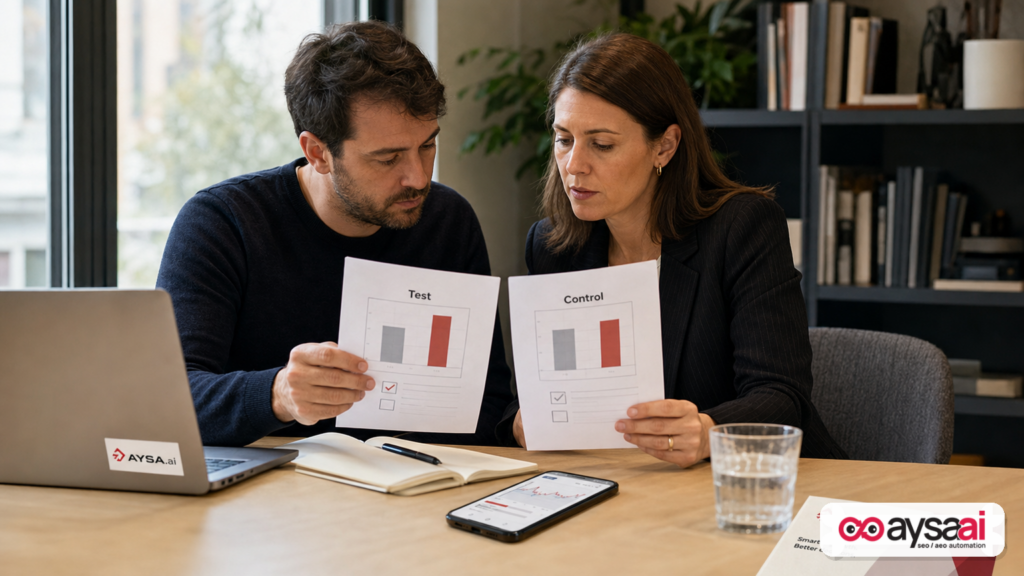
- Geo holdouts: reduce Shopping in a set of regions while maintaining a control set; compare total revenue and new customers. Requires careful matching and seasonality adjustments.
- Category holdouts: pause or reduce Shopping for a product category where you have stable demand; watch what happens to total category revenue and organic demand.
- Brand vs non-brand isolation: test whether Shopping is simply “catching” intent that your brand search and organic listings already capture.
- Time-boxed experiments with lag: run tests long enough to include conversion lag and typical repurchase windows (especially for subscription-like products).
The key is governance: define in advance what level of revenue loss is acceptable, what metrics decide the outcome, and when the test stops early. That’s not a PPC tactic; that’s a leadership decision.
What can go wrong when you chase “new impressions”
When a major competitor exits and you see impression share opportunities, it’s tempting to open the budget floodgates. Here are the most common failure modes I see (and the ones you should actively defend against):
1) You scale spend before you fix the store
If your landing pages are slow, your product pages are thin, your shipping policy is unclear, or your returns process scares shoppers, more clicks just means more expensive disappointment. Paid media can’t outrun a leaky funnel.
2) You buy “coverage,” not profit
Broad queries and broad product sets can soak budget. But if they attract comparison shoppers who churn, return products, or never become repeat buyers, your CAC math breaks.
3) You let automation spend into your worst margins
Automation is not your enemy, but it needs constraints. If you don’t structure Shopping / Performance Max around product-level economics, you can end up scaling the SKUs you least want to sell.
4) You confuse “Amazon isn’t there” with “competition is down”
As the source coverage describes, other large retailers and marketplaces can expand quickly. In many categories, you’re not inheriting Amazon’s demand—you’re fighting for it with different competitors.
A concrete SME scenario: the home goods brand that thought CPC was the win
Let’s make this real.
Scenario: A $3M/year direct-to-consumer home goods brand sells premium kitchen organizers. They run Google Shopping year-round and Performance Max during peak gifting seasons. After a major competitor reduces presence, their CPC drops ~5–10% in certain ad groups. Clicks rise. The marketing team celebrates and increases budgets.
What happens next (the hidden part):
- More clicks come from broader, less-qualified queries (“kitchen storage ideas” instead of “bamboo drawer organizer set”).
- Conversion rate falls slightly; AOV doesn’t rise.
- Returns increase because shoppers didn’t realize the product is premium priced.
- Customer support load increases; margin per order decreases.
- Platform ROAS looks acceptable because attribution credits the last click—but incremental profit is down.
The fix isn’t “spend less.” The fix is to treat Shopping as a controlled merchandising channel:
- Segment by margin and inventory availability.
- Improve titles, images, and variant clarity to pre-qualify the click.
- Use negatives and query sculpting where possible to avoid top-of-funnel waste.
- Set measurement to evaluate new customers and contribution margin, not just ROAS.
This is why I keep returning to the same principle: when auctions change, fundamentals decide who benefits.
The feed is your real storefront on Google (and it’s becoming “feed + meaning”)
Many business owners still think of Shopping as “ads.” Operationally, Shopping is closer to distribution. Your product feed is the catalog Google uses to match you to demand.
In 2026, the feed is also becoming the bridge to richer discovery surfaces (including AI-driven summaries and shopping experiences). Even without making claims beyond the supplied context, the strategic direction is clear: better structured product data and better content around products improves both paid relevance and organic understanding.
Feed improvements that usually pay back (without inventing magic)
These are foundational, and they matter more when auctions get competitive:
- Product titles: lead with the defining attribute (type + key spec + brand/model), not internal naming.
- Accurate identifiers: maintain consistent GTIN/MPN where applicable so platforms can match you correctly.
- Variant clarity: color/size/material should be explicit so shoppers don’t “bounce-back” after clicking.
- High-quality images: clear, accurate, with consistent backgrounds—optimized for product comprehension, not just aesthetics.
- Shipping and returns transparency: reduce post-click anxiety; fewer surprises improves conversion quality.
- Landing page alignment: the page must match the feed attributes (price, availability, options) in real time.
“Feed + meaning”: why SEO and AEO now support paid Shopping
Retail discovery is converging. A shopper might start on Google Shopping, bounce to organic results for reviews, then ask an AI assistant for “best organizer for small drawers,” then return to a product page.
That means your product pages can’t be just transactional. They need to be:
- Machine-readable (structured data where relevant, clear taxonomy, consistent attributes)
- Human persuasive (proof, reviews, comparisons, sizing, use cases)
- Answer-friendly (content that supports being cited or summarized accurately)
This is exactly where ecommerce SEO and AEO stop being separate workstreams and become the same workstream: build assets that win clicks and earn trust across surfaces.
New KPIs for Shopping in 2026: stop grading yourself on ROAS alone
Platform ROAS still matters. But ROAS is a local metric. Your business needs global metrics.
Here’s a practical KPI set you can implement without pretending you have Amazon-level data science:
Tier 1: Business outcomes (executive-safe)
- New customers acquired (with a consistent definition)
- Contribution margin (or gross margin after marketing, if contribution is hard)
- Blended CAC / MER (marketing efficiency ratio, where applicable)
- Repeat purchase rate by cohort (especially for consumables)
Tier 2: Channel health (operator-safe)
- Category-level ROAS (not just account-level)
- Search term quality trends (are you drifting broader?)
- Price competitiveness signals (where observable via performance changes, not invented external indexes)
- Landing page conversion rate for Shopping traffic specifically
Tier 3: Leading indicators (early warning)
- Impression share trends by category
- Click share shifts during seasonal peaks
- Inventory availability and disapprovals (feed hygiene)
The takeaway: if your reporting can’t answer “are we buying incremental profit?” you’re going to lose budget to channels that can.
What agencies should rethink: reporting, testing, and governance
If you run paid media for clients, Amazon’s behavior (whatever the internal motivation) is a reminder that clients will eventually ask: “Are these results real, or are we paying for what we’d get anyway?”
Agencies that survive the next wave will do three things better:
1) Build test design into the retainer
Not a one-off “experiment.” A repeatable cadence: hypothesis → holdout → decision → documentation.
2) Report in business language
ROAS is not a business outcome; it’s a platform ratio. Translate outcomes into margin, new customers, and cash-flow risk.
3) Improve execution throughput
The best strategy memo is worthless if the site, feed, and content can’t be updated quickly and safely. Most organizations are bottlenecked not by ideas, but by approvals and deployment.
Where AYSA fits: monitoring + approved execution so you can move fast (without breaking the site)
This is the operational gap AYSA is built to close. The modern ecommerce team needs:
- Monitoring to detect visibility and performance shifts early
- Preparation of the right changes (technical, content, internal linking, structured data, on-page improvements)
- Approval workflows so humans stay in control
- Execution that actually ships changes when approved
AYSA is an “approved execution” system: it monitors, proposes changes, asks for your approval, and executes accepted website changes—so you can keep your visibility stack healthy even when paid auctions change.
Practical ways to use AYSA in this exact context:
- Monitor volatility and visibility signals so you know when to investigate (see AYSA Monitoring).
- Strengthen organic and AI-era discoverability so your business isn’t only “renting” traffic (see AI Search Visibility).
- Use AI SEO tools for prioritized fixes that help product pages match intent, reduce bounce, and support richer understanding (see AI SEO Tools).
- Align budgets with execution capacity: if you plan to scale Shopping, make sure the site can support it first. AYSA helps reduce the lag between “we should fix this” and “it’s fixed.”
If you’re evaluating tooling, pricing matters—especially for SMEs—so here’s the reference: AYSA Pricing. And for more implementation playbooks, you can browse the AYSA blog.
What to do next: a practical action plan
Whether Amazon returns tomorrow or never returns, the actions below are durable. They make you better in stable auctions and resilient in unstable ones.
1) Build your “visibility stack” map
List your current reliance by percent of revenue on:
- Paid Shopping / Performance Max
- Paid search (brand and non-brand)
- Organic search
- Email/SMS
- Marketplaces
- Social and creator channels
If any one layer is dangerously dominant, set a goal to reduce dependency over 2–3 quarters.
2) Establish an incrementality-ready measurement baseline
- Choose 2–3 primary business metrics (new customers, contribution margin, blended CAC).
- Document conversion lag expectations by category.
- Decide what “acceptable downside” looks like for a test.
3) Run a low-risk holdout test
Don’t copy Amazon’s scale. Copy the logic. Choose a category or region you can isolate, set a time window, and compare total outcomes—not just attributed conversions.
4) Fix feed hygiene and product page alignment before scaling spend
- Audit titles, variants, identifiers, and image consistency.
- Verify price and availability accuracy.
- Improve on-page clarity: shipping/returns, sizing, comparison points.
5) Use monitoring to shorten reaction time
Set up alerts and routines so you notice auction shifts quickly (impression share changes, click quality shifts, disapprovals). This is where AYSA Monitoring and operational discipline matter more than “genius” strategy.
6) Invest in organic + AI visibility as the hedge
Even if paid is your growth engine, build organic assets that keep demand coming when auctions tighten. Start here: AI Search Visibility.
Sources and further reading
- Search Engine Journal — Amazon Left US Google Shopping A Year Ago & Never Came Back (primary source used for this editorial’s factual backbone and research leads)
- Search Engine Journal — PPC News (for ongoing paid media context)
- Search Engine Journal — SEO coverage (for broader search visibility context)
Note: The source article references third-party benchmark reporting and tools (e.g., Tinuiti, Smarter Ecommerce, Optmyzr). Those primary reports were not included in the supplied research context, so I have not added direct links or introduced additional figures beyond what was described in the provided source excerpt.
Final word: the lesson is not about Amazon—it’s about discipline
Amazon’s absence from U.S. Google Shopping (as reported) is a reminder that the ground can move under your feet without warning. The winning response is not panic, and it’s not blind budget expansion. It’s disciplined measurement (incrementality), disciplined merchandising (feed + landing pages), and disciplined execution (monitor → approve → ship).
That’s how you build a brand that grows in good auctions—and survives the weird ones.
Continue the AI search topic inside AYSA.
Use these pages to connect the article with AI SEO tools, AI visibility monitoring, AI Overviews and approved website execution.
Turn this topic into a website action plan.
Use these AYSA hubs to move from reading to technical fixes, AI visibility monitoring, research, glossary context and approval-first SEO execution.