Dinner Party Planning Is a Preview of AI Search: What Google’s New “Host Mode” Means for Your Business Visibility
Google is turning Search into an action engine: you ask, it visualizes, recommends, and connects to apps to execute. The dinner-party examples are friendly—but the implication is serious for SMEs: AI Search is moving up-funnel and down-funnel at the same time, and your content has to be usable, attributable, and ready for AI-driven decisions.

Google just published a light, consumer-friendly post about using AI-powered Search features to host a better dinner party. On the surface, it’s about tablescapes, menu ideas, drink pairings, playlists, and printable menus. Under the hood, it’s a clear signal of where Search is going: fewer blue links, more multi-step planning, more personalized recommendations, and more direct “do the thing” actions.
That matters far beyond dinner parties. For SMEs, agencies, and ecommerce teams, this is a preview of the next search battleground: AI-led journeys where the customer asks for a plan and expects Search to assemble it—products, vendors, content, and next steps—often without clicking 10 different websites.
This editorial breaks down what changed, why it matters, what can go wrong for brands, and what you should do next. I’ll also show where AYSA fits: Monitoring for AI Search shifts, preparing changes, asking for approval, and executing accepted updates on your website so you don’t get stuck in “strategy-only” mode.
Concise summary
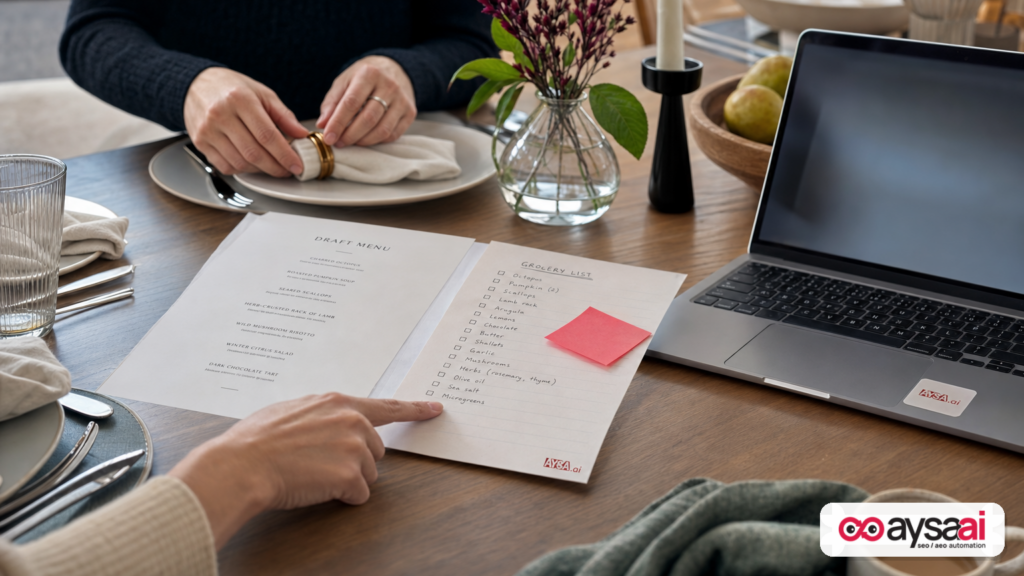
- Google is pushing Search toward end-to-end planning and execution. The dinner-party examples are a friendly wrapper around a serious product direction.
- AI Search rewards usable, attributable, structured information. If your content can’t be cleanly summarized, compared, or recommended, you’ll be invisible in AI-led answers.
- Expect “plan the thing” queries to grow. Customers will ask AI Mode to build menus, itineraries, shopping lists, vendor shortlists, and more.
- SMEs need a new playbook: AEO + GEO + operational freshness. Accurate offerings, clear constraints, and proof (reviews, expertise signals) matter as much as keywords.
- Execution speed becomes a competitive advantage. Monitoring + approved changes + continuous iteration is the only sustainable approach.
Table of contents

- The dinner party story is a Trojan horse (in a good way)
- What Google actually introduced (and why it’s bigger than dinner parties)
- Why this matters to SMEs: AI Search is becoming an action engine
- New user behavior to expect: “plan the thing,” not “find the thing”
- Who wins and who loses when AI assembles the plan
- Content requirements for AI Mode: what your site must provide
- Trust, attribution, and the fight for being cited
- Operational freshness: the unsexy ranking factor that becomes decisive
- The SME scenario: a local catering company competing inside AI Mode
- What agencies should rethink: deliverables vs. outcomes
- What to monitor now (even if you don’t “do AI”)
- A practical action plan (30/60/90 days)
- Where AYSA fits: monitor, prepare, approve, execute
- What to do next
- Sources and further reading
The dinner party story is a Trojan horse (in a good way)

I like Google’s dinner party framing because it’s relatable: most people understand the chaos of coordinating food, drinks, ambiance, dietary constraints, and timing. What makes it editorially important is how Google positions Search in that chaos.
Instead of “here are 10 links to table-setting guides,” the new posture is:
- Visualize what you’re imagining (tablescape, menu design).
- Recommend options that fit constraints (menu ideas, pairings).
- Connect to apps to execute (playlists saved to your music app).
- Package results into something usable (printable menus, lists).
For a business owner, this isn’t “Search for fun.” It’s Search as planning software. And planning software changes markets because it influences which brands and sources become the default ingredients inside the plan.
This is the source post, and it’s worth reading for the examples (not because you run a dinner party business, but because it shows the product direction): Google Search Blog: “5 ways to host the ultimate dinner party with Google Search”.
What Google actually introduced (and why it’s bigger than dinner parties)
Based on Google’s post, the capabilities being showcased include:
1) Visualizing ideas in Search (tablescapes, menus)
Google highlights using “Nano Banana” within AI Mode to visualize a tablescape and even generate a printable menu design. You don’t have to care about the name. You should care about the function: Search generating visual outputs that shape decisions.
In classic SEO, you compete for a click. In AI Search, you increasingly compete to be a recommended component inside an AI-assembled plan. Visual outputs accelerate decisions by reducing uncertainty (“I can see it, therefore I can commit”).
2) Recipe/menu discovery with creator-centric presentation
Google also mentions a visual treatment in AI Mode that makes it easier to discover dishes from recipe creators, with prominent links featuring images and details like ratings and ingredient counts.
In editorial terms, this is a directional shift: Google is experimenting with structured “cards” that highlight sources and attributes people actually use to decide. It’s not “10 blue links.” It’s “here are the options; choose fast.”
3) AI-driven pairing and reasoning (drinks for the menu)
Google gives a specific example prompt asking for drink pairings for miso salmon, a cheese platter, and key lime pie—and emphasizes that the AI explains why the recommendation complements the meal.
This “explain the why” piece matters. When AI Search explains its reasoning, it implicitly teaches users to trust the plan. For brands, the question becomes: is your content easy to use as evidence in that reasoning?
4) App connections from Search (playlist creation and saving)
Google notes you can connect “go-to apps” so AI Mode can curate a playlist and save it directly to YouTube Music.
That’s the clearest “action engine” signal: Search isn’t only answering; it’s moving work into integrated flows. If your industry has app ecosystems (booking, ordering, scheduling, commerce), expect similar “connect and execute” behavior to expand.
Why this matters to SMEs: AI Search is becoming an action engine
Most SMEs still think of Google as:
- A place to rank for a handful of keywords
- A place to win Local Pack Visibility
- A channel where traffic equals opportunity
That model isn’t dead, but it’s incomplete. AI Mode-style experiences push Search into a more opinionated role: Search becomes the coordinator.
In coordinator mode, Search isn’t optimizing for “did the user click a result.” It’s optimizing for “did the user complete the job.” And when Search optimizes for job completion, it tends to:
- Summarize rather than list
- Recommend rather than retrieve
- Compare rather than send you out to compare
- Reduce steps (and reduce Clicks) between question and action
That changes what “visibility” means. You’re not only chasing rankings—you’re chasing inclusion and Attribution inside AI-generated answers, plans, and shortlists.
If you want the AYSA version of this in practical terms, start here: AI Search Visibility. The core concept is simple: you can’t “set and forget” when the interface, the query patterns, and the selection logic are moving.
New user behavior to expect: “plan the thing,” not “find the thing”
Google’s dinner party examples are all variations of a single behavior shift:
Users increasingly want an AI to assemble a complete plan that fits constraints, not a list of resources that might help build that plan.
In SEO terms, this is a move from:
- Single-intent queries (e.g., “best tiramisu recipe”) to
- Compound-intent queries (e.g., “plan an Italian dinner party for 8 with gluten-free options, shopping list, timeline, and wine pairings”).
Those compound queries don’t map cleanly to one webpage or one keyword. They map to systems of information:
- Clear product/service pages
- FAQs that reflect real constraints
- Policies (delivery, returns, booking)
- Up-to-date pricing signals where appropriate
- Proof and credibility (reviews, expertise)
- Structured data that helps machines interpret content
This is why AEO (Answer Engine Optimization) and GEO (Generative Engine Optimization) are becoming normal conversations, even for non-SEO operators. At AYSA, we treat this as an execution problem, not a buzzword problem. If you want the tools angle, see: AYSA AI SEO tools.
Who wins and who loses when AI assembles the plan
When AI becomes the planner, it has to choose ingredients. Brands and publishers will land in one of four buckets:
Bucket 1: “Default sources” (consistently included)
These are sources that are:
- Clear and structured
- Frequently updated
- Easy to cite
- Aligned with user constraints
They tend to produce content that is unglamorous but machine-usable: tables, checklists, well-labeled sections, explicit steps, and specific recommendations with conditions.
Bucket 2: “Occasionally included” (context-dependent)
Good brands with gaps: a strong product, weak content structure; strong blog, weak product pages; great expertise, unclear policies.
Bucket 3: “Invisible despite being good”
Many SMEs live here. The business is real and competent, but the site doesn’t clearly explain:
- Who it serves
- What it offers (in machine-digestible terms)
- How pricing works
- What constraints apply
- How to take the next step
Bucket 4: “Excluded” (low trust, conflicting info, poor UX)
Outdated pages, contradictory statements, missing contact info, unclear legal/policy pages, or content that looks like it was written “for SEO” rather than to help a human complete a task.
The strategic takeaway: AI Search isn’t only about “better writing.” It’s about making your business legible.
Content requirements for AI Mode: what your site must provide
Let’s translate the dinner-party features into a business checklist. If AI can assemble menus, pairings, and playlists, it can assemble:
- Vendor shortlists (caterers, venues, photographers, clinics, contractors)
- Product bundles (starter kit + accessories + refill schedule)
- Service plans (consult + follow-up + prep instructions)
- Travel itineraries (hotels + restaurants + activities)
To be included, your site needs to be structured around questions AI can answer confidently.
1) Offer clarity (what you sell, for whom, under what conditions)
Most SME sites say what they do in marketing language. AI needs operational language too:
- Service area
- Lead time
- Minimum order / minimum project size
- Dietary/allergen support (for food), insurance/licensing (for services), compliance (for healthcare)
- Scheduling and capacity constraints
2) Constraints and “if/then” logic (so AI can recommend correctly)
AI plans are only as good as the constraints they respect. Your content should include explicit “if/then” guidance, for example:
- If you need delivery within 24 hours, choose these options
- If you’re allergic to X, avoid these products
- If your budget is under Y, here is the best package
3) Proof and credibility signals
AI recommendations will lean on trust. You should ensure your website makes it easy to verify:
- Who is behind the business (real people, credentials where relevant)
- Clear contact methods
- Policies (returns, cancellations, refunds)
- Testimonials/reviews where appropriate
4) Structure that machines can digest
This includes:
- Descriptive headings
- Short paragraphs
- Bulleted lists for requirements and steps
- Tables for comparisons
- FAQ sections that match real questions
If you want to operationalize this without turning your team into an SEO department, this is where AYSA’s workflow matters: we monitor changes, prepare page updates, request your approval, and then execute the accepted changes. See: Monitoring.
Trust, attribution, and the fight for being cited
In the source post, Google notes AI Mode responses can surface prominent links to recipe creators with images and details. That’s an important clue: Google knows it needs to show sources, not just answers.
For publishers and brands, the competitive target isn’t only rankings—it’s being:
- Cited (linked/referenced as a source)
- Represented accurately (your offer summarized correctly)
- Chosen (included in option sets or recommendations)
Here’s the uncomfortable truth: AI can misinterpret you if your content is ambiguous. You may get “visibility” but lose “accuracy.” That’s worse than not being included because it creates customer expectations you can’t meet.
How to reduce ambiguity
- Use explicit pricing language where possible (or explain pricing ranges and drivers)
- Clarify what’s included vs. add-on
- State exclusions plainly
- Keep policies in sync with what sales/support actually does
AI Search will compress your business into a few sentences. Your job is to make those few sentences true.
Operational freshness: the unsexy ranking factor that becomes decisive
Dinner party planning is time-sensitive. Availability, ingredient substitutions, and timing matter. That’s the same with most SME purchases:
- Clinics: appointment availability, insurance accepted, services offered
- Home services: service area, lead times, emergency availability
- Ecommerce: stock status, shipping cutoffs, returns windows
- Hotels: rates, amenities, seasonal policies
In AI-led journeys, freshness becomes decisive because the system is trying to complete the task in fewer steps. Outdated info creates failed tasks—which the system will learn to avoid.
Practically, this means your “SEO program” can’t be quarterly blog posts. It has to include:
- Regular audits of key money pages
- Ongoing updates to FAQs and policy pages
- Consistent internal linking so AI can find the authoritative page fast
- A process for approving and shipping changes quickly
AYSA exists because most teams can’t do this reliably. The bottleneck is almost never “ideas.” It’s execution and approvals. If you’re curious what that looks like in practice, start with Pricing to understand the commitment level, then explore the education resources at AYSA Blog.
The SME scenario: a local catering company competing inside AI Mode
Let’s make the dinner party theme literal, but in a way that maps to any service business.
Scenario
You run a local catering company. Your customers increasingly ask AI Mode-style queries like:
- “Plan a Mediterranean dinner party for 12 in Austin under $45 per person, with two vegetarian mains and a dairy-free dessert. Suggest a caterer and what to order.”
- “I need a catered dinner for 8 next Saturday, low-sodium options, and a wine pairing recommendation.”
In the old world, your SEO strategy might focus on “Austin catering” and “Mediterranean catering Austin.” In the AI world, you’re competing inside a plan.
What the AI needs from your website to recommend you
- A clearly labeled “Dinner Party Catering” page (not just “Services”)
- Sample menus with dietary labels (vegetarian, vegan, gluten-free, dairy-free)
- Minimum order, lead time, and weekend availability guidance
- Service area and delivery details
- A “how pricing works” section that prevents wrong assumptions
- FAQs that mirror real customer constraints
What goes wrong if you don’t do this
- You’re omitted because the AI can’t confidently match you to constraints.
- You’re included but misrepresented (“They do vegan dessert” when you don’t).
- You’re compared poorly because your pages don’t expose enough attributes.
This is the exact type of work AYSA is built for: keep critical pages current, structured, and aligned with the reality of what you can deliver—while minimizing time spent in endless SEO meetings. The system monitors, prepares, asks for approval, and executes changes. That loop matters more as AI Search compresses decisions.
What agencies should rethink: deliverables vs. outcomes
Agencies are about to get squeezed from both sides:
- From clients who see traffic flattening and ask, “Why are we paying for content if AI answers reduce clicks?”
- From platforms that move faster than quarterly roadmaps
The agency move is to shift from “we shipped X pages” to “we improved inclusion and conversion in AI-led journeys.” That requires new deliverables:
- AI visibility monitoring and reporting (not only rank tracking)
- Content restructuring and entity clarity improvements
- FAQ and policy maintenance as an ongoing service
- Technical hygiene focused on crawlability and clarity
- A workflow that ships changes continuously with client approval
Execution is the differentiator. If the agency strategy depends on “send recommendations to the dev team and hope,” you lose. A system that can propose and implement changes with approval wins. That is exactly where AYSA plugs in for agencies as well as in-house teams.
What to monitor now (even if you don’t “do AI”)
If you’re an SME, you don’t need to become an AI researcher. You do need to watch for changes that will quietly erode demand capture.
1) Query patterns moving from keywords to tasks
In your own customer conversations, note when people ask for:
- Bundles (“What should I buy together?”)
- Plans (“How do I do this end-to-end?”)
- Constraints (“Given my situation, what’s best?”)
2) Performance of “money pages” vs. blog pages
AI-led experiences can reduce top-of-funnel blog clicks, while raising the importance of pages that define your offer. If your service/product pages are thin, you’ll feel it.
3) Representation accuracy
Even if you’re cited, are you described correctly? AI summaries can create wrong impressions if your site is unclear. Monitor your own brand queries and read how your offerings are summarized.
4) Update velocity
If it takes you 30 days to update a core page, you’re too slow for AI Search volatility. This isn’t theory; it’s operational reality.
AYSA’s monitoring is designed to catch issues early and turn them into approved, shippable updates: AYSA Monitoring.
A practical action plan (30/60/90 days)
Here’s a business-friendly plan that doesn’t require a huge SEO team.
Days 1–30: Make your business legible
- Inventory your “decision pages.” Product pages, service pages, pricing pages, location pages, policy pages.
- Rewrite the top sections for clarity. Who it’s for, what’s included, key constraints, next steps.
- Add an FAQ section to each major offer page. Use real customer questions, not SEO guesses.
- Fix internal linking. Ensure every blog post that mentions an offer links to the canonical offer page.
Days 31–60: Build “AI-usable” assets
- Create comparison and selection guides. “Which package is right for you?” style pages.
- Add constraint-based recommendations. Budget ranges, timelines, compatibility, prerequisites.
- Standardize how you present attributes. Ingredients/allergens, materials, sizes, service areas, turnaround times.
Days 61–90: Turn it into a system
- Set a monthly refresh cadence for top pages (pricing, availability, policy, seasonal content).
- Implement monitoring and change workflow. Someone owns approvals; someone owns implementation.
- Operationalize testing. Small changes, measured outcomes, repeat.
If you want a system rather than a spreadsheet, this is where AYSA fits most naturally: AI Search Visibility + tools + approved execution.
Where AYSA fits: monitor, prepare, approve, execute
The dinner party post is ultimately about reducing cognitive load: let AI handle logistics so you can focus on people. That’s also the right framing for SEO and AI Search optimization.
Most SMEs don’t lose because they lack ideas. They lose because:
- They can’t keep pages updated
- They can’t coordinate approvals
- They can’t ship changes fast enough
- They don’t know what to monitor
AYSA is designed as an execution system:
- Monitors search visibility and site issues (Monitoring)
- Prepares recommended content and technical updates
- Asks for approval (so humans stay in control)
- Executes accepted changes on your website
That “approved execution” model is the difference between knowing what to do and actually doing it. In AI-led search environments, the businesses that ship clarity fastest become the default picks.
What to do next
- Pick 10 pages that represent your revenue. Not your blog—your offers.
- Add constraint language. Who it’s for, what’s included, what’s excluded, and what the customer should do next.
- Create one “selection guide” page. Help customers choose between options using simple rules.
- Refresh your FAQs. Use customer emails, call logs, and chat transcripts to choose questions.
- Set a monthly update cycle. Commit to keeping top pages current.
- Adopt monitoring + execution. If your updates depend on “someday,” you’re already behind.
If you want AYSA to help you move from intentions to shipped changes, start with AYSA’s AI SEO tools and the overview of pricing.
Sources and further reading
- Google Search Blog — 5 ways to host the ultimate dinner party with Google Search
- Google DeepMind blog (official Google research and product context)
- Google Research blog (official Google research updates)
- Google Developers blog (official platform and tooling updates)
- Google Cloud blog (official AI and infrastructure context)
- Google Ads & Commerce blog (official commerce ecosystem context)
- Google Security blog (official trust and safety context)
AYSA internal reading:
Note: This editorial is based on the product direction and examples described by Google’s Search team in the source post. Where broader claims are made about industry impact, they are presented as analysis and practical guidance rather than as verified performance metrics.
Continue the AI search topic inside AYSA.
Use these pages to connect the article with AI SEO tools, AI visibility monitoring, AI Overviews and approved website execution.
Turn this topic into a website action plan.
Use these AYSA hubs to move from reading to technical fixes, AI visibility monitoring, research, glossary context and approval-first SEO execution.