
Reddit, Reviews, and Location Data: The New Local SEO Stack for AI Search (And How to Operationalize It)
AI answers are increasingly built from off-site conversations—especially Reddit—plus reviews and location data. Here’s the practical playbook multi-location and local businesses can run to earn AI mentions, fix data conflicts, and turn “being found” into “being recommended.”

Local SEO used to be a pretty clean equation: keep your listings accurate, collect reviews, build a few location pages, and you’d compete on proximity + relevance + prominence.
AI Search breaks that mental model.
Today, customers increasingly ask a model (ChatGPT, Gemini, Perplexity, and others) what to do, where to go, and which business to trust. And the model doesn’t just “rank” results—it recommends. That recommendation is built from a blend of your website, your location data across directories, your reviews, and a fast-growing input that many brands still treat as optional: community conversation, especially on Reddit.
This editorial is a practical playbook for SMEs and multi-location brands that need a system—not another checklist—to earn AI mentions and prevent AI from repeating incorrect business details. It draws on insights reported by Search Engine Journal and expands them into an operational framework you can actually run. Source: Search Engine Journal recap (July 2026).
Concise summary

- AI answers pull heavily from off-site sources. Your website is necessary but rarely sufficient.
- Reddit is a major citation source in AI answers (per the SEJ recap), because it contains high-context human recommendations and debate at scale.
- Location data consistency is now a gating factor. If hours/addresses/phones conflict across platforms, AI may pick the wrong version—or omit you.
- Reviews and review responses act like validation layers. AI systems connect what you claim with what customers corroborate.
- You need an execution cadence. Monitoring + approved changes + repeatable participation beats one-time “optimization.”
Key takeaways (print this)
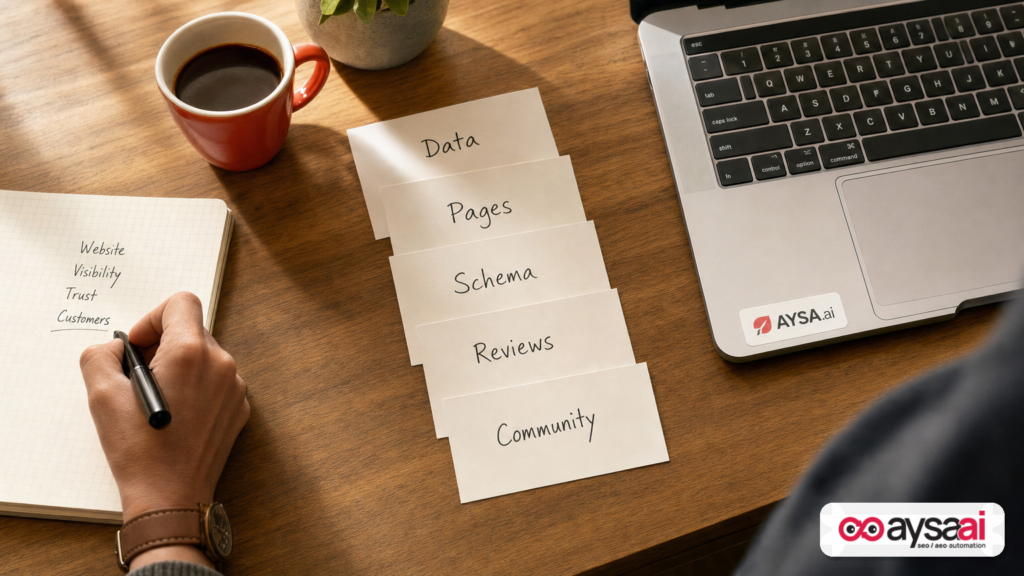
- Fix your inputs before you chase mentions. Data consistency → location pages → schema/FAQs → review system → community participation.
- Treat Reddit like a public Q&A layer for your category. If you’re absent, competitors and misinformation fill the void.
- Operationalize, don’t improvise. Assign owners, set an SLA for data fixes and review replies, and track AI visibility over time.
- Build for “citable” clarity. Make it easy for humans (and AI systems) to quote the correct facts about each location.
- Use a system that monitors, prepares, asks for approval, and executes. That’s how you scale accuracy across 10, 100, or 1,000 locations.
Table of contents
- What Changed: From Ranking to Being Recommended
- Why Reddit Shows Up So Often in AI Answers
- The Local Twist: When Conversations Surface Next to Your Business
- The New Local AI Visibility Stack (In The Only Order That Works)
- Play 1: Location Data Consistency (The Gatekeeper)
- Play 2: Location Pages + Schema + Local FAQs (Make Yourself Citable)
- Play 3: Reviews as Validation (and Why Responses Matter)
- Play 4: Participate on Reddit Without Getting Downvoted (or Breaking Brand)
- Play 5: Measurement + Cadence (Because AI Visibility Drifts)
- A Concrete SME Scenario: The 12-Location Clinic With Wrong Hours in AI Answers
- What Agencies and Multi-Location Teams Need to Rethink
- Where AYSA Fits: Monitoring + Approved Execution for AI-First Local SEO
- What to Do Next (Action List)
- Sources and Further Reading
What Changed: From Ranking to Being Recommended
In classic search, the customer typed “best brunch near me,” scanned a list, and clicked a few results. The website and the map listing did most of the work.
In AI search, the customer asks: “Where should I go for brunch near me if I need gluten-free options and I can’t wait more than 20 minutes?” The answer increasingly arrives as a single recommendation list with short reasoning. That reasoning is built from multiple sources—some of which you don’t control.
That’s the strategic shift the SEJ recap captures well: the competition isn’t just about outranking the business down the street. It’s about becoming the most believable, verifiable, and repeatable option across the web, in the exact contexts customers ask about.
This is why local and multi-location businesses feel whiplash:
- You can have a strong website and still be absent from AI answers.
- You can have the right address on your site and still have AI repeat an old one.
- You can have great service, but if the public internet doesn’t reflect it consistently, AI won’t “know.”
From an operator’s perspective, the new objective is straightforward:
Make every location accurate, easy to cite, and socially validated—then keep it that way.
Why Reddit Shows Up So Often in AI Answers
Reddit is not “just another social network.” It’s a public archive of customers doing what customers always do before they buy:
- Asking for recommendations
- Comparing options
- Challenging claims
- Sharing first-hand experience
- Updating each other when things change
The SEJ recap argues that AI systems cite Reddit frequently because it provides human context at scale. The practical implication isn’t “go spam Reddit.” It’s this:
If your category has active Reddit threads and you’re never mentioned, AI will build a picture of the market without you.
For local businesses, Reddit can influence:
- “Best in [city]” and “worth it?” threads
- Neighborhood-specific recommendations
- Service-provider shortlists (“best plumber in Austin?”)
- Travel planning (“where to stay near…”)
- Trust and safety discussions (scams, bad experiences, bait-and-switch pricing)
And unlike many platforms, Reddit often preserves the conversation, not just the final answer. That thread structure is useful to AI systems trying to summarize a consensus with caveats.
Important restraint: we are not claiming privileged access into how any specific model weights any single source. We’re working from the SEJ recap’s reporting and what’s observable in the market: AI answers often include citations, and Reddit is frequently present among them in many categories.
The Local Twist: When Conversations Surface Next to Your Business
The SEJ recap highlights a development with huge local implications: Google may surface Reddit discussions around businesses directly in business-facing contexts. Whether this is universal across categories or markets is hard to verify without a broad study, but the direction is clear: community conversation is becoming part of the local “knowledge layer.”
Even if a customer never Clicks into Reddit, the existence of a thread can influence how they think about you. The same is true for AI answers: threads can become “evidence” for or against your positioning.
This reframes reputation management into something more operational:
- It’s not only about your star rating.
- It’s about what the internet believes is true about each location: hours, policies, pricing, wait times, parking, returns, accessibility, and the real customer experience.
For multi-location brands, the risk is amplified because small inconsistencies become system-wide confusion. One location has different holiday hours. One franchisee changed a phone number. One old listing still ranks. One local thread says “they moved.” That’s how you end up with AI confidently repeating the wrong details.
The New Local AI Visibility Stack (In The Only Order That Works)
Most businesses approach AI visibility backwards. They start with “How do we get mentioned in ChatGPT?” and skip the prerequisites.
Here’s the stack that consistently makes sense for local and multi-location operators—aligned with the SEJ recap’s emphasis on location data, citable pages, reviews, and Reddit participation, then expanded into a repeatable operating model.
Stack overview
- Location data consistency (NAP + hours + categories + attributes)
- Location pages that match reality (one canonical source per location)
- Structured data + local FAQs (make facts easy to extract and cite)
- Review system + responses (validation layer)
- Community presence (Reddit and beyond) (credibility + context)
- Monitoring + cadence (because drift is constant)
The reason order matters: AI systems (and humans) need a stable foundation of facts before they can trust higher-level claims.
Now let’s make each play practical.
Play 1: Location Data Consistency (The Gatekeeper)
If your name, address, phone number, and hours conflict across major platforms, you create an avoidable failure mode:
- AI systems choose a version at random
- or they skip you because the facts don’t reconcile cleanly
The SEJ recap makes the same point in plain terms: conflicting data can cause AI to select incorrect details or omit the business.
What counts as “location data” in 2026 reality?
- Core NAP: business name, address, phone
- Hours: regular hours, holiday hours, seasonal hours
- Categories: primary and secondary categories
- Attributes: parking, accessibility, delivery, reservations, services
- URLs: Location page URL, appointment URL, menu/service URL
- Images: storefront signals and “is this real?” cues
Your minimum viable audit (SME and multi-location)
If you have limited time, copy the spirit of the SEJ Q&A advice: audit your top locations first across the directories that matter. That typically includes Google, Apple, Yelp, and key vertical directories for your industry (we won’t name verticals we can’t verify from the supplied context; choose those your customers actually use).
Do this for the top 10–20 revenue-driving locations (or all locations if you’re under 10):
- Confirm NAP matches your legal/brand standard
- Confirm regular hours and holiday hours
- Confirm the correct location URL exists and loads fast
- Confirm categories and key attributes are accurate
- Check for duplicates and old addresses
Common failure patterns
- “We moved.” Old address persists on a directory nobody owns.
- “We changed phone systems.” Tracking numbers proliferate, confusing canonical contact.
- “Holiday hours got messy.” One manager updated Google, nobody updated the site.
- Franchise drift. Local operators publish inconsistent details in good faith.
Fixing this isn’t glamorous. It is, however, the cheapest lever you have because it prevents compounding errors everywhere else.
Play 2: Location Pages + Schema + Local FAQs (Make Yourself Citable)
AI systems don’t just “read your homepage.” They look for specific, corroborated facts that match the user’s intent and location.
Your website needs to be the canonical, citable source for every location.
What a good location page includes
- Exact NAP and hours (matching your listings)
- Primary services/products offered at that location
- Directions, parking, accessibility notes
- Local photos (storefront and interior where relevant)
- Clear calls to action (call, book, order, get directions)
- FAQs that reflect real customer questions (wait times, returns, insurance accepted, etc.)
Structured data (schema) as extraction insurance
Structured data won’t fix a bad business, and it doesn’t guarantee AI citations. But it helps make your facts unambiguous. At minimum, local businesses often implement LocalBusiness (and relevant subtypes) plus opening hours, address, and contact markup. The official reference is Schema.org.
Two practical cautions:
- Don’t mark up what isn’t true. Schema is not a wish list; it’s a representation of reality.
- Don’t let schema drift from visible content. If your JSON-LD says one thing and your page says another, you reintroduce ambiguity.
Local FAQs: the “citation-friendly” format most brands underuse
FAQs are not fluff when they’re grounded in real customer conversations. They create short, quotable answers that AI systems can reuse with less risk. If Reddit threads reveal recurring questions (“Do they take walk-ins?” “Is parking free?” “Is it loud?”), your location pages should address those directly—without hype.
This is AEO/GEO in practice: not tricking a model, but reducing uncertainty.
Play 3: Reviews as Validation (and Why Responses Matter)
The SEJ recap answers a question many owners still debate: review responses matter for AI visibility because they reinforce signals of attentiveness and help validate claims.
Let’s translate that into an operator’s model.
Think of reviews as the “proof layer”
Your website is your claim:
- “Fast service.”
- “Friendly staff.”
- “On-time appointments.”
- “Great with kids.”
Reviews are the market’s verification of those claims. When reviews consistently confirm what you say, that’s a coherence signal.
Why responses change the meaning of reviews
- You correct misunderstandings in public. That’s critical when a single complaint could become a thread that gets referenced repeatedly.
- You show recency. A business that responds looks alive; a business that never responds looks abandoned.
- You build language models can quote. A thoughtful response often contains clarifying facts (“Our weekend hours changed in May…”) that become citable.
Practical response standards (SME-friendly)
- Respond to negative reviews within 48–72 hours
- Respond to a portion of positive reviews weekly (don’t try to answer 100% if you can’t)
- Never argue. Clarify, invite offline resolution, and document policy.
- For multi-location: keep brand voice consistent but allow local specifics.
If you want a single metric that matters: response time and response coverage for high-sentiment reviews. Not because it’s “an algorithm,” but because it changes the public record AI systems can observe.
Play 4: Participate on Reddit Without Getting Downvoted (or Breaking Brand)
The SEJ recap captures the cultural truth: Reddit rewards participation and punishes overt promotion. If you treat it like ad inventory, you will lose—and you may create a permanent negative artifact that gets cited later.
So what should a business do?
First: treat Reddit as market research you can act on
Before you post anything, read:
- Which subreddits talk about your category in your city/region?
- What questions recur?
- Which competitors get recommended, and why?
- What “deal-breakers” show up (parking, price transparency, appointment availability)?
Even if you never post, this informs your location FAQs, your policies, and your operational priorities.
Second: show up as a helpful operator, not a brand mascot
A practical participation framework:
- Answer questions you can answer credibly. If you’re a clinic, clarify insurance, scheduling, walk-ins, what to bring.
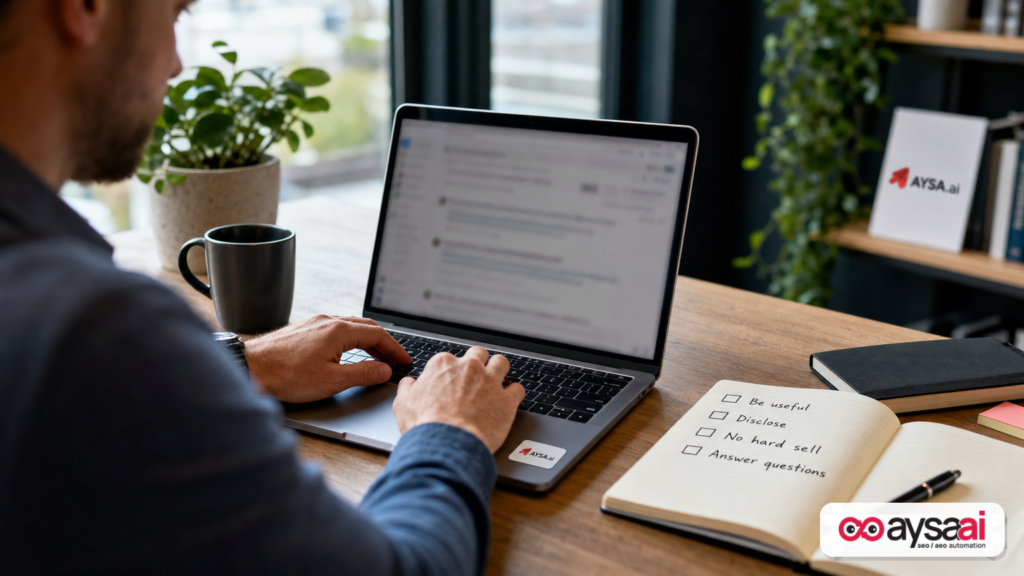
- Disclose affiliation. “I work with/own [business]. Happy to answer questions.”
- No hard sell. Provide options, including competitors when appropriate. That’s how you earn trust.
- Thank people who recommend you. Short, human, non-promotional appreciation creates a visible trail.
Third: build guardrails (brand safety + compliance)
Especially for regulated industries (health, finance, legal), you need boundaries:
- What you can and cannot promise
- What you can and cannot discuss publicly
- When to move to private channels
If you’re a franchise, define who is allowed to represent the brand in community spaces. The SEJ recap suggests a split-ownership model: corporate owns infrastructure and guardrails; franchisees own local context. That’s directionally correct—and it’s the only scalable way to keep authenticity without chaos.
Paid vs organic: don’t confuse presence with advertising
The SEJ recap references Reddit campaign performance for a brand example, but we cannot independently verify the numbers from the provided context. The strategic point still stands: you can combine community/context targeting with local intent. But for most SMEs, the immediate win is not paid—it’s making sure the public web accurately reflects your location reality, then participating selectively where you can be genuinely useful.
For official platform context, see Reddit’s own site: Reddit.
Play 5: Measurement + Cadence (Because AI Visibility Drifts)
AI visibility is not a one-time project. It drifts for three reasons:
- Your business changes. Hours, staff, services, seasonal demand.
- The web changes. New reviews, new posts, old listings resurfacing.
- Models change. Systems update retrieval and citation behaviors over time.
What you should monitor (even as an SME)
- Location accuracy: Are hours, phone, and address consistent everywhere?
- AI answer presence: Do AI answers mention your brand for your core queries?
- AI answer accuracy: When you are mentioned, are the details correct?
- Review trends: Volume, sentiment, recurring themes by location
- Community threads: Emerging issues, repeat questions, competitor mentions
A simple cadence that works
- Weekly: review response hygiene; check alerts for listing changes; scan top community mentions
- Monthly: audit top locations for NAP/hours drift; update FAQs based on recurring questions
- Quarterly: deep audit of all locations; refresh local photos; rebuild weak location pages
If you’re multi-location, “quarterly” may be “monthly for top markets, quarterly for the long tail.” The point is: you need a rhythm competitors struggle to copy.
A Concrete SME Scenario: The 12-Location Clinic That Keeps Getting the Hours Wrong in AI Answers
Let’s make this real.
Business: a 12-location clinic (could be dental, urgent care, physiotherapy—doesn’t matter). They run ads, rank well locally, and have good reviews.
Problem: customers show up and find the doors locked. When asked, the clinic discovers that AI answers and some listings still show the old Saturday hours for three locations. A few Reddit comments mention “they’re never open when they say they are.” Now the issue is no longer just operational—it’s reputational.
What likely happened (the boring truth)
- Corporate updated hours on the website for all locations.
- Some location managers updated Google profiles; others didn’t.
- An Apple/Yelp/third-party listing still had old hours.
- A community thread preserved the complaint and became a reference point.
The fix (in the right order)
- Establish a single source of truth. One canonical record per location with owner + last-updated timestamp.
- Push accurate hours everywhere. Start with the major platforms your customers use.
- Update location pages + structured data. Make it easy to extract correct hours.
- Respond to reviews mentioning hours/wait times. Calmly correct and explain.
- Address community concerns. If appropriate, clarify publicly with disclosure and without sales language.
- Set monitoring alerts. So the next change doesn’t repeat the cycle.
Outcome you’re aiming for: within weeks, the public web stabilizes around the correct hours; within months, the old narrative fades as new, consistent evidence accumulates.
This is not “AI optimization.” It’s operational excellence made visible.
What Agencies and Multi-Location Teams Need to Rethink
If you’re an agency or an in-house marketing leader, AI search pulls you toward uncomfortable questions:
1) Your deliverables can’t be only on-site anymore
If only ~15% of what an AI system reads comes from the brand’s site (a data point referenced in the SEJ recap; treat as directional), then the old plan—publish content, build links, wait—will underperform for local recommendation queries.
Your new scope must include:
- Listings and location data governance
- Reviews operations (including response process)
- Community listening and selective participation
- Local page systems and schema hygiene
2) Measurement has to include “answer presence,” not only clicks
The SEJ recap notes that many searches end without a click. Regardless of the exact percentage in your industry, the reality is observable: AI summaries can satisfy intent without a website visit.
So agencies should report:
- Where the brand appears in AI answers for priority prompts
- Which locations are mentioned
- Whether cited facts are correct
- Which sources are being cited (site vs directories vs forums)
3) Franchise alignment is now an SEO problem
Franchises have always struggled with consistency. AI makes the penalty more immediate because inconsistencies lead to omissions or wrong answers.
The split that tends to work (aligned with the SEJ recap):
- Corporate owns: listings infrastructure, schema standards, location page templates, brand voice, and guardrails
- Franchisees own: local nuance, local photos, local events, market-specific FAQs, community engagement where permitted
4) Execution speed is a competitive advantage
If it takes you three weeks to correct hours across platforms, you’re building an error that AI systems can repeat for months. The winners will be the teams that can detect drift quickly and execute fixes safely.
Where AYSA Fits: Monitoring + Approved Execution for AI-First Local SEO
This is the part most playbooks ignore: doing the work consistently.
At AYSA.ai, our perspective is simple: AI visibility is a systems problem. Businesses don’t fail because they don’t know what to do. They fail because they can’t operationalize it across pages, locations, and teams—without breaking things or drowning in tickets.
AYSA is built as an execution system for modern SEO/AEO/GEO:
- Monitor what matters over time
- Prepare changes (content, technical fixes, structured data, local page improvements)
- Ask for approval so humans stay in control
- Execute accepted website changes safely and consistently
For this specific AI-local stack, AYSA fits in four practical places:
1) Location page quality at scale
When you have 10+ locations, location pages become template-driven—and templates drift. AYSA can help maintain consistent, citable structure (hours, services, FAQs) while still allowing local nuance.
Explore: AI Search Visibility
2) Ongoing monitoring instead of one-time audits
You don’t want to discover data drift because a customer showed up to a locked door. You want alerts and routines.
Explore: AYSA Monitoring
3) Approved execution (reduce risk, increase speed)
Many teams avoid making improvements because they fear breaking pages, impacting compliance language, or creating inconsistency. AYSA’s approval step ensures changes are reviewed before going live—critical for franchises and regulated businesses.
Explore tools: AI SEO Tools
4) A practical implementation path for SMEs
SMEs don’t need more theory. They need a prioritized queue of actions and a way to ship improvements weekly.
Pricing and fit: AYSA Pricing
For more execution-oriented guidance, see: AYSA Blog
What to Do Next (Action List)
If you want a no-nonsense plan you can start this week, here it is.
Week 1: Stabilize facts
- Pick your top 10 locations (or all, if under 10).
- Audit NAP + hours across Google, Apple, Yelp, and your most important vertical directories.
- Eliminate duplicates and outdated listings (or document what you can’t control yet).
Week 2: Make your website the canonical citation source
- Upgrade each location page with clear, matching facts and local services.
- Add local FAQs based on real questions (including community threads and reviews).
- Implement/validate structured data using Schema.org guidance.
Week 3: Build the proof layer
- Set a review response SLA (especially for negative reviews).
- Tag recurring themes (hours, wait times, pricing transparency, staff quality) and feed them into FAQs and operations.
Week 4: Earn trust in the conversation
- Identify 3–5 relevant subreddits (local + category).
- Listen first. Document recurring questions and competitor narratives.
- Participate selectively where you can be genuinely helpful, with clear disclosure.
Ongoing: Put monitoring and execution on rails
- Set a weekly routine for reviews + listing drift checks.
- Set a monthly routine for AI prompt checks and location page updates.
- Use a system like AYSA to monitor, prepare, approve, and execute changes consistently.
Sources and Further Reading
- Search Engine Journal: AI Search Cites Reddit: 5 Proven Plays To Boost Multi-Location Visibility
- Search Engine Journal: Local Search category (context and related reporting)
- Schema.org (official structured data vocabulary)
- Reddit (platform context)
- AYSA: AI Search Visibility
- AYSA: Monitoring
- AYSA: AI SEO Tools
- AYSA: Pricing
- AYSA Blog
Note on claims and numbers: This editorial intentionally avoids adding new statistics beyond what’s described in the provided SEJ recap. Where the recap references percentages or performance figures, we treat them as directional context rather than universally verified benchmarks.
Continue the AI search topic inside AYSA.
Use these pages to connect the article with AI SEO tools, AI visibility monitoring, AI Overviews and approved website execution.
Turn this topic into a website action plan.
Use these AYSA hubs to move from reading to technical fixes, AI visibility monitoring, research, glossary context and approval-first SEO execution.

