Gemini 3.5 Pro’s Delay Is a Reminder: AI Search Timelines Are Unreliable—Your Visibility System Can’t Be
Bloomberg reports Google’s Gemini 3.5 Pro is delayed, with coding performance among the issues. For businesses, the bigger lesson isn’t model gossip—it’s operational: AI search changes on uneven schedules, and your brand needs a monitoring-and-execution system that keeps facts, content, and technical signals correct every week, not only when Google ships a flagship model.

By Marius Dosinescu (AYSA.ai)
Google’s Gemini 3.5 Pro was expected to ship by now, but it hasn’t. Search Engine Journal reports that Bloomberg attributes part of the delay to coding performance concerns.
That’s interesting for model-watchers. But for operators—business owners, marketers, and agencies—the bigger lesson is more practical:
AI Search timelines are unreliable by nature. Your search visibility and brand accuracy systems can’t be.
Whether Gemini 3.5 Pro ships next week, next month, or quietly morphs into something else, you still have customers asking AI Mode, AI Overviews, and other AI assistants questions like:
- “Is this clinic open on Saturdays?”
- “What’s the best alternative to [competitor]?”
- “Which product is compatible with my model?”
- “What does this warranty cover?”
If your site, feeds, and business facts aren’t consistently correct—and easy for machines to parse—AI answers will drift. And the drift doesn’t wait for a flagship model release.
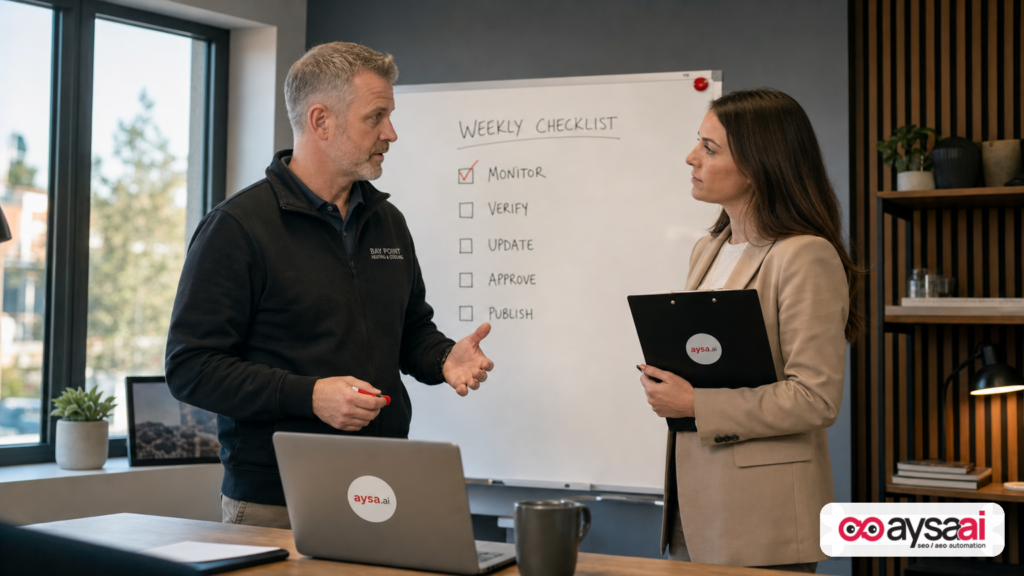
This editorial breaks down what changed, what the reported delay signals about the AI race, and what businesses should do now. I’ll also explain how AYSA fits as an execution system: monitor → prepare changes → ask for approval → implement accepted fixes, continuously.
Concise summary
- Gemini 3.5 Pro is late relative to Google’s stated expectation in May; Bloomberg reportedly points to coding performance as one reason.
- The delay doesn’t necessarily change what Search outputs today—but it highlights how uneven and unpredictable model timelines are.
- Businesses should stop planning around model launch dates and instead build operational readiness: Structured data, content hygiene, entity consistency, and Monitoring.
- AI search visibility increasingly rewards “boring” excellence: correct facts, clear pages, crawlable architecture, fast updates, and credible sourcing.
- AYSA’s role: keep your brand’s AI-facing inputs accurate through monitoring and Approved Execution, so you don’t rely on manual audits that happen too late.
Key takeaways (for busy operators)
- Don’t gamble on a single model. AI search is a multi-surface environment (AI Mode, AI Overviews, assistants, browsers). Your visibility must be resilient across them.
- “Coding” matters because it enables agents. Better coding capability means faster tooling, automation, and iterative improvements—especially on the vendor side, but also for your marketing ops.
- Accuracy beats volume. Many AI answer failures are simple: wrong hours, ambiguous service areas, thin policy pages, outdated pricing tables, missing schema, or contradictory location data.
- Execution speed is a competitive advantage. The team that can ship verified updates weekly will outperform the team that “plans content” quarterly.
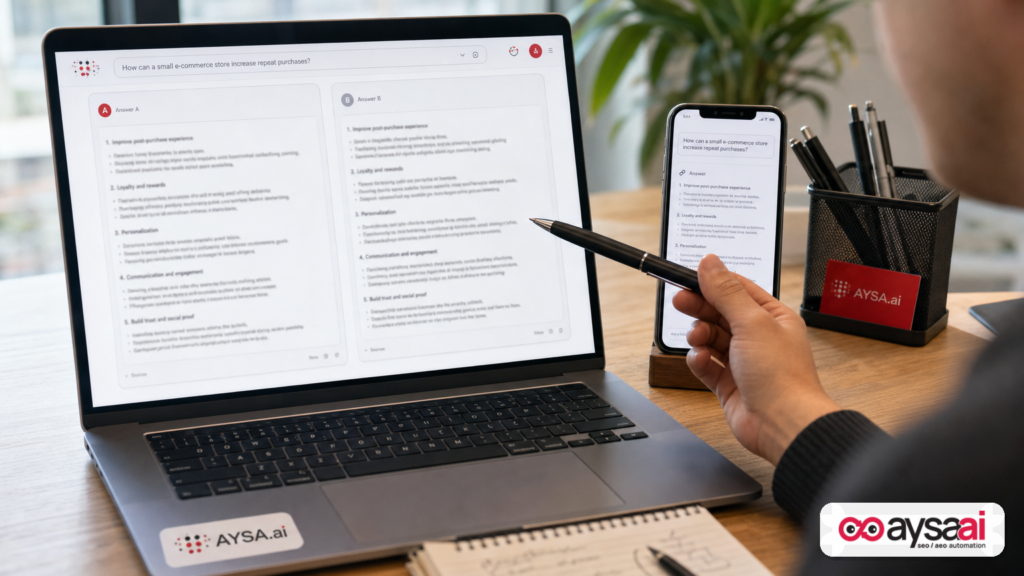
- Measure what AI says, then fix the inputs. Monitoring AI answers without the ability to implement changes is just anxiety with dashboards.
Table of contents

- What happened: Gemini 3.5 Pro didn’t ship on time
- The real story isn’t the delay—it’s what the delay reveals about AI search
- What changes for businesses when the flagship model slips
- The coding angle matters more than it sounds (even if you never ship code)
- How AI search is changing user behavior (and why your funnels feel weird)
- What AI systems tend to reward: machine-readable clarity + credibility
- Where AI answers go wrong for SMEs (the common failure modes)
- A concrete SME scenario: the local clinic that wins by being boringly accurate
- Agency implications: deliver “approved execution,” not just recommendations
- The 30-day action plan: stabilize your AI search inputs
- Where AYSA fits: monitoring + approvals + execution
- What to do next
- Sources and further reading
What happened: Gemini 3.5 Pro didn’t ship on time
Here’s the part we can responsibly say based on the provided reporting context:
- Google announced the Gemini 3.5 series and released Gemini 3.5 Flash.
- Google indicated in May that it looked forward to rolling out Gemini 3.5 Pro “next month.”
- As of the reporting date, Gemini 3.5 Pro hadn’t appeared in API release notes, and Bloomberg reportedly cites coding performance as a factor in the delay (per SEJ’s write-up).
You can read the SEJ coverage (which references Bloomberg’s reporting) here: Gemini 3.5 Pro Delayed Over Coding, Bloomberg Reports (Search Engine Journal).
It’s also worth noting what SEJ emphasized: this doesn’t automatically mean Search outputs change tomorrow. Google has already deployed Gemini 3.5 Flash in some search experiences (as described in the reporting), and the “flagship” model being late doesn’t necessarily rewrite what your customers see today.
So why am I writing a long editorial about it?
Because the delay is a useful signal that leaders should internalize: AI search capability is shipping on uneven timelines, and you can’t build your marketing plan around vendor calendars.
The real story isn’t the delay—it’s what the delay reveals about AI search
Model delays happen in every frontier lab. But when a company publicly hints at a timeline and misses it, it reinforces three realities about the AI search era:
1) The AI search stack is a moving target
In “classic SEO,” you could treat Google Search as a relatively stable interface: results pages, snippets, and ads. In AI search, you’re dealing with multiple layers:
- The model (e.g., Flash vs. Pro and whatever else is running behind the scenes)
- The retrieval system (what content gets pulled in, cited, summarized)
- The policy layer (safety, YMYL constraints, medical/legal boundaries)
- The product UI (AI Mode vs. AI Overviews vs. assistant integrations)
- The publisher/business inputs (your website, feeds, structured data, listings)
A change in any layer can change outcomes. Sometimes vendors improve the model. Sometimes they change retrieval. Sometimes they “tune” how aggressively they cite sources. Sometimes they adjust what’s allowed. And sometimes none of that changes—but your competitor updates their pages and becomes the easiest thing to cite.
2) There is no single “Google AI” behavior to optimize for
Businesses still ask me: “What does Gemini prefer?” The premise is wrong. You’re not optimizing for a single preference. You’re building machine-readable, credible, unambiguous information that survives across systems.
3) Execution is the differentiator, not insight
The internet has no shortage of insight. What most SMEs lack is:
- A clear list of what to fix
- A safe way to implement it without breaking the site
- A workflow for approvals
- A monitoring loop that catches drift early
This is exactly why AYSA exists as an approved execution system, not another “SEO audit PDF generator.” Start here if you want the product context: AI Search Visibility and Monitoring.
What changes for businesses when the flagship model slips
Even if the delay doesn’t change what’s in Search today, it changes how you should think about planning.
Stop tying your quarter to vendor ship dates
I’ve seen this pattern repeat:
- Leadership hears “new model coming next month.”
- Marketing plans a big AI-content push “after the new model.”
- Engineering says, “We’ll fix structured data when we see the new experience.”
- Meanwhile, AI answers keep happening daily, using whatever systems are live.
The outcome is predictable: you defer hygiene, and the AI layer cements an understanding of your business based on outdated inputs.
Assume staggered rollouts and partner tests
The reporting context mentions Google testing with partners. That’s normal in this era. You can’t assume “shipped” means “everyone sees it.” That’s true for:
- Search features
- API versions
- AI answer formats
- Citation rules
Your response shouldn’t be to guess what’s rolling out. It should be to build a system that stays correct under variability.
Expect “Flash-like defaults” to persist
In product design, defaults are sticky. When a “fast, cheaper” model becomes the default in a major experience, it can persist longer than you’d think—because it’s operationally convenient. That means your content must perform under the constraints of the default model: concision, clarity, explicitness, and high retrieval confidence.
The coding angle matters more than it sounds (even if you never ship code)
Bloomberg’s reported focus on “coding” can sound niche. Most business owners aren’t asking, “Is my AI provider good at competitive programming?”
But coding performance matters for three reasons that hit marketing operations directly.
1) Coding is a proxy for tool-use and “agent” reliability
When people say “agentic coding,” they usually mean systems that can:
- Understand a goal (e.g., “Add FAQ schema to these pages”)
- Navigate a codebase or CMS
- Make changes safely
- Run checks
- Submit changes for review
If a model struggles with coding, it often struggles with the structured, multi-step thinking required for high-confidence automation. That slows down the ecosystem: fewer reliable tools, less automation, more manual work.
2) “Coding” touches the pace of web change
The web is increasingly updated by scripts, templates, and automation. If AI vendors unlock better coding and safer agentic workflows, the pace at which competitors iterate on their sites increases.
That matters even if you’re a florist or a local clinic—because your competitors can ship improvements (landing pages, structured data, Internal linking, product details, local pages) at a faster cadence.
3) The market is converging on a simple truth: execution beats strategy decks
This is where the delay becomes instructive. The model race is hard. Your race is simpler:
- Make your business facts consistent everywhere.
- Make your pages easy to parse and cite.
- Update quickly when reality changes.
- Prove credibility with clear sourcing and policies.
AYSA was built for this “execution layer.” If you want the overview of how we think about AI-era optimization across SEO/AEO/GEO, start with: AI SEO Tools.
How AI search is changing user behavior (and why your funnels feel weird)
AI search shifts behavior in ways that don’t always show up as a clean “rankings” change.
Users ask longer questions—and they ask follow-ups
Instead of “dentist near me,” users ask:
- “Do you take walk-ins for a chipped tooth?”
- “Can I book online and what’s the cancellation policy?”
- “What does the first visit cost without insurance?”
If your site doesn’t answer these with plain-language specificity, AI systems will stitch together answers from other sources (or infer). That’s how you lose control of your narrative without “losing rankings.”
AI answers compress the discovery phase
AI summaries reduce the number of pages a user visits before deciding. That means the pages they do visit must carry more weight:
- Service pages
- Location pages
- Pricing/policies
- Product compatibility and “how-to choose” content
Visibility becomes partly “citation share,” not just traffic
Classic SEO rewarded pageviews. AI search also rewards being referenced—even if the user never clicks. That affects brand recall and downstream conversion.
Practically, this pushes businesses toward:
- Cleaner entity signals (who you are, where you are, what you do)
- More explicit claims backed by on-page evidence
- Machine-readable formats (structured data where appropriate)
What AI systems tend to reward: machine-readable clarity + credibility
I’m going to be careful here: we can’t “verify” a universal ranking formula for AI citations. But we can use the reality of how retrieval systems generally work—and what consistently helps in practice.
1) Unambiguous business facts (entity clarity)
This is the foundation for AI answers that include:
- Correct hours
- Correct address/service area
- Correct phone numbers and booking URLs
- Correct policies (returns, cancellations, shipping)
If you’re a multi-location brand, entity clarity becomes an operations problem, not a “local SEO tactic.”
2) Content that answers intent, not content that “targets keywords”
In AI search, the best pages often look boring:
- They define the service/product plainly.
- They list constraints and exceptions.
- They include pricing ranges or at least pricing logic.
- They explain process steps.
- They use consistent terminology.
3) Internal consistency across the site
Contradictions kill retrieval confidence.
Example: Your footer says you serve “Dallas–Fort Worth,” your service page says “North Texas,” your Google Business Profile says “Dallas,” and your FAQ says “We don’t service Fort Worth.”
An AI system can’t reconcile that cleanly. It will either hedge (“may serve”) or choose a source that isn’t yours.
4) Technical accessibility (crawlability and performance basics)
AI search still depends on web fundamentals:
- Pages that can be crawled
- Clean canonicalization
- Fast, stable rendering
- Clear headings and structured content
Not glamorous. But it’s how you become the “safe cite.”
Where AI answers go wrong for SMEs (the common failure modes)
If you’re reading this and thinking, “AI is new; we’ll wait,” here’s the uncomfortable truth: the most damaging AI mistakes are not futuristic. They’re basic business communication problems that AI surfaces amplify.
Failure mode #1: Outdated or missing policy pages
AI assistants love policy questions because they’re decisive:
- Returns
- Cancellations
- Shipping windows
- Warranty coverage
If your policy is unclear, AI may cite a reseller, a review site, or a scraped snippet that doesn’t match your current terms.
Failure mode #2: “Thin” service pages that don’t answer real objections
A service page that’s 400 words of marketing copy forces the AI to look elsewhere for specifics. That’s how competitors get recommended in the same answer that mentions you.
Failure mode #3: Inconsistent location data and duplicate pages
Multi-location brands routinely create drift:
- Old location pages left live
- Multiple phone numbers per location
- Hours updated on one page but not another
This isn’t only a Local SEO issue. In AI search, it becomes an answer accuracy issue.
Failure mode #4: Ambiguous product specs and compatibility
Ecommerce owners: if your product pages don’t explicitly state compatibility (models, sizes, standards, versions), AI answers will fill gaps with guesses or third-party info.
Failure mode #5: “We published AI content” without a governance system
Publishing more content can increase surface area for contradictions. If you don’t maintain it, AI search will find the contradiction faster than your team does.
This is why AYSA emphasizes monitoring and controlled execution rather than content volume. Monitoring lives here: AYSA Monitoring.
A concrete SME scenario: the local clinic that wins by being boringly accurate
Let’s make this real with a scenario I see constantly.
The business
A multi-provider local clinic (dental, urgent care, physical therapy—pick your vertical). They’re not trying to “go viral.” They want:
- More calls
- More bookings
- Fewer no-shows
- Less time answering repetitive questions
The AI search reality
Prospects ask AI Mode / AI Overviews / assistants questions like:
- “Do they take walk-ins?”
- “Do they accept my insurance?”
- “What’s the cancellation policy?”
- “Are they open late?”
If your site doesn’t provide explicit, structured answers, the AI will assemble an answer from:
- Old pages on your site
- Third-party directories
- Reviews
- Other clinics’ policies generalized to you
What “winning” looks like (and it’s not complicated)
The clinic that wins usually does a few unsexy things:
- Creates a single source of truth for hours, services, insurance notes, and policies on the site.
- Updates location pages so each one clearly states services available at that location (not “call us”).
- Adds clear FAQ blocks that match real questions.
- Prevents contradictions by consolidating duplicate pages and cleaning internal links.
Then they do the part most teams skip: they keep it updated.
This is where AYSA fits operationally: we monitor what AI experiences and search surfaces say about your brand, prepare recommended updates, request approval, then execute the approved changes on the site. Learn more at AYSA AI Search Visibility.
Agency implications: deliver “approved execution,” not just recommendations
If you run an agency, the Gemini 3.5 Pro delay is a reminder that the market is shifting under your deliverables.
Clients don’t need more audits—they need fewer unresolved issues
Most clients already have a backlog:
- Fix location inconsistencies
- Update policies
- Improve core pages
- Resolve technical debt
AI search increases the cost of delay. An unresolved issue isn’t just a missed ranking opportunity; it can become a persistent wrong answer.
The new agency advantage: speed + safety
The winners will offer:
- Monitoring (find drift early)
- Prioritization (what affects revenue, not what’s easy to report)
- Approved execution (ship changes with client sign-off)
- Documentation (what changed, when, and why)
This is why we position AYSA as execution infrastructure for teams and agencies, not “another tool.” If you want to see how we frame the system, start at AYSA AI SEO Tools or browse examples on the AYSA blog.
The 30-day action plan: stabilize your AI search inputs
If you do nothing else after reading this, do this. It’s designed for SMEs with limited time and for agencies that need a repeatable playbook.
Week 1: Establish a source-of-truth inventory
- List your top 10 money pages (services, products, locations, booking, pricing, policies).
- List your top 20 “AI questions” customers ask (sales calls and inbox are gold here).
- Identify where the answers live today (website pages, PDFs, blogs, listings).
Output: a simple map of “question → authoritative page.”
Week 2: Fix contradictions and missing essentials
- Ensure each key page has a clear answer to its primary question.
- Remove or redirect outdated pages that conflict with current info.
- Standardize naming conventions (services, locations, product variants).
Output: fewer conflicting signals, higher retrieval confidence.
Week 3: Make pages easier to parse (humans and machines)
- Add clear headings (what it is, who it’s for, pricing, process, FAQs).
- Use scannable formatting: bullets, tables for specs, short paragraphs.
- Where appropriate, implement structured data carefully (don’t spam). If you’re unsure, get expert review.
Output: pages that can be summarized accurately.
Week 4: Implement monitoring and a change cadence
- Choose a cadence: weekly checks for fast-changing businesses; biweekly/monthly for stable industries.
- Create an approval workflow: who signs off on policy changes, pricing, medical/legal claims.
- Track changes and outcomes (what changed, what improved).
Output: an operational system, not a one-time project.
If you want a system that does this continuously—monitoring, preparing changes, requesting approval, then executing—see AYSA Monitoring and Pricing.
Where AYSA fits: monitoring + approvals + execution
Most “AI visibility” conversations fall into two traps:
- Trap 1: Over-indexing on prompts. Prompts don’t fix your canonical facts.
- Trap 2: Over-indexing on reports. Reports don’t ship changes.
AYSA is designed to close the loop:
1) Monitor what matters
We focus on the signals that affect whether AI systems can confidently represent your business: accuracy, consistency, content completeness, and technical accessibility. See: AYSA Monitoring.
2) Prepare changes (without guesswork)
Instead of telling you “fix your SEO,” AYSA prepares specific recommended changes tied to outcomes: clarify hours, improve a service page section, consolidate duplicates, strengthen FAQs, adjust internal linking, etc.
3) Ask for approval (because businesses need control)
In regulated or high-risk categories, you can’t have an automation tool changing policies or claims without oversight. Our model assumes humans approve meaningful changes.
4) Execute accepted updates
This is the part most teams can’t scale. Execution is where ROI lives. Learn more about the platform positioning at AI Search Visibility and browse additional guidance on the AYSA blog.
What to do next
- Pick your top 10 pages that should be cited or summarized correctly (services/products/locations/policies).
- Write down the top 20 customer questions you want AI to answer accurately.
- Check for contradictions across those pages (hours, pricing, service area, eligibility).
- Fix the “boring” issues first: missing policy details, outdated pages, unclear service descriptions.
- Set a cadence (weekly/biweekly/monthly) and assign an owner for AI-facing accuracy.
- Implement a monitor-and-execute loop so updates don’t stall in a backlog.
If you want AYSA to help you operationalize this—monitor, prepare, approve, execute—start here:
Sources and further reading
- Search Engine Journal: Gemini 3.5 Pro Delayed Over Coding, Bloomberg Reports
- Search Engine Journal: Latest News (useful for tracking ongoing AI/search shifts)
- Search Engine Journal: SEO (context on technical and content implications)
Note: The SEJ article references Bloomberg reporting, but Bloomberg’s original URL was not included in the provided research context. I’m intentionally not linking or quoting Bloomberg directly here to avoid mis-citation.
Continue the AI search topic inside AYSA.
Use these pages to connect the article with AI SEO tools, AI visibility monitoring, AI Overviews and approved website execution.
Turn this topic into a website action plan.
Use these AYSA hubs to move from reading to technical fixes, AI visibility monitoring, research, glossary context and approval-first SEO execution.