Search Is Being Re-Metered: What Google’s Core Update, AI Mode’s Model Switch, and ChatGPT Business Hub Mean For Real-World Growth
Google rolled out a new core update while switching AI Mode’s default model. OpenAI introduced Business Hub metrics for mentions and clicks. Meanwhile, major publishers are planning for weaker search referrals. Here’s the practical playbook for SMEs and agencies: what changed, why it matters, what to monitor, and how to execute fixes with approval-based automation.
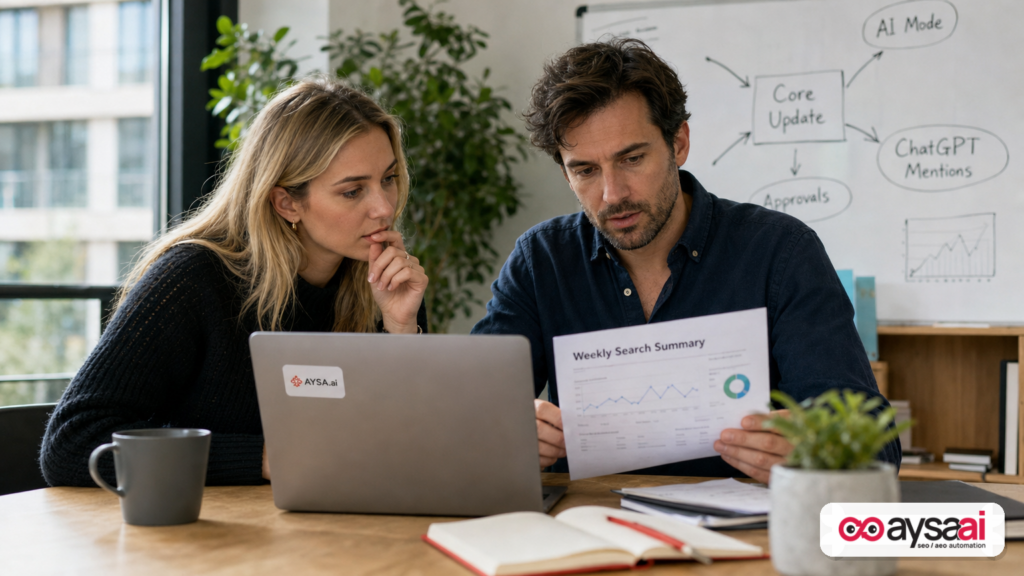
Search is changing in a specific (and uncomfortable) way: it’s being re-metered.
Not “AI is coming” change. Not “SEO is dead” change. Real, operational change—where the platforms that distribute attention also define the metrics you use to understand that attention. This week’s signals—Google’s November core update rolling out, Google switching AI Mode’s default model, OpenAI releasing ChatGPT Business Hub metrics, and public companies openly planning around reduced free search traffic—are all versions of the same story.
As a founder and operator, you don’t win by arguing about definitions. You win by building a measurement layer you control, an execution engine that ships improvements consistently, and a strategy that assumes the shape of search traffic will keep changing.
This editorial is my practical playbook for SMEs and agencies: what changed, why it matters, what can go wrong, what to monitor weekly, and how an approved-execution system like AYSA fits into the reality of AI Search.
The concise summary: what changed this week (and why you should care)
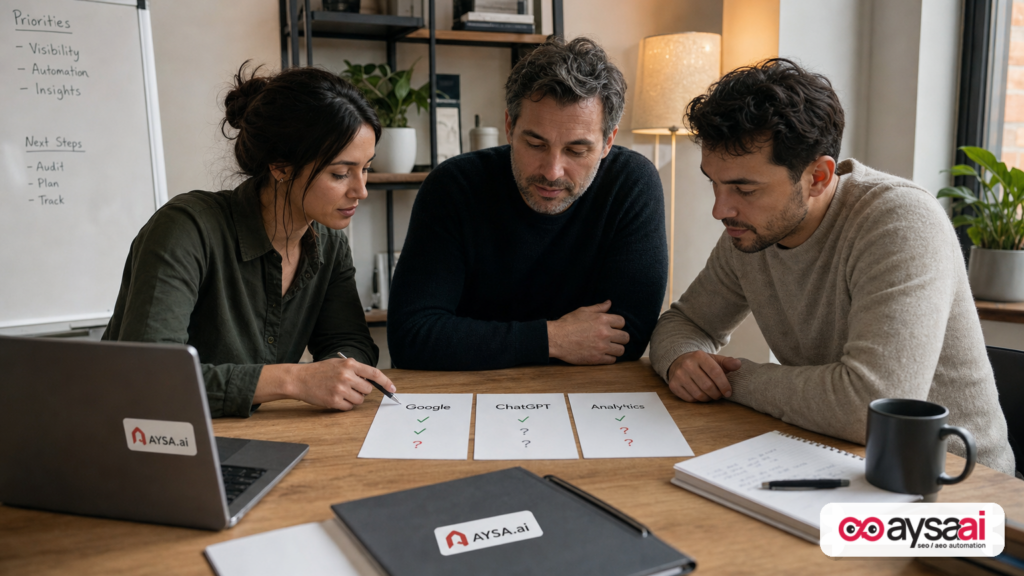
Based on reporting from Search Engine Journal, four developments are reshaping how businesses interpret and respond to search performance:
- Google began rolling out a November 2026 core update, impacting rankings globally and across languages, with a rollout window of up to two weeks.
- Google switched AI Mode’s default model (Gemini 4 Hydrogen) and said it would connect users to a broader range of links—without providing link-count specifics.
- OpenAI launched ChatGPT Business Hub (beta), allowing businesses to claim profiles and view aggregated mentions and website Clicks for the past 28 days—based on OpenAI’s definitions.
- Large web businesses publicly planned for weaker search referrals and discussed AI features, impression-to-click ratios, and increased reliance on paid channels.
The practical implication: you now have two layers of volatility at the same time—(1) ranking/quality volatility from core updates and (2) presentation volatility from AI features and model changes that alter how often users click through.
Who this is for
- SMEs that depend on inbound demand (local services, ecommerce, clinics, SaaS, travel/hospitality).
- Marketing teams that need a clean way to interpret noisy signals.
- Agencies that must justify retainers when “rankings” matter less than outcomes.
Key takeaways (pin these to your wall)
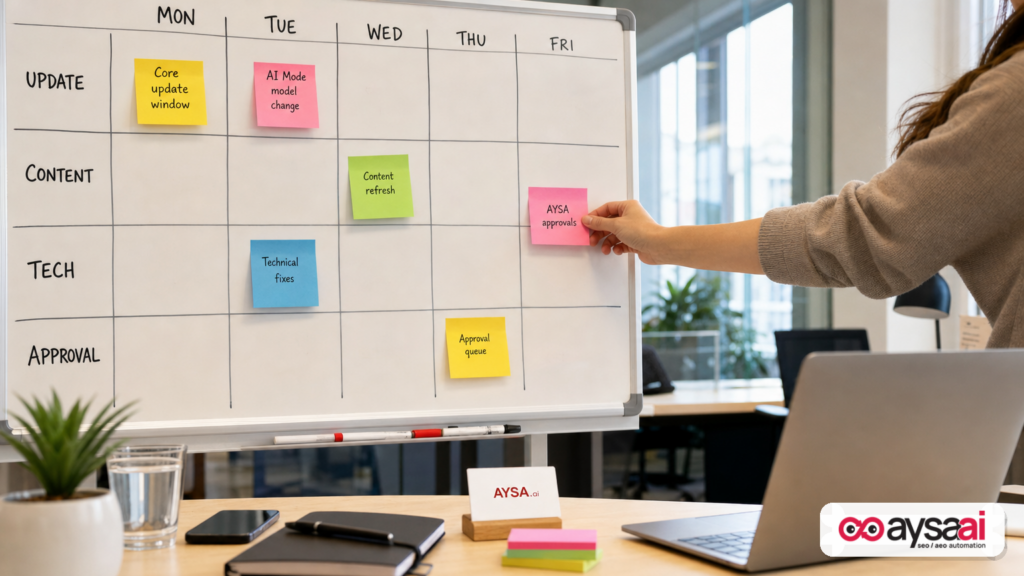
- Log events like you’re running ops. Model switches and core updates are now normal. If you don’t time-stamp them, you’ll misdiagnose causes.
- Stop treating platform metrics as truth. Mentions, clicks, Impressions, and “AI visibility” are definitions chosen by each platform. You need your own reconciled view.
- Assume more answers, fewer clicks. You can still win, but you must target citations, consideration, and conversion—not just visits.
- Execution speed beats perfect analysis. The businesses that ship quality improvements weekly will outpace those waiting for certainty.
- Approved Execution is the new competitive edge. Monitoring without shipping changes is just anxiety with charts.
Table of contents
- The concise summary: what changed this week
- Key takeaways
- Context: why this isn’t just “another update”
- Google core updates: what changes and how to analyze without fooling yourself
- AI Mode’s model switch: why “the model” changes your traffic mix
- ChatGPT Business Hub: mentions and clicks are useful—if you treat them correctly
- Why “platform-defined metrics” are the new battleground
- What can go wrong for SMEs (even if you didn’t do anything wrong)
- A practical monitoring blueprint: what to log weekly
- SME scenario: a local clinic + a small ecommerce brand facing AI answers
- Agency reset: how to sell outcomes when clicks decline
- Where AYSA fits: monitor, prepare, ask for approval, execute
- What to do next (a real action list)
- Sources and further reading
Context: why this isn’t just “another update”
Historically, SEO volatility was largely about Ranking Volatility: you moved up or down based on relevance, authority, and content quality, and your click-through rate (CTR) varied mostly with title/position/brand.
Now, search volatility increasingly includes interface volatility:
- AI Overviews and AI Mode can answer questions without a click.
- Citations can rotate, vary by model, and change based on query fan-out behavior.
- A model switch can change what gets cited—even if your pages didn’t change.
That’s why the combination reported by SEJ—a core update plus an AI Mode default model change—is so important. It means a spike or drop in traffic can come from multiple overlapping causes. If your team treats this like “just watch rankings,” you’ll likely make the wrong changes—or make no changes while competitors adapt.
At the same time, OpenAI’s Business Hub introduces a new reality: businesses will be tempted to treat “mentions” as a KPI. They might be. But only if you connect them to business outcomes and reconcile them with your own analytics.
Google core updates: what changes and how to analyze without fooling yourself
SEJ reports that Google started rolling out a November 2026 core update on Nov. 10, described as a “regular update,” global and multilingual, with up to two weeks for completion.
You don’t need to be an SEO to understand core updates. Think of them as Google updating the “grading rubric” for which pages deserve visibility. Sometimes it’s subtle; sometimes it’s brutal. The issue for operators is less “what did Google change” and more:
- Which parts of my site are now considered less helpful?
- Which competitors are being rewarded, and why?
- Which actions are safe to take immediately vs. after the dust settles?
The analysis trap: comparing the wrong weeks
SEJ highlights a practical problem: Google advises waiting at least a week after rollout ends (or stabilizes) to compare performance. But if the rollout overlaps major seasonal events (like holiday shopping periods), your comparison week can be non-representative.
Here’s the operator-friendly fix: you need three comparisons, not one:
- Same-week year-over-year (seasonality control).
- Pre-event baseline vs. post-event baseline (rubric control).
- Query-class segmentation (intent control): brand vs non-brand, informational vs transactional, local vs national.
This is where teams get hurt: they look at a single blended chart (“Organic traffic down 18%”) and panic. But blended charts combine everything: seasonality, product mix changes, SERP changes, and AI features stealing clicks.
What to do during a core update rollout (practical rules)
- Do not mass-edit titles/meta on day 2. That’s often noise-driven and can damage stable pages.
- Audit losers by intent group. If only informational pages dropped, your problem isn’t your checkout funnel.
- Ship obvious quality fixes. Broken internal links, outdated pages, thin FAQs, unclear authorship—these are safe improvements regardless of the rubric.
- Keep a change log. If you make changes without logging dates, you won’t know what helped.
If you want a clean operational baseline, your “core update playbook” should look more like incident response than like a marketing brainstorm.
AI Mode’s model switch: why “the model” changes your traffic mix
SEJ reports Google made Gemini 4 Hydrogen the default model in AI Mode on Nov. 12 and that it’s used for some AI Overview questions too. Google claimed it offers better query fan-out and connects users to a broader range of helpful links.
Even without exact citation counts provided, there’s an immediate takeaway for businesses:
Your visibility in AI features is partly a product decision, not a direct reward for your latest blog post.
When a default model changes, you can see differences in:
- Which sources are cited for similar prompts.
- How many citations appear (sometimes fewer, sometimes more).
- Whether citations lean toward brands, aggregators, forums, or specialists.
- How aggressively the system “fans out” into subqueries, affecting what content types get pulled in.
Why model switches matter for SMEs (not just publishers)
If you run a local business, your goal isn’t to be cited for “what is a root canal.” Your goal is to be recommended when someone asks:
- “Best dentist near me for anxious patients”
- “How much does Invisalign cost in [city]?”
- “Same-day flower delivery that’s actually reliable”
AI Mode and AI Overviews can intercept those queries and deliver “shortlisted” providers. If the model’s retrieval behavior changes, your inclusion can change—without your rankings visibly changing in traditional tracking tools.
This is why AEO/GEO work (Answer Engine Optimization / Generative Engine Optimization) is quickly becoming table stakes. You’re optimizing for being selected and cited, not just for ranking blue links.
AYSA maintains an overview of how businesses can approach AI visibility here: AI Search Visibility.
ChatGPT Business Hub: mentions and clicks are useful—if you treat them correctly
SEJ reports OpenAI launched Business Hub (beta) on Nov. 10, allowing businesses to claim their ChatGPT profiles and see aggregated mentions, website clicks, and discovery topics for the past 28 days. The setup guide noted that, for online businesses, a mention counts when ChatGPT references the business’s website; the brand name alone doesn’t count.
This is a big deal—because it’s one of the first times a major AI assistant is offering a business-facing measurement surface that resembles “analytics.” But the danger is obvious: teams will over-interpret it.
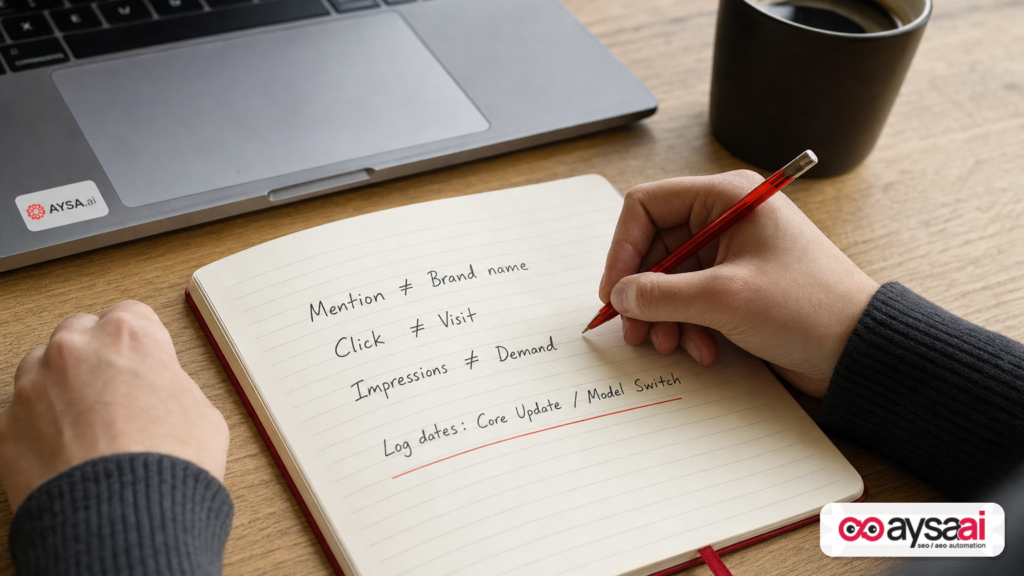
Mentions are not brand awareness (and not all mentions are equal)
In a human conversation, a “mention” can be praise, criticism, or neutral context. In an AI answer, a mention might mean:
- You were cited as a source for a claim.
- You were included in a list of options.
- You were referenced in a comparison.
Those are different levels of commercial value. A “you should buy from X” mention is not equal to “X exists.”
So if you adopt Business Hub metrics, treat them like you’d treat impressions: directional, not definitive.
Clicks are not visits (reconcile them)
SEJ’s summary cautions that a recorded click isn’t a confirmed visit. That’s true across the web: clicks can be blocked, dropped, or attributed differently due to privacy settings, redirects, consent banners, ad blockers, and measurement configuration.
Operationally, your job is to reconcile three layers:
- Platform clicks (ChatGPT Business Hub)
- On-site sessions (GA4 or equivalent analytics)
- Business outcomes (leads, purchases, calls, bookings)
If your outcomes rise while your organic sessions fall, you might be winning in AI answers even as classic SEO traffic declines. If your mentions rise but outcomes don’t, you might be cited in non-commercial contexts—or cited but not trusted enough to earn action.
What Business Hub is good for right now
- Baseline tracking: Are you appearing at all?
- Trend detection: Did something you changed correlate with a rise in mentions/clicks?
- Topic discovery: What discovery topics show how users frame questions about you?
What it is not (yet): a full-fidelity revenue attribution system.
Why “platform-defined metrics” are the new battleground
SEJ’s “Theme of the Week” is the most important concept for business leaders: you are being counted on the platform’s terms.
Let’s translate that into business language. When a platform defines the metric, it also defines:
- What is included (and excluded)
- What is measurable (and what is conveniently “unknown”)
- What looks like progress
- What budgets you justify
Examples directly implied by the SEJ summary:
- OpenAI defines “mention” in Business Hub, and it explicitly doesn’t count brand-name-only references for online businesses.
- Google defines AI impressions and clicks through Search Console reporting. If you compare AI impressions to total clicks incorrectly, you can tell the wrong story internally.
- Google claims “broader range of helpful links” for a model, but without counts, you can’t assume that means more clicks for your site.
What smart teams do instead
They build a reconciliation layer:
- Platform metrics are inputs, not truth.
- Your analytics and CRM are the system of record for outcomes.
- Your change log provides causality clues.
If you want a simple mantra: define your KPI in business terms first, then map platform metrics to it.
What can go wrong for SMEs (even if you didn’t do anything wrong)
SMEs often assume volatility is punishment. Sometimes it’s not. Sometimes it’s just a redistribution of attention.
Here are common failure modes in an AI-search + core-update environment:
1) You “hold rankings” but lose clicks
This happens when AI Overviews/AI Mode satisfy intent directly. Your position might not change, but the click opportunity shrinks. If you only monitor rank, you miss the problem.
2) Your content is “correct” but not citable
AI systems tend to cite content that is:
- Specific and structured
- Clearly attributable (who wrote it, why they know it)
- Updated and consistent
- Easy to extract (clean headings, definitions, steps)
You can have a great page that is hard to extract. That page can rank—and still not get cited.
3) You publish more, but your baseline quality erodes
Teams react to traffic drops by flooding content. That often creates thin pages, duplicates, and internal competition, which can make you more vulnerable in core updates.
4) You chase the wrong metric
Mentions, impressions, and “AI visibility scores” can become vanity metrics. If they don’t connect to leads, sales, or bookings, they’re entertainment.
5) You know what to fix—but you can’t ship
This is the hidden killer. Many businesses can diagnose issues but can’t execute because:
- The developer queue is full
- Approvals take weeks
- Stakeholders disagree
- Nobody owns the last mile
This is precisely where automation must evolve from “reporting” to “approved execution.”
A practical monitoring blueprint: what to log weekly (starting now)
If you do nothing else after reading this, do this: create a weekly search change log. It can be a spreadsheet. The point is consistency.
Log these external events
- Core update windows (start date, end date once confirmed)
- AI feature changes you can date (e.g., AI Mode default model change date referenced in public announcements as reported by SEJ)
- Major seasonal events relevant to your business (promos, holidays, launches)
Log these internal events
- Content updates shipped (which pages, what changed)
- Technical changes (redirects, templates, site speed work)
- New product/category launches (affects query mix)
- Tracking/analytics changes (cookie consent, GA4 config)
Monitor these KPIs (SME-friendly)
- Non-brand organic traffic (your “new customer” engine)
- Brand traffic (your demand + reputation engine)
- Top landing pages by conversions (not just sessions)
- Lead/sale conversion rate from organic (quality signal)
- Search Console query themes (intent shifts)
- AI feature visibility where available (treat as directional)
AYSA’s monitoring approach is built for exactly this style of operations-first visibility: AYSA Monitoring.
SME scenario: a local clinic + a small ecommerce brand facing AI answers
Let’s make this real with two examples you can picture—no SEO jargon required.
Scenario A: Local clinic (high-value leads, low tolerance for bad info)
A dental clinic in Austin depends on organic search for:
- “emergency dentist near me”
- “Invisalign cost Austin”
- “dentist open Saturday”
During a core update, their “Invisalign cost” page drops. At the same time, AI Overviews expand and summarize cost ranges and factors directly in the SERP.
What can happen:
- They lose informational traffic, but calls might stay flat if local intent remains.
- Or calls drop because the AI summary answers the question and users never reach the clinic’s financing details.
What the clinic should do (week 1–2):
- Update the page to be unmistakably citable: clear pricing factors, ranges with context, what’s included, who qualifies, next steps.
- Add “decision support” content AI can’t replace: appointment availability, insurance details, transparent process, before/after disclaimers, patient experience notes.
- Ensure local trust signals are prominent (address, service area, credentials) and consistent.
Scenario B: Small ecommerce brand (mid-AOV, fierce comparison shopping)
A niche ecommerce store sells specialty coffee gear. Their traffic is mostly non-brand:
- “best grinder for espresso under $200”
- “V60 vs Chemex”
- “how to descale an espresso machine”
AI Mode starts citing fewer “how-to” pages and more consolidated guides. Their ranking positions don’t change much—but their clicks fall.
What they should do:
- Turn key pages into definitive guides with structured sections, troubleshooting steps, and clear product recommendations.
- Create comparison pages that are honest (pros/cons), reducing buyer uncertainty—because that’s what AI answers compress into a summary.
- Ensure product pages include the “extraction-ready” facts AI systems tend to reuse: specs, compatibility, warranty, what’s in the box, support.
The shared lesson
Both businesses need the same thing: a weekly cadence of improvements tied to measurable outcomes, not a one-time SEO “project.”
This is why we built AYSA to operate like an execution system, not a reporting tool: AI SEO Tools.
Agency reset: how to sell outcomes when clicks decline
If you run an agency, the hardest part of the next 24 months won’t be tactics. It will be explaining performance in a world where the platforms answer more queries directly.
SEJ’s reporting includes earnings call commentary about planning for weaker search traffic and shifting toward paid channels. You don’t need to agree with every executive interpretation to accept the operational reality: some categories will see fewer free clicks.
What agencies should stop selling (or at least reframe)
- Rankings as the product. Rankings are now a leading indicator, not the goal.
- Traffic as the only proof of value. Less traffic can still mean more revenue if intent quality improves.
- Monthly reporting without execution. Clients will increasingly ask, “What did we ship?”
What agencies should sell instead
- Share-of-answer for priority topics (are we cited/mentioned when it matters?).
- Conversion resilience (can we maintain leads/sales even if organic clicks drop?).
- Execution cadence (how many meaningful improvements shipped per month?).
- Approved execution workflow that reduces client friction.
AYSA is designed to support that last point: it monitors, prepares proposed changes, asks for client approval, and executes accepted changes—so agencies can move faster without risking uncontrolled edits.
If you’re evaluating whether that model fits your workflow, start here: AYSA Pricing.
Where AYSA fits: monitor, prepare, ask for approval, execute
The biggest mismatch I see in modern SEO stacks is this: they are built to observe more than they are built to ship.
But in AI search, execution speed is a moat. Not reckless speed—approved speed.
Here’s how AYSA fits into the specific realities highlighted in SEJ’s roundup:
1) Core update volatility: turn panic into a controlled queue
- Monitor: detect meaningful drops by segment (page groups, query themes, intent).
- Prepare: generate prioritized recommendations—content refreshes, internal linking fixes, structured improvements.
- Approve: stakeholders review proposed changes before they go live.
- Execute: ship changes and log them automatically for later analysis.
2) AI Mode changes: optimize for being cited, not just ranked
AI Mode and AI Overviews shift value toward content that is easy to extract, trustworthy, and specific. That means your execution backlog increasingly includes:
- clarifying definitions and step-by-step guidance
- strengthening topical coverage and internal linking
- updating outdated pages that AI systems may avoid citing
AYSA’s AI search visibility approach is covered here: AI Search Visibility.
3) Business Hub metrics: build your own KPI definitions
As platforms provide new metrics, AYSA’s role is not to blindly amplify them. It’s to help you translate them into an operating system:
- What actions increased qualified traffic, leads, or sales?
- What pages are becoming citation-worthy?
- What should we ship next week?
If you want more examples and playbooks, AYSA’s editorial library is here: AYSA Blog.
What to do next (a real action list)
If you’re an SME owner or marketing lead, you don’t need more theories. You need a sequence.
In the next 48 hours
- Create a search change log (events + internal releases).
- Segment your organic performance: brand vs non-brand; top converting landing pages vs informational pages.
- Identify your top 10 “money queries” (the ones that drive calls, bookings, sales) and list the pages that support them.
In the next 2 weeks
- Refresh your top money pages for clarity, specificity, and trust: FAQs, pricing factors, comparison sections, updated dates where appropriate.
- Fix extractability: add clean headings, definitions, step lists, and remove fluff that blocks scanning.
- Strengthen internal linking from high-authority pages to the pages that must win in AI answers.
- Validate measurement: reconcile any “click” counts (where available) with analytics sessions and outcomes.
In the next 90 days
- Build topic clusters around decision-making, not just information. AI compresses info; your job is to reduce risk and enable action.
- Create a shipping cadence: at least weekly improvements, even if small.
- Invest in an execution system so changes don’t die in stakeholder limbo.
Sources and further reading
- Search Engine Journal: Core Update, ChatGPT Business Hub & AI Mode’s New Model – SEO Pulse
- Search Engine Journal: SEO coverage
- Search Engine Journal: AI Search coverage
- Search Engine Journal: Google algorithm updates history
- Search Engine Journal: Technical SEO
- Search Engine Journal: Local SEO
Where AYSA can help
- AI search visibility (AEO/GEO) approach
- Monitoring and change detection
- AI SEO tools and execution system
- Pricing and plans
- AYSA blog: playbooks and operator guides
Continue the AI search topic inside AYSA.
Use these pages to connect the article with AI SEO tools, AI visibility monitoring, AI Overviews and approved website execution.
Turn this topic into a website action plan.
Use these AYSA hubs to move from reading to technical fixes, AI visibility monitoring, research, glossary context and approval-first SEO execution.