
A Shared AI Training Control in robots.txt Is Coming: What It Means for Website Owners (and How to Act Without Breaking Search)
Google plans to support a shared AI training control in robots.txt so websites can express AI training preferences across multiple AI providers in one place. Here’s what changed, why it matters, what can go wrong, and the practical steps SMEs and agencies should take—without accidentally damaging crawling, indexing, or revenue.

Google has announced plans to support a shared AI training control in Robots.txt—a move designed to help website owners express AI training preferences across multiple AI providers in one place, rather than managing a growing patchwork of provider-specific rules.
This matters because the web is entering a new governance phase: it’s no longer only about Crawling and Indexing for search. It’s also about how content might be reused to train AI systems. And while the industry is still early on standards and enforcement, the direction is clear: more controls, more expectations, and more operational responsibility for site owners.
In this editorial, I’ll break down what changed, why it matters for SMEs and agencies, how to avoid unforced errors, and how to operationalize this safely with an execution system like AYSA—where we monitor, prepare changes, ask for approval, and execute only what you accept.
Concise summary
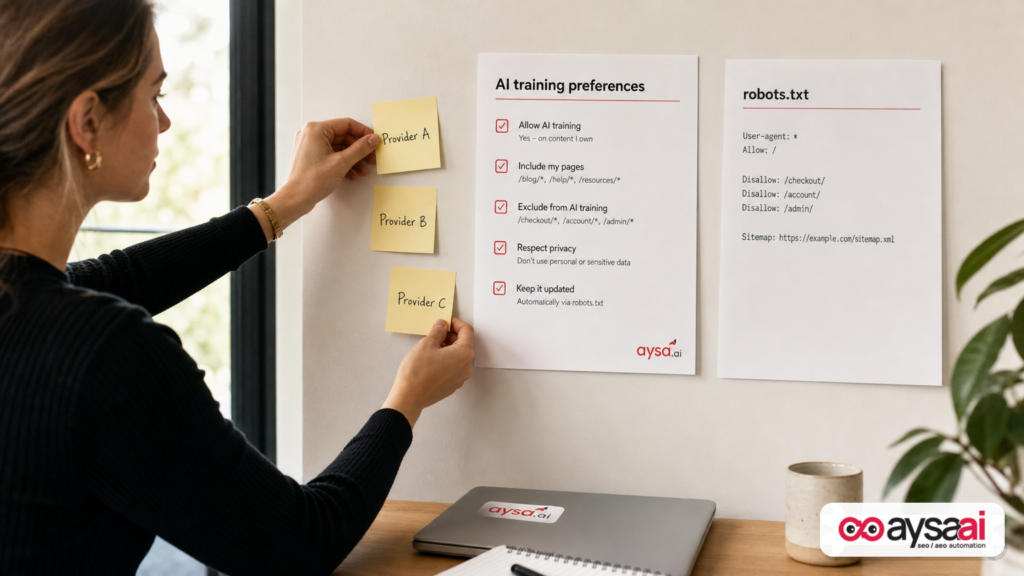
- What changed: Google plans to support a shared AI training preference signal via robots.txt, based on work from the IETF’s AIPREF group, building on existing controls like Google-Extended.
- Why it matters: The “who can use my content for training” question is becoming operational, not theoretical—especially for publishers, ecommerce brands, and IP-heavy businesses.
- Main risk: People will try to “block AI” and accidentally block crawling, break rendering, or harm search visibility and revenue.
- What to do: Treat it like a policy + engineering change: decide your stance by content type, implement carefully, test, monitor, and document.
Key takeaways (for busy operators)

- robots.txt is not a contract. It’s a long-standing, widely used mechanism for crawler directives, but it doesn’t automatically guarantee downstream “no training” outcomes.
- Policy beats panic. The right question isn’t “block or allow?”—it’s “what do we want to permit for each content class (blog, docs, product pages, user-generated content, premium content)?”
- Standards are good—misconfiguration is expensive. A shared control can reduce fragmentation, but it also increases the chance of copy/paste mistakes spreading across environments.
- Execution discipline is the moat. Teams that implement changes safely (approval workflow, QA, Monitoring, rollback) will outperform teams that treat this like a one-time toggle.
Table of contents

- What changed: from provider-specific controls to a shared AI training preference
- Why now: the web is negotiating a new “content supply chain”
- The robots.txt reality check: what it can and cannot do
- How the new control may work (and what to watch as specs mature)
- Where this fits with Google-Extended and existing Google controls
- Business implications: who should care most (and why)
- What can go wrong: failure modes you should plan for
- An SME scenario: the ecommerce brand that wants visibility but not free training data
- What agencies should rethink: governance, reporting, and contracts
- Practical action plan: decide, implement, test, monitor
- How AYSA fits: monitor, prepare, ask for approval, execute (safely)
- What to do next
- Sources and further reading
What changed: from provider-specific controls to a shared AI training preference
For the last few years, website owners have been pushed into an awkward position: if you wanted to express a preference about AI training use, you often had to do it provider by provider. That might mean different user agents, different documentation pages, and different interpretations—none of which feels like a stable foundation for a web-scale norm.
Google’s announcement (via Search Central) is a signal that the industry is moving toward something closer to a standard: a shared AI training control in robots.txt that sites can set once and have interpreted consistently across multiple AI providers—at least in principle.
According to Google, this work is based on efforts from the AIPREF working group at the Internet Engineering Task Force (IETF), and it builds on Google’s existing approach to offering site controls, including Google’s own announcement and its earlier AI training control, Google-Extended (referenced in the announcement). The key idea is not that one company defines the rules for everyone, but that there’s a shared mechanism for expressing preferences.
From an operator’s perspective, the big difference is this:
- Before: “Figure out which AI systems matter, then implement separate controls for each.”
- After (directionally): “Implement a shared control once, then validate which providers honor it.”
That’s a major workflow change for SMEs and agencies—especially those managing many sites or complex web properties.
Why now: the web is negotiating a new “content supply chain”
Historically, the web’s operating model was simpler: you published content, crawlers accessed it, search engines indexed it, and users clicked through. Yes, it was never perfectly clean (scraping, republishing, “borrowed” content), but the system’s incentives were obvious and the primary battleground was ranking.
AI changes the economics because it changes the product. If the primary output is no longer “a ranked list of links,” but rather “an answer synthesized from the web,” then the content supply chain becomes less visible to users. That triggers reasonable questions from site owners:
- Is my content used to train a model that competes with me?
- If my content contributes to answers, do I still get traffic?
- Can I set boundaries without disappearing from discovery?
- How do I express my preference once, consistently?
This is the context in which a shared training preference control makes sense. It’s also why the operational maturity of your web governance matters more than ever. The companies that win won’t be the ones with the strongest opinion; they’ll be the ones who can implement policy consistently, verify behavior, and adjust quickly.
The robots.txt reality check: what it can and cannot do
If you’re not an SEO person, here’s the most important thing to understand:
- robots.txt is a public file that tells automated agents (crawlers) how they should interact with your site.
- It has a long history and broad support in SEO for managing crawling behavior.
- It is not a secure access control system.
Google maintains documentation on robots.txt and crawler controls as part of Search Central. If you need a refresher on how robots.txt works in practice, start here: robots.txt documentation. For broader crawl management, this is also relevant: Crawler management.
Now, the critical nuance for this AI training control discussion:
- Crawling directives can help determine whether a bot should fetch content.
- Training use is a downstream behavior—what someone does with content after access.
So a shared AI training control is best viewed as:
- a standardized preference signal that reputable AI providers can adopt, and
- an operational lever to reduce accidental or ambiguous use by well-behaved systems.
But it won’t stop bad actors from scraping you. If you have high-value proprietary content, you still need traditional protections (authentication, paywalls, rate limiting at the edge, watermarking strategies where appropriate, and legal terms).
Also: robots mistakes are notoriously easy to make and devastating when they happen. Many businesses have learned the hard way that a single line can block essential pages from crawling. That’s why you should treat any new robots control—AI-related or otherwise—as a change requiring careful review, testing, and monitoring.
How the new control may work (and what to watch as specs mature)
Google’s announcement frames this as a plan to support a shared AI training control in robots.txt, based on IETF work. The key phrase to hold onto is: plans to support.
Operationally, that means businesses should prepare for a few realities:
1) Expect iteration in naming, behavior, and adoption
Because this is based on a working group effort, we should expect details to evolve: exact directive names, expected semantics, and how providers interpret edge cases. Don’t build a fragile, one-off system around an assumption. Build a governance process that can accommodate change.
2) Expect asymmetry across providers
Even with a shared control, adoption will likely be uneven. Some providers will honor it quickly; others may lag; others may partially comply. A shared directive is a coordination mechanism, not a guarantee.
3) Expect scope questions: training vs. retrieval vs. display
Teams will conflate multiple concepts:
- Training (building/updating a model)
- Retrieval (fetching content to answer a query)
- Display (showing excerpts, citations, or cached copies)
These are not the same, and policy choices may differ. You may be okay with retrieval/citation but not okay with training, or the reverse. One of the biggest risks is implementing an overly broad block because stakeholders don’t distinguish the use cases.
4) Start with policy, then implement
Before you touch robots.txt, decide:
- Which content types should be included/excluded?
- Which environments should be affected (production only vs. staging too)?
- Who approves changes and how are they documented?
This is governance work. It belongs in your operating rhythm, not as an emergency ticket.
Where this fits with Google-Extended and existing Google controls
Google notes this builds on a longer history of giving site owners controls, and it references Google-Extended as a prior AI training control offered since 2023 (as described in the announcement).
Here’s the practical way to think about it:
- Provider-specific controls (like a specific user agent directive) are useful but create fragmentation.
- A shared control aims to reduce fragmentation and make the web more governable.
At the same time, your website already has multiple layers of control that influence crawling, indexing, and appearance:
- robots.txt directives (docs)
- meta tags and other page-level mechanisms (Meta tags)
- Canonicalization and duplicate consolidation (Canonicalization)
- removal tools for urgent cases (Removals)
So don’t treat AI training preference as a new world separate from SEO. It’s part of the same operational system: controlling access, clarifying intent, and reducing ambiguity for machines.
Business implications: who should care most (and why)
In theory, every website owner should care about how their content is used. In practice, the stakes vary by business model.
Publishers and content-first brands
If you’re a publisher, a research site, a paid newsletter, or any business whose core asset is original information, you’re exposed to the biggest risk: someone else can train on your work and produce competing answers without sending you traffic. For these companies, AI training controls are less about ideology and more about protecting unit economics.
Ecommerce
Ecommerce is nuanced. Product pages are often partly commoditized (specs, sizes), but your differentiation might be:
- unique product photography
- editorial buying guides
- customer Q&A and reviews
- bundles, recipes, usage ideas
Blocking everything might reduce how often your brand is referenced in AI answers and shopping research flows. Allowing everything might leak valuable merchandising insights. The right answer is usually segmentation by content type, not a sitewide yes/no.
Local services (clinics, contractors, home services)
Local businesses often benefit from broader distribution of their basic informational content (services, hours, location, FAQs). The bigger risk is usually not training—it’s inaccurate representation. For them, governance should focus on clarity, structured information, and monitoring mentions.
Google’s own Search Central resources are helpful background for non-technical teams trying to understand discovery mechanics, for example: How Google Search Works and the SEO Starter Guide.
SaaS and B2B
Documentation and help centers are often meant to be discovered and reused. In fact, widespread citation can be a growth lever. But your premium knowledge base, templates, internal benchmarks, and proprietary methodology might not be.
In other words: your marketing content and docs might be “distribution assets,” while certain resources are “IP assets.” Your AI training preference should reflect that difference.
What can go wrong: failure modes you should plan for
This is where most teams will stumble—not because the concept is hard, but because the execution lives in the messy reality of websites.
1) Blocking essential assets and breaking rendering
Overly aggressive robots rules can block CSS/JS resources. That can harm how crawlers render pages and interpret content. In SEO terms, you can hurt indexing quality even without directly blocking HTML URLs.
2) Breaking international and multilingual discovery
Many sites rely on consistent crawling of language variants, Hreflang clusters, and canonical relationships. If you apply a blanket directive without considering URL patterns, you can accidentally weaken the signals that keep your international pages properly organized.
3) Blocking high-value “machine-friendly” endpoints
Some sites expose sitemaps and feeds that help discovery. If your robots posture becomes “block anything that looks machine-readable,” you can unintentionally cut off distribution channels that are not about AI training at all.
Related reading: Google’s overview of Sitemaps.
4) Having no policy—just a quick directive
This is the most common governance failure: an exec asks for “block training,” a developer pastes a snippet, and nobody defines what “training” means for the business.
Result: you either block too much (losing discovery) or block too little (failing the actual business goal), and you have no audit trail explaining why.
5) False confidence that a directive equals compliance
Even if a shared control is widely adopted, you still need to monitor whether your content appears in AI experiences and how it is attributed. A preference signal is not the same thing as enforceable control.
An SME scenario: the ecommerce brand that wants visibility but not free training data
Let’s make this tangible with a scenario I see constantly in the market:
Business: A 20-person ecommerce brand selling specialty skincare.
Assets:
- Standard product pages with ingredients and usage directions
- High-performing blog content (“how to treat dryness,” “routine builder”)
- Premium guides used as lead magnets
- Customer Q&A and reviews that drive conversion
Concern: The founder sees their content quoted in AI answers and worries they’re fueling competitors.
The wrong move: “Block all bots everywhere.”
That’s emotionally satisfying and operationally dangerous. It risks cutting off legitimate crawlers that help customers find the brand in the first place. It can also degrade how the site appears in search, which is still a primary acquisition channel for most ecommerce businesses.
The better move: Create a segmented policy:
- Allow AI systems to access basic product information that customers need (with appropriate controls on duplication and canonicalization).
- Restrict premium content and lead-magnet PDFs that represent real IP and differentiation.
- Monitor how the brand is represented in AI results and ensure key facts are consistent.
Then implement the policy using the least risky mechanism available, with careful testing. The shared AI training control in robots.txt is promising because it reduces the fragmentation problem—but it still needs to be implemented within a broader operational workflow.
And this is where modern search strategy shifts from “SEO tweaks” to “governed execution.”
What agencies should rethink: governance, reporting, and contracts
If you run an agency, a shared AI training control is not just another Technical SEO bullet point. It’s a governance product. Clients will ask you:
- Should we block training?
- Will this hurt rankings?
- What about AI Overviews / AI answers / generative search visibility?
- Can we allow Google but block others? Or vice versa?
Even without getting into speculative details, there are immediate operational impacts:
Update SOPs
Your technical SOPs should explicitly address:
- robots.txt change review and approval steps
- testing requirements (staging vs production parity)
- rollback plan and change log requirements
- monitoring triggers (traffic, indexing, crawl stats, key templates)
Evolve reporting: from rankings to “machine consumption governance”
Clients increasingly care about:
- whether their brand is cited in AI-generated answers
- how accurately they’re represented
- which content is being “used” vs “visited”
Google has also been publishing resources around generative AI optimization in Search Central. Even if you’re not ready to build a full AEO/GEO practice, your strategists should understand Google’s framing. A starting point is: Optimizing for generative AI search.
Clarify liability and decision-making
Because AI training controls are adjacent to IP and legal concerns, agencies should be careful not to present implementation as legal advice. Instead:
- provide technical options and risk trade-offs
- document client approvals
- recommend legal review for high-stakes content
This is also where tooling matters: you need a system that can document what changed, why, and who approved it.
Practical action plan: decide, implement, test, monitor
If you’re an SME or agency trying to respond responsibly (without breaking revenue), here’s a practical plan you can use this quarter.
Step 1: Inventory content types and business value
Create a simple matrix. For each content class, answer two questions:
- Discovery value: Do we benefit when this content is widely found and referenced?
- IP value: Would it harm us if this content was used to train systems that reduce our traffic or commoditize our expertise?
Example content classes:
- Homepage and core service pages
- Blog posts and educational articles
- Product pages and category pages
- User-generated content (reviews, Q&A)
- Help center documentation
- PDFs, templates, gated content
Step 2: Define an AI training preference policy (plain English)
Write a policy your team can understand. Not “we disallow training.” Something like:
- We allow AI systems to access public marketing pages for discovery.
- We restrict training use of premium educational assets and downloadable guides.
- We monitor AI citations and correct factual errors through content updates.
This becomes the basis for implementation and approvals.
Step 3: Map policy to controls (robots.txt + page-level)
The shared robots.txt control (as Google describes it) is one tool. But you may also need:
- page-level meta controls (Meta tags)
- canonical strategy (Canonicalization)
- removal processes for urgent cases (Removals)
The right mix depends on what you’re protecting and how your site is structured.
Step 4: Implement conservatively and test in stages
Guiding principles:
- Prefer narrow scope first (specific directories or file types) instead of sitewide “big bang” changes.
- Validate syntax and deploy through your normal release process.
- Keep robots readable—a messy robots.txt accumulates risk over time.
If you’re unsure about impacts, consult the official robots guidance first: robots.txt.
Step 5: Monitor effects (search + AI visibility)
Even if your goal is AI training governance, you must watch for unintended SEO damage. Monitor:
- index coverage and template-level indexing stability
- crawl behavior changes (spikes or drops)
- traffic and conversions to affected templates
- visibility of your brand in generative AI experiences (where applicable)
This is where execution tooling becomes more than convenience. If you can’t detect breakage early, you will pay for it later.
Step 6: Create a rollback plan and change log
Any robots change should have:
- an owner
- a reason
- a timestamp
- a rollback method
This is basic engineering hygiene—but many marketing-led changes skip it. Don’t.
How AYSA fits: monitor, prepare, ask for approval, execute (safely)
This is exactly the type of change where most organizations struggle: high-impact, easy to misconfigure, requires cross-functional buy-in, and demands ongoing monitoring.
AYSA is built to operationalize SEO/AEO/GEO work as an execution system—not just a reporting layer:
- Monitor: Track changes and signals that indicate risk or opportunity. (See AYSA Monitoring.)
- Prepare: Turn a policy decision into a concrete, reviewable implementation plan—robots changes, page-level tags, internal linking, content updates.
- Ask for approval: Because crawler controls are not “set and forget,” approvals matter. Stakeholders should explicitly accept the trade-offs.
- Execute accepted changes: Ship the changes you approved—cleanly, consistently, and with an audit trail.
That workflow becomes essential as AI search expands. It’s not enough to “opt out.” You also need to ensure your site is still discoverable and accurately represented.
If you want the broader context of how we think about AI-era visibility, start here: AI Search Visibility. For execution support and tooling, see AI SEO Tools. If you’re evaluating operational fit, pricing is transparent: Pricing. And for more editorials like this, browse the AYSA blog.
What to do next
- Don’t touch robots.txt yet without a policy. Write a one-page AI training preference policy in plain English.
- Segment by content type. Decide what you want for product pages vs. premium guides vs. UGC.
- Audit your current crawler controls. Review robots.txt, key meta tags, canonicals, and sitemap exposure.
- Plan a conservative rollout. Implement narrowly first, then expand once verified.
- Set monitoring alerts. Watch indexing stability, crawl behavior, and traffic to affected templates.
- Document approvals. Treat this like a governance change, not an SEO experiment.
- Build an execution loop. Use a system (like AYSA) to monitor, propose, approve, and execute—so changes don’t become silent regressions.
Sources and further reading
- Google Search Central Blog: Supporting a shared AI training control for websites
- Google Search Central: robots.txt
- Google Search Central: Meta tags
- Google Search Central: Removals
- Google Search Central: Canonicalization
- Google Search Central: Sitemaps
- Google Search Central: How Google Search Works
- Google Search Central: Optimizing for generative AI search
- Google Search Central: SEO Starter Guide
Continue the AI search topic inside AYSA.
Use these pages to connect the article with AI SEO tools, AI visibility monitoring, AI Overviews and approved website execution.
Turn this topic into a website action plan.
Use these AYSA hubs to move from reading to technical fixes, AI visibility monitoring, research, glossary context and approval-first SEO execution.