
Technical SEO Audits For AI Search: The Practical Playbook Businesses Need Before Visibility Breaks
AI search rewards websites that are crawlable, renderable, and reliably understood—by Googlebot and by AI crawlers. Here’s a modern technical audit framework, how to prioritize fixes by business impact, and how AYSA helps teams monitor, prepare, approve, and execute changes without chaos.

Technical SEO audits used to be a periodic “health check.” In AI Search, they’re becoming a recurring operational discipline: if crawlers (and the systems that power AI answers) can’t reliably access, render, and interpret your site, your brand can lose visibility even when your content is strong.
This editorial was inspired by Search Engine Journal’s announcement of a live technical SEO audit webinar focused on AI search readiness—specifically the idea of comparing what visitors, Google, and AI crawlers actually receive, then prioritizing fixes by business impact. The announcement is here: Search Engine Journal – Technical SEO Audit For AI Search: Watch Us Do It Live.
Concise Summary
- AI search raises the bar: “crawlable” isn’t enough. Your pages must be renderable, consistent, and unambiguous for multiple systems.
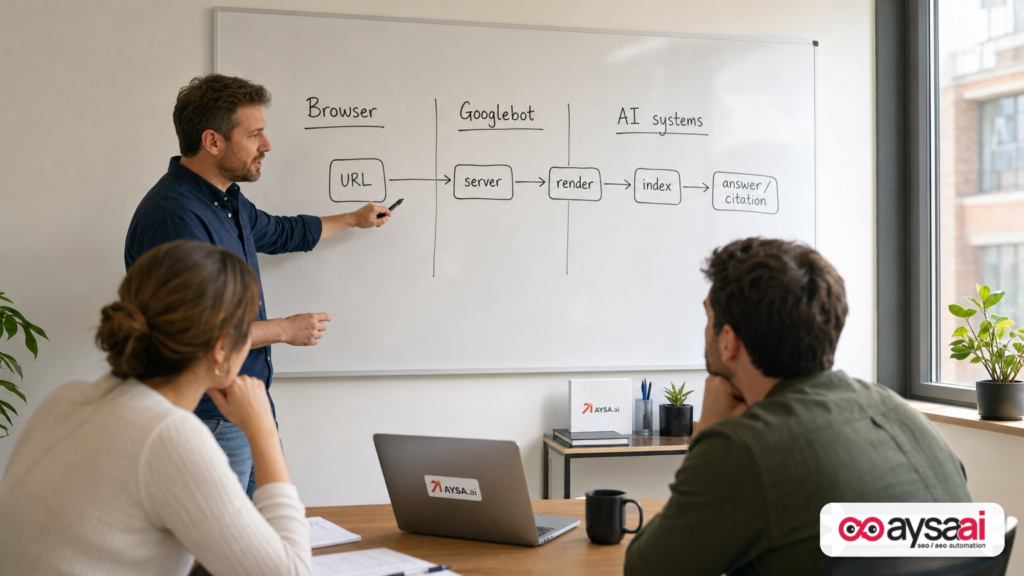
- Modern audits are comparative: browser vs. crawler vs. AI Retrieval pipelines, including server responses, robots rules, and rendered DOM.
- Prioritization is the differentiator: separate revenue-impacting blockers from warnings that only look scary in tools.
- Execution is the bottleneck: audits don’t move metrics—approved changes shipped to production do.
- Where AYSA fits: monitor technical risk, prepare recommended fixes, request approval from stakeholders, and execute accepted changes in a controlled workflow.
Key Takeaways (Read This If You Only Read One Section)

- Technical SEO is now “answer infrastructure.” If your pages can’t be fetched and interpreted reliably, you can’t win citations, recommendations, or consistent rankings.
- Stop measuring audits by “issues found.” Measure by: blockers removed, templates stabilized, regressions prevented, and money pages protected.
- In AI search, small inconsistencies compound. A minor canonical mistake or hidden content pattern can ripple into fewer Impressions, fewer citations, and lower brand trust signals.
- Build an operating cadence. The best teams treat technical SEO like uptime: monitor continuously, fix quickly, validate, and prevent recurrence.
Table of Contents

- What Changed: From “Can Google Crawl It?” To “Can AI Reliably Use It?”
- Why Most Technical Audits Fail In Practice (Even If They’re “Correct”)
- The New Goal: Reliability, Not Perfection
- The Modern Technical Audit Checklist (AI-Ready Edition)
- How To Compare What Users, Googlebot, And AI Systems See
- Prioritizing Fixes By Business Impact (Not By Tool Severity)
- AI Readiness: Technical Details That Influence AEO/GEO
- A Concrete SME Scenario: The Clinic That “Disappeared” From AI Answers
- A Concrete Ecommerce Scenario: The Category Page That Stopped “Existing”
- Large Site & Multi-Team Realities: Where Audits Go To Die
- What Agencies And In-House Teams Must Rethink
- Where AYSA Fits: Monitor → Prepare → Ask For Approval → Execute
- What To Do Next: A 30-Day AI-Ready Technical Audit Plan
- Sources And Further Reading
What Changed: From “Can Google Crawl It?” To “Can AI Reliably Use It?”
In classic SEO, technical audits were about clearing the runway: ensure Googlebot can crawl, ensure pages can be indexed, ensure signals like canonicals and internal links don’t contradict each other. That foundation still matters. If anything, it matters more because the consequences of inconsistency have multiplied.
The change is not “AI replaced search.” The change is that more systems now sit between your website and your customer:
- Discovery systems: crawlers, feeds, sitemaps, internal graphs.
- Rendering systems: JavaScript execution, resource fetching, mobile-first representation.
- Understanding systems: Structured data, entity resolution, topical relationships, trust cues.
- Answer systems: summaries, citations, comparisons, recommendations, “best X for Y” lists.
That’s why Search Engine Journal’s webinar framing is the right mental model: compare what visitors and crawlers see, then rank fixes by business impact. Technical SEO has become a discipline of parity + prioritization.
My perspective at AYSA.ai: the winners won’t be the teams that “do the biggest audit.” They’ll be the teams that make their sites boringly reliable for machines—then ship improvements continuously without breaking the business.
Why Most Technical Audits Fail In Practice (Even If They’re “Correct”)
Most audits don’t fail because the auditor lacks expertise. They fail because the deliverable can’t survive reality.
Here’s what I see again and again:
- The audit is too long. Two hundred “issues,” no clear owners, no sequencing, no definition of “done.”
- It’s tool-shaped, not business-shaped. Problems are described in the language of the crawler, not in the language of revenue paths (product pages, service leads, bookings, demos).
- It lacks a validation loop. Fixes ship (or don’t). Nobody rechecks rendering, log behavior, or index coverage after deployment.
- It has no regression protection. A later release changes headers, robots rules, canonicals, or templates and undoes the work.
AI search makes these failures more expensive. Why?
- Visibility loss can look like a “soft” decline rather than a dramatic ranking drop. That makes it harder to diagnose.
- AI answers often compress the customer journey. If your brand isn’t present early (citations/recommendations), you can lose demand before a user ever Clicks a traditional result.
- Many teams don’t track AI visibility in a structured way yet, so technical regressions can last longer before someone notices.
So the real question is no longer “Did we run an audit?” The real question is: Did we build an operating system that prevents technical SEO from breaking under AI-driven scrutiny?
The New Goal: Reliability, Not Perfection
A modern AI-ready technical audit is not a hunt for perfection. Perfection is expensive and often unnecessary—especially for SMEs.
The goal is reliability:
- Reliability of access: the right pages return the right status code, consistently, to the right user agents.
- Reliability of rendering: critical content and links are present when systems fetch the page—without requiring fragile client-side behavior.
- Reliability of meaning: structured data and on-page claims match; canonical and internal signals agree about which version matters.
- Reliability over time: releases, A/B tests, performance optimizations, security changes don’t silently rewrite your SEO.
In other words: the audit is not the product. The repeatable process is the product.
If you’re a non-SEO business owner, think of it like accounting. You don’t “do accounting” once a year and hope the numbers are right. You set up systems so the numbers stay right, and you check exceptions quickly. That’s the mindset shift technical SEO needs in the AI era.
The Modern Technical Audit Checklist (AI-Ready Edition)
Below is a practical, opinionated checklist. It’s designed for SMEs and lean teams first—then it scales up.
Important: Your audit output should not be a generic report. It should be a prioritized set of tickets: issue → impact → recommendation → owner → effort band → validation step.
1) Access & Crawlability: Robots, Responses, And Crawl Paths
This is the “don’t shoot yourself in the foot” section. Most catastrophic SEO incidents happen here.
- robots.txt: confirm no disallow rules are blocking important sections (products, services, locations, blog). Watch for legacy rules that survived a redesign.
- Meta robots & X-Robots-Tag headers: verify noindex is not applied broadly via templates, headers, or edge rules.
- Status codes: find 404/410 spikes, redirect chains, redirect loops, and “soft 404” pages that show content but behave like errors.
- Sitemaps: validate that sitemaps reflect canonical URLs, update when inventory changes, and don’t list redirected or blocked pages.
- Internal crawl paths: ensure money pages can be discovered from navigation and contextual links—not just from search boxes or filtered UIs.
AI-search lens: If an AI system can’t fetch a page reliably, it can’t cite it. If it can fetch but sees inconsistent signals, it may choose not to use it.
2) Rendering & Content Parity: What The System Actually Sees
Rendering is where “it looks fine to me” becomes dangerous.
- Source HTML vs rendered DOM: confirm critical content (and internal links) exist reliably in the fetched page.
- Client-side rendering risk: if key content loads only after JS execution, you’ve added points of failure. Some setups work—many don’t consistently.
- Blocked resources: ensure robots rules aren’t blocking CSS/JS required to render key templates.
- Lazy-loaded content: if important text is loaded only after interaction (tabs/accordions/click events), you may be hiding your best answers.
- Mobile parity: make sure mobile and desktop content match in substance (not necessarily in layout).
AI-search lens: If your “answers” are trapped behind client-side UI patterns, don’t be surprised when AI answer engines don’t treat you as a source.
3) Indexing Controls: Canonicals, Duplicates, And Parameter Chaos
Indexing problems are often invisible until they become expensive.
- Canonical tags: confirm self-canonicals on primary pages; avoid canonicals pointing to non-equivalent pages.
- Duplicate URL variants: eliminate http/https, www/non-www, trailing slash and case duplicates.
- Facets & filters (ecommerce): define which filtered URLs are indexable (if any) and prevent infinite URL combinations.
- Pagination: ensure paginated sets are crawlable; avoid blocking discovery of products/articles that only appear deeper in lists.
- Thin or “search results” pages: keep internal search pages out of index unless you have a very deliberate strategy.
AI-search lens: Duplicates dilute clarity. If systems can’t tell which page is “the source of truth,” they’re less likely to quote you accurately.
4) Site Architecture & Internal Linking: Make Importance Obvious
Internal links are still the most underutilized “technical” lever—because they sit between content and engineering.
- Hub pages: identify your top-level service/category/location hubs and ensure they’re strong, linked, and maintained.
- Orphan pages: find pages with no internal links pointing to them (common after migrations).
- Navigation and breadcrumbs: use them to communicate hierarchy and relationships.
- Contextual links: within content, link to the pages you want treated as authoritative.
AI-search lens: Strong internal structure helps machine understanding. It’s not only about PageRank—it’s about semantics: what relates to what, and what you consider central.
5) Structured Understanding: Schema That Matches Reality
Structured data is not a shortcut. It’s a consistency layer.
- Schema validity: ensure markup parses and reflects the page’s visible content.
- Organization/about signals: make it easy to understand who you are, what you do, where you operate, and how customers can contact you.
- Product/service clarity: consistent naming and descriptions across pages.
- Article/FAQ patterns: only use when content is genuinely present and user-facing.
AI-search lens: AI systems reward aligned signals. Mismatched schema is a trust hit, not a win.
6) Performance & Reliability: Speed Is Still A Trust Signal
Speed isn’t just about rankings; it’s about crawl efficiency and user satisfaction.
- Core Web Vitals: aim for stability and obvious improvements; don’t chase micro-optimizations at the expense of rendering reliability.
- Server reliability: monitor uptime, TTFB spikes, and caching behavior.
- CDN/edge rules: verify bots and users get consistent responses; avoid “bot blocking” mistakes by security layers.
7) Governance: Change Control, Approval, Rollback
This is the part almost nobody puts in an audit—and it’s why the same problems come back every quarter.
- Who can change indexing controls? Robots, headers, canonicals, template-level metadata should require an approval step.
- Release checklists: before shipping, confirm key templates still render critical content and correct index directives.
- Rollback plan: know how to revert if a release causes deindexing or crawl failures.
- Audit trails: track what changed, when, and who approved it.
That last section is where “technical SEO” stops being an SEO project and becomes a business process. In AI search, that’s a competitive advantage.
How To Compare What Users, Googlebot, And AI Systems See
One of the most actionable lines in SEJ’s webinar description is also the most overlooked: compare what visitors, Google, and AI crawlers receive.
Here’s a practical workflow you can adopt without needing a huge tool stack.
Step 1: Start With The Server Response (Before You Think About Content)
For your top pages (home, key categories/services, top products, top locations, top articles), check:
- Status code: is it truly 200? Are there intermittent 5xx errors? Is it a “soft 404”?
- Redirect behavior: are there unnecessary hops? Does it redirect differently by user agent or location?
- Headers: is there an unexpected noindex header? A cache header that serves outdated HTML? A security layer blocking certain bots?
Why this matters: You can publish the best content in your industry, but if your server gives crawlers a bad response—or inconsistent responses—you’ve lost before the content is read.
Step 2: Compare Source HTML vs Rendered DOM
If you’re not sure what this means: source HTML is what the server returns. Rendered DOM is what the page becomes after CSS/JS run.
Compare both and ask:
- Is the main text present in the source, or only after JS?
- Are internal links present without scrolling, clicking, or waiting for delayed scripts?
- Is critical information (pricing, availability, locations, services) visible as text—not only inside images or embedded widgets?
AI-search lens: AI systems can be surprisingly unforgiving about fragile content delivery patterns. If extraction is inconsistent, citations become inconsistent too.
Step 3: Audit Robots Rules As Living Policies
Robots policies are often treated like a one-time file. They’re not. They’re production policies that can outlive teams and vendors.
Common pitfalls:
- Old “disallow” rules from a staging environment that got copied to production.
- Blocking resource directories (scripts/styles) that render the page.
- Blocking filtered URLs in a way that also blocks canonical category pages.
Even if you can’t verify each AI crawler’s behavior, you can enforce a simple rule: don’t block important content unless you’re very sure why.
Step 4: Use Logs As Reality (If You Can)
If you have access to server logs (or CDN/edge logs), they can answer:
- Which crawlers are visiting?
- Which URLs do they request most?
- What status codes do they receive?
- Are they wasting time on parameter spam and duplicates?
If you don’t have logs, treat that as a maturity gap. In AI search, “we think crawlers can access it” is not good enough for competitive markets.
Prioritizing Fixes By Business Impact (Not By Tool Severity)
Audit tools are great at producing lists. They’re terrible at answering: what should we do this week?
Here’s the prioritization model I recommend. It’s simple by design, because simple models get used.
1) Define Your “Money Pages” And Protect Them First
Your money pages are the URLs that directly drive business outcomes:
- Ecommerce: category pages, top product pages, “sale” pages, shipping/returns pages that remove purchase friction.
- Local services/clinics: location pages, service pages, appointment pages, insurance pages, pricing pages.
- B2B/SaaS: product pages, features pages, integration pages, demo pages, high-intent solution pages.
If your audit doesn’t start with these pages, it’s backwards.
2) Assign Each Finding To A Business Impact Bucket
- Revenue blocker: prevents key pages from being crawled/indexed/understood at all.
- Demand capture loss: reduces visibility for high-intent searches (especially top-of-funnel AI answers that shape choices).
- Efficiency loss: wastes crawl resources or dilutes signals via duplicates.
- Interpretation risk: confuses systems about meaning (mismatched schema, contradictory canonicals, inconsistent page purpose).
- Cosmetic/tool warning: looks bad, rarely moves outcomes in your situation.
3) Put Effort In Ranges, Not Fake Precision
Use bands like:
- Quick: minutes to <2 hours
- Small: half-day to 2 days
- Medium: 3–10 days
- Large: multi-sprint or cross-team
This helps leadership make decisions without getting stuck in estimation debates.
4) Sequence Fixes To Reduce Catastrophic Risk First
Typical sequencing:
- Indexing blockers (noindex accidents, canonical disasters, robots misconfigurations)
- Rendering/access parity issues on money templates
- Internal linking/architecture to reinforce priority pages
- Duplicate/index bloat cleanup (parameters, facets, near-duplicates)
- Structured data improvements aligned to visible content
- Performance refinements that don’t introduce fragility
Notice what’s not on top: chasing dozens of minor warnings while your core templates send contradictory signals. That’s how teams burn quarters without moving outcomes.
AI Readiness: Technical Details That Influence AEO/GEO
People throw around AEO (Answer Engine Optimization) and GEO (Generative Engine Optimization). Regardless of what acronym wins, the technical requirements converge around three principles:
- Clarity: the page’s purpose and claims are explicit.
- Retrievability: the facts can be extracted reliably.
- Consistency: signals don’t contradict each other across templates, languages, or versions.
Here’s what that means in real technical terms.
Clarity: Make Your Site Easy To Interpret
- Every important page should answer: “What is this page about? Who is it for? What action should a user take?”
- Use consistent naming for services and products across pages. Don’t call the same offer three different things depending on the template.
- Make company information easy to find and consistent (about/contact/policies).
Retrievability: Make Key Facts Easy To Extract
- Don’t hide core content behind interactions (tabs, accordions that load on click, “read more” that injects HTML late).
- Ensure key details exist as text, not embedded only in images or PDFs.
- If you use structured data, keep it aligned with visible content. Treat schema as a mirror, not makeup.
Consistency: Remove Contradictions
- Title/heading mismatch can confuse understanding systems.
- Schema claims that aren’t supported by the page undermine trust.
- Canonicals pointing to different versions create ambiguity about what’s authoritative.
If you want a single sentence to remember: AI search doesn’t need your site to be perfect; it needs your site to be reliably interpretable.
A Concrete SME Scenario: The Clinic That “Disappeared” From AI Answers
Let’s make this real with a scenario I’ve seen versions of across clinics and local services.
Imagine a multi-location clinic. They invest in content: service pages, procedure pages, FAQs, aftercare articles. They rank decently. They get bookings.
Then they redesign the site to improve conversions. The marketing team is happy: the new design looks modern, pages feel faster, forms convert better.
Thirty days later: leads soften. The phones aren’t dead, but it’s noticeable. The instinct is to blame seasonality or ad spend. But the real issue is technical.
What Often Breaks In This Scenario
- Location pages become JS-dependent (the address, hours, and service list load from a script). To humans it looks fine; to systems it’s inconsistent.
- FAQ content gets hidden and only loads after a click, removing the very content that would make the clinic a good “answer source.”
- Canonical tags change due to new template logic, causing multiple locations to canonicalize to one “main” page.
- Robots rules block assets (scripts/styles), which can break rendering and extraction.
Why It Shows Up As “AI Visibility” Loss
AI answers rely on clear, extractable facts: what services you provide, where you are, and what you specialize in. If those facts become unreliable to fetch or interpret, your brand is less likely to be cited or recommended—even if you still rank for some queries.
How A Modern Audit Would Catch It
- Compare raw HTML vs rendered DOM for a location page (is the address/hours in the HTML?).
- Check server headers/status codes and canonical outputs across all location templates.
- Verify internal linking from navigation and from hub pages to each location.
- Validate structured data alignment (Organization/LocalBusiness patterns where appropriate) and ensure it matches visible content.
Business owner translation: the clinic didn’t become less relevant. The website became less reliable as a source of truth. That’s a technical problem with a pipeline outcome.
A Concrete Ecommerce Scenario: The Category Page That Stopped “Existing”
If you run ecommerce, your category pages are often your most valuable SEO assets. They capture demand, introduce shoppers to your catalog, and support internal linking to products.
Now imagine this common situation:
- You launch a new faceted navigation (color, size, price, materials).
- You also launch a “fast experience” with client-side filtering and infinite scroll.
- You add tracking parameters everywhere for marketing attribution.
The site feels modern. But a few months later, organic traffic to categories declines. AI answers that used to mention your store for “best X under $Y” now cite competitors. What happened?
What Often Breaks
- Index bloat: thousands of filter combinations become crawlable, diluting signals.
- Canonical confusion: filtered URLs canonicalize inconsistently, sometimes to themselves, sometimes to base categories.
- Discovery collapse: infinite scroll hides product links from crawlers if pagination isn’t handled in an accessible way.
- Thin category templates: the meaningful explanatory content (what makes these products different) is removed, leaving only a grid.
How An AI-Ready Audit Prioritizes Fixes
- Define index policy: which filters (if any) deserve indexation based on search demand.
- Stabilize canonicals: enforce a consistent rule: canonical category pages remain the primary targets.
- Make product discovery robust: ensure crawlers can access product links without requiring infinite scroll execution.
- Re-add category meaning: keep short, helpful editorial content on category pages to improve interpretability for both users and systems.
That’s the pattern: ecommerce teams often optimize UX in ways that accidentally break discoverability and meaning. A modern audit closes that gap.
Large Site & Multi-Team Realities: Where Audits Go To Die
The bigger the organization, the less the audit matters unless execution is designed into the process.
Here’s what breaks at scale:
- Multiple code owners: marketing controls content; product controls UI; platform controls headers/CDN; security controls bot policies. Nobody owns “SEO outcomes.”
- Release velocity: changes ship weekly or daily, so a quarterly audit is outdated before it’s read.
- Template sprawl: 20 templates become 80. Canonical rules or structured data changes behave differently across them.
- International complexity: hreflang, regional URLs, language variants, and localization workflows introduce contradictions easily.
For large companies, the “modern technical audit” is really two things:
- A current-state risk assessment (what’s broken, what’s fragile, what’s contradictory).
- A governance blueprint (how you prevent it from breaking again).
If you’re an enterprise leader reading this: don’t reward “big audits.” Reward systems that reduce incidents and improve release safety for search visibility.
What Agencies And In-House Teams Must Rethink
AI search pressures teams to update their operating model, not just tactics.
1) Audits Can’t Be Annual PDFs
In many industries, the site changes weekly: new products, promotions, landing pages, experiments, releases. Audits must evolve toward continuous QA for critical templates and indexing controls.
2) “Best Practices” Must Be Contextual
Tools treat every issue as equal. Mature teams don’t. They invest where:
- the page is a money page or supports money pages,
- the change reduces catastrophic risk,
- the fix improves reliability of extraction/interpretation,
- the effort is reasonable relative to impact.
3) Execution Capacity Is The Constraint
The limiting factor is rarely “knowing what’s wrong.” It’s shipping fixes without causing new problems.
That’s why governance matters: approvals, validation, rollbacks, and monitoring. AI search makes regressions more costly because you might not notice them until demand capture is already lost.
4) Proof Needs To Be Operational, Not Just Analytical
In 2026–2027, showing value means:
- Clear tickets shipped, not just findings reported.
- Pre/post checks documented (before release vs after release).
- Reduced incident frequency (fewer accidental noindex, fewer canonical regressions).
- Improved index coverage and stability for critical templates.
In other words: the audit becomes the start of a disciplined operating loop.
Where AYSA Fits: Monitor → Prepare → Ask For Approval → Execute
At AYSA.ai, we believe the future of SEO operations is approved execution. Not “auto-publish everything,” and not “deliver a 60-page audit and hope it gets done.” A system that:
- Monitors risk and opportunity continuously
- Prepares specific recommended changes (with context and expected impact)
- Asks for approval from the right stakeholder
- Executes accepted changes and validates outcomes
This maps directly to what SEJ highlights in the webinar announcement: compare what visitors and crawlers see, separate real issues from tool noise, and prioritize by business impact—then follow through.
How This Looks In Practice
- Continuous monitoring: spot crawl/index anomalies and template-level regressions before they become revenue problems. (AYSA Monitoring)
- AI search visibility as a business goal: build a plan around being cited and recommended—not only ranked. (AI Search Visibility)
- AI-assisted execution tools: accelerate analysis and preparation while keeping humans in control of approvals. (AYSA AI SEO Tools)
- Packaging for SMEs and agencies: the goal is to ship improvements without chaos. (AYSA Pricing)
- Ongoing playbooks: practical education and operational frameworks. (AYSA Blog)
My opinion: the market has plenty of “audit generators.” What it lacks are systems that turn audits into shipped improvements with controlled risk. That is the gap AYSA is designed to close.
Why Approved Execution Matters In AI Search
AI search increases both opportunity (more ways to be discovered) and fragility (more ways to fail). That’s why “execution governance” is now a core SEO skill.
Approved execution helps because:
- It prevents accidental catastrophic changes (robots/noindex/canonical mistakes).
- It forces prioritization (you approve what matters most first).
- It creates a validation habit (change shipped → recheck parity and access).
- It builds organizational memory (what changed, why, and who signed off).
What To Do Next: A 30-Day AI-Ready Technical Audit Plan
If you’re an SME or a lean team, you don’t need a six-month program to get safer and more visible. You need a focused plan that reduces the biggest risks first.
Before Day 1: Pick Scope And Define Success
- List your top 10–25 money pages (the ones that drive bookings, leads, or revenue).
- List your key templates (home, category/service, product, location, article, FAQ, comparison).
- Define what “better” means: fewer indexation anomalies, stable canonicals, improved crawlability, stronger internal linking to money pages.
Week 1: Establish Crawl + Index Safety
- Review robots.txt and indexing directives for key templates.
- Confirm money pages return correct status codes and are indexable.
- Fix obvious redirect chains and broken internal links pointing to key pages.
Week 2: Rendering Parity Checks
- Select 10 critical URLs representing templates.
- Compare source vs rendered output: main text, internal links, key facts.
- Make sure key information isn’t hidden behind clicks or late-loading scripts.
Week 3: Architecture + Internal Linking
- Create or strengthen hub pages (services/categories/locations).
- Remove orphan pages or connect them properly.
- Ensure navigation reflects how customers search, not internal org charts.
Week 4: Structured Data + Prevention
- Validate structured data on key templates; remove anything misleading or mismatched.
- Set a recurring monitoring cadence for crawl/index anomalies.
- Implement a lightweight approval workflow for changes that affect indexing/rendering.
What To Do Next (Action List)
- Pick 10 money pages and confirm they’re accessible, indexable, and render critical content reliably.
- Audit your robots and indexing controls like you’re investigating an outage—because in AI search, visibility loss behaves like an outage.
- Separate blockers from noise: write a top-10 fix list tied to business impact and effort bands.
- Ship one fix per week and validate post-release (don’t skip this step).
- Operationalize it with monitoring and approved execution so you don’t repeat the same mistakes after every release.
Sources And Further Reading
- Search Engine Journal: Technical SEO Audit For AI Search: Watch Us Do It Live (primary source inspiration)
- SEJ webinar landing page: Prioritize SEO Fixes For Google And AI Search (context referenced in the source page)
- Search Engine Journal: Technical SEO section (ongoing technical SEO coverage)
- Search Engine Journal: AI Search section (AI search developments and implications)
- Search Engine Journal: Google Updates timeline (historical context for search evolution)
- SEJ: All SEO (broader SEO strategy context)
Continue the AI search topic inside AYSA.
Use these pages to connect the article with AI SEO tools, AI visibility monitoring, AI Overviews and approved website execution.
Turn this topic into a website action plan.
Use these AYSA hubs to move from reading to technical fixes, AI visibility monitoring, research, glossary context and approval-first SEO execution.